Showing posts with label Vesakha. Show all posts

Sunday, May 10, 2026

Reflections on Vesak (May 2026)


Buddhism for All: The Joyful Path
Vesak Month 2026: A Month-Long Celebration of the Buddha | Buddhism.net One day isn’t enough to honor the Enlightened One. While Vesak Day falls on May 31, 2026 [the second full moon of the month on the Gregorian calendar], we’re celebrating at Buddhism.net all month long, with five special episodes of "Vibe with Venerables." Join our global community throughout May to commemorate the Buddha’s birth, great enlightenment, and final nirvana, featuring five special "Vibe with Venerables" episodes. Three leading Buddhist masters -- Bhante Buddharakkhita (Theravada), Trungram Gyalwa Rinpoche (Vajrayana), and Roshi Joan Halifax (Zen) -- will host sessions on the Buddha, alongside two joint sessions with Pali canon sutra experts Bhante Sujato and Venerable Canda. Register

Mahamevnawa Meditation
Vesak (Mahamevnawa Meditation Center, North of England) Namo Buddhaya! Commemorating the sacred threefold anniversary of our Great Teacher, the Supremely Enlightened Buddha, Mahamevnawa Buddhist Monastery, Liverpool, proudly presents a Glorious Vesak Festival 2026 for the 4th consecutive year. We warmly invite all to witness the splendor of Vesak and gather merit. The festival will be held with great devotion at the Liverpool Mahamevnawa Monastery premises on: May 15, 16, and 17, 2026.

(Buddha Lotus Mantra [AI slop]) Robotic dreams of Vesak

Get ready for change! The Vesak (Wesak) Full Moon Festival of Lights 2026 ignites

(WTC) As we are now experiencing the Full Moon of Scorpio on May 1, 2026, it brings with it the ability to step into a transformative energy that allows us to expand more deeply into a new phase of a divine plan. Self comes into focus.

This means that the alignment of Cosmic energies are opening up so that each individual can enter more deeply into the shadow of self and allow for deeper healing to occur within the body's full system (physical-etheric-emotional-mental).

While that may seem like so much “esoteric verbiage,” it carries with it a very real-world shift in what is occurring in terms of our spiritual potential.

The moon in Scorpio can be intensely emotionally challenging each year, as it is a time of deep reflection that allows for an opening of the subconscious mind into a state of purity. This is a rare occasion for humanity to allow for reflection. Doing so can cause emotional upheavals and challenges to occur.

For most of us it is difficult to realize that there are elements in our reality that no longer are working... More: walkingterrachrista.com

Friday, September 5, 2025

The Full Hunter's Moon (Uposatha)

The Moon is inside our atmosphere, which is much larger than we're told  (USSR).
.
Triple Moon headband with pentagram of Man
Culturally and spiritually significant across many societies, full moons are associated with festivals such as Buddhist Vesak (~May) and various Hindu purnima observances (such as the Buddha's Birthday). The "fasting day" or Uposatha is also of tremendous importance to the Buddha and Theravada Buddhism.

Many traditions have named specific full moons—like the harvest moon or hunter's moon—and linked them to seasonal and agricultural events.

Folklore has associated full moons with madness, supernatural events, and insomnia, though scientific studies have so far found inconsistent evidence of behavioral effects on anything but the tides.
  • Eric Dubay stands by his position that the tides are NOT related to the moon for the simple fact of lunar distance having absolutely no effect on massive bodies of freshwater like lakes and mighty rivers (Ganges, Mississippi, Nile, Amazon, Yangtze, Saraswati); however, could this be because salt plays a role in their electromagnetic pull?
In modern times, terms like “blood moon” and “blue moon” have entered popular use, often referring to lunar eclipses or rare lunar events....

In folklore and tradition
The Moonship tilts and lists, glows and fades.
In Buddhism, Vesak (Wesak) is celebrated on the full moon day of the ancient Indian month of Vaisakha, marking the birth, great enlightenment, and final nirvana of the historical Buddha [11].

In Arabic, badr (بدر ) means "full moon," but it is often translated as "white moon," referring to The White Days, the three days when the full moon is celebrated.

Moonstruck is not necessarily lunacy.
Full moons are traditionally associated with insanity (lunacy and lunatic), various supernatural or "magical phenomena" such as clinical lycanthropy (turning into a werewolf or hirsute dogman), and insomnia (the persistent inability to sleep).

Psychologists, however, have found evidence for effects on human behavior around the time of a full moon, but it tends to be weak [12] except for sensitives, who may be driven over the edge (as seen in asylums and emergency rooms across the country).

Scientists find that their poorly designed studies are generally inconsistent, with some showing a positive effect and others showing a negative effect. In one instance, the Dec. 23, 2000, issue of the British Medical Journal published two studies... More

So what's the big deal? Why does the Moon matter so much. To explain that we have the Saga of Vanity Lycan coming up in Part 2: Who cares about the Moon? Vanity does
  • Ashley Wells, Seth Auberon, Amber Larson (eds.), Wisdom Quarterly Wiki edit

Monday, May 11, 2020

Celebrating Vesak in Malaysia (video)

Ven. Mahinda (Malaysia), May 6, 2020; CC Liu, Crystal Quintero (eds.), Wisdom Quarterly


The Significance of Vesak
(Malaysia Buddhist Festival) This Vesak 2020 message is given by Bhante Mahinda, who talks about its significance and meaning. Other than the usual making of merit, what else can we do during lockdown on this great day for Buddhists all over the world? This video is courtesy of the Australian Buddhist Mission, Inc. (ABM), of which Bhante Mahinda is the spiritual director

ABOUT
Ven. Mahinda was ordained in 1976 as a Buddhist monk in the Sri Lankan Theravada tradition under the tutelage of the late Ven. Dr. K. Sri Dhammananda Nayaka Thera, a well-known Sri Lankan monk residing in Malaysia for more than 50 years. After his ordination, Bhante undertook a Buddhist studies program at the Paramadhamma Buddhist Institute in Sri Lanka from 1977 to 1982. He was trained in meditation by several well-known masters in Sri Lanka, India, Burma, and Thailand. He was also inspired by Mahayana masters from China, Taiwan, Korea, and Japan, as well as by Vajrayana masters from Tibet, Nepal, Bhutan, and India. Bhante has taught mindfulness and metta meditation for more than 30 years in 20 countries. His participation in inter-religious conferences and Dharma propagation has taken him to more than 30 countries. Currently, he is the abbot of the Aloka Meditation Centre in Australia (AMC); founder, spiritual director of the Australian Buddhist Mission Inc. (ABM); Buddhist chaplain at the University of Technology, Sydney (UTS); trustee of the University Buddhist Education Foundation (UBEF); and Training Committee member and training course presenter of the Australian Association of Buddhist Counsellors and Psychotherapists (AABCAP). He is the founder and spiritual director of the Aloka Foundation, Malaysia; religious patron of the Young Buddhist Association of Malaysia (YBAM); religious advisor to the Buddhist Missionary Society, Malaysia and a number of other Buddhist organizations in East and West Malaysia and Singapore.

Wednesday, May 6, 2020

Vesak: Buddhist Xmas, May full moon day

Dhr. Seven, Amber Larson, Ashley Wells, Ananda (eds.), Wisdom Quarterly Wiki edit
A human was born to complete a mission: Wake up and awaken others: The Buddha
.
Buddhist Afghanistan (R.P.)
Vesak (Pali Vesākha, Sanskrit Vaiśākha) is also known as Buddha Jayanti, Buddha Purnima (full moon day), and "Buddha Day." It is the name of the ancient month on which, on the full moon night, three marvelous things happened:
  • The Future-Buddha (Bodhisattva) was born as Prince Siddhartha Gautama.
  • The wandering ascetic Siddhartha attained a buddha's great enlightenment.
  • The Buddha consciously moved through the absorptions and passed away into is final nirvana.
Buddhist countries
Vesak is a holiday traditionally observed for thousands of years by Buddhists and some Hindus on different days in
Missionary Buddhism started on the Silk Road when the Buddha sent out 60 arhats.
Buddhism began in Afghanistan (Scythia, Shakya Land, Silk Road) and Bihar (before it India)
. 
I want to be the Little Buddha
"Buddhist Christmas" or "The Buddha's Birthday" or the "Great Enlightenment Day" is also celebrated in many other parts of the world, wherever Buddhists live or are staying.

The festival commemorates the birth, great enlightenment (buddhahood), and passing (parinirvāna) of Siddhartha Gautama the Buddha in ancient Theravada and Tibetan Vajrayana Buddhism. More

The full Harvest Moon appearing orange close to the horizon (Roadcrusher, England/Wiki)
.
.When is Vesak in 2020 (2563 BE)?
Look for the Earth's timekeeper the Moon.
It's easy to figure out the exact day: Determine when the month of Vaisakha falls then look for the full moon. This year it coincides with May, and the moon is full on the 6th and/or 7th.

The exact date of Vesak is based on Asian lunisolar calendars and is primarily celebrated in the Indian month of Vaisakaha on the Buddhist calendar and the Hindu (Vedic) calendar.

Full moon calendar (moonconnection.com)
Theravada Buddhist countries follow the BUDDHIST CALENDAR, which is based on the dependable phases of the moon. The uposatha (fasting or Eight Precept observance day), typically in the 5th or 6th lunar month.

Nowadays, in many countries it is celebrated on the full moon day in May on the Gregorian calendar. (Because of all these regional and sectarian variations, Vesak lasts all month longs and usually spills into the beginning and end of adjacent months. More

Sunday, May 12, 2019

"Buddha Day" as Vesak celebration (May 12)

Editors, Wisdom Quarterly, Wikipedia edit
Vesak Day 2555.jpg
Vesākha

Vesak Day celebrations at Borobodur in Java, Indonesia
Official nameVesākha, Buddha Purnima, Buddha Jayanti, Vaisakha, Vesak, Vaishakhi Purnima
বৈশাখী পুর্ণিমার
包囲祭
衛塞節
वेसाक
វិសាខបូជា
Also calledThe Buddha's Birthday or Buddha Day
Observed byBuddhists and some Hindus in South and Southeast Asia and in East Asia (as The Buddha's Birthday)
TypeReligious
SignificanceThe birth, enlightenment and death of Gautama Buddha
ObservancesMeditation, observing the Eight Precepts, partaking of vegetarian food, giving to charity, "bathing" the Buddha
DateFull moon of the month of Vesākha, usually in April (first), May or June (last)
2018 date29 April
(Sri Lanka, Cambodia, Burma, and Bangladesh)
30 April (India, Nepal)
29 May (Singapore, Thailand, Malaysia and Indonesia)
2019 dateMay 19
Frequencyannual
Related toBuddha's Birthday
Other related festivals
Laba Festival (in China)
Rohatsu (in Japan)
Bathing the Buddha on Vesak
Vesak (Pali Vesākha, Sanskrit Vaiśākha), also known as Buddha Jayanti, Buddha Purnima, and Buddha Day, is a holiday traditionally observed by Buddhists and some Hindus on different days in the various Buddhist countries of India, Sri Lanka, Nepal, Tibet, Bangladesh, Bhutan, Indonesia, Singapore, Thailand, Cambodia, Laos, Malaysia, Burma, Mongolia, the Philippines, and in China (but not in formerly Buddhist countries of Afghanistan, Pakistan, Baluchistan, Kazakhstan, Kirgystan, Tajikastan, Gandhara (the former Scythian/Shakyian Land of the Buddha), Japan, Korea, Taiwan, and Vietnam as "Buddha's Birthday" as well as in other parts of the world. The festival commemorates the birth, enlightenment (Buddhahood), and final nirvana (parinirvāna) of the Buddha Gautamaa in the Theravada or more orthodox tradition. More

Tuesday, May 1, 2018

Buddha's Birthday (Vesak) on Cinco de Mayo

LA Buddhist Vihara (FB); Jen B., Ananda, Dhr. Seven, Crystal Quintero, Wisdom Quarterly
The historical Buddha, born Prince Siddhartha who became Shakyamuni ("the Sage of the Shakya Clan"), was born on the full moon day in Vesak/May.
 
This year the full moon officially falls on our April 29th. Unofficially, it's celebrated in Pasadena on Cinco de Mayo and is called "Vesak."

We're eating FREE food and celebrating at the Los Angeles Buddhist Vihara (facebook), Pasadena's Sri Lankan Theravada temple, which is full of rich island-traditions from formerly Buddhist India.

There are two parts to the day, the spiritual meditation from 8:00 am-6:00 pm and the "cultural celebration" from 6:30-9:30 pm.
 
FREE, all our welcome regardless of religion, race, sex, gender, political affiliation (yes, even Republicans), status, views, or anything. No wankers! Well, yes, even wankers.

Tuesday, January 2, 2018

Buddhists and the Moon (Full Wolf Moon)

Ashley Wells, Seth Auberon, CC Liu, Wisdom Quarterly; Moongiant.com; Space.com


Tonight is the brightest supermoon of the year, and the brightest our moon, Soma/Chandra/Luna, will be in a long time. There is another full supernoon this month on the 31st, which is a "blue moon" (a second full moon occurring in a month according to our distorted Gregorian calendar).

Dhr. Seven figured something out: The truth is -- and anyone can do the math -- is that according to Nature's own cycles, there are 13 "moonths" in a year. How? If a week has seven days and month has four weeks (4x7=28), __x28=364? (Add a free day for reflection as a transitional New Year's Day). In other words, How many months in a year? Wrong. The correct answer is 13 (13x28=364).

We have been lied to, and we have been disconnected from the natural cycles of time on earth. A lunar calendar would be more accurate and beneficial to our health and sanity. A lunisolar calendar, like the one forced on the world by the West, is the worst.

Buddhists and the Moon
What do Buddhists care about the moon so much? Our Buddhist spiritual calendar is based on the moon. The lunar observance day is the most important way of the week, and the full moon day is the most important day for meditation, learning, and practice of the month. And Vesak full moon day is the most important day of the year because it is the day the Buddha was born, became enlightened, and passed into final nirvana. All three events happened on the same full moon of Vesakha on the ancient Indian calendar, in different years of course. The uposatha or "sabbath" day is when Buddhists visit the temple/vihara complex and stay all night keeping the Eight Precepts, hearing sutras chanted or explained, and meditate until the following morning.

What mysteries do the pyramids reveal about the moon and time on our planet?

Monday, May 1, 2017

Vesak celebrations all month, May 2017

Editors, Wisdom Quarterly; CONTACT YOUR LOCAL THERAVADA BUDDHIST TEMPLE

Theravada Buddhist temples all over Los Angeles and Orange County are currently celebrating "Vesak" -- the name of the Indian month (Vesakha) the Buddha or, more correctly, Prince Siddhartha:
  1. was born,
  2. attained supreme enlightenment, and
  3. passed into final nirvana.
Full moon: May 10, 2017
They all took place on the full moon day of that same month years apart.

Each event is crucial to Buddhism. By being born in this age we have the great fortune of being exposed to the Dharma, the Path to Freedom.

Of course, that was only made possible because the prince was willing to renounce the worldly life and pursue the spiritual life, which resulted in his enlightenment. The promise of enlightenment is the direct realization of nirvana in this very life.

Nirvana is the ultimate bliss, the end of all suffering. The Buddha proved that 45 years after enlightenment, which was a glimpse, a touching of that ultimate reality, called "the unconditioned element," the deathless, the highest peace.

May 2: OC, May 3: LA
The Buddha, contrary to popular opinion, described nirvana in many ways. (By saying it is not this, not that, not the other, many have mistakenly thought it is "not" itself. It is not not. It is very much an ultimately ineffable thing).

Of course, no description can possibly do justice to the direct experience of it. It is beyond words.

So it is said at the culmination of the Heart Sutra: "Gone, gone, gone beyond, gone altogether beyond, oh, what an awakening, so it is!"

Mantra: Gate [gaw-tay] gate paragate parasamgate bodhi swaha!

These three events are being celebrated across the US and in all Theravada countries (Burma, Cambodia, Laos, Sri Lanka, Thailand) or wherever Buddhist adhering to the oldest extant school of Buddhism live.

Friday, May 20, 2016

The Buddha's Birthday: VESAK 2016 (video)


2015 Vesak celebrations in Theravada Buddhist Sri Lanka's "Festival of Lights," Colombo.*

Birth, Awakening, Rest: Happy Vesak Day!
The Buddha's Birthday (Vesak) is the ancient name of the month the Buddha-to-be (Bodhisatta) Prince Siddhartha was born, attained enlightenment (bodhi) thus becoming the Buddha, and passed into final nirvana (parinirvana). All of these happened on the full moon night of the same month, in different years, of course.
Dressed in white for Vesak (Dhammakaya)
When Prince Siddhartha Gautama of the Shakiyan (Scythian) clan was born is not known exactly. But it is generally agreed that he reached enlightenment and began teaching the path to awakening 2,600 years ago when he was 35. He had renounced the throne and left home at 29 to undertake a spiritual quest.

Happy Vesak Day (BodhiPunx)
When he reached the final goal -- to find the cause of suffering and the way to bring it to a complete end -- he was able to claim to be the Enlightened One (Buddha), set rolling the Dharma (Teaching), and establish the Sangha (the community of enlightened individuals, which is known as the Noble or Arya Sangha, and the community of fully ordained monastics, the Bhikkhu and Bhikkhuni Sangha, comprised of monks and nuns).
.
Young monastic novices set oil lamps around the Buddha in Sri Lanka (newsinsidelanka).
.
*VIDEO: The 2015 annual Vesak Theravada Buddhism Festival of Lights held at Gangaramaya Temple on Beira Lake in Colombo, Sri Lanka -- celebrating the birth, enlightenment, and passing of the Buddha. Music: "Breathe the Horizon" and "Buddha's Dream." DoP: Lipton Jayawickrama, 2nd Camera: Tharanga Srinath and Saminda Rajapaksa, production manager: Ayesha Dissanayake, directed and edited by: Devinda Fernando. Video production by Annoyboy Pictures (Pvt) Ltd., 36/1 Sujatha Mawatha, Kalubowila, Dehiwala, Sri Lanka (annoyboy.lk)

Saturday, May 17, 2014

Vesak celebrations sweep across Los Angeles

Ashley Wells, Dhr. Seven, Bhante, Amber Larson, Wisdom Quarterly  THREEFOLD VESAK
Indonesian Buddhist Vesak, May 25, Ontario, So. California (DhammaCakraTra)
 
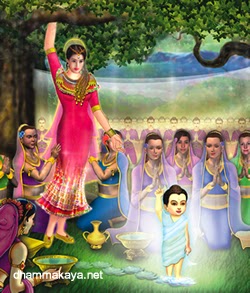
Birth of Siddhartha, Salabhanjika
The full moon day of May marks the traditional anniversary of three major events in the Buddha's life, and Buddhists celebrate it worldwide as the most significant holiday on the calendar of observances.

Some call it "Buddhist Christmas" as it commemorates the Buddha's birth somewhere northwest of India 26 or more centuries ago. But his birthday is only important because of something that happened 35 years later.
 
Vesak 2013 (LABV)
Now in the Buddhist-year 2558, families gather, children and elders dress in all white. Flowers flood shrines. Candles glisten, incense smoke permeates the air with many perfumes. There are devotional activities, recitations, meditations, and eight precept observances.

LABV Vesak 2012
After all, what we are really celebrating is Prince Siddhartha's renunciation and conquest of suffering, the enlightenment (mahabodhi) and glimpsing nirvana.

People still become enlightened, still glimpse the timeless bliss of nirvana, but what does not happen is the arising of a world teacher, a samma-sam-buddha, a "perfectly and fully enlightened teacher" of the Path to Enlightenment, replete with mental and linguistic abilities that make possible the establishing of the Dharma in the world-system again.
 
Overcoming Mara's army, tide of death
Such a person will come -- far in the future when the Dharma has disappeared and the world is rapidly decaying. "But the world is rapidly decaying right now!" some say. It will get even worse before it turns around. Being cyclical in nature, it always turns around. And that goes not only for this plane of existence -- this Human Realm which extends far off the planet to include other planets that other "humans" inhabit.
 
On Earth we are earthlings and unique for that, but among humans we are only a part of the puzzle of which the class is composed. We are fortunate beyond belief that it was here that Siddhartha Gautama, the Shakyan prince, heir of a human kingdom (likely in modern A5fghanistan beyond the area and territories that would have been considered "India," as if India were a country then) practiced here, became enlightened here, and established the Dharma here for the benefit of devas and humans, and other living beings.
 
Massive Vesak celebrations, Dhammakaya (dimc.net), Azusa, Los Angeles (WQ file photo)
 
Buddha flags, Lantau Island (m.gin/flickr)
Other living beings? Our scientific Western education tells us we are the only ones who exist. We very quickly forget the other animals that far outnumber us on this planet. We are not allowed to seriously entertain talk of ghosts, the dead, shapeshifting spirits, divinities, titans, gnomes, avians, reptilians, poltergeists, sylphs, goblins, ogres, or maras (spiritual killers). They are well remembered in our histories, our cosmologies, and our mythologies. And even when scientists study them, all that happens is that those "scientists" lose the label. They have stepped out of bounds of what the gatekeepers will allow. So when will UFOs be real? When academics, approved scientists, and government officials give us permission to believe our eyes -- and not a moment sooner! So look down, bow your heads, brothers and sisters, a raise a mighty voice unto the Judeo-Christian "lord," the approved God in capitalism, in whom we trust, with obedience and discipline for all. The priests in white lab coats approve of some gods, not others.

And to this day after 45 years of the Buddha's teaching, the Dharma survives -- fragmented, obscured, and falling but nevertheless still sufficient that some attain the knowing-and-seeing the Awakened One intended when he taught others to awaken.

Vesak, named after the Indian lunar calendar month Vesakha, marks the birth, enlightenment, and final nirvana of the Buddha. These events took place years apart on the full moon day of that month.
 
Buddhist flags above golden Buddha (WQ)
Los Angeles is being swept up in celebration in Theravada temples across the county. Sri Lankan temples, adhering closely to the Buddhist traditions of ancient India, raises Buddhist banners (rainbow colored with a lot of monastic orange).