Showing posts with label gregorian chants. Show all posts

Friday, March 13, 2026

Friday 13th? Remove 13, ruin calendar

Earth's calendar timekeeper, the Moon (Luna, Soma, Chandra) over Los Angeles

Saturday, March 15, 2025

How consciousness creates reality


Consciousness creates reality (the power of observation)
(The Mountain) March 15, 2025: We are not inside the world; the world is inside our awareness. To name a thing is to summon it from the void. #quantumconsciousness #holographicuniverse #observer

Music weaponized against us?

Will no one dare to question the "observer effect"?

TAGS: Antoine de Saint-Exupéry, Joan of Arc, Karl H. Pribram, Quantum Consciousness, Observer Effect, Reality Fabrication, Perception Alchemy, Thought Manifestation, Mind Over Matter, Holographic Universe, Wavefunction Collapse, Reality Distortion, Dimensional Awareness, Mental Projection, Non-Dual Awareness, Conscious Creation, Observer Reality Loop, Awareness Constructs Matter, Perceptual Engineering, Cosmic Mind, Simulation Hypothesis, Lucid Manifestation, Ontological Design, Hologram, Islam, Judaism, Hinduism, Vedas, Vedantic, Esoteric, Preparation, Worlds, Kabbala, Olam Haba, World to Come, Illusion, Separation, Rebirth

Friday, September 13, 2024

Happy Friday the 13th (California chills)

Out on a Moonlight Walk, Little Red Riding Hood? How convenient, no Door Dash fee.
.
13 is bad. Be afraid! 666, bich!
Thirteen is scary. Friday (party night!) is scarier. Combine them and holy F. Festivities could get spooky. It's not that we suffer from triskaideka-phobia ("fearing and avoiding the number thirteen").

This phobia is one of the reasons we FEAR Friday the 13th (para-skevidekatria-phobia or frigga-triskaideka-phobia, from the Old Norse Goddess Frigg, whose day is Friday).
12 apostles + 1 leader = 13
In 1910 Isador Coriat mentioned it in Abnormal Psychology, according to Wiki. The supposed unlucky nature of the number 13 -- which we were made to fear by the Church as it defamed our beautiful Moon, Earth's calendar with its 13 lunations or repeating phases, swapping it out with the solar Gregorian calendar, moving lunar calendars to lunisolar systems).
Oh, Goddess Soma (Moon), forgive us.
Imagine a time when things made sense for the ancients. Our Moon Moon (Sin, Nanna, Soma, Chandra, Luna) was a calendar in the sky, the seasons came and went, the sun did its thing (going around in a halo, not over us, as depicted in ancient Buddhist, Jain, Hindu, Vedic cosmology, and the modern realization of hated genius Eric Dubay), the stars seemed to wander yet magically keep their positions as Earth, we are now told, spun at 1,000 MPH and wobbled and wiggled all through open space, while expanding with everything else). Hogwash. Here we are on a platform with things moving above us. The Moon and 13 are key, so to keep that from us, we must fear them.


Give us the Sun! We want the return of the Sun! We'll convert to Astrotheology and do whatever the Church says! Just bring back the Son with all your priests and their cult magic.

Time to break out the Edgar Allen Poe poetry.
Several authors claim fear of 13 is an older belief but have yet to produce evidence to document the claim. In fact, the earliest attestation of 13 being unlucky is found after the Middle Ages in Europe. So enjoy a dose of triskaidekaphobia until what we've lost becomes clear. This is the first FTT of the year after all. There will be one more (12/13/24) closer to Xmas.

California was overheating; now it's chilly.
Can't wait? Move to Dictator Maduro's new Venezuela, where he declared Oct. 1st as "Early Christmas" three months ahead of time in a bid to deflect criticism for taking over and the economy being bad. But imagine three extra months of the holiday season! That ought to cheer everyone up for smiley face authoritarianism rather than Orwellian truncheons and 1984 imagery.

Sunday, August 18, 2024

Rains Retreat service, Super Blue Moon

Supermoon rises over Los Angeles' snow covered San Gabriel Mountains behind the megacity
Full moon, Surprise, AZ, on 8/1/23 (Diannie Chavez, The Arizona Republic via USA Today)
.
Where is the Moon Goddess?
A rare sky spectacle will occur Monday night that (probably) won't happen again for years:

A full moon that can be called both a "supermoon" and "blue moon" will grace the night skies over the U.S.

Dubbed a "super blue moon," the rare combination occurs when the different cycles of blue and supermoons happen to align on the calendar, says NASA's Noah Petro, Lunar Reconnaissance Orbiter project scientist.
If that's not confusing enough, astronomers also have varying definitions for what counts as a supermoon and what counts as a blue moon. (Just last year a full moon met the criteria for both, by some definitions). Here's why Monday's full moon is special:

What is a supermoon?
What's super about it? Its size from proximity
When the moon’s orbit brings it closer to Earth than usual, this cosmic combo is called a supermoon. A supermoon occurs when the moon’s orbit is closest to Earth at the same time the moon is full.

The term was coined by astrologer Richard Nolle in 1979. "Different publications use slightly different thresholds for deciding when a full moon is close enough to the Earth to qualify as a supermoon," NASA explains.

"Because the orbit of the moon is not a perfect circle, the moon is sometimes closer to the Earth than at other times during its orbit."
When the moon reaches its closest point to Earth, about 226,000 miles away, full moons appear larger and brighter than at other times. A supermoon will appear 30% brighter and 14% larger than a typical full moon.

What is a blue moon?
Yes, look! It's all blue in color and cloudy!
There are two types of blue moons, seasonal and monthly. The one Monday will be of the seasonal variety. A seasonal blue moon occurs when there are four full moons in a single season (on this occasion, summer). When this happens, the third of the four is considered a blue moon.

The second definition – which arose from a misunderstanding of the original – is the monthly blue moon, referring to the second full moon in any single calendar month.

In either case, blue moons earn their reputation for being rare because of a quirk in the typical rhythm of one full moon per month [which always only had one full moon until the Vatican thrust the Gregorian Calendar on the world and divorced us from our planet's natural timekeeper].

The moon's cycle takes 29.5 days [28 days by our count of four weeks in a moonth, which means the time between full moons].

But, as Missouri State University Professor of Astrophysics Mike Reed notes, months [in the convoluted Gregorian Calendar] can have 28, 29, 30, or 31 days [to keep the number of days in a year with only 12 rather than the natural 13 moons that there should or used to be, given than 13x28=364+1 New Year turnaround day].

The two cycles create odd mismatches resulting in one more moon in a season or month than is typical – and that's a blue moon. Months usually have only one full moon – unless there's a (monthly) blue moon.

And seasons typically have three full moons – unless there's a (seasonal) blue moon.

Blue moons are not blue in color. Monday's full moon is unlikely to appear blue: Blue-colored moons in photos are usually made using special blue camera filters or photo editing apps.

Launch of a SpaceX Falcon 9 rocket on Starlink 8-9 mission, Launch Complex 40, Cape Canaveral Space Force Station, Florida, July 3, 2024, viewed from the Banana River.
.
How rare is a super blue moon? When will the next one occur? "It's tricky to answer, because it depends on your definition of a supermoon and a blue moon," Edward Bloomer, senior astronomy manager at the U.K.'s Royal Observatory Greenwich told USA TODAY via e-mail.

The answer is different depending on whether you're talking about a seasonal blue moon or a monthly blue moon. If you tweak what counts as a supermoon, the answer also changes.

In general, a blue moon happens once every two or three years on average, according to NASA. The time between super blue moons can be as much as 20 years – but in general, 10 years is the average.

So when will the next super blue moon actually occur? A safe bet is January 2037, according to NASA. However, depending on what you count as a super blue moon, you may hear of another one rising before then. Source

Rains Retreat (Vassa) Buddhist Observance Day (Uposatha)
The Buddha under full moon (JUNAIDI/DeviantArt)
Every seven days, observant Buddhists honor the lunar observance day (the sabbath, which stands for "Saturday," the holy day of the Bible in Abrahamic faiths before it was changed to the Son's day without anybody noticing other than Jews, Seventh Day Adventists, and diehard Christian sects). This is weekly and in accord with the phases of the Moon (Soma/Chandra, Luna) everyone can look up and see. Of all four in a month, of particular significance is the one that falls on the full moon. It is kept in the same way, observing the Eight Precepts and "fasting" after noon (only eating between sunup and midday). It is a day to visit the monastery (vihara), nunnery, pagoda, or temple to study, hear the Dharma (Dhamma in the form of Bana or instruction), ask questions, practice meditation, and observe the additional precepts.
    This article originally appeared on USA TODAY: Monday's rare super blue moon is a confounding statistical marvel
    • Doyle Rice, USA TODAY, Aug. 17, 2024; Sheldon S., Dhr. Seven, Seth Auberon (eds.), Wisdom Quarterly

    Monday, June 24, 2024

    The 12 lunar calendars still in use


    There are 12 lunar calendars still in use around the world. Welcome to this deep dive into the fascinating world of lunar calendars. Let’s explore how the moon’s journey has shaped timekeeping traditions across cultures and civilizations from antiquity to the present day. As we traverse this celestial journey, we’ll highlight the 12 significant lunar calendars that are still in use around the world. Ever marvel at the serene beauty of the moon and ponder its influence on our lives and cultures? Many have. From time immemorial, humans have been intrigued by the moon’s celestial dance and one of the ways this fascination manifested itself was through the creation of lunar calendars. A lunar calendar is a timekeeping system that is based on the moon’s phases (though many are actually lunisolar). While the world has largely transitioned to the solar Gregorian calendar for everyday use, many cultures and religions around the globe continue to rely on lunar calendars for various purposes. These calendars are not relics of a bygone era but vibrant aspects of contemporary life, underscoring the enduring resonance of lunar timekeeping. 

    Buddhist lunar calendar
    The Buddha, Gandhara bust
    Thailand officially uses the solar-based Gregorian calendar for civil and business purposes to conduct business with the West. But the Thai Buddhist lunar calendar continues to hold a vital place in cultural and religious life. Its roots are deeply embedded in the country’s Theravada Buddhist traditions and agricultural practices, the Thai lunar calendar keeps track of time and also aids in shaping and preserving the cultural identity of Thai communities.

    The Thai Buddhist calendar, also known as the Thai lunar calendar, is primarily a lunisolar system. Each month commences with the new moon, culminating in lunar months that span either 29 or 30 days in length, closely aligning with the moon’s synodic period.
    • Gilded Buddha statue in ancient Sukhothai, Thailand
      If a day is exactly 24 hours long, and if a month is four weeks (28 days) long, what number multiplied by these many months would equal 365 days? It has to be 12 because a year is 365 days long. Right? 12x28=365? No, do the math. It's 13x28=364, plus one New Year's turnover day to repeat. There are 13 lunar months or something close to it because there are two full moons in a month (a "blue moon") only every two years, but by our calculation, it should be every year. A day must not be exactly 24 hours, and a week must not be seven days, and a month is certainly not 28 days, so the Gregorian calendar popularized by the Vatican (formerly dedicated to the worship of Mithras, a form of the name Mitra/Mithras/Maitreya) and Catholic Church has duped our world and broken connection with the Earth's ancient timekeeper. What are we told the Native Americans said to another after a long absence? "It has been many moons," not "many suns," which if the sun is how anyone were keeping time should be the saying.
    However, to reconcile the 11-day difference between a lunar year (12 lunar months) and a solar year, the Thai lunar calendar employs a system of intercalated months, adding an extra month about every two to three years.

    A unique aspect of the Thai calendar is its dual year count. Alongside the Common Era (CE) count, it also features a Buddhist Era (BE) count, which begins with the enlightenment of the Buddha Siddhartha Gautama.

    To find the Buddhist year, 543 years are added to the Gregorian year. For example, the year 2023 CE is 2566 BE in the Buddhist calendar.

    Jainism
    Mahavira mirrored the Buddha
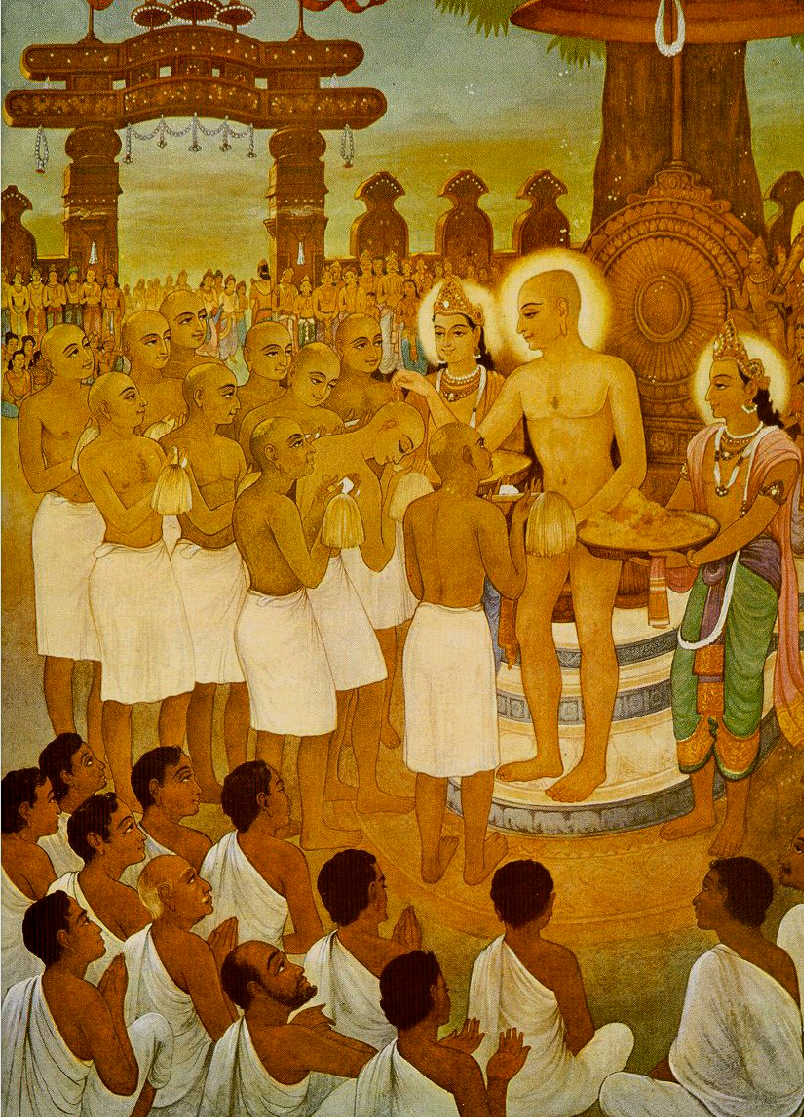
    Jainism (the religion most analogous to Buddhism, as the only other surviving shramanic or wandering ascetic tradition, both of which rejected the Vedas as the ultimate source of knowledge, whereas Hinduism embraces them as its root texts) has a calendar.

    It is the prime example of a lunar calendar that seamlessly weaves religious practice, timekeeping, and the rhythms of the natural world.

    Used by the Jain community predominantly in India but also worldwide, the Jain calendar plays a vital role in religious observances and cultural practices, thereby upholding the enduring relevance of lunar calendars.

    Gymnosophist (naked philosopher) Mahavira
    The Jain calendar, also known as the Jain Panchang or Jain Panchangam, is a lunisolar calendar that balances the lunar year’s shorter duration with the solar year’s longer span, by incorporating an extra month, or “adhik maas,” approximately every three years.

    This intercalary month helps align the calendar with the seasons, a key factor considering many Jain observances are intimately tied to seasonal cycles.

    In accordance with lunar cycles, each month in the Jain calendar commences with the new moon, resulting in lunar months of approximately 29.5 days, closely mirroring the moon’s synodic period.

    The month is divided into two halves, the Shukla Paksha, or “bright fortnight,” and the Krishna Paksha, or “dark fortnight,” each lasting around 15 days and ending with either the full moon or new moon. More: The 12 Lunar Calendars Still in Use Around the World

    Monday, March 20, 2023

    SPRING BEGINS with snow, rain in USA

    Joe Rao, space.com, 3/20/23 at 2:24 PM PDT; Eds., Wisdom Quarterly

    Weather news girls celebrate springtime!
    The glory of spring sort of begins. "Equinox" literally means when night and day are equal (equi - equal, nox = night).

    But the earth must have flattened out or something, or perhaps the Gregorian reworking of the calendar -- taking the planet's timekeeping away from the moon -- has gone askew.

    This year, "the length of daylight is actually longer than darkness by several minutes," reports space.com. Just look at this phony CGI being presented as actual video of the planet as spring arrives: jwplayer.com.

    Take a virtual drive through a deserted, snowy Yosemite National Park (Weather Channel)

    What are the best places to see wildflowers in the US? (The Weather Channel)

      Vernal equinox 2023 brings spring to the Northern Hemisphere with a not-so-equal timing twist
      Joe Rao (space.com, 3/20/23)
      Joe Rao, spring season "expert"
      On the equinox date in March, the length of daylight is actually longer than darkness by several minutes.
       
      It's time to say goodbye to winter -- at least in the Northern Hemisphere. On Monday (March 20) at 5:24 pm EDT (2:24 pm PDT) the spring (vernal) equinox occurs.
       
      At that moment, the sun comes to one of two places where its rays shine directly down on the equator. It will then be shining equally on both halves of the Earth (Bhumi, Terra, Tierra, Ertha).
       
      More precisely at that moment, the sun will be shining directly down on the equator at a point over the Pacific Ocean, roughly 1,900 miles (3,100 km) southeast of the Hawaiian Islands.
       
      Not "equal" on the equinox!
      Another complexity involving the vernal equinox concerns the axiom, "equal days and equal nights on the equinox." Yet each year I [Joe Rao] always get at least one or two inquiries asking why that isn't so.
       
      Perhaps someone, skimming through the weather page of their newspaper on the day of the equinox, looked at the almanac box, which provides the local time of sunrise and sunset, and noticed that the length of day and night is not equal at all.
       
      Banned! (ericdubay.com)
      In fact, on the equinox dates in both March and September, the length of daylight is actually longer than darkness by several minutes. Check out the situation for New York City.
       
      As the table below shows, days and nights are equal not on the equinox, but on Saint Patrick's Day: More
      Ban Eric Dubay! Obey the gatekeepers (Facebook.com/UniverseUnplugged)

      Wednesday, June 10, 2020

      The Dalai Lama's choir: Tibetan chanting

      Jose Luis Aristizabal, Feb. 9, 2015; CC Liu, Ashley Wells, Wisdom Quarterly


      Tibetan Morning Chant
      Song in this video: 五會念佛 (圓光禪寺). Artist: 圆光法师. Album: 五會念佛 (圓光禪寺). Licensed to YouTube by Believe Music (on behalf of 梵音文化有限公司).

      Friday, September 13, 2019

      Good Full Moon Friday the 13th! (video)

      Dhr. Seven, Ashley Wells, Crystal Quintero, Seth Auberon, CC Liu (editors), Wisdom Quarterly


      Friday is a happy day in the West, the end of the work week. Full moons are the most beautiful moons of the moonth: each month gets only one. What?

      There are 13 months in a year. How? A week is seven days (7), a month has four weeks (4). 7x4=28. There are 13 months in a year (13), which has 365 days. 13x28=364. 364+Day Zero=365.
      The Human Calculator Calendar has 365 days divided into 13 months of 28 days each and the first day of the year is the Zero Day. The 13 months are numbered 0-12. Every month has 4 weeks. Every date falls on the same day of the week every month (Scott Flansburg).
      .
      Pomona, Harvest Goddess
      Just ask the creator (rediscoverer) of the Human Calculator Calendar, Scott Flansburg, "the Human Calculator."

      But the Catholic Church with its world headquarters in the Vatican in the world's smallest country, the Holy See at the center of the former capital of the world/the Roman Empire wants us to be very afraid of 13 and the moon, the earth's natural timekeeper.

      What if every month went back to having exactly 28 days, and every one of those days fell on the same day of the week, like every month beginning on a Monday, for example? That's how it was meant to be, and we can have it again.

      Let's end the "fear of thirteen," triskaidekaphobia, a phobia inculcated in us by a corrupt priestly ruling caste, the modern Brahmins. Moreover, let's end the "fear of Friday the thirteenth," paraskevidekatriaphobia. Let's celebrate our Moon (Luna, Soma, Chandra), the weekend, and 13!

      Earth's moon is an artificial satellite placed there.
      In Buddhism the moon, Soma, is revered as a deity. It is the basis of the "sabbath" day, the uposatha or "lunar observance day" when
      • Buddhists go vegetarian,
      • observe the Eight Precepts,
      • meditate in earnest, and
      • stay overnight at the temple listening to Dharma talks and sutras and meditation instructions.
      It's a weekly occurrence that at least gets observed once a month on the full moon and special holidays.

      Think of the moon as a big clock face. Anyone can see what time of the month it is and what day of the month by its phases -- full, half, quarter, or new. It is constantly and unfailingly guiding us through the dark, chasing the sun in a circle above us as old maps show. We've been shown a whole other unbelievable story of what's really going on in front of us.

      This is the Harvest Moon, closest to the autumnal equinox, the beginning of the fall season. Another one will not fall on a Friday the 13th until 2049, so enjoy the special micromoon in its brilliance tonight.

      Thursday, September 5, 2019

      Why we hate math and dates (video)

      Scott Flansburg (humancalculator.com, 10/12); Dhr. Seven, Ashley Wells, Wisdom Quarterly


      The Human Calculator
      (Superhero You) Re-Learning Math with Scott Flansburg: Remember hating math in school? The Human Calculator says it's because we were all taught the "wrong," least intuitive, and most complex ways of solving for answers. Why did they do this to us? They had their reasons. In reality, math is simple. Calculating (without a calculator) is simple. It can even be magical...when learned the "right" way, the better, more intuitive, easier way. Watch as he, the world's fastest human calculator, makes us fall in love with dreaded math in a whole new way.


      The Human Calendar
      Moon-based time is better. We had it from time immemorial because it works infinitely better than Catholic Empire time (Gregorian), which was the pope's calendar to accurately calculate Easter (Saturnalia) and the hell with everything else. There are 13 months (full moons) in a year, 7 days (a lunar phase) in every week, and four weeks in every moonth. This adds up to (4 x 7 = 28; 28 x 13 =) 364. What about the 365th? That's day zero. All counting begins with zero.

      Tuesday, January 2, 2018

      Buddhists and the Moon (Full Wolf Moon)

      Ashley Wells, Seth Auberon, CC Liu, Wisdom Quarterly; Moongiant.com; Space.com


      Tonight is the brightest supermoon of the year, and the brightest our moon, Soma/Chandra/Luna, will be in a long time. There is another full supernoon this month on the 31st, which is a "blue moon" (a second full moon occurring in a month according to our distorted Gregorian calendar).

      Dhr. Seven figured something out: The truth is -- and anyone can do the math -- is that according to Nature's own cycles, there are 13 "moonths" in a year. How? If a week has seven days and month has four weeks (4x7=28), __x28=364? (Add a free day for reflection as a transitional New Year's Day). In other words, How many months in a year? Wrong. The correct answer is 13 (13x28=364).

      We have been lied to, and we have been disconnected from the natural cycles of time on earth. A lunar calendar would be more accurate and beneficial to our health and sanity. A lunisolar calendar, like the one forced on the world by the West, is the worst.

      Buddhists and the Moon
      What do Buddhists care about the moon so much? Our Buddhist spiritual calendar is based on the moon. The lunar observance day is the most important way of the week, and the full moon day is the most important day for meditation, learning, and practice of the month. And Vesak full moon day is the most important day of the year because it is the day the Buddha was born, became enlightened, and passed into final nirvana. All three events happened on the same full moon of Vesakha on the ancient Indian calendar, in different years of course. The uposatha or "sabbath" day is when Buddhists visit the temple/vihara complex and stay all night keeping the Eight Precepts, hearing sutras chanted or explained, and meditate until the following morning.

      What mysteries do the pyramids reveal about the moon and time on our planet?