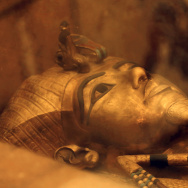
(WION) After 20 years of construction, the $1 billion Grand Egyptian Museum finally opens, but rather than showing the world all that this cultural marvel might contain, Zahi "Indian Jones" Hawass has succeeded in burying the truth about the construction of the pyramids and underworld caverns, hollows, caves, and cities. Once fired for all his cover ups and claims that modern Egyptians are related to the builders, now he goes unquestioned, likely due to corrupt leadership in a nation controlled by Israel, CIA, and USA.
Showing posts with label King Tut. Show all posts
Saturday, November 1, 2025
Wednesday, October 22, 2025
Philippines gold artifacts, no mines
![]() |
| AI depictions should not be taken literally. |
(Time forge Stories) BUTUAN, Philippines. This city served as the former capital of the Rajahnate of Butuan before 1001 until about 1521. The city used to be known during that time as the best in gold and boat manufacturing in the entire Philippine archipelago, having traded with places as far as Champa, Ming, Srivijaya, Majapahit, and the Bengali coasts. It is located at the northeastern part of the Agusan Valley, Mindanao, sprawling across the Agusan River. It is bounded to the north, west, and south by Agusan del Norte, to the east by Agusan del Sur, and to the northwest by Butuan Bay. More
Labels:
Ancient Egyptians,
artifacts,
artist,
carvings,
craft,
face masks,
gold,
jewel,
King Tut,
master,
mining,
pharaoh,
Philippines,
riches,
secret island mystery
Tuesday, July 1, 2025
New secrets of King Tut's tomb found
A British archaeologist believes he has uncovered a wealth of secrets in King Tut’s tomb — including a hidden chamber
![]() |
| Inside King Tut's secret chamber, Egypt |
British archeologist and Egyptologist Nicholas Reeves (news.nationalgeographic.com) has recently put forth a groundbreaking theory that the famous burial site — discovered by Howard Carter in 1922 — contains not one but two hidden chambers.
Even more interestingly, he thinks Queen Nefertiti, whose burial site remains a mystery, is inside one of them.
Reeves bases his theory on high-resolution scans of the tomb’s walls and history. Indeed, three thousand years ago, intruders discovered Pharaoh Horemheb’s sarcophagus after they barged through a false wall adorned with a painted scene — walls with similar decorations and architectural features to those in Tutankhamun’s tomb. More
Thursday, June 19, 2025
'2nd hidden city' found 2K ft under Giza
![]() |
| Anunnaki aliens designed these energy centers? |
Located under the Mankaure Pyramid, this colossal find may be able to "prove" how the three Giza pyramids are connected through the potential existence of a massive subterranean complex buried 2,000 feet underground.
![]() |
| Delicate linen survived millennia |
This remarkable discovery comes after the team previously found large underground structures below the Khafre Pyramid back in March 2025.
However, this latest research isn't without contention, as some archeologists and Egyptologists, such as [nationalist mouthpiece] Dr. Zahi Hawass, have said these findings, which have not yet been peer-reviewed or published in a scientific journal, are impossible due to a lack of sufficient technology as ground-penetrating radar isn't able to analyze the surface that is thousands of feet deep.
What have the researchers said? 'Second hidden city' discovered 2,000 feet under Giza pyramids (MSN)
Labels:
Africa,
alien technology,
Ancient Egyptians,
city,
cover up,
Egypt,
Giza,
hidden,
kemet,
King Tut,
pyramids,
riches,
subterranean,
Timbuktu,
underground,
Zahi Hawass
Monday, February 24, 2025
New pharaoh's tomb found in Egypt
Egyptologists discover NEW pharaoh's tomb after 100 years
Bright Insight tells Joe Rogan facts about Egypt - Stonecutters know Egypt was not pounded out
You heard that right! It’s the first pharaoh’s tomb to have been found in over a century. This is absolutely wild. This channel doesn’t do much news much, but I HAD to share this.
![]() |
| Nubia (Sudan) has more pyramids than Egypt. |
Any discovery of a pharaoh’s tomb is a big deal, but the last one was found so long ago, this is big news. It is the last undiscovered royal tomb of the 18th Egyptian dynasty, the husband of the legendary Queen Hatshepsut. That’s right. They’ve found King Thutmose II’s tomb.
π BOOK: The Other Ancient Civilisations
- UK: amzn.to/3BGcoki
- bbc.co.uk/news/articles/c...
- thetimes.com/article/c302...
- livescience.com/archaeology...
- heritagedaily.com/2025/02...
- mota.gov.eg/ar
- ees.ac.uk/our-cause/publi...
My top archeology 101 book: amzn.to/2EcgVtQ. Some of these are affiliate links, which means purchases from these links may earn me a small commission, which really helps to support the channel. I am not promoting anything that I do not 100% recommend or would not use myself.
#ancientegypt #pharaoh #thutmoseII #tutankhamun #archaeologicaldiscoveries #archaeologicaldiscovery
- Dig It With Raven, Feb. 23, 2025; Pat Macpherson, Dhr. Seven, Seth Auberon (eds.), Wisdom Quarterly
Labels:
amenhotep,
cultural treasure,
Discovery,
Egyptian tomb,
extraterrestrials,
gold,
King Tut,
kings,
Moses,
pharaoh,
pyramids,
queen,
royalty,
valley,
Zahi Hawass
Sunday, July 21, 2024
First look inside King Tut's tomb (BBC)
The excavation of Tutankhamun’s mummy | King Tut in Color
ABOUT: King Tut In Color looks, a century after the world’s most sensational archaeological find, at the tomb of Tutankhamun. Now witness the dramatic scenes of its discovery and marvel at its extraordinary treasures, exactly as they were seen then, in color. It’s all thanks to the latest colorization techniques which use detailed historical research to bring the Egypt of discoverer Howard Carter back to life. ➡ NatGeo subscription #NationalGeographic #KingTutInColor
The first ever view inside Tutankhamun's tomb in Egypt | BBC Global
![]() |
| I am the greatest god-human hybrid ruler! |
Subscribe to BBC Global. For the latest news, analyses, and features visit: bbc.com
Thursday, May 16, 2024
Mysterious lost branch of Nile found, Egypt
![]() |
| Who were these mysterious ET "gods" who walked among us that we worshiped them? |
![]() |
| Now-extinct Ahramat Branch of Nile was used to build pyramids (Eman Ghoneim et al/CNN) |
.
![]() |
| What's the Sahara Desert's Nile got to do with it? |
Egypt’s Great Pyramid and other ancient monuments at Giza exist on an isolated strip of land in Africa at the edge of the Sahara Desert.
The inhospitable location has long puzzled archaeologists, some of whom had found evidence that the Nile River once flowed near these pyramids in some capacity, facilitating the landmarks’ construction starting 4,700 years ago.
Using satellite imaging and analysis of cores of sediment, a new study published Thursday (5/16/24) in the journal Communications Earth & Environment has mapped a 40-mile (64-kilometer) long, dried-up, branch of the Nile, long buried beneath farmland and desert.
“Even though many efforts to reconstruct the early Nile waterways have been conducted, they have largely been confined to soil sample collections from small sites, which has led to the mapping of only fragmented sections of the ancient Nile channel systems,” said lead study author Eman Ghoneim, a professor and director of the Space and Drone Remote Sensing Lab at the University of North Carolina Wilmington’s department of Earth and ocean sciences.
“This is the first study to provide the first map of the long-lost ancient branch of the Nile River.”
Prof. Ghoneim and her colleagues refer to this extinct branch of the Nile River as Ahramat, which is Arabic for “pyramids.”
![]() |
| Red Pyramid at Dahshur necropolis is located near now-defunct arm of Nile (Ghoneim) |
.
The ancient waterway would have been about one-third of a mile (0.5 kilometers) wide with a depth of at least 82 feet (25 meters) — similar to the contemporary Nile River, Prof. Ghoneim said.
“The large size and extended length of the Ahramat Branch and its proximity to the 31 pyramids in the study area strongly suggests a functional waterway of great importance,” Prof. Ghoneim said.
She said the river would have played a key role in ancient Egyptians’ transportation of the enormous amount of building materials and laborers needed for the pyramids’ construction.
“Also, our research shows that many of the pyramids in the study area have [a] causeway, a ceremonial raised walkway, that runs perpendicular to the course of the Ahramat Branch and terminates directly on its riverbank.”
Hidden traces of a lost waterway
![]() |
| The researchers collected soil samples to confirm findings because Nile branch was invisible. |
.
Traces of the river aren’t visible in aerial photos or in imagery from optical satellites, Prof. Ghoneim said. In fact, she only spotted something unexpected while studying radar satellite data of the wider area for ancient rivers and lakes that might reveal a new source of groundwater.
“I am a geomorphologist, a paleohydrologist looking into landforms. I have this kind of trained eye,” she said.
“While working with this data, I noticed this really obvious branch or a kind of riverbank, and it didn’t make any sense because it is really far from the Nile,” she added.
Born and raised in Egypt, Prof. Ghoneim was familiar with the cluster of pyramids in this area and had always wondered why they were built there.
She applied to the National Science Foundation to investigate further, and geophysical data taken at ground level with the use of ground-penetrating radar and electromagnetic tomography confirmed it was an ancient arm of the Nile.
Two long cores of earth the team extracted using drilling equipment revealed sandy sediment consistent with a river channel at a depth of about 82 feet (25 meters).
It’s possible that “countless” temples might still be buried beneath the agricultural fields and desert sands along the riverbank of the Ahramat Branch, according to the study.
![]() |
| Red Pyramid at Dahshur necropolis is located near now-defunct arm of Nile (Ghoneim/CNN) |
.
Why this branch of the river dried up or disappeared is still unclear. Most likely, a period of drought and desertification swept sand into the region, silting up the river, Prof. Ghoneim said.
The study demonstrated that when the pyramids were built, the geography and riverscapes of the Nile differed significantly from those of today, said Nick Marriner, a geographer at the French National Centre for Scientific Research in Paris.
He was not involved in the study but has conducted research on the fluvial history of Giza.
“The study completes an important part of the past landscape puzzle,” Marriner said.
“By putting together these pieces we can gain a clearer picture of what the Nile floodplain looked like at the time of the pyramid builders and how the ancient Egyptians harnessed their environments to transport building materials for their monumental construction endeavors.”
- CNN’s Wonder Theory science newsletter: Explore the universe with news on fascinating discoveries, scientific advancements
- Katie Hunt, CNN (via MSN.com), May 16, 2024, "Newly mapped lost branch of the Nile could help solve long-standing pyramid mystery"; Pat Macpherson, Dhr. Seven (eds.), Wisdom Quarterly
Labels:
advanced technology,
Africa,
ancient temples,
desert,
drought,
extraterrestrials,
Giza,
Israel,
King Tut,
liquid water,
nile river,
north,
pharaoh,
pharoah,
pyramids,
sahara,
satellite,
science,
sphinx,
zecharia sitchin
Sunday, November 5, 2023
Friday, July 28, 2023
Inside an undiscovered Egyptian tomb
First Look Inside an Undiscovered Tomb | Opening Egypt's Tombs
British historian Bettany Hughes helps go inside first pyramid in Egypt
A selection of these tombs was found by Harold Carter, long before he found King Tut (Tutankhamun). Opening Egypt's Tombs follows Robinson to the City of the Dead to find the remains of a mummy and look inside the tomb recently discovered by Dr. Bommas.
ABOUT: Channel 5. Watch this and more full episodes on My5. Download the My5 App:
App Store: https://apple.co/2sHmfTx
Google Play: https://bit.ly/2LjieuK. More from Channel 5: facebook.com/channel5uk, twitter.com/channel5_tv, instagram.com/channel5_tv, #AncientHistory
Labels:
Ancient Egyptians,
archeology,
Bettany Hughes,
Discovery,
Egypt,
Egyptian tomb,
explore,
inside,
King Tut,
mummies,
pharaoh,
skull,
space aliens
Tuesday, February 28, 2023
Extraordinary Ancient Egyptian treasures
loveEXPLORING (MSN, Feb. 28, 2023); Pat Macpherson, CC Liu (eds.), Wisdom Quarterly
![]() |
| King Psusennes (1039-991 BC) funerary mask from Tanis, N.E. Egypt, Egyptian Museum, Cairo, made from sheet gold ("the flesh of the gods"), blue lapis lazuli, and glass paste string holding false beard curving upward slightly to indicate divine status (msn.com). |
![]() |
| Treasures of Ancient Egypt |
Few cultures have left behind as many fascinating treasures and monuments as Ancient Egypt: The Great Pyramid and Sphinx, the Valley of the Kings, the gold mask of King Tut (Pharoah Tutankhamun) and the Rosetta Stone are all world renowned, attracting millions of curious visitors per year. Treasures of Ancient Egypt: Artefacts, Tombs & Temples from the Land of the Pharaohs by Nigel Fletcher-Jones explores the spectacular riches of this ancient world through a selection of stunning photographs. Take a peek inside it here, so as to feast on Egypt's familiar sights and lesser-known relics and discover the fascinating stories behind them. More
Treasures of Ancient Egypt (Nigel Fletcher-Jones) See more than 150 stunning photos that celebrate the wonders of ancient Egypt, from its hieroglyph-covered papyrus scrolls to the awe-inspiring pyramids. Few cultures have left behind as many familiar objects and buildings as Ancient Egypt. The Great Pyramid and Sphinx, the Valley of the Kings, the Colossi of Memnon, the plaster bust of Nefertiti, the gold mask of Tutankhamun, the rock-cut temples at Abu Simbel, and the Rosetta Stone all are immediately recognizable. The exceptional beauty of Ancient Egypt's temples, tombs, and objects draw millions of people each year to Egypt and to museums around the world (including Los Angeles' latest installation that rolls into other big cities).
Treasures of Ancient Egypt tells the tale of many of these familiar places and riches alongside some that are less familiar, but just as spectacular, framed by a lively and highly readable account of Egypt's history from around 3000 BCE to the death of Queen Cleopatra in 30 BCE. Over 150 color photographs, including never-before-published images, complete this fascinating exploration of Ancient Egypt's unique culture and its contribution to world history and art. More
- The mysterious prehistoric city that has baffled scientists for years (starsinsider.com)
- [Irish think they are descendants of ancient Egyptian Queen Scotia] Metal detectorist discovers well-endowed 1st century Celtic fertility pin
- Statue of a bearded man wearing a cap and a belt with penis sheath, attributed to Proto-dynastic period of Egypt (c. 2900-2650 BC) (basalt) (bridgemanimages.com)
- 500,000-year-old signs of extinct human species found in Poland cave (msn.com)
- Homo heidelbergensis | The Smithsonian Institution's Human Origins Program
- Archeologist makes Ancient Sumerian discovery so wild that experts thought it was fake (msn.com)
- VIDEO: Archeologist makes discovery so wild, experts thought it was fake (Exemplore News)
- An ancient restaurant was unearthed by US team of archeologists in Iraq, known as the "Cradle of Civilization" in the Near East/Middle East
- Ancient pre-Columbian Chancay tomb found in Peru
- New Moai statue that "deified ancestors" found on Easter Island (msn.com)
- Kids are convinced they caught a Bigfoot on film during a snow day (msn.com)
- How to SCUBA on the cheap: SMACO Scuba Tank 1liter Mini Scuba Tank S400 scuba diving tank diving equipment
Saturday, August 10, 2019
Did ET give King Tut iron dagger? (video)
Quest TV, May 26, 2018; Pat Macpherson, Seth Auberon (eds.), Wisdom Quarterly
The Mystery Of Tutankhamun's Bronze Age Iron Dagger
What on Earth? Archeologists discovered two daggers buried with Egyptian King Tutankhamun, one with an iron blade that never rusts, which would have had to have been made at a time when iron manufacturing was technologically impossible. Only bronze was capable of being produced on Earth. But other kings in neighboring kingdoms made offerings of gifts -- including emissaries from space, as recorded in Egyptian writings. And then there were meteors coming down directly.
- Full episodes at questtv.co.uk
- Full episodes questod.co.uk/shows
- Quest on twitter.com/QuestTV
Saturday, March 23, 2019
Why broken noses on Egyptian statues?
Julia Wolkoff (cnn.com); Seth Auberon, Crystal Q., Wisdom Quarterly

The most common question that curator Edward Bleiberg fields from visitors to the Brooklyn Museum's Egyptian art galleries is a straightforward but salient one: Why are the statues' noses broken?
Bleiberg, who oversees the museum's extensive holdings of Egyptian, Classical and ancient Near Eastern art, was surprised the first few times he heard this question. He had taken for granted that the sculptures were damaged; his training in Egyptology encouraged visualizing how a statue would look if it were still intact.
![]() |
| Flat reliefs often feature damaged noses as well, supporting the idea that the vandalism was targeted, specific, and iconoclastic (Brooklyn Museum). |
It might seem inevitable that after thousands of years, an ancient artifact would show wear and tear.
But this simple observation led Bleiberg to uncover a widespread pattern of deliberate destruction, which pointed to a complex set of reasons why most works of Egyptian art came to be defaced in the first place. The bust of an Egyptian official dating from the 4th century BC.
Museum exhibit
Bleiberg's research is now the basis of the poignant exhibition "Striking Power: Iconoclasm in Ancient Egypt." A selection of objects from the Brooklyn Museum's collection will travel to the Pulitzer Arts Foundation later this month under the co-direction of the latter's associate curator, Stephanie Weissberg.
Pairing damaged statues and reliefs dating from the 25th century BC to the 1st century AD with intact counterparts, the show testifies to ancient Egyptian artifacts' political and religious functions -- and the entrenched culture of iconoclasm that led to their mutilation. More + VIDEO
But this simple observation led Bleiberg to uncover a widespread pattern of deliberate destruction, which pointed to a complex set of reasons why most works of Egyptian art came to be defaced in the first place. The bust of an Egyptian official dating from the 4th century BC.
Museum exhibit
Bleiberg's research is now the basis of the poignant exhibition "Striking Power: Iconoclasm in Ancient Egypt." A selection of objects from the Brooklyn Museum's collection will travel to the Pulitzer Arts Foundation later this month under the co-direction of the latter's associate curator, Stephanie Weissberg.
Pairing damaged statues and reliefs dating from the 25th century BC to the 1st century AD with intact counterparts, the show testifies to ancient Egyptian artifacts' political and religious functions -- and the entrenched culture of iconoclasm that led to their mutilation. More + VIDEO
Labels:
Ancient Egyptian,
archeology,
cairo,
gnostic,
King Tut,
Near East,
new york,
pays to be jewish,
pyramids,
statue
Friday, January 4, 2019
The Great King Tut HOAX? (video)
Ancient Architects, Jan. 17, 2018; Pat Macpherson, Dhr. Seven (eds.), Wisdom Quarterly
Photos were retrieved from Google Images and are used for educational purposes only.
The Great Tutankhamen Hoax: Was the tomb of King Tut faked?
The boy-king Tutankhamen, whose tomb was famously discovered in 1922 by Lord Carnarvon and Howard Carter, is arguably the most famous pharaoh in Egyptian history. Every child has heard about "King Tut," and Carter and Carnarvon have both gone down in history and folklore due to the golden artifacts they uncovered in Egypt's Valley of the Kings. Today, just years from the 100 year anniversary of the discovery, we continue to learn more and more about the finds.
But when we put the information together, when we logically look at the tomb of King Tut, something is very wrong, not the fabled "curse." Far from being the greatest historical discovery of all time, have we actually been taken in by greatest historical hoax of all time?
Thursday, October 11, 2018
Mysterious discoveries in Egypt (video)
Origins Explained, Oct. 8, 2018; Crystal Quintero, CC Liu, Xochitl (eds.), Wisdom Quarterly
Most Mysterious Discoveries Made in Egypt
Let's look at the most mysterious discoveries made in Egypt. This Top 10 list of recent bizarre archaeological discoveries from Egypt is baffling scientists. What are they?
Most Mysterious Discoveries Made in Egypt
10. Mystery Heads: Finding disembodied heads underground in an Ancient Egyptian tomb sounds like something from a horror movie. But don’t worry, they’re not real heads. As for what they were doing there, the jury’s still out. The heads are a bit of a mystery to this day. The first examples were discovered in 1894 and since then, over 30 have been located. They were nicknamed ‘reserve heads’ because… well, they looked like a bunch of spare heads!
9. The Giza Void: It’s amazing how even the oldest landmarks can still surprise you. In 2017 experts were very surprised when examining the legendary Great Pyramid of Giza on the West Bank of the Nile. As you may know, but just in case you don’t this ancient wonder of the world was built for Pharaoh Khufu and is the largest one of three.
8. Kites Mysterious: lines in the Egyptian deserts have been seen from the air for around a century. Everyone was wondering what they were! It turns out, they’re made up of little stone walls, not very high at all, in a kite-style formation. Some of them are as long as 40 miles. Even more mysterious was the fact that they lead toward a pit in the sand.
7. King Tut’s Mummy: One of the great mysteries of Ancient Egypt is the circumstances surrounding the death of King Tutankhamun. Howard Carter found his legendary tomb in 1922 and made him a historical superstar. What’s maybe not as well known is that King Tut died very young, while in his teens.
6. Black Boxes: If you thought the Great Pyramid of Giza sounded mysterious, wait till you hear about what was found in Memphis! In a cave network 12 miles away from Giza, 24 big black boxes were found. They weigh 100 tons each and are so unusual that some believe them to be alien artifacts!
5. Lost Labyrinth: In the vicinity of the Middle Egyptian city of Faiyum, 62 miles (100 km) southwest of Cairo, there is an area known as Faiyum Oasis. Supposedly, there lies what’s left of one of the most immense and talked-about structures of Ancient Egypt…the mysterious Lost Labyrinth.
4. That’s a Wrap: Though people don’t know a lot about Ancient Egypt, there are certain things everybody knows about, hopefully. Egypt is famous for its pyramids and also the mummies. Examples have been found of mummies that don’t look the way you’d expect. Take this one in the Louvre museum in Paris. It’s an exhibit in the long-established Department of Egyptian Antiquities, which is made up of an impressive 30 rooms showcasing all manner of finds.
3. The Dendera Light: While we believe the light bulb is a relatively modern invention, some commentators would dispute this. In fact they’d go so far as to say the Ancient Egyptians had access to a power source that gave them things like electric light way before it was officially invented!
2. Exploding Pyramid: So I just mentioned a possible power supply in ancient Egypt. But what if I told you about another theory on this subject that takes place on a MUCH bigger scale? It all revolves around that classic image we associate with the time…a pyramid.
1. The Building of the Pyramids: I know, we’ve talked a lot about pyramids but this is a video about Ancient Egypt! What did you expect? After many, many years, the question still is, how did the pyramids get built in the first place? The construction of these mighty structures is a matter of ongoing debate between pros and amateurs alike. Origins Explained is the place to be to find all the answers to your questions, from mysterious events and unsolved mysteries to everything there is to know about the world and its amazing animals!
Labels:
Ancient Egyptians,
artifacts,
Discovery,
Egyptian tomb,
King Tut,
Los Angeles,
mystery sites
Thursday, November 30, 2017
Artifacts: King Tut's tomb coming to L.A.
AP/KPCC FM (scpr.org, Nov. 29, 2017); Pat Macpherson, CC Liu (eds.), Wisdom Quarterly

Dr. Diane Perlov, Deputy Director for Exhibits at the California Science Center, told KPCC the exhibit will be "more of an immersive-type experience" as each artifact is paired with multimedia to tell the story of Tutankhamun's afterlife.
Supreme Court may [not] put new limits on government access to cellphone data
Matt Lauer fired by NBC News after complaint of "inappropriate sexual behavior"
Secrets inside the Sphinx:
Proof! There are shafts and chambers inside the great Sphinx of Giza near Cairo ("Mars"), Egypt, accessible via an opening at the top of the Sphinx's head.
This video presents evidence from a Harvard University professor of archaeology who describes the interior of the Sphinx's chambers, including the tomb of the first Pharaoh Menes. Could this also be the location of the legendary Hall of Records spoken of by America's "Sleeping Prophet" Edgar Cayce? (Images were taken from Google Images for educational purposes only).

.
Artifacts from King Tut's tomb are going on tour next year to mark the upcoming 100th anniversary of the discovery of the Egyptian pharaoh's resting place.
The California Science Center says the exhibit, "KING TUT: Treasures of the Golden Pharaoh," will be on view at the Los Angeles museum for 10 months before heading to Europe in January 2019 as part of a 10-city international tour.
![]() |
In this Thursday Nov. 5, 2015 file photo, tourists look at the tomb of King Tut as it is displayed in a glass case at the Valley of the Kings in Luxor (Amr Nabil/AP).
|
Dr. Diane Perlov, Deputy Director for Exhibits at the California Science Center, told KPCC the exhibit will be "more of an immersive-type experience" as each artifact is paired with multimedia to tell the story of Tutankhamun's afterlife.
The museum says the exhibition represents the largest collection of artifacts and gold from Tutankhamun's tomb ever to go on public display outside of Egypt. It says 40 percent of the items are leaving Egypt for the first and last time before going on permanent display at a new museum being built near the Giza Pyramids in Egypt.
King Tut's tomb was discovered in 1922, more than 3,000 years after his death. More + AUDIO
Women in Film announces new help line to combat sexual harassment in Hollywood
King Tut's tomb was discovered in 1922, more than 3,000 years after his death. More + AUDIO
Women in Film announces new help line to combat sexual harassment in Hollywood
Supreme Court may [not] put new limits on government access to cellphone data
Matt Lauer fired by NBC News after complaint of "inappropriate sexual behavior"Secrets inside the Sphinx:
Proof of Internal Chambers
Ancient Architects, Sept. 25, 2017; Dhr. Seven, Pat Macpherson, Wisdom Quarterly
This video presents evidence from a Harvard University professor of archaeology who describes the interior of the Sphinx's chambers, including the tomb of the first Pharaoh Menes. Could this also be the location of the legendary Hall of Records spoken of by America's "Sleeping Prophet" Edgar Cayce? (Images were taken from Google Images for educational purposes only).
Labels:
Ancient Egyptians,
artifacts,
boys,
cairo,
Egyptian tomb,
ETs,
king,
King Tut,
Los Angeles,
mars,
museum,
pharaoh,
pyramids,
Rolling Exhibition,
sphinx,
USC
Wednesday, November 29, 2017
King Tut coming back to Los Angeles 2018
KingTutExhibition.com; Dhr. Seven, Pat Macpherson, Wisdom Quarterly; Mystery History
A Russian indigo child, Boriska (video below), we previously reported on has disappeared or been effectively silenced for his claims of recalling a past life as a space pilot who saw the destruction of his planet, Mars, in a nuclear catastrophe that destroyed the red planet's atmosphere. The same could happen to Earth, except that there is a time capsule hidden in Egypt's Spinx, in a chamber that will be opened by a special mechanism behind the Sphinx's ear. However, not if Enemy of the People Zahi Hawass, deposed autocrat head of Egyptian antiquities.
![]() |
| Treasures never seen outside of Egypt come to LA's California Science Center, March 2018 |
Secret Chamber Behind Sphinx's Ear?
Mystery History/Facebook, Nov. 26, 2017
A Russian indigo child, Boriska (video below), we previously reported on has disappeared or been effectively silenced for his claims of recalling a past life as a space pilot who saw the destruction of his planet, Mars, in a nuclear catastrophe that destroyed the red planet's atmosphere. The same could happen to Earth, except that there is a time capsule hidden in Egypt's Spinx, in a chamber that will be opened by a special mechanism behind the Sphinx's ear. However, not if Enemy of the People Zahi Hawass, deposed autocrat head of Egyptian antiquities.
Labels:
alien technology,
Ancient Egyptians,
cairo,
Egyptian tomb,
gold,
King Tut,
Los Angeles,
mars,
museum,
past lives,
pharaoh,
pharoah,
Rolling Exhibition,
save the world,
science,
space aliens,
sphinx,
Time,
USC
Subscribe to:
Posts (Atom)


_-_078.jpg)