
Showing posts with label andes. Show all posts
Showing posts with label andes. Show all posts
Wednesday, April 22, 2026


Wednesday, January 14, 2026
The Inca Mummy: Frozen Maiden found


(Journal - History Documentaries) 500 years frozen: The Inca children, particularly "The Maiden," 14, who changed history. Mummies: see Children of Llullaillaco
- Inca Empire and civilization: Ice Maiden
- Mountain worship?
- Coca leaves chewed for cocaine
- Andes Mountains
- Longest continental mountain range in the world
- Ojos del Salado: world's highest volcano, Argentina
- Mummy Juanita of Argentina
- Andes Website - trekking, hiking, skiing and climbing in the Andes mountains of South America
- Mount Ampato, the Andes, Argentina
- Inca Mummies: Secrets of a Lost World
Thursday, August 21, 2025
ET technology in Peru's masonry
(The Secret) The Quechua people of Machu Picchu (Coreloop) Perus greatest mystery finally solved by Google AI: megalithic ruins no human could build.
- Forbidden archeology with Michael Cremo
- Crystal Quintero, Pfc. Sandoval (eds.) Wisdom Quarterly
Thursday, July 31, 2025
Peru's Paracas Pyramids, south coast
Peru is a country in South America, and the Paracas culture apparently left behind many pyramids. How could they have developed the advanced technology to construct them without extraterrestrial assistance, the same as the incredible technological innovations all over and under ancient Egypt?
In fact, the distribution of such marvels worldwide, overland and undersea, is startling and seems to have been covered up, particularly by China and Nubia (modern Sudan).
North Africa and West Asia DNA in Egypt
The largest pyramid in the world is in Mexico (Great Pyramid of Cholula), and Sudan (Pyramids of Meroë) has more pyramids than Egypt. But if there are 200 more in China, or if Bosnia and Indonesia have mountains that are really superannuated pyramids that science is only slowly coming around to admitting to, we have been deceived about the world.
Thursday, March 20, 2025
Atlantis found again? (Brien Foerster)

(The InBetween) Atlantis FOUND: Eye of Sahara secrets exposed (Atlantis documentary) full
(Brien Foerster)
Lost Treasures of Dashur (Dahshur) and Memphis in Egypt: Walk through the lost cities of Dashur and Memphis, home to forgotten pyramids (like the "Bent Pyramid") and hidden relics of Egypt’s golden age. More
Jimmy Corsetti (Bright Insight) with Joe Rogan
- Home - Atlantis Tours (atlant.gg) #AncientEgypt #LostPyramids #Pharaohs
- VIDEO: Lost Treasures of Dashur and Memphis in Egypt
- VIDEO: What melting glaciers in Norway reveal
- Brien Foerster | Facebook
- Brien Foerster | University of Victoria - Academia.edu
- VIDEO: Everyone knows Atlantis is in the Andes, Foerster. Just ask Brien Foerster (11 years ago). Was it worth a personal exploration?
- Pat Macpherson, Seth Auberon (eds.), Wisdom Quarterly
Monday, February 24, 2025
New pyramid discovered in Peru: Caral

New pyramid discovered in Peru!


 |
| The Sacred City of Caral, Peru, South America travel information: Ancient City Guide |
- Turkey Tour: thecommunitygarden.org
- Where is Peru? Where is Caral?
- The Sacred City of Caral in Peru is almost 5,000 years old, making it the oldest city in the Americas. It predates the great pyramids of Egypt in Giza and includes six pyramids, the largest of which measures 150x160 meters, two sunken ceremonial plazas, residential districts, and an irrigation system (r/ArtefactPorn)
Where and what is "Central" America? Not South - Trying to understand South America below US
Sources
- gob.pe/institucion/cultur...
- jpost.com/archaeology/arc...
- arkeonews.net/archaeologists-....
- archaeologymag.com/2025/01/py...
- greekreporter.com/2025/02/01/...
- miamiherald.com/news/nati...
- colombiaone.com/2025/01/31/py...
More videos
- Sechin culture: Chankillo, Oldest Astronomical Observatory
- Human evolution: Hominids
- Ancient structures: Ancient Structures
- Ancient queens: The REAL truth about Hatshepsut
- New discoveries: New Discoveries
- Fact or fiction: Fact or Fiction?
- Support: historywithkayleigh.live
- Links to all socials and merch: beacons.ai/historywithkayleigh
- Merch: historywithkayleigh.com
- Become a channel member: @historywithkayleigh
- Support on Patreon: historywithkayleigh
- Music: Adrian von Ziegler
- Leave a comment, like, subscribe
For the book The Ultimate Guide to Rebuilding Civilization, use promo code KAYLEIGHBOOK10 for 10% off (valid until March 16th). Get a copy: tinyurl.com/5bwxxbtj #thebook #hungrymindsbooks #giftTheBook #theultimategift
- Pfc. Sandoval, Seth Auberon, Ashley Wells (eds.), Wisdom Quarterly
Monday, January 27, 2025
Shamanism in Sweden (video)
 |
| This path of practice to know and see |
- Inca mythology
- Inca Empire
- Shamanism
- Is there Buddhist shamanism? Tengrism and Bon
- Shamanism is the folk religion before Buddhism
- There is a worldwide belief in Animism
The Beginning of Religion and Faith: The History of Religion

Is there shamanism in Sweden? Of course, there are the Sami, the Indigenous whites, the original Scandinavians we seem to base all of our Christmas imagery on -- reindeer sleighs dashing through the snow in colorful clothes, dropping psychedelic mushrooms the shaman dropped in through the chimney of our yurt through to deliver so that we could place them in stocking over the fireplace to dry so they wouldn't rot and turn into charcoal-looking petroleum sludge. The red and white of the Amanita muscaria or powerful fly agaric entheogen was the "gift surprise" we are mimicking under the pine tree, where they grow in a symbiotic relationship to the conifers. It all ties in from former Lapland (now Sapmi) to the Arctic Circle, where the North Pole is located. The shamanism in this cold part of the world is what we have been mirroring and remembering in our racial or genetic memory as a collective human family. Just ask Terence McKenna or the Machine Elves.
Inca Wisdom: Urban Shaman Annika Panotzki's Guide to Emotional Transformation

For Annika, her life completely transformed after opening herself to the wisdom of the shamanic Inca way. In the Inca tradition, Annika says, we see that we are all creators of our lives.
The higher awareness we have, the more we can create and choose good things. When we see that we already have everything we need around us and we see that there is enough for everybody, then we are no longer guided by our ego.
When life is flowing for us, then it is natural to receive and have the desire to share with others. We can share our unique talents, passions, kind thoughts, and so on.
This natural teaching is beautiful and can be applied no matter who we are, what we are working with, or where on earth we live. Inca Shamanism's philosophy of life has amazing tools for us.
- Watch this FREE masterclass: Shamanic Journeying for Guidance and Healing 👉 shiftnetwork.infusionsoft.com...
💙 Let's connect!
Join the community: Wisdom From North membership
➡️ wisdomfromnorth.com/membership ➡️ Website: wisdomfromnorth.com ➡️ YouTube channel: wisdomfromnorth. Wisdom From North partners with The Shift Network. Music: Epidemic Sound. Become a co-creator and donate here
➡️ wisdomfromnorth.com/donation. Thanks so much for the support. Jannecke Øinæs COPYRIGHT© 2016.💙 Podcast: Spotify ➡️ wisdomfromnorth.com/spotify. Apple ➡️ wisdomfromnorth.com/apple-pod...
- Annika Panotzki, Jannecke Øinæs, Wisdom From North, Nov. 9, 2016; Amber Larson and Dhr. Seven (eds.), Wisdom Quarterly
Wednesday, September 25, 2024
Secret site in Peruvian Andes: Naupa Huaca
The "Temple of the Moon" is an Incan ceremonial temple on Huayna Picchu near Machu Picchu, in Peru. The site is made up of stone masonry and an open-face, shallow cave. In the center of the cave is a stepped sculpture cleanly carved out of rock (hard andesite). Beside the stepped sculpture are steps that lead more deeply into the cave. It is thought that the caves were possibly used to hold mummies. The Temple of the Moon dates back at least 1500 years [1]. [We suspect much older.] It was rediscovered in 1936. It rests 1,280 feet (390m) below the summit on the north side of Huayna Picchu. More
Pre-flood ruins of advanced civilization high in the Andes mountains: Naupa Huaca
(Universe Inside) Sept. 22, 2024: Far from the bustling tourist Peruvian paths that lead up to famous Machu Picchu or Ollantaytambo, in the remote Andean highlands of Peru's Sacred Valley, rests a mystery site hidden away within a rock cave.
This site is called Naupa Iglesia, or more accurately, Naupa Huaca. This unexplained structure is believed to be a prehistoric site left by a civilization far more ancient and far more advanced than the Incan civilization which inhabited the region.
Join in fueling this mission to create insightful videos backed by thorough research by supporting on Patreon or PayPal: universeinsideyou, https://paypal.com/donate/?hosted_but... Support can help dive even deeper into topics that matter, enabling producing more engaging content that informs and inspires. Contributing backs a project and empowers a wealth of knowledge to be shared. Stand behind this effort to bring meaningful videos to life. Every contribution counts.
Discover a world of creativity at this art and merchandise shop: https://teespring.com/stores/universe... Join on Instagram: universe.inside.you. Facebook: universalloving. For Spanish-narrated videos, visit Spanish channel: universe inside you español #universeinsideyou
Thursday, August 15, 2024
ETs, not humans, made Puma Punku
Ancient Aliens: Mysterious megalithic stones of Puma Punku

- Chariots of the Gods (Erich von Däniken)
- "Indigenous Aymara people, who speak Quechuan and Spanish, who made these stones?" "Los dioses (the gods)." Who are these dioses/gods? They are in Buddhism the devas or asuras (the gods or antigods, shining ones or titans, who came down to earth from the second heaven known as the World of the Thirty-Three a deva-loka, or "realm of the shining ones [in space]," two tiers up from the world of earthlings).
Watch all new episodes of Ancient Aliens, Fridays at 9/8c, and stay up to date on all favorite shows on The HISTORY Channel website at history.com/schedule.
#AncientAliens
- Pat Macpherson, Dhr. Seven, Pfc. Sandoval (eds.), Wisdom Quarterly
Tuesday, June 25, 2024
Easter Island linked to Gobekli Tepe (Gaia)
The "heads" are whole bodies, far too tall to have been nearly buried by natural erosion on the island in just 800 years. Taking soil samples from the depths of the base of the statues will show they are 12,000 years or older. There would be no surprise in finding the remnants of a superannuated culture from before the ice age, as Michael "the Forbidden Archeologist" Cremo constantly addresses. There are ancient records of solar flare plasma from 10,000 BC, which Dr. Robert Schoch and his wife Catherine Ulissey.
Forgotten Civilization: New Discoveries on the
Solar-Induced Dark Age (Dr. Schoch)

Could the megalithic Easter Island heads be over 12,000 years old?
 |
| In Rapa Nui, Chile (aka "Easter Island") the natives do a Polynesian dance for tourists (Lufke) |

 |
| Gobekli Tepe (Andrew Collins) |

ABOUT: Gaia offers the largest resource of consciousness expanding videos. Answer life's deeper questions and go beyond the mainstream narrative with Gaia — a member-supported media network of truth seekers and believers empowering an evolution of consciousness.
Einstein says gravity works by pushing not pulling
according to theoretical physicist Dr. Michio Kaku
 |
| Wiki map of Gobekli Tepe |
Explore over 8,000 ad-free, streaming titles that challenge modern paradigms and allows us to manifest the reality that defines our being. Experience Gaia in English, Spanish, German, or French. Gaia offers original, dubbed or subtitled content in these languages. Join hundreds of thousands of members in 185 countries in awakening consciousness.
Connect with Gaia:
Visit Gaia WEBSITE: gaia.com Like Gaia on FACEBOOK: gaia
Like Gaia Unexplained on FACEBOOK: gaiaunexplained
Like Gaia Yoga on FACEBOOK: yogaongaia
Follow Gaia on YOUTUBE: gaiavideo
Follow Gaia on TWITTER: yourmothergaia
Follow Gaia on INSTAGRAM: wearegaia
Follow Gaia on TIKTOK: we_are_gaia
#Gaia 8,000+ Films, Shows & Classes on Gaia. Start Free Trial: cs-link.gaia.com/3PVRJO9
- Gaia.com, July 28, 2023; Pat Macpherson, Dhr. Seven (eds.), Wisdom Quarterly
Thursday, January 11, 2024
Science maps NEW Amazonian lost cities
Christina Larson, AP Science Writer, The Associated Press (apnews.com, 1/11/24); Xochitl, Dhr. Seven, Ashley Wells (eds.), Wisdom Quarterly


 |
| Mexico's archeolocal ruins in Chichen Itza, Cenote, Valladolid (tripadvisor.com) |


 |
| Red heads: Sacred burials were being performed thousands of years ago in the Americas. |
 |
| Fall of Incan Empire brought by whites, say historians (Factinate Media Group via MSN) |
 |
| Lost cities of Amazon jungle in Meso-, Central, and South America found by LiDAR (AP) |
Archeologists map lost cities in Ecuadorian Amazon, settlements that lasted 1,000 years

“It was a lost valley of cities," said Rostain, who directs investigations at France’s National Center for Scientific Research. “It's incredible.”


José Iriarte, a University of Exeter archaeologist, said it would have required an elaborate system of organized labor to build the roads and thousands of earthen mounds.
 |
| Recent headline: Archeologists discover ancient Mayan city hidden in forest for 2K years |

.
 |
| Ecuador flag, Latin America |
WASHINGTON, DC [outside of USA, in "Columbia," and reigning over it] — Archeologists have uncovered a cluster of lost cities in the Amazon rainforest that was home to at least 10,000 farmers around 2,000 years ago.
A series of earthen mounds [like Buddhist stupas, tepes (tels), kurgans, and barrows (tumulus)] buried roads in Ecuador was first noticed more than two decades ago by archaeologist Stéphen Rostain.
 |
| Map of Ecuador with Amazon (wiki) |
But at the time, " I wasn’t sure how it all fit together,” said Rostain, one of the researchers who reported on the finding Thursday [1/11/24] in the journal Science.
Recent mapping by laser-sensor technology [LiDAR] revealed those sites to be part of a dense network of settlements and connecting roadways, tucked into the forested foothills of the Andes [most of which are in Peru], that lasted about 1,000 years.
 |
| Meso-, S. America were advanced places on earth |
The settlements were occupied by the Upano people between around 500 B.C. and 300 to 600 A.D. — a period roughly contemporaneous with the Roman Empire in Europe, the researchers found.
Residential and ceremonial buildings erected on more than 6,000 earthen mounds were surrounded by agricultural fields with drainage canals. The largest roads were 33 feet (10 meters) wide and stretched for 6 to 12 miles (10 to 20 kilometers).
 |
| LiDAR scans reveal topographical features like X-rays reveal bones: This LiDAR image provided by researchers in Jan. 2024 shows a main street crossing an urban area, creating an axis along which complexes of rectangular platforms are arranged around low squares at the Copueno site, Upano Valley in Ecuador. Archeologists have uncovered a cluster of lost cities in the Amazon rainforest that was home to at least 10,000 farmers around 2,000 years ago, according to a paper published Thursday, Jan. 11, 2024, in the journal Science (Antoine Dorison, Stéphen Rostain via AP/MSN). |
.
While it’s difficult to estimate populations, the site was home to at least 10,000 inhabitants — and perhaps as many as 15,000 or 30,000 at its peak, said archaeologist Antoine Dorison, a study co-author at the same French institute. That's comparable to the estimated population of Roman-era London, then Britain’s largest city.
“This shows a very dense occupation and an extremely complicated society,” said University of Florida archeologist Michael Heckenberger, who was not involved in the study. “For the region, it’s really in a class of its own in terms of how early it is.”
- VIDEO: Archaeologists discover a vast network of Amazon villages: Live Science
- VIDEO: Archaeologists discover a vast network of Amazon villages: (MSN.com)
- Brazil fights wildcat gold mining in Amazon
- Bolivia's amazing site Tiwanaku (Tiahuanaco)
- Mexico's Yucatan Peninsula is near US, Cuba!
 |
| It looks like an ancient Afghan (Gandharan) Buddhist stupa like Swat: Five Best Incan Ruins |
 |
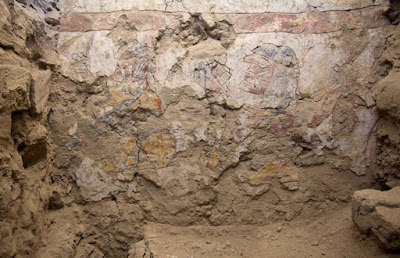
| Recent discovery in Peru, where new art was found, Moche, Inca (Lisa Trever via MSN) |


 |
| The Amazon jungle is alive and conscious |
“The Incas and Mayans built with stone, but people in Amazonia didn’t usually have stone available to build — they built with mud. It’s still an immense amount of labor,” said Iriarte, who had no role in the research.
 |
| Neighboring Guatemala, just below Mexico, has Tikal, Mayan ruins in the jungle (2009) |
.
 |
| The star people helped us build these marvels. |
The Amazon is often thought of as a "pristine wilderness with only small groups of people. But recent discoveries have shown us how much more complex the past really is,” he said.
Scientists have recently also found evidence of intricate rainforest societies that predated European contact elsewhere in the Amazon, including in Bolivia and in Brazil.
“There’s always been an incredible diversity of people and settlements in the Amazon, not only one way to live,” said Rostain. “We’re just learning more about them.”
 |
| There was more to the Inca of Peru besides the amazing Machu Picchu (Reuters via jpost.com) |
___
The Associated Press Health and Science Department receives support from the Howard Hughes Medical Institute’s Science and Educational Media Group [and therefore may be biased and willing to cave in to corporate pressure for all of its reporting.].
Subscribe to:
Posts (Atom)





















































