Showing posts with label buddhist second heaven. Show all posts

Friday, July 19, 2024

The Anger-Eating Demon (sutra)

What modern person can believe in angelic and demonic influences? That's nonsense!


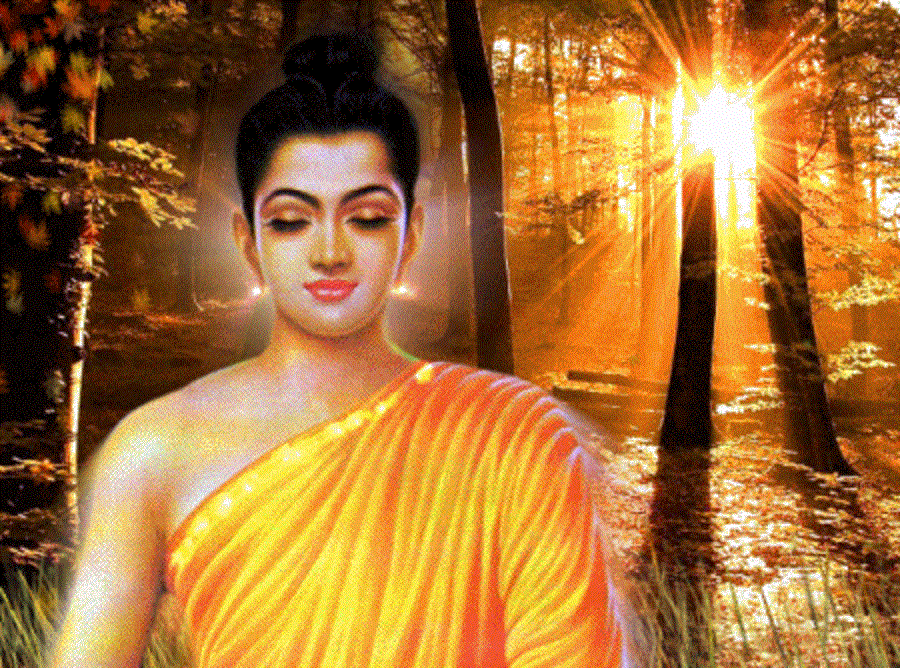
Indian artists try to depict ancient sacred texts.
The Anger-Eating Demon is an ancient Buddhist story retold by German Theravada monk Ven. Nyanaponika Thera.

Once there lived a demon (asura) who had a peculiar diet: He fed on the anger of others. And as his feeding ground was the human world, there was no lack of food for him. He found it quite easy to provoke a family quarrel, or national and racial hatred.

Even to stir up a war was not very difficult for him. And whenever he succeeded in causing a war, he could gorge himself without much further effort. For once a war starts, hate multiplies by its own momentum and affects even normally friendly people.

This man is not channeling an ET creature.
So the demon's food supply became so rich that he sometimes had to restrain himself from overeating, being content with nibbling just a small piece of resentment found close by.

But as it often happens with successful people, he became overbearing and one day when feeling bored he thought, "Shouldn't I try it with the happy celestials (devas)?"

Sakka (Magdha of Macala): St. Michael
On reflection he chose the Heaven of the Thirty-Three Devas ruled by Sakka, King of the Devas. He knew that only a few of these fortunately reborn beings had entirely eliminated the fetters of ill-will and aversion (which is possible by the practice of Buddhism), though most devas were far above petty and selfish quarrels.

So by his magic power (abhinna) he transferred himself to that heavenly realm and was lucky enough to come at a time when the Divine King Sakka was away. There was no one in the large audience hall and without much ado the demon seated himself on Sakka's empty throne, waiting quietly for things to happen, which he hoped would bring him a good feeding.

Sakka as warrior deva (archangel, light being)
Soon some of the devas came to the hall and at first they could not believe their own divine eyes when they saw that ugly demon lounging on the throne, squat and grinning.

Having recovered from their shock, they started to shout and lament: "Oh you ugly demon, how can you dare to sit on the throne of our supreme king? What utter disrespect! What a crime! You should be thrown headlong into a lowly hell and straight into a boiling cauldron! You should be drawn and quartered alive! Begone, begone!"

But while the devas grew more and more angry, the demon was pleased because from moment to moment -- as their anger grew -- he grew in size, in strength, and in power.

What "demons" possess an infamous person?
The anger he absorbed into his system started to ooze from his body as a smoky red-glowing mist. This putrid aura kept the devas at a distance and their streaming radiance was dimmed.

Suddenly a bright glow appeared at the other end of the hall, and it grew into a dazzling light from which Sakka, the King of Devas, emerged.

He who had firmly entered the irreversible stream that leads to nirvana (sotapannaship, the first stage of Buddhist enlightenment) was unshaken by what he saw.

The smokescreen created by the devas' anger parted when he slowly and politely approached the usurper of his throne:

"Welcome, friend! Please, remain seated. I can take another seat. May I offer you a drink of hospitality? Our ambrosia (amrita) is good this year. Or do you prefer a stronger brew, like Vedic soma?"

While Sakka spoke such friendly words, the demon rapidly began to shrink into a diminutive size and finally disappeared, trailing behind a whiff of malodorous smoke, which likewise soon dissolved. — Based on Samyutta Nikaya, Sakka Samyutta, No. 22.

Commentary
It was my idea to get tattoos and amputations
The gist of this story dates back to the sutras (discourses) of the Buddha. But even now, over 2,600 years later, our world looks as if large hordes of Anger-Eating Demons are haunting it and are kept well nourished by millions slaving for them all over the earth.

Fires of hate and wide-traveling waves of violence threaten to engulf humankind. Also, the grassroots of society are poisoned by conflict and discord, manifesting in angry thoughts and words and in violent deeds.

Is it not time to end this self-destructive slavery of humans to our impulses of hate and aggression, which only serve demonic forces?

Oh, that we would be as loving and kind as the devas, the "shining ones," in the heavens!
.
This story tells how these demons of hate can be exorcised by the power of gentleness and love (metta). If this power of love can be tested and proven, at a grassroots level, in a widely spread net of personal relationships, society at large and the world at large will benefit from it. Source

NOTE: 1. The Buddhist "Doctrine" or "Natural Law and Regularity" (Dhamma) here referred to may be expressed in the words of the Dhammapada (V. 5):

"Not by hating does hatred cease
In this world of tooth and claw;
Love alone from it can release —
This is an Eternal Law."

Wednesday, September 14, 2022

Sutra: Is there a heaven? (video)

Ven. Kiribathgoda Gnanananda Thera (trans.), Rajjumālā Vimānavatthu (Khuddaka Nikāya, Crimson Chapter (4.12) Rajjumala’s Mansion or UFO; Dhr. Seven, Seth Auberon (eds.), Wisdom Quarterly

Ven. Moggallana: "Devata, your beauty shines in all directions like the bright star named Osadhi.

"When you dance, divine music and sweet fragrance spread from your hands and feet. Also, the ornaments on your head play delightful music. The bouquet of flowers on your head spreads sweet fragrance, like that of a manjusaka tree, and plays music when the breeze blows on it. Surely, you must smell that fragrance and see your own divine body?

"Tell me, Devata, what kind of meritorious action [skillful karma] did you do when you were in the human world to have gained this beauty that shines in all directions and to have earned all these wonderful things?"

Devata: "In my previous life, I was in the human world living in the city called Gaya. I was a servant girl working in a high-caste family. I did not have much merit and was very unfortunate. Everybody called me 'Rajjumala.' I was abused, threatened, and beaten. I was tired of living that way.

“One day I took a water pot and, pretending to get some water, I ran away. I ran into the forest beside the road. There I contemplated suicide. I thought that there was no point in living like this. I made a strong noose and tied it to a tree. I looked around to see whether anybody was there. Then I saw the Supreme Buddha, the most compassionate teacher of all beings in the world, sitting at the root of a tree meditating, free from all fears.

(Roxy Music, April 3, 1973) "In Every Dream Home a Heartache." Brian Ferry asks, "Is there a heaven? I'd like to think so." BBC TV: The Old Grey Whistle Test, Brian Eno on keyboards. 

“I was shocked and surprised. The hairs on my body stood on end. I thought, 'Who is that being in this forest – is he a human or a deva?' The sight of him was thrilling! He has escaped from the forest of defilements and attained the bliss of calmness. When I saw him, I was delighted. I realized that he was not an ordinary human being. The Blessed One lived with restrained senses, delighting in meditation, with his mind established in nirvana. Truly, he is the Supreme Buddha, the most compassionate teacher in the world.

“Like a lion living in his cave, the Blessed One is afraid of nothing. Seeing a brave buddha is very rare, like seeing a [heavenly] udumbara flower. The Supreme Buddha called to me gently, saying, 'Rajjumala,' and asked me to go for guidance to the Supreme Buddha. When I heard those sweet, gentle, meaningful, soft, and lovely words, all my sorrows went away. My mind was joyful and clean. I was ready to understand the Dharma [Teaching of Liberation]. At that time, the most compassionate teacher in the world taught me the Dharma, saying, 'This is suffering, this is the cause of suffering, this is the end of suffering, and this is the way leading to deathlessness [nirvana].' I followed the advice of the most compassionate and skilled teacher, the Supreme Buddha. I understood the peaceful and deathless state, nirvana. With the realization of the Four Ennobling Truths, my love towards the Buddha became strong, unshakable, well rooted, and well established. I became a daughter born of the heart of the Supreme Buddha.

We're here to entertain you, Shining One!
“Now, I enjoy living in this heaven, playing and dancing. I do not have any fear of falling into the plains of misery again [because she has attained at the very least the first stage of enlightenment called stream entry, which means one can never be reborn anywhere lower than the human plane]. I wear divine flower garlands and drink water from the divine river Madhumaddava. Sixty thousand musical instruments wake me from my sleep. Devas entertain me. Their names are Alamba, Gaggara, Bhima, Sadhuvadin, Samsaya, Pokkhara, and Suphassa. Other devatas, including Vina, Mokkha, Nanda, Sunanda, Sonadinna, Sucimhita, Alambusa, Missakesi, Pundarika, Athicharuni, Eniphassa, Suphassa, Subhadda, and Muduvadini entertain me as well. These and many other devatas entertain me with divine music coming to me whenever I wish. They approach me saying, 'Come now! Let’s dance and sing! We are here to entertain you.'

“Those without merit will not receive mansions [vimanas = UFOs = celestial platforms, mansions, palaces, motherships] like this. Only those with merit receive this happiness in the heavenly Nandana Park in the Heaven of the Thirty-Three (Tavatimsa).

“Those who have not gathered merit will not get any happiness in their current life or their next life. Only those who have gathered merit get happiness in both the present and next life. Those who would like to be reborn in the Heaven of the Thirty-Three must collect much merit. Only people who do good things are able to enjoy heavenly [celestial] pleasures.

“Definitely, supreme buddhas are born into this world for the happiness of all beings. Thus, buddhas are the unique fields of treasure where donors can plant their seeds of merit [with massively abundant results]. Having respected such great beings, these fortunate people enjoy heavenly pleasures. Source: Vv 50: Rajjumālāvimānavatthu—Ven. Kiribathgoda Gnanananda Thera (suttacentral.net)

Friday, December 13, 2019

Buddhist legend: "The War in Heaven"

Pfc. Sandoval, Dhr. Seven, Pat Macpherson (eds.), Wisdom Quarterly Wiki edit; G.P. Malasekera
Time-travel bells (stupas over Buddha statues), Borobudur pyramid Buddhist temple
Sakka King of the Devas: St. Michael (fmrly. Magha of Macala), Roman Catholic Church

Sakka versus Vepacitti (Vemacitrin) as St. Michael vs. Lucifer (Satan) the dragon (wiki)
.
The Deva-Asura War
Sakka (St. Michael) defeats a dragon (wiki)
The Asuras ("Titans") formerly lived in the Heaven of the Thirty-Three (Pali Tavatimsa, Sanskrit Trāyastriṃśa), the world on the peak of Mt. Sumeru with the other Shining Ones of that world.

When Sakka, King of the Devas (Śakra, Indra, analogous to Archangel Michael) became the ruler of that world, the Titans celebrated by drinking a lot of gandapāna wine, a celestial alcohol so strong that Sakka forbade the other Shining Ones from drinking it.

Asura in Kōfuku-ji, Nara, 734, Japan
Weakened by their drunkenness, the Titans could not resist when Sakka had the whole lot of them thrown over the edge of the World of the Thirty-Three into what would become the Titan-world at the base of the mythical mountain Mt. Sumeru.

A tree grows there called cittapātali. When the Titans saw it blossom, they realized that it was different from the pāricchattaka (Sanskrit pāriyātra) tree which had grown in their old home, and they knew that they were dispossessed.
Asuras (Greek "Titans") find themselves tossed out of heaven, wake on earth (wiki).
Layout of heavenly Borobudur Buddhist temple representing Three Spheres or dhatus.
.
They now contemplated war. In armor and weapons, they climbed up the steep slopes of Mt. Sumeru "like ants." Sakka set out to meet them, but he was forced to retreat because of their numbers.

Garuda/Avian, Delhi (wiki)
Passing through the forest where the Avians (Garuḍas) live on his flying chariot [UFO, spaceship, vimana], Sakka saw that his passage was destroying the nests of the Avians and ordered his charioteer Mātali to turn back.

When the pursuing Titans saw Sakka turn around, they felt certain that he must be coming back with an even larger army. So they fled, ceding all the ground they had gained (Robert Chalmers, 1895, "No. 31, Kulāvaka-Jātaka," The Jataka [Rebirth Tales] Volume I).

Despite their many wars, there was eventually a partial concord between the Shining Ones of the World of the Thirty-Three and the dispossessed Titans.

This came about because Sakka fell in love with Shachi (aka Sujā), daughter of a Titan chieftain named Vepacitti (Sanskrit, Vemacitrin).

Vepacitti had given Sujā the right to choose her own husband at an assembly of the Titans, and she chose Sakka, who had attended disguised as an aged Titan. Vepacitti therefore became Sakka's father-in-law.
Sakka as St. Michael
Sakka (St. Michael) and Vepacitta
Before he was reborn as Sakka, King of the Devas, due to his unusually good karma (keeping seven vows), he was a human named Magha of Macala (Western "Michael"). He is also called Maghava. He is the ruler of two celestial worlds above this earth (bhumi) among Buddhist cosmology's 31 Planes of Existence. He rules the "World of the Thirty-Three" with 33 other "lords," and he is the king of four regents one world down, the "Realm of the Four Great Regent-Kings" of the four cardinal directions in space. His nemesis is the Asura-Titan chief Vepacitta, now his father-in-law. Sakka is not a unique figure but a station like the presidency because every "world-system" (cakkavala) has one. More

Thursday, June 2, 2016

Another Sun and civilization inside the Earth

Pat Macpherson, Wisdom Quarterly; UFO Mania (FB ufo.maniaII); Mlordandgod


UFO maniaFor years scientists preserved the shocking secret interpretation of data of photographs of our planet from space. In the ice of the North Pole area a huge hole can clearly be seen. See helenastales.weebly.com.


Heat signature reveals polar opening (HS)
What did the US government find in Antarctica then cover up?

Two oases and a region of ice-free lakes and land. More than 300,000 square miles of unpathed territory were charted by aerial mapping operations. Their observations proved that radical changes would have to be made on existing maps of the Antarctic.

Operation Highjump commenced 26 August 1946 and ended in late February 1947. Task Force 68 included 4,700 men, 13 ships, and multiple aircraft. The primary mission of Operation Highjump was to establish the Antarctic research base Little America IV. More: IntelliHub.com/what-the-us...
Could Antarctica have been home to an ancient civilization? We need
to wait for science to give us permission to believe what we see.

Saturday, November 10, 2012

Would the Buddha carry an iPad? (Yes, if...)


What is it with Thailand, the Apple Corporation, and Buddhist temples lately? First, abbot of the Dhammakaya temple said that former Apple CEO Steve Jobs is kickin’ it in the afterlife as a mid-level deva with his own celestial palace in space. Now a temple in Thailand’s Chom Phra district has decided that the Buddha carries around an iPad with him wherever he goes.
  
Ban Jabok-Ban Nong Leg temple in Thailand’s northeastern Surin province is now trying to send a message by making the Buddha hold an iPad in their next statue, says The Bangkok Post:
Traditionally, Phra Sivali, a pose of the Buddha, carries a walking stick, an umbrella, and a bowl, and is worshipped for those seeking love, luck, and prosperity.
But the one to be built by the temple will have one hand carrying the umbrella -- and the other one clutches one of the innovative bestsellers launched by the late Steve Jobs instead of the stick.
[WQ: This is quite incorrect. Venerable (Phra) Sivali is not "a pose"; he was a famous enlightened Buddhist monk, now a popular and powerful source of veneration because of his incredibly good karma and resultant good luck. He easily obtained all he wanted. Many Thai good luck charms and amulets are based on him as a well known arahant. Theravada Buddhism does not have many such prosperity figures, so Southeast Asia loves Great Sivali. Therefore, this entire Bangkok Post story is misleading: It will not be "the Buddha" holding a posh iPad, a modern symbol of abundance and cool, but Sivali.]

Thai Temple Says Buddha Should Carry An iPadThis might seem like an attention-grabbing gimmick, and maybe it kind of is. But the message the temple wants to send is good and forward-facing. They want to stress that monks need to embrace the technology of the modern world in getting their message across:
  
“Monks have to catch up with the changes and use those gadgets, such as the iPad, to lure the [younger] generation to the temple. Monks can use them to teach Dhamma to those who live their life with new communication technologies,” a temple spokesman said.

Apple CEO reborn in space?
Seven Dharmachari and Amber Dorrian, Wisdom Quarterly (COMMENTARY)
Bright golden complexion of the Buddha entering nirvana, Thailand (Luped/flickr.com)
  
Would a Buddha statue carry an iPad? Yes, if... it were in Thailand. The Buddha himself, not so much. In his day he delighted in letting go of those things which are powerful sources of grasping and clinging in the world.

In his day he instructed his disciples in pursuing the joy and liberation that comes from letting go of impermanent, unsatisfactory, impersonal things and, moreover, the personal phenomena we cling to as ourselves. That can only be let go of through wisdom, as insight uproots what is otherwise impossible to drop.

But Thailand's massive lay meditation movement, known as Dhammakaya ("body of the Dharma"), is kidding about Steve Jobs in "heaven," right?

Buddhism is atheistic? No There is no all-producing creator God; there are many gods (brahmas), many of whom are creative and powerful. Buddhism is scientific? Maybe. It is certainly the spiritual tradition most consistent and amenable to science. Buddhism is nihilistic? No.
  
Unlike modern nerds who think or hope or fear everything ends at death, that's not what happens. Conventionally speaking, life carries on like nothing happened. Ultimately speaking, "we" are dying from moment to moment and do not need to wait for bodily collapse/death to start crying about it or feeling relieved.

"Everything (all conditioned phenomena) is hurtling towards destruction; work out your liberation with diligence," the historical Buddha is reputed to have said (Mahaparinibbana Sutra, DN 16). These were his last words before passing into final nirvana. The fully enlightened do not die, because "death" entails being reborn (as well as currently existing in some ultimate sense). But we do die, conventionally speaking. And Steve Jobs has. With the coming together of the aggregates, there is renewed-becoming an instant later.
  
And there are many worlds in space to be reborn in. "Space" (akasha) to the ancients was called "sky." That "celestial" world above is the endless blue that goes to black nightly. There are many levels superior to the human plane. It is not too difficult to be reborn into these worlds of devas ("shining ones"), which are increasingly more subtle and refined, brilliant and long-lived. The first two "heavens" are far more advanced technologically and closely related to this world. The proof, the scientific evidence?

They can be seen now before dying. Because the knowledge is filtered and kept from us does not mean it is concealed form all scientists. And when they become whistleblowers telling us what they've seen and worked on, the knowledge-filterers tell us they're bonkers and not to be listened to. There are two ways to see, internally and externally. The first is harder but more convincing; the second is tough but will leave one feeling bonkers.
  
(What is it? Get a job in a scientific field in academia or the private sector then get recruited to work on black budget project, top secret stuff. Go to Washington through underground highspeed trains through tunnels beneath this country and scattered around the planet, or to Area 51, or Dreamland, or the Skunkworks, or any other secret site).

The first is developing insight (vipassana) and wisdom (prajna). This does not come from studying and thinking, but from intensive serenity-concentration and mindfulness-contemplation. Good luck. It takes effort. So for everyone who would rather study, the texts are there. Drink deep, for a little knowledge is a dangerous thing.

We won't like the answer we see; it's too much like the Christianity we laugh at as moronic and senseless. The truth is more mystic than systematic. But Buddhist practice is great for being systematic resulting in mysticism, rather than mysticism resulting in confusion.

(Dhammakaya International)

All religious traditions teach something worthwhile. It is not their fault if we do not understand what they are trying to say. The shamans were right, the mystics were onto something. But how do we get from here to there? There's an eightfold path that lays out the basics. And there is a very detailed 37 Requisites of Enlightenment that lays bare all the Buddha taught as necessary for seeing and experiencing enlightenment in this very life.

Steve Jobs in a heaven (akasha deva world)? It could be, but we doubt it. After selling millions of human beings out to the monsters on the planet who would spy on everyone, control us, damage our DNA, entrance us, lull us into sleep, enslave us, wipe us out? If he was a man caught up in his work, obsessed with innovation, okay. Great.

But if he was a man who sold the world for earthly success and fame, then... It doesn't look good for him. A "bad" person can go to a heaven. Christianity understands this, but Christians don't. It is not by being forgiven or absolved for our karma. It is by being fortunate at the moment of passing from this life to the next, by having a skillful, useful, lovely act (deed, karma, intention, will, fruition, impulsion) come up for us.

That will be a lot easier to do if we begin to calm our minds/hearts now and store up many more beneficial acts than detrimental ones. Why do harm when it only comes back around to us to harm us? What did Jobs do? What else did he do? He surely did terrible things (just ask the FBI and CIA and NSA). But all his hands toting iProducts love him, too. Look, there's a Buddha statue holding one!

So if he did acts motivated by nongreed, nonhatred/fear, nondelusion, then he is quite possibly in a better place. These heavens are not permanent, but they are much longer-lived than this human realm. There are other human and human-like realms, too. Here is a simplification that sounds an awful lot like Christianity and even Islam, like what shamans see and rabbis teach. Rather than laugh, ask: In what way is this true, too? More (with insert photos explained for those activating Google Translate)


Monday, December 19, 2011

Sakka, "St. Michael," Lord of the 33 (video)

Dharmachari Seven, Wisdom Quarterly (ORIGINAL RESEARCH)
Sakka a "shining one" (deva) from space (akasha-loka), Nordic alien -- a Thor and Saint Michael figure from ancient India, Sumeria, and mythologies worldwide (SMW).

SPACE, Earth - Sakka [Magha of Macala], King of the near Earth orbit Devas (Devanam-Indo), is the world's most famous extraterrestrial Buddhist. As Indra, Indo, Maghavant, and "Saint Michael the Archangel" he appears in many forms across traditions including the Judeo-Christian Bible.

INDO-nesia (Arthurcha/Flickr)

There he is referred to as "St. Michael," a "son of God" (devaputra) often confounded with primary godson Christ, who tossed Lucifer (Satan) out of heaven in Christian lore. It would be more correct to say that Christianity picked up the strand of this ancient pre-Buddhist tale, popularized by the Buddha who explained many aspects of it, and modified the story to retell legends of ancient wars in the heavens.

Sakka's Titles
Because he is the "Lord" (Indo, sovereign) of Second Heaven (Tavatimsa, the Space Realm or Realm of the Thirty-Three) and because the 33 after which this world is named are lords there as well, Sakka is known as the "Lord of Lords," often literally and misleadingly translated as "king of the gods."

Because he is the "king" of First Heaven (Catumaharajika, the Realm of the Four Great Kings, spanning the quadrants of the cardinal directions) and because those regents are called kings (rajas), Sakka is also called the "King of Kings."

Because he is not a human, although he can assume human guise at will, but has left this world and been reborn among the devas (beings of light), he is a devaputra (literally, "Son of God"). This does not mean God had a son; it merely means that the word "god" is being used as a loose translation for deva, and putra (lit. "son") indicates birth among devas.

He is an "archangel," one reborn in heaven (sagga, the deva loka or "world of devas," any of numerous space worlds in Buddhist cosmology).

Celestial devas do not give birth. Rather, one appears "spontaneously" (fully formed without parents) in proximity to them by the workings of karma, more or less as their offspring, children, ruler, or in some cases servants. We are all potential devaputras, capable of being born among devas.

Catholic and Christian conceptions of wars in "heaven," rooted in biblical texts derived from ancient Sumerian lore, are not as preposterous as they first sound (turnbacktogod.com).

Vedic Brahmanism, the ancient Indus River Valley Civilization traditions inherited by Hinduism (created by Adi Shankara only a few centuries ago), called Sakka "Indra." He had other titles such as Indo and Maghavant, but only came to be called "Sakka" by the Buddha. He was at war in "heaven" (near Earth space) with the Titans (demonized Asuras).

The Buddha told us more about Indra/Sakka than was known before. Sakka appears in numerous sutras, with a whole section (the Sakka Samyutta consisting of 25 discourses) dedicated to stories about him. One of the most touching and educational is about HOW Sakka got to be Sakka.
  • Sakka famously asked questions of the Buddha and entered the first stage of enlightenment, stream entry, as a result (Sakkapañha Sutta). This weaves Buddhism into ancient Indian mythology/history but with innovations.
In Buddhism many names are stations in the world system more than individuals. There have been many Sakkas, many buddhas (enlightened rediscoverers and proclaimers of the Dharma), many maras (destroyers), and brahmas (creators), and others. The sutras speak mostly of those in "office" now, but mention is made of others in the past.

Chariots (vimanas) of the gods (devas) in ancient Asian conception, heavenly platforms capable of flight (Thailand-Delights.com)

In the past, Magha of Macala (also Maghavā, Maghavant) is called Archangel "Michael," the mythological figure famous in the West via Bible stories of his feats tossing Lucifer (Vepacitti, chief of the Asuras) out of "heaven" (Tavatimsa) because of his rebellious nature in the sight of the divine (Maha Brahma).

Magha's karma led to his rebirth as chief of the space shining ones (akasha-devas) in two worlds. The Buddha explained that the future Sakka had vowed to make merit by engaging in particularly good acts (karma, actions, deeds).

Sakka as St. Michael the Archangel subduing a Naga, a "dragon" or reptoid alien (catholictradition.org).

These are recorded by Buddhaghosa and Burlingame as seven lifelong vows, which having made him famous in the "heavens" are echoed in the Judeo-Christian Bible as being of preeminent importance to getting in up there, literally in advanced space worlds:
  1. supporting mother and father
  2. honoring elders
  3. avoiding backbiting
  4. living free of avarice, generous in renouncing (not clinging to but sharing) what is mine, with open hand, delighting liberality, attentive to requests for help, delighting in distributing alms
  5. speaking the truth (honesty)
  6. remaining free of anger
  7. and, if anger should arise, quickly getting rid of it

Nearby space worlds "heavens" are not true paradises of glorious cherubim, seraphim, and Amazon warrior goddesses, but ETs have those elements

What does Sakka do now?

The nicest thing about lore regarding Sakka (St. Michael) is that as he defends two heavens, he also keeps a protective eye on humans.

There are space beings among us, light beings other traditions call "angels." Sakka rules in Second Heaven and oversees First Heaven of the 31 Planes of Existence.

There he has ordered the Four Great Sky Kings of the four directions and their UFO fleets (vimana craft) to keep an eye on the human world (D.ii.207f; iii.194f). These kings and their retinues are:

  1. Dhatarattha, East, deva messengers (Gandhabbas)
  2. Virūlhaka, South, dwarves (Kumbhandas)
  3. Virūpakkha, West, dragons (Nāgas)
  4. Vessarana, North, nature protectors (Yakkhas)

They report back their finding regarding our general moral state at regular bimonthly meetings in a spaceport called the Hall of Truth. Such concern with virtue and restraint (sila) is characteristic of anyone who attains the first stage of enlightenment, because such individuals recognize the supreme value of virtue, which leads to the mind collecting (and a serene heart), which makes liberating-insight possible. The truth -- as hard as it is to believe -- is what sets one free.

These kings are mentioned (D.ii.257f) as protectors of the Buddha and his followers (DhA.ii.146; iii.96) in the Atānātiya Sutra.

Indo-Island (the formerly Buddhist nation of Indonesia) was the site of this anomalous security cam footage of a light being descending to Earth (scottcwaring blog).

Sakka is, of course, a devoted follower, incapable of taking another teacher, having directly realized the Truth the Buddha made known. Sakka referred to Maha Moggallana as "brother" when the latter visited his Vejanta mansion in space and stirred partiers their to consider their transient enjoyments, the danger in craving, and their unsatisfactory life of luxury (Cula-tanha-sankhaya Sutra).

The Four Kings are recorders of the proceedings in the assemblies of the protective devas (D.ii.225). On the eighth day of the lunar half-month, they send council members into the human world to discover if humans are cultivating righteousness and virtue. On the 14th day they send their sons (putras), and on the 15th day they themselves appear in the world.

All of these visits having the same purpose: At the assembly of the devas, they submit their report to the lords of the Realm of the Thirty-Three, who rejoice or lament depending on whether humans prosper in virtue or not (A.i.142f.; more details at AA.i.376f).