
Showing posts with label northeast thailand. Show all posts
Showing posts with label northeast thailand. Show all posts
Thursday, November 13, 2025


Sunday, February 23, 2025
Ajahn Mun's nirvana: Forest Tradition
 |
| Devas like this devi interact with sensitive humans? |
Ãcariya Mun: The Buddhist master who took the gods to school

 |
| Maybe Kali's just time, destruction |

 |
| What's a deva or "shining one"? |
TIMESTAMPS
00:00-3:31 The dhutanga (sane ascetic) practices
What do the devas have to do with anything? - 3:32-7:09 Early psychic phenomena
- 7:10-8:43 Embracing fear
- 8:44-11:45 The deva of Sarika Cave
- 11:46-16:07 Remote viewing
- 16:08-20:36 Discipline and progress
- 20:37-22:27 Realms and devas
- 22:28-26:29 Miracles and powers
- 26:30-29:19 Life-death-rebirth
- 29:20-31:00 The hypercritical naga
- 31:01-34:28 The spiritual warrior

- Venerable Ãcariya Mun Bhuridatta Thera, A Spiritual Biography by Ãcariya Maha Boowa Nanasampanno (2004)
Patreon: americanesoteric, Venmo: venmo.com/u/Collin-Conkwright, Instagram: american.esoteric
- Collin Conkwright, American Esoteric, Feb. 19, 2025; Sayalay Aloka and Dhr. Seven (eds.), Wisdom Quarterly
Saturday, December 14, 2024
Mindful Way: Theravada Ajahn Chah
The Mindful Way | documentary on Theravada Buddhism | Ajahn Chah

Ajahn Chah was Ven. Chah Subhaddo (Thai ชา สุภัทโท), occasionally with the honorific titles Luang Por and Phra. He is also known by his honorific name "Phra Bodhiñāṇathera" (Thai พระโพธิญาณเถร [1], Chao Khun Bodhinyana Thera [2]). He was an enlightened Buddhist monk (June 17, 1918–January 16, 1992 [3]) famous for effectively being able to teach Westerners.
To state that he was "enlightened" is to say he was a "noble one" (ariyan), which is to say he experienced a "change of lineage" from "ordinary uninstructed worldling" to enlightened one by attaining any of the various stages of awakening from stream entry to arhatship. (We normally say there are four stages, but there are more according to the Path to Freedom (Vimuttimagga), which distinguishes various kinds of stream enterers). In the case of Ajahn Chah, he is presumed to have been an arahant, which means "fully enlightened." This, sadly, is said of monks just for being wise, or longstanding members of the Monastic Sangha, or has good moral behavior, or out of respect for one's teacher, or misunderstanding what enlightenment (bodhi) literally means and implies. The term should not be thrown around lightly because it is very rare; the opposite mistake is also made of never using it as if it no longer existed in the world, which it does. The belief that it doesn't exist is considered wrong view (miccha ditthi), though logic dictates that one day that will be true and there will be no more arhats in the world (but maybe still some stream enterers) so long as the Dharma is still in the world.
Why is this man happy?

He was an influential teacher of the Buddha Dhamma (Buddhist Doctrine or Dharma) and a founder of two major monasteries in the Thai Forest Tradition.
Respected and loved in his own country as a man of great wisdom, he was also instrumental in establishing Theravada Buddhism (and the popular practice of vipassana or "insight meditation" rooted in systematic mindfulness practice from the Maha Satipatthana Sutta) in the West.
Beginning in 1979 with the founding of Cittaviveka (commonly known as Chithurst Buddhist Monastery) [4] in the United Kingdom, the Forest Tradition of Ajahn Chah has spread throughout Europe, the United States, and the British Commonwealth. The Dhamma talks of Ajahn Chah have been recorded, transcribed, and translated into several languages.
Read more about Theravada Buddhism on Dhammasource.com. Rights owned or controlled by The Open University.
- Ajahn Chah, The Mindful Way, via Dhamma Source, July 26, 2021; Amber Larson, Dhr. Seven, Pat Macpherson (eds.), Wisdom Quarterly
Saturday, August 13, 2022
Ajahn Sumedho: How I became a monk (video)
Ajahn Sumedho: How I became a Buddhist monk

Saturday, July 11, 2020
In the forest of meditation (video)
True Little Monk (short video documentary, July 21 2018); TEXT by Ajahn Chah (ajahnchah.org) via Ven. Sujato and Ellie Askew, edited by Dhr. Seven, Wisdom Quarterly
 Here is a rare documentary about Ajahn Chah's Thai meditation center for Westerners, the "International Forest Monastery" (Wat Pah Nanachat) in Ubon Ratchathani, Northeast Thailand from True Little Monk: The Wisdom Training Program for Novices.
 |
| There are two kinds of suffering....become free. |
To live the lay life and practice Dharma (Pali Dhamma), one must be in the world but must rise and remain above it. Virtue (sīla), which begins with the basic Five Precepts, is the all-important parent of all good things.
It is for removing all wrong from the mind/heart, removing that which causes agitation and distress. When these basic things are gone, the heart/mind will always be in a state of serene mental coherence (samādhi).
At first, the basic thing is to make virtue really firm. Practice formal meditation when there is the opportunity. Sometimes it will be good, sometimes not. Don’t worry about it, just continue.
If doubts arise, just realize that they, like everything else in the mind, are impermanent.
If doubts arise, just realize that they, like everything else in the mind, are impermanent.
From this base, mental coherence (samādhi) will come, but not yet wisdom. One must watch the mind at work -- see like and dislike arising from sense contact [with the pleasant and unpleasant things], and not attach to or reject them.
 Let’s not be anxious for results or sudden progress. An infant first crawls then learns to walk then to run.
When one is fully grown and able to run, one can travel half way around the world to Thailand [to practice in forest meditation centers like Wat Pah Nanachat].
A Western monk explains the Path (video)
Ajahn Nyanadhammo via True Little Monk; Ellie Askew, Dhr. Seven (eds.), Wisdom Quarterly
Ajahn Chah's student on kindness

ABOUT: Ven. Nyanadhammo was born in 1955 in Australia, where he studied biology in college. His contact with the Dharma came from reading a Buddhist book, which eventually inspired him to travel to Thailand to receive his novice ordination in 1978 at Wat Bowon Niwet Wiharn in Bangkok. Full ordination as a monk followed in 1979 at the age of 24, under Ven. Ajahn Chah at Wat Pah Pong in Ubon Ratchathani. In 2002, he became abbot of Wat Pah Nanachat, the Western branch monastery with an international community of English-speaking monks. In 2007, he became abbot of Wat Ratanawan, where he currently resides (bubsoc.org).
Tuesday, May 26, 2020
Theory vs. Experience (Ajahn Chah)
Master Ajahn Chah (ajahnchah.org) via Ellie Askew and Dhr. Seven (ed.), Wisdom Quarterly
This is an extremely important point. The theoretical Buddhist teaching is accurate, but it’s essential to bring it into our hearts. It must be internalized.
How do I get enlightened?
 |
| I get it. Yeah, this'll work! I've memorized the lists, understood, and I'm ready to start. |
.
 |
| Don't be too stiff (serious) nor too lax. |
Practice with unflinching dedication! If anyone wants to practice Dharma then please try not to think too much.
If we’re meditating and we find ourselves trying to force specific results then it’s better to stop.
When our mind settles and becomes peaceful and we think, "That’s it! That’s it, isn’t it? Is that it?" then stop.
Take all that analytical and theoretical knowledge, wrap it up, and store it away in a locked chest. And don’t drag it out to discuss or teach. That’s not the type of knowledge that penetrates inside. Theory and experience are different types of knowledge.
 |
| Ah, this is a much better way to sit and sleep. |
When the reality of something is seen, it’s not the same as any written description.
For example, let’s say we write the words "sensual craving." When "sensual craving" actually floods in and overwhelms the heart/mind, it’s impossible that the written word had any ability to convey the meaning of the reality.
For example, let’s say we write the words "sensual craving." When "sensual craving" actually floods in and overwhelms the heart/mind, it’s impossible that the written word had any ability to convey the meaning of the reality.
It’s the same with the word "anger." We can write the letters on a blackboard, but when we’re actually angry, the experience is different. We can’t read the letters we've written fast enough when the heart becomes engulfed with rage.
 |
You said you wouldn't get angry any more. - STFU!
|
If the Dharma isn’t brought into the heart, it’s not truly known. It’s not actually seen.
How do I get enlightened?
 |
| Relax. Pushing is NOT the way to meditate. |
Directly knowing-and-seeing is at the heart of successful Buddhist practice.
Paradoxically, it is accomplished by not thinking too much and not trying too hard. Instead, go easy and keep going.
The Buddha said it very beautifully using the analogy of how he himself crossed the "great flood" samsara to reach the great peace nirvana. They are not the same thing, though it may be useful to think so or tell oneself so.
We already are, in a sense, all we are capable of being, so long as we keep striving in a balanced way because we certainly do not yet realize what we are capable of. See Crossing the Flood.
In another very powerful analogy, the Buddha teaches a lute player that just as he cannot make beautiful music if his strings are either too tight or too loose, so a meditator cannot succeed if s/he is too stiff or too lazy. The secret is balanced effort and persistence.
Paradoxically, it is accomplished by not thinking too much and not trying too hard. Instead, go easy and keep going.
The Buddha said it very beautifully using the analogy of how he himself crossed the "great flood" samsara to reach the great peace nirvana. They are not the same thing, though it may be useful to think so or tell oneself so.
We already are, in a sense, all we are capable of being, so long as we keep striving in a balanced way because we certainly do not yet realize what we are capable of. See Crossing the Flood.
In another very powerful analogy, the Buddha teaches a lute player that just as he cannot make beautiful music if his strings are either too tight or too loose, so a meditator cannot succeed if s/he is too stiff or too lazy. The secret is balanced effort and persistence.
- AUDIO: Balance Spiritual Urgency with Serene Calm
- Happiness is not the destination; happiness is the way
Saturday, April 4, 2020
Emptiness is the Greatest (Ajahn Brahm)
Imgur;Ajahn Brahm (BSWA); Pfc. Sandoval, Seth Auberon, A. Wells (eds.), Wisdom Quarterly
(Imgur.com, 3/28/20) APCs shipping through the high desert [heading toward Los Angeles, CA]
Emptiness is the Greatest
 Ajahn Brahm spoke on March 26, 2020 at the Buddhist Society of Western Australia (BSWA). This Dharma talk on "emptiness" (sunnata = anatta, the egoless, selfless, and impersonal nature of all things) is from a series of daily meditation and Dhamma teachings offered by the monks at Bodhinyana Monastery to support the community during the coronavirus pandemic. To support the BSWA in making teachings available for free online via Patreon.
(Imgur.com, 3/28/20) APCs shipping through the high desert [heading toward Los Angeles, CA]
Emptiness is the Greatest
Ajahn Brahm spoke on March 26, 2020 at the Buddhist Society of Western Australia (BSWA). This Dharma talk on "emptiness" (sunnata = anatta, the egoless, selfless, and impersonal nature of all things) is from a series of daily meditation and Dhamma teachings offered by the monks at Bodhinyana Monastery to support the community during the coronavirus pandemic. To support the BSWA in making teachings available for free online via Patreon.Tuesday, March 31, 2020
When it's time to die and you're next (audio)
Ajahn Jayasaro, "Our Real Home: A Talk to an Aging Lay Disciple Approaching Death" by Ajahn Chah, Sangha at Wat Pah Nanachat (trans.), 1983dukkha, Ellie Askew, Dhr. Seven (ed.), Wisdom Quarterly

The Collected Teachings of Ajahn Chah (2012), a complete collection of talks translated into English, recorded by Abbot Ajahn Amaro, Amaravati, England.
.
 |
| This body is hurtling toward destruction. |
Now determine in your mind to listen with respect to the Dhamma (the Dharma, the Buddha's Teaching). During the time that I am speaking, be as attentive to my words as if it were the Buddha himself sitting in front of you.
Close your eyes and make yourself comfortable, compose your mind, and make it one-pointed. Humbly allow the Triple Gem of wisdom, truth, and purity to abide in your heart as a way of showing respect to the Fully Enlightened One.
 |
| "We practice to learn letting go." - Ajahn Chah |
Today I have brought nothing material of any substance to offer you, only Dhamma, the teachings of the Buddha. Listen well. You should understand that even the Buddha himself, with his great store of accumulated virtue [good karma], could not avoid physical death.
When he reached old age he relinquished his body and let go of its heavy burden. Now you, too, must learn to be satisfied with the many years you've already depended on your body. You should feel that it's enough.
You can compare it to household utensils you've had for a long time — your cups, saucers, plates, and so on. When you first had them they were clean and shining, but now after using them for so long, they're starting to wear out. Some are already broken, some have disappeared, and those that are left are deteriorating. They have no stable form, and it's their nature to be like that.
Your body is the same way: It's been continually changing right from the day you were born, through childhood and youth, until now it's reached old age. You must accept that. The Buddha said that conditions (sankharas), whether they are internal conditions, bodily conditions, or external conditions, are not-self (impersonal), their nature is to change. Contemplate this truth until you see it clearly.
 |
| One day, black and blue, this body is a log. |
This very lump of flesh that lies here in decline is sacca-dhamma, the truth. The truth of this body is sacca-dhamma, and it is the unchanging teaching of the Buddha. The Buddha taught us to look at the body, to contemplate it and come to terms with its nature.
We must be able to be at peace with the body, whatever state it is in. The Buddha taught that we should ensure that it's only the body that is locked up in jail and not let the mind be imprisoned along with it.
Now as your body begins to run down and deteriorate with age, don't resist that, but don't let your mind deteriorate with it. Keep the mind separate. Give energy to the mind by realizing the truth of the way things are.
The Buddha taught that this is the nature of the body. It can't be any other way: Having been born, it gets old and sick, and then it dies. This is a great truth you are presently encountering. Look at the body with wisdom and realize it.
 |
| Amaravati Buddhist Monastery, England |
The time is ripe. You've been alive a long time. More
Friday, March 6, 2020
Wise words from a British monk (video)
Ajahn Jayasaro via Culture Exchange Blog; Pat Macpherson, Ashley Wells, Wisdom Quarterly
Ajahn Jayasaro (born Shaun Michael Chiverton) is a British monk who trained with the famous Thai forest tradition Meditation Master Ajahn Chah.
Ven. Jayasaro was at Amaravati, a Theravada Buddhist monastic center in England, when he delivered this talk: "Your Ultimate Classroom is Here and Now."
It is slow, calming, and remarkable for its depth of wisdom and the usefulness of its advice. It's easy for us to start meditating in a way that is ineffective. Then a little advice from the heart puts us back on track.
The talk begins with a quote from Chekov who once ended a message, "I'm sorry this is such a long letter; I didn't have time to write a shorter one." Brevity and editing are the heart of wisdom.
He then quotes Ajahn Chah: "You have to bring your heart to the Dhamma (Dharma). You don't bring the Dhamma to your heart." You don't pick and choose. There is a subtle difference of great significance.
 |
| A stupa in the mist, Amaravati (Jake Barnes) |
Ven. Jayasaro was at Amaravati, a Theravada Buddhist monastic center in England, when he delivered this talk: "Your Ultimate Classroom is Here and Now."
 |
| Stillness Flowing (Jayasaro) |
The talk begins with a quote from Chekov who once ended a message, "I'm sorry this is such a long letter; I didn't have time to write a shorter one." Brevity and editing are the heart of wisdom.
He then quotes Ajahn Chah: "You have to bring your heart to the Dhamma (Dharma). You don't bring the Dhamma to your heart." You don't pick and choose. There is a subtle difference of great significance.
- READ FREE: Stillness Flowing (abhayagiri.org)
 |
| We gave the Buddha many things. What he wanted was for us to practice what he taught. |
Saturday, February 29, 2020
Ajahn Chah: practice is most important thing
Ajahn Chah (ajahnchah.org), Ven. Sujato, Ellie Askew, Dhr. Seven (ed.), Wisdom Quarterly

 |
| Why is there aversion/attraction? |
The practice is thus the most important thing. In my [Ajahn Chah] own practice, I didn't spend all my time studying theoretical descriptions of mind (cittas) and mental factors (cetasikas).
Instead, I watched "that which knows." When the mind had thoughts of aversion I asked, "Why is there aversion?" When there was attraction I asked, "Why is there attraction?" This is the way to practice.
Instead, I watched "that which knows." When the mind had thoughts of aversion I asked, "Why is there aversion?" When there was attraction I asked, "Why is there attraction?" This is the way to practice.
I didn't know all the finer points of theory (the Dhamma) or go into a detailed analytical breakdown of the mind and mental factors (Abhi-Dhamma). I just kept prodding at that one point in the mind until I was able to settle the whole issue of aversion and attraction and make it completely vanish.
Whatever happened, if I could bring my mind/heart to the point where it stopped liking and disliking, it had gone, gone beyond suffering. It had reached the point where it could remain at ease, whatever it was experiencing. There was no craving or attachment...it had stopped.
 |
| Ajahn Chah became an enlightened one. |
Even if you don't talk much about it, the practice still comes back to this point. Whether we proliferate a lot or a little, it all comes back to this. If there is rebirth, it comes from this. If there is extinction [of all ignorance], this is where the extinction occurs.
However much the mind proliferates, it doesn't make any difference. The Buddha called this place "that which knows." It has the function of knowing according to the truth of the way things are. Once we have really discerned the truth, we automatically know the way the mind and mental factors are.
Saturday, February 8, 2020
Thailand: Soldier mass murderer kills 20+
BBC.com (bbc.co.uk); AP.org, Feb. 8, 2020; Pfc. Sandoval, Seth Auberon, Wisdom Quarterly


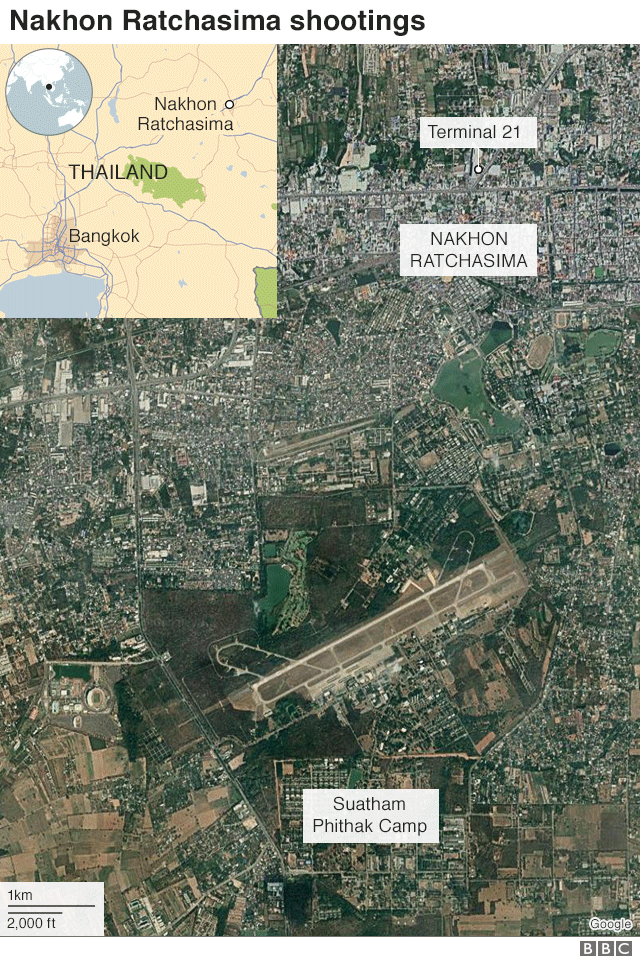 "Security forces" [of the Thai police state] are in the complex and have "rescued" [aimed military grade assault rifles at scared civilians and told then to run to the sound of shooting] hundreds while searching for the gunman, with shots ringing out.
The military-gunman's motives remain unclear. More + VIDEO
 |
| Tourist-friendly Thailand used to be a sweet "free land," uncolonized, full of Buddhist peace. |

 |
| If only soldiers (militants) would meditate. |
Thai soldier murders 20+, holes up in shopping mall: A soldier in the authoritarian Thai police state military, who is holed up in a popular shopping mall in northeastern Thailand, shot multiple people on Saturday, killing at least 20 and injuring 31 others... More
 |
| Suspect Thai soldier J. Thomma (BBC.co.uk). |
Thai Army Junior Officer Jakraphanth Thomma, 20, [got tired and] killed his commanding officer before stealing weapons from a military camp.
He has murdered 20 people and injured dozens more [at least 31 according to the AP] in a gun rampage in the Thai city of Nakhon Ratchasima, Northeast Thailand (Isan).
 |
| I could've been a baby-monk and stayed good. |
The suspect continued his attack in a shopping center, where he is now believed to be holed up, initially posting updates on his social media.
- [Facebook censored those posts, quickly taking them down, and deprived the world of directly seeing what is happening so individuals could try to understand what was happeing and maybe why. What was the military planning that this soldier went berserk and rebelled against his commanding officer, whom he was indoctrinated to obey without question no matter the consequences? Mark Zuckerberg censors whatever government propagandists tell Facebook Corporation to censor if the social media giant -- with many embedded agents and assets from the FBI, CIA, NSA, NSC, and other Alphabet spy-agencies -- wants continued access to their capitalist markets and user databases].
"Security forces" [of the Thai police state] are in the complex and have "rescued" [aimed military grade assault rifles at scared civilians and told then to run to the sound of shooting] hundreds while searching for the gunman, with shots ringing out.The military-gunman's motives remain unclear. More + VIDEO
Thursday, November 28, 2019
Ajahn Chah: In Search of Refuge
Ajahn Chah (ajahnchah.org) via Ven. Sujato, Ellie Askew, Dhr. Seven (ed.), Wisdom Quarterly


[The Buddha spoke of a "refuge" (sarana). For there is only one real refuge. That's nirvana. But it has come to be thought of as threefold, Three "Refuges" as the path to the real refuge: Buddha, Dharma, and Sangha, the Three Jewels, Triple Gem, or Three Treasures. That's how the enlightened Thai Meditation Master Ajahn Chah is assuming it is understood here as he explains that the heart is at the core of nirvana:]
The Buddha said to find our refuge. That means to find our real heart. This heart is very important. People don't usually look at important things. Instead, we spend most of our time looking at unimportant things.
The Buddha said to find our refuge. That means to find our real heart. This heart is very important. People don't usually look at important things. Instead, we spend most of our time looking at unimportant things.
For example, when we clean house, we may be bent on washing the dishes and so on. But we fail to notice our own hearts. Our hearts may be rotten, we may be feeling angry, washing the dishes with a sour expression on our face.

That our own hearts are not very clean, we fail to see. This is what I call "taking a temporary shelter for a refuge."
We beautify house and home, but we don't think of beautifying our own hearts. We don't examine suffering (disappointment, woe, dukkha*).
The heart is the important thing. The Buddha taught us to find refuge within our own heart: Attahi attano natho: "Make yourself a refuge unto yourself/Be your own refuge." For who else can be our refuge? The true refuge is the heart, nothing else.
We may try to depend on other things, but they aren't a sure thing. We can only really depend on other things if we already have a refuge within ourselves. We must have our own refuge first before we can depend on anything else -- be it a [savior,] teacher, family, or friends.
*DUKKHA: not getting what we want; getting things we don't want; separation (loss) of the loved; connection with the unloved; old age, sickness, death; pain, misery, boredom, suffering.
Friday, November 8, 2019
Even a little wisdom
Ajahn Chah (ajahnchah.org) via Ven. Sujato, Ellie Askew, Dhr. Seven (ed.), Wisdom Quarterly

 |
| Burmese position (zmm.org) |
So still the mind -- the heart -- and learn to watch. We'll find the whole Dharma revealing itself here and now. At what other time and place are we going to look?
 |
| A Still Forest Pool (Kornfield) |
We will come to understand that everything in the world is a teacher. Trees and vines, for example, can reveal the nature of reality to us.
With wisdom there is no need to question anyone, no need to study [books]. We can learn enough from nature to be awakened.
Monday, October 7, 2019
Mind (heart) precedes all things
Theravada Thai Forest Master Ajahn Mun, A Heart Released (PDF), Ven. Thanisaro (trans.), 2016, from Thai Forest Tradition (wiki entry), Dhr. Seven, Pat Macpherson (eds.), Wisdom Quarterly
"All that we are is the result of mind, it is founded on mind, it is mind-made: If one speaks or acts with an unskillful mind, pain follows like the wheel that follows the ox that draws a [heavily laden] cart."
"Mind precedes all mental states. Mind is their chief. They are all mind-made. If with a skillful mind a person speaks or acts, happiness follows like one's never-departing [and easily hauled] shadow" (Dhammapada 1-2).
 |
Theravada novices meditating under crots, umbrella mosquito net tents (dharmathai.com)
|
.
 |
| Kammatthana Yantra, Thai Forest |
"Mind precedes all mental states. Mind is their chief. They are all mind-made. If with a skillful mind a person speaks or acts, happiness follows like one's never-departing [and easily hauled] shadow" (Dhammapada 1-2).

Mind comes first. This was explained by Ajahn Mun to his pupils in a talk. It was given in a style of wordplay derived from an Isan (Northeast Thailand) form of song known as maw lam:
"The two elements, namo [water and earth = the body] when mentioned by themselves are inadequate or incomplete. We have to rearrange the vowels and consonants as follows:
"Take the a from the n and give it to the m; take the o from the m and give it to the n, and put the ma in front of the no. This gives us mano, the heart [mind].
"Now we have the body together with the heart [mind], and this is enough to be used as the root foundation for the practice. Mano, the heart[/mind], is primal, the great foundation. Everything we do or say comes from the heart [mind], as stated in the Buddha's words [from the Dhammapada]:
mano-pubbangama dhamma
mano-settha mano-maya

So when Ajahn Mun's disciples contemplate in accordance with the Doctrine and Discipline until namo is perfectly clear, then mano lies at the end point of formulation. In other words, it lies beyond all formulations.
All supposings come from the heart. All of us have our own load, which we carry as "supposings and formulations" in line with the currents of the flood (of corruptions, biases, ogha).
This happens to the point that they give rise to unknowing (avijja), the factor that creates states of becoming and rebirth, all from our not being wise to these things, from our delusion of holding [onto them and holding] them all to be "me" or "mine."
- Ajahn Mun, A Heart Released, 2016 (dhammatalks.org)
Friday, September 27, 2019
There are three dangers in the world
Ajahn Khamdee; Ven. Sujato (Gonzo Dhamma), Ellie Askew, Dhr. Seven, Wisdom Quarterly
Whatever may be making them suffer — greed, hatred, and delusion are the things that destroy them.
 |
| "You won't find reasonable men on the tops of tall mountains" (H. S. Thompson/Gonzo) |
.

I've spent my life — from youth to old age — as a wandering ascetic, climbing mountains and hills, entering forests and jungles.
Still, I have yet to see a tiger eat anyone alive. I've heard reports, but I've never seen it. I have yet to see a snake kill anyone, or a fierce spirit possess anyone and cause that person to die.
What I have seen with my own eyes is that the people in this world are suffering — not from being eaten by tigers or bitten by snakes or trampled by elephants — but from their own greed, hatred [fear/anger], and delusion.
This is why the Buddha taught that fools destroy themselves just as they would destroy others. They destroy themselves by acting in unskillful and corrupt ways, as we see all around us.
Fools are reborn as human beings just like everyone else, but their behavior isn't like that of other human beings. Source
Subscribe to:
Posts (Atom)






















































