Showing posts with label stupas. Show all posts

Wednesday, August 26, 2026

The 'Bones of the Buddha' found (PBS)


  • The Buddha did not have a "tomb" but rather various stupa mound sites that served as repositories of his cremation ashes and relics divided among the major rulers of his day.
Bones of the Buddha (S12, E6) premiered July 23, 2013 (NR) The mystery surrounding the bones [actually the cremation remains and relics or Śarīra] of the Buddha dates back more than 100 years ago, when British colonial estate manager William Peppe set his workers to the task of digging up a mysterious "hill" (actually an ancient, buried stupa) in Northern India. Peppe had no idea what they would find a little more than 20 feet below the surface. They unearthed an astonishing discovery: a huge stone coffer, containing five reliquary jars (urns) and more than 1,000 separate jewels and gold and silver ornaments.

(TSOL) Ritual cremations with stupas for chakravartins or buddhas do not leave piles of bones

Gandharan Buddhist (Greco-Buddhist) art
PBS is dedicating a full evening to the Buddha [in the summer of 2013], anchored by an intriguing new Secrets of the Dead episode called "Bones of the Buddha."

This documentary presents a convincing collection of evidence that suggests an amateur archeologist discovered a portion [1/8th] of the historical Buddha’s sacred relics more than a century ago.

Bones of the Buddha first aired Tuesday, July 23, 2013, 10:00-11:00 pm (ET) on PBS (check local listings).

Preceding Bones of the Buddha is a rebroadcast of The Buddha, acclaimed filmmaker David Grubin’s documentary about a royal [Central Asian] prince who fled the opulence of the palace more than 2,500 years ago.

Journeying on his quest for enlightenment for six years, he witnessed human suffering for the first time and had a great awakening, that eventually led to the establishing of a new religion, Buddhism.

American Buddhist Richard Gere narrates the two-hour film airing Tuesday July 23, 2023, 8:00-10:00 pm (ET) on PBS (check local listings).

The mystery surrounding the bones (cremation remains) of the Buddha dates back more than 100 years ago, when British colonial estate manager William (Willie) Peppe and his workers began digging at a mysterious hill in Northern India.
Burned bone fragments survived cremation?
Peppe had no idea what they would find just a little more than 20 feet below ground.  They unearthed a stupa that contained an astonishing discovery: a huge stone coffer, containing five reliquary jars full of
  • more than 1,000 separate jewels
  • carved semi-precious stones
  • gold and silver treasures
  • ash and bone fragments.
One of the jars bore a Sanskrit inscription which, when translated, stated the jar contained the remains of the historical Buddha himself.

Doubt and rumors of forgery have overshadowed this remarkable find, dividing Buddhist scholars for more than 100 years. Many believe the whole thing could be an elaborate hoax. Others insist the burial mound on Peppe’s estate is one of the final resting places of the leader of one of the world’s great religions, a [Scythian, Indo-Sakan] sage who died attained final-nirvana and passed away nearly 2,600 years ago.

For doubters, suspicion focuses on a key figure from the time, disgraced forgerer German archeologist Dr. Anton Führer.

Renowned historian Charles Allen sets out to solve this extraordinary mystery once and for all.  Is the little-known monument in Northern India really the Buddha’s burial mound enshrining his relics in a coffer tomb? Is this find genuine?  And if it is, who created it and when?

Allen begins his journey in England at the home of Neil Peppe, the grandson of William Peppe. From there he travels 4,000 miles to Birdpore House in India, built by the Peppe family in the 1840s.

Precious artifacts (Bones of the Buddha | PBS)
The mysterious hill known as Piprahwa where the tomb was found sits on the northern edge of the Birdpore estate.

Allen traces Peppe’s steps to authenticate the find, uncovering how the discovery became shrouded in scandal and where the Piprahwa ashes and bones reside today.
Photo of Brahmi script inscription (PBS)
But is the inscription on the jar stating “these are the relics of the Buddha – the Lord [Bhagwan]” genuine?

Allen meets with Prof. Harry Falk at Germany’s oldest institute of Indology, the world’s leading authority on ancient Indian languages, to authenticate the ancient Brahmi script.

Though Falk’s findings may finally clear William Peppe’s name and resolve the mystery surrounding his find, Allen must still unravel who built the mound and buried the remains of the Buddha with a treasure of artifacts 2,600 year ago.
Bones of the Buddha is an Icon Films Production for THIRTEEN in association with WNET, ARTE France, and National Geographic Channels. Executive producer for Icon Films is Harry Marshall. Executive in charge for WNET is Stephen Segaller. Executive producer for WNET is Steve Burns.  Coordinating producer for WNET is Stephanie Carter.

Wednesday, July 16, 2025

Buddhist Pyramids of Thailand: Si Thep

Africa has poster children of prototypical earthling pyramids (and on exoplanets like Mars)

Praveen Mohan fresh from The Cosmic Summit is on the trail of pyramids in deeply Theravada Buddhist Thailand, ancient Siam, in Southeast Asia. There is much to see in this friendly country. Here's a list of world heritage sites in Thailand. Today, we're exploring Si Thep Historical Park. There's already a massive Buddhist temple in Indonesia (Java), declared the largest excavated Buddhist temple in the world, called Borobudur. There's a much larger and older pyramid in Indonesia, one the size of a mountain. Now, science says humans did not build it. And science still can't wrap its head around the possibly more massive pyramids of Bosnia.

(Fringe Field Notes) Bosnian pyramids, cruel hoax or the real thing?

China hides many pyramids. And what country has the most number of pyramids? No, it's not Egypt. It might be Mexico/Mesoamerica when all is said and done, but the current count it is Nubia, modern Sudan.

Thursday, April 17, 2025

What are Buddhist relics, 'stupas'?


Buddhist Stupa: What we know about Buddhist burial mound reliquaries
(Bodhisattva) Everything anyone needs to know about stupas might be found here. Stupas are some of the oldest structures venerated in India [and Central Asia long before that]. Until a thousand years ago the entire region of the Indian subcontinent from Afghanistan (ancient Gandhara) to formerly Buddhist Bangladesh was dotted with thousands of stupas, large and small. Sacred relics (sarira) are placed inside of them.


Now only a few survive that are also in very bad condition. Why were these stupas made in the first place? What is the significance of stupas in Buddhism? What role did they play in the spread of Buddhism? Why is this stupa different from that one and that one and this one? How are they different from each other apart from basic structural differences? Why have abandoned stupas in India been continuously targeted by treasure hunters for centuries? What was placed in stupas that is of such interest to the treasure hunters?

NOTE: The Buddha did not "die," which means rebirth. He ended samsara.


CHAPTERS
  • 0:00 - Intro
  • 1:18 - Origin of stupas
  • 3:55 - Types of stupas
  • 6:18 - Architecture of stupas
  • 11:52 - Rituals, pilgrimage, perambulation
  • 15:46 - Global expansion and evolution of stupas

Let's find out more about stupas and understand their significance so that the world can appreciate and preserve them better. Origin of stupas, different types, architecture, significance, and global expansion and evolution of stupa architecture. This is a comprehensive video on the subject. #Buddha #Stupa #Buddhism
  • Bones of the Buddha; Bodhisattva; Amber Larson, Dhr. Seven (eds.), Wisdom Quarterly

Friday, November 29, 2024

Pyramid secrets revealed: levitation


Levitation device exposed in Egypt?
(Mystery History) Nov. 27, 2024: Narration by Don Moffit (donmoffit.com). Thanks for watching. Contact: Mysteryhistorymail@gmail.com. Join channel to get access to perks: @mysteryhistory. Support the mission via the following avenues: Facebook: mysteryhistorybook, Patreon: mysteryhistory, PayPal: mysteryhistory@ctemplar.com, QR Code: postimg.cc/zLZLQfyx. Gofundme: https://gofund.me/fe6a4a10 Bitcoin: 3CH8tZUFW1dk9gtL6ssDgsshhEfRDuZ4nz Ethereum: 0x00AA1CEa97f3Ca39D8B0366CA7D8c84dFa603967. All contributions, no matter how small, help the channel grow and flourish.

The Pyramid Code (Dr. Carmen Boulter)

The Pyramid Code (complete)
(bestphone lense) The Pyramid Code, a documentary series of five episodes, explores the pyramid fields and ancient temples in Egypt as well as ancient megalithic sites from around the world, looking for clues to matriarchal consciousness, ancient knowledge, and sophisticated technology in a Golden Age.

The series is based on the extensive research done on 23 trips to Egypt and 50 other countries around the world by Dr. Carmen Boulter in the Graduate Division of Educational Research at the University of Calgary.

The Pyramid Code features interviews with prominent scholars and authors in multidisciplinary fields: geology, physics, astrophysics, archeology, biological engineering, magnetic field theory, hieroglyphics, and Egyptology. The series explores penetrating questions:
  • Who were the ancients and what did they know?
  • Could the pyramids be much older than traditional Egyptology would have us believe?
  • Could it be that the ancients were more technologically advanced than we are today?
  • Why do we have so little understanding of the ancient Egyptians?
  • Are there still secrets hidden in plain sight?
  • Do new discoveries force the issue of establishing a new chronology?
  • Are there little-known sites that provide clues to a new understanding of our distant past?
  • Are we really the most advanced civilization to ever live on Earth?
The Egyptian pyramids have fascinated us for thousands of years. Who built them, how were they built, and why? Experts across Egypt are discovering new information that sheds light on the ancient Egyptians' pyramids and how they evolved.

One theory suggest that King Snefru's Bent Pyramid was not a mistake. Recent discoveries show how the pyramids evolved from [an Asian Buddhist stupa-like] mound of rocks and sand to flat, rectangular mastabas, to the pyramid shape, so famously exhibited in the Great pyramid of Khufu and beyond. Now the archeology is being taken a stage further with new technology.

This series shows how the next generation of archeologists is finally piecing together the secret pyramid code that might have been used by the Egyptians. Reviewer: LesLey-A.
  • Narrator Don Moffit, Mystery History, Nov. 27, 2024; Dr. Carmen Boulter, The Pyramid Code via bestphone lense, Jan. 24, 2023; Pat Macpherson, Dhr. Seven (eds.), Wisdom Quarterly

Monday, November 25, 2024

America's 1st pyramid megacity: Cahokia

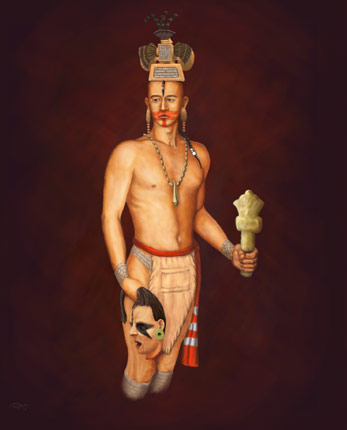
Chromesun, Mississippian priest (digital painting)

What happened to America’s first megacity?
(PBS Terra) Nov. 21, 2024: Overview. In its prime, Cahokia was a prosperous mega-city with a population similar to London’s.

But this sprawling Native American metropolis from the Mississippian culture vanished long before European settler-colonial invaders arrived in North America. What happened?

This Indigenous city’s enigmatic rise and fall has inspired countless theories and has long captivated the imaginations of archeologists.
  • [The pyramids in the U.S. were beheaded (the peaks destroyed) by arriving Catholic priests and soldiers who did not want to face up to what amazing advanced technology the Indigenous non-humans had developed with their amazing architecture and alignments, so they were tortured, killed en masse in a slow genocide that continues to this day along with cultural erasure.]
Now, cutting-edge scientific research offers a glimmer of hope in unraveling the mystery of Cahokia's disappearance.

Hosted by Joe Hanson from Be Smart, Overview uses stunning 4K drone footage to reveal the natural and human-made marvels shaping our planet -- literally from a 10,000-foot view.

Take an augmented reality tour of Cahokia courtesy of SA Creative: sacreative.com. play.google.com/store/apps/de... apps.apple.com/us/app/cahokia...

PBS Member Stations rely on viewers like to support local stations: to.pbs.org/DonateTerra.  Subscribe to PBS Terra so as to never miss an episode bit.ly/3mOfd77 and keep up with PBS Terra on: Facebook: pbsdigitalstudios, Tiktok: pbsterra, Instagram: pbsterra.

Monday, September 9, 2024

Scythian Buddha, post-Yamnaya culture

Who were these blue-eyed people like the Buddha living in Central Asia near Iranian Aryans?
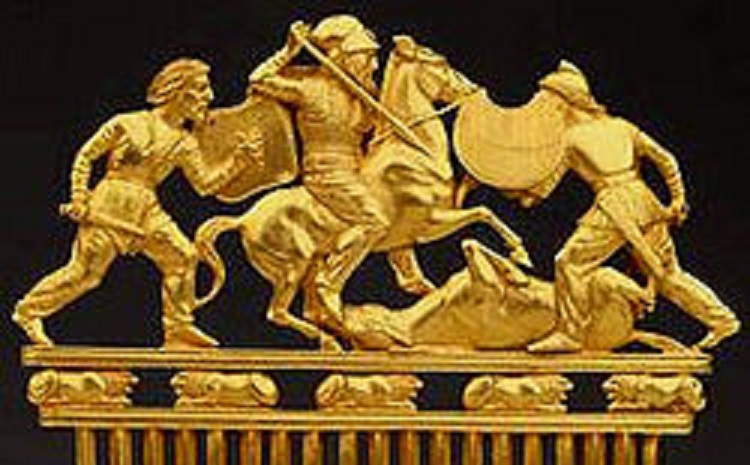
Who were the Scythians who could make gold jewelry like this comb? (Solokha, 4th cent. BC)
Buddhist coin, gold kapana, circulating in Scythia/India
The distinct caps
When the Buddha-to-be, the Bodhisatta, was a boy, he grew up spoiled in a Scythian warrior culture. He had a white pony named Kanthaka. He was married off at 16 to his extraordinarily beautiful 16-year-old cousin, Princess Bimba (known to the world by the moniker Yasodhara). He learned to ride, shoot with bow and arrow, play and compete with other Scythian boys, and was educated in all the arts and sciences of the day by royal tutors, likely Brahmins and other instructors. All of this would be extraordinarily unlikely for a Nepalese or Indian boy, but it was common for a Central Asian, a Gandharan, a proto-Afghan. Similar to the Scythians of Central and North Asia are another culture designated by recent studies by Western scholars of the Yamnaya (named by Russians to refer to their burial pits, tumuli, kurgan, barrow tombs, their "stupas" of sorts).

Scythians (Barry Cuneliffe)
The Buddha was not from India. He was an outsider, a foreigner. First of all, there was no "India" at the time. There may have been a "Great Bharat" (Maha Bharata) at some time in the past, but not until the Buddhist Emperor Ashoka united disparate kingdoms and republics into a united empire two centuries after the life of the Buddha did anything like modern India come to be.

It was perhaps bigger in the past, extending into Pakistan and Afghanistan (until 1947's Partition that divided India between Hindu-majority and Muslim-majority areas (Pakistan, Kashmir, Bangladesh). The Buddha was from ancient Gandhara (in a region that is now Afghanistan), part of what the ancient Greeks called Scythia.

This was the Indo-Scythian land of the Sakas (Shakyas). These formerly nomadic horse-riding warriors (not caste kshatriyas) were very strange compared to the people of Magadha and neighboring kingdoms where Prince Siddhartha Gautama, renouncing his kingdom of Kapilavastu, went in search of spiritual answers, namely, "What do we suffer, and what can be done about it." The Magadhis and people we would today label as Indians spoke poorly of the barbarians in the Northwest frontier. They did things that ran contrary to the post-Indus Valley Civilization peoples guided by Brahmin priests and their Vedas and countless creeds, belief systems, and practices.


Female Scythians, warrior princesses
For one, they (Scythians in general throughout Central Asia, not South Asia and Indo-Scythians from around ancient Gandhara by Taxila, Pakistan, and modern Sakastan/Afghanistan/Sistan Baluchistan):
  • did not adhere to the Vedic/Brahminical caste system
  • did not revere Brahmins as but ruled by kings and warriors
  • did not subjugate women, who were fellow warriors
  • did not keep sexual standards as the east did, marrying among cousins [like British and other royals]
  • and so on as befits an exceedingly "proud," nomadic, horseback extended family clans in there mahajanapada or "country" (foothold of the clan).
What was the Buddha's country?
The Shakyan Clan was one of these Aryan peoples, living in what is now the Stans, the steppe of Central Asia all the way up to Ukraine and down to Persia/Iran, or land of Iranians/Ariyans.

Dr. Ranajit Pal, Ph.D.
This is not the story we are told, but it is very well explained by maverick Indian historian Dr. Ranajit Pal, Ph.D. and aligns with the facts we have from the texts about how the Buddha was regarded, particularly by the founder of Hindu-ism (Indus-ism) as a systematic religion under the Brahmins and extending their lineage back thousands of years to the ancient Vedas [much like Jews due to push themselves back as a group into Sumerian times and the precursors of the Bible stories].

The video above shows how these family clans, these Scythian-like people venturing to the steppe, like Genghis Khan and his Mongol hordes on the eastern end of Asia in and around Mongolia.

Territory of the Indo-Scythians in and around Gandhara and expanding into South Asia

Super Afghan stupa carved out of stone
  • One of the most distinguishing aspects of the Buddha and Buddhism and what he perceived to be his (Solar Race, Aryan) lineage and their traditions is the stupa or burial mounds. These barrows, tumuli, kurgans, burial mounds have an ancient history. The Buddha continued it. One Ukrainian scholar even saw fit to declare that the Buddha was from Ukraine nearer to North Asia than Central Asia, and while this may sound ludicrous and self-aggrandizing, there are indications that he was more a part of that ancient Scythian, for lack of a better more comprehensive designation, tradition than anything "Indian." But the Indo-Scythians abutted the kingdoms that later became India, and it is said that the Buddha's clan, the Sakas or Shakyas (Shakyian/Scythians) invaded and took over and occupied Bihar (now a state in India so named because of the large number of Buddhist vihars or abbeys built throughout the land), where their leader had his great enlightenment in Bodh Gaya.
  • Archaeologists challenge theory of violent Steppe invasion in Europe's Iberian Peninsula
  • Archaeologists stumble upon priceless gold-coins in unusual location: Bulgaria
  • 11 most expensive ancient coins ever discovered
The Yamnaya
Wiki edit by Wisdom Quarterly
Devoted Scythian couples with the Buddha (center), Scytho-Parthian, Kushan (wiki)
.
The Yamnaya culture [a] or the Yamna culture [b], also known as the Pit Grave Culture or Ochre Grave Culture, is a late Copper Age to early Bronze Age archeological culture of the region between the Southern Bug, Dniester, and Ural rivers (the Pontic–Caspian steppe), dating to 3300–2600 BCE [2].

It was discovered by Vasily Gorodtsov following his archeological excavations near the Donets River in 1901–1903. Its name derives from its characteristic burial tradition: Я́мная (Romanization Yamnaya) is a Russian adjective that means "related to pits (yama)," as these people used to bury their dead in tumuli (kurgans) containing simple pit chambers.

Research in recent years has found that Mikhaylovka, in lower Dnieper river, Ukraine, formed the Core Yamnaya culture (c. 3600–3400 BCE) [3]. The Yamnaya economy was based upon animal husbandry, fishing, and foraging, and the manufacture of ceramics, tools, and weapons [4].

Exotic nomadic Eurasians with wagons
The people of the Yamnaya culture lived primarily as nomads, with a chiefdom system and wheeled carts and wagons that allowed them to manage large herds [5].

They are also closely connected to Final Neolithic cultures, which later spread throughout Europe and Central Asia, especially the Corded Ware people and the Bell Beaker culture [5], as well as the peoples of the Sintashta, Andronovo, and Srubnaya cultures.

Back migration from Corded Ware also contributed to Sintashta and Andronovo [6]. In these groups, several aspects of the Yamnaya culture are present [c].

Yamnaya material culture was very similar to the Afanasevo culture of South Siberia, and the populations of the two cultures are genetically indistinguishable [1]. This suggests that the Afanasevo culture may have originated from the migration of Yamnaya groups to the Altai region or, alternatively, that both cultures developed from an earlier shared cultural source [7].

Genetic studies have suggested that the people of the Yamnaya culture can be modelled as a genetic admixture between a population related to Eastern European Hunter-Gatherers (EHG) [d] and people related to hunter-gatherers from the Caucasus (CHG) in roughly equal proportions [8], an ancestral component which is often named "Steppe ancestry," with additional admixture from Anatolian, Levantine, or Early European farmers [9, 10].

Genetic studies also indicate that populations associated with the Corded Ware, Bell Beaker, Sintashta, and Andronovo cultures derived large parts of their ancestry from the Yamnaya or a closely related population [1, 11, 12, 13].

According to the widely-accepted Kurgan hypothesis of Marija Gimbutas, the people that produced the Yamnaya culture spoke a stage of the Proto Indo-European language, which later spread eastwards and westwards as part of the Indo-European migrations. More: Yamnaya culture
  • Dhr. Seven, Amber Larson, Pat Macpherson (eds.), Wisdom Quarterly Wiki edit

Wednesday, August 14, 2024

The Buddha's Bones: burial mound stupas

Look what I found, Coolies! - Yes, Sahib, you are a genius to dig up sacred religious monuments.

Bones of the Buddha
What are Buddhist cremation "relics"?
(PBS Documentary) The mystery surrounding the bones of the [historical] Buddha dates back more than 100 years ago. When colonial estate manager Willie Peppe set his workers digging at a mysterious "hill" (Piprahwa Stupa) in Northern India in 1898, he had no idea what they would find. Just over 20 feet down, they made an amazing discovery: a huge stone coffer [like the amazing Bimaran casket's steatite container], containing five reliquary jars [with rare spiritual relics known as Śarīras], more than 1,000 separate jewels, and some ash and bone.
The Buddha in gold (British Museum)
One of the jars bore an inscription that appeared to say that these were the remains of the Buddha himself. This seemed to be the most extraordinary find in Indian archeology. But doubt and scandal have hung over this amazing find for more than 100 years. For some, the whole thing has to be an elaborate hoax [employing countless artisans to recreate ancient treasures, fraudulent archeologists, fake workers, and corrupt Indian and British politicians]. For others, it is no less than [one of] the [eight or so] final resting place[s] of the leader of one of the world's great religions, a sage who passed into final nirvana 2,600 years ago. For the doubters, suspicion focuses on a key figure from the time, disgraced German archeologist Dr. A. Anton Fuhrer. Renowned historian Charles Allen sets out to solve this extraordinary mystery [for PBS] once and for all. #BuddhaBones #BuddhaAshes #BuddhaRelic #Buddhism
Ancient shrine that may hold the Buddha's skull bone found in crypt (Live Science)

Bhutan (Peterwescarey/flickr.com)
The history of buddhas on earth (Bhumi) and on the human plane (manussya loka) in general is very strange and prehistoric. We have the historical Buddha as our source of information about prehistoric buddhas (seven recent among 28 named in this incredibly long cycle or recent cycles, kalpas, of time). The Buddha in prescribing burial practices of noble ones (Aryans, arhats) detailed an ancient Central and North Asian custom of dolmens, tumuli, kurgans, barrows, long barrows, chortens, burial mounds or what are known in Buddhism today as stupas. The Buddha, after passing into final nirvana, planned for his mortal remains to be divided among great rulers of that time. He chose a very rural and out-of-the-way place at which to pass. His attendant Ananda was shocked that he would leave the world in such a spot, until the Buddha revealed to him that in the distant past, this spot (Kushinagar near modern Gorakhpur, India) was once the center of a prosperous kingdom in super-ancient times. Moreover, it was between the current kingdoms of great kings.

North Asian style stupa burial mound topped by statue of buried person? (Abdul Mohammadi)
.
How many millions of years old could they be?
If he had passed away within any of these, that king would have enshrined the precious relics in one great dolmen in stupa. Instead, many got the chance to do so by partitioning them, with one going to the celestial devas (in "heaven") and another going to the partitioner, who saw to their care. These were not the first stupas as many might think. It was an ancient custom all the way to Ukraine. Modern Tibetan Buddhists know this and visit secret ancient sites of other buddhas and arhats in Central and North Asia, rumor has it. Sadly, archeologists argue and do not recognize all discoveries of treasure within them unless they accord with preconceived notions of where they should be located. So the ones in Afghanistan and outside modern India get shorter shrift. This is most shockingly true as exposed in the movie Bones of the Buddha, where a stupa or dolmen ("portal tomb") was opened, its treasures looted and taken to England, and rather than being clawed back by the Indian government or Buddhists was allowed to be passed on from the British excavator (looter) to his son, who keep this priceless Buddhist treasures in his little cottage in England, much of it under his bed. Ancient Scythians and other tribes all over Central and North Asia built these funerary sites, reliquaries, mounds to enshrine significant individuals. Originally, they were topped with statuary figures rather than the pagodas that came to be in South, East, and Southeast Asia.

Giant prehistoric dolmens in the Caucasus built with advanced technology
Stupas everywhere in the land of Pagan (Bagan), Burma (Myanmar).
.
Gold container of the Buddha's relics
(Universe Inside You) Aug. 14, 2024: Join us in fueling our mission to create insightful videos backed by thorough research by supporting us on Patreon or PayPal: universeinsideyou (paypal.com/donate...). All support can help UIY dive even deeper into topics that matter, enabling them to produce engaging content that informs and inspires. By contributing, one is not just backing a project, one is empowering a wealth of knowledge to be shared. Stand with UIY as they strive to bring meaningful videos to life. Every contribution counts. Discover a world of creativity at this art and merchandise shop: teespring.com/stores/universe... Join on: Instagram: universe.inside.you Facebook: universalloving. For Spanish-narrated videos, visit UIY's Spanish channel: universe inside you español #universeinsideyou

Tuesday, July 23, 2024

The Buddha was a Scythian warrior (doc)

As WQ has covered, based on Dr. Pal's realization, Shakyamuni was a Scythian/Saka.

What kind of Scythia was the Buddha? Gandharan, Indo-Scythian, a Saka from Indo-Sakastan

Siddhartha Gautama the Buddha was from Gandhara/Afghanistan
Scythian females were warrior princesses, the basis of the Greeks' Amazonian legends

The frozen sarcophagus of a Scythian warrior discovered in Mongol Steppes | SLICE | full documentary
The Scythians (Shakyians) were fierce and proud
(SLICE) June 28, 2024: In the icy steppes of the Mongolian Altai, an archaeological expedition explores the 2,500+year-old tomb of an Eastern Scythian warrior.

The ancient Scythian practice of deep burial of the dead, combined with extreme climatic conditions, could uncover the last frozen tombs on the planet and shed light on this little-known branch of Scythian civilization.


Dr. Pal made the connections
But time is running out. Global warming is threatening the remains of these [Central Asian and] European pioneers who conquered the Asian side of the Altai.

The tombs are full of surprises. Attracted by the unusual hustle and bustle, Kazakh nomads set up their summer camp near the excavations. These people are among the last to be cut off from the modern world.

The Scythians (Barry Cunliffe)
Archaeology collaborates with ethnology to reveal disturbing similarities between these two peoples separated by 2,000 years.

Documentary: Le Sarcophage Glacé de Mongolie. Directed by Cédric Robion. Production: AGAT Films & Cie.

SLICE fully owns the rights to the use of the published content. Any illegal reproduction of this content will result in immediate legal action. SLICE wants to fill up viewers' curiosity! Accessible to anyone from anywhere at any time, this channel is a weekly dose of short docs about curious facts, discoveries, astounding info, unusual stories, weird, fun, and instructive. Be smart, have a slice!

Were there red head giants among them?
Subscribe now ► @slicedocumentary. Become a fan: @slicedocumentary. Follow 👇 in French: slicefr, Facebook: slicedocs. Instagram: slicedocs. #documentary #slice #fulldocumentary #freedocumentary #mongolia #mongol #steppes #scythian #warrior #archeology #nomad #amazing #tomb

Tattoos reveal hidden wonders of 2,300-year-old Scythian grave in Mongolia | Secrets in the Ice

Read Dr. Ranajit Pal, Ph.D.
(Science Channel) Join us on a remarkable journey as we delve deep into the ancient mysteries surrounding a 2300-year-old Scythian [pronounced \sih-thee-en\] grave in Mongolia. Prepare to be amazed as we unveil the hidden wonders hidden within the icy confines of this archeological marvel discovered in the heart of Mongolia's vast wilderness. Unearthed with care and expertise, this Scythian grave (kurgan, tumulus, Buddhist stupa) holds invaluable secrets waiting to be revealed.

ABOUT: Explore the most remote, cold, and inhospitable places on the planet and discover great mysteries that were once frozen in time on Secrets in the Ice. #sciencechannel #secretsintheice. Stream Secrets in the Ice: discoveryplus.com/show/se...
  • Dhr. Seven and Amber Larson (eds.), Wisdom Quarterly; SLICE, 6/28/24; Science Channel, 7/14/23; Dr. Ranajit Pal, Ph.D. (Non-Jonesian Indology and Alexander