Showing posts with label burial mound. Show all posts
Showing posts with label burial mound. Show all posts
Wednesday, March 4, 2026


Thursday, September 4, 2025
Priceless relics of the Buddha found

 |
| Dr. Ranajit Pal, Ph.D. |
- Ranajit Pal's Non-Jonesian Indology and Alexander makes sense of the ancient history of proto-India and India and sheds light on the real motives of Alexander the Great in his Gedrosian expedition.
What treasure was in the stupa?
(Doug's Dhamma) William Claxton Peppe excavates on his land in India
Bones of the Buddha: full documentary puts this monumental find in context
- Charles Allen; Bones of the Buddha (documentary); Dhr. Seven, Amber Larson (eds.), Wisdom Quarterly
Monday, August 4, 2025
Aztec's Tenochtitlan (Mexico) turns 700
 |
| They Had Names |
- Where is Tenochtitlan (Mexico City)?
- Historic center of Mexico City
- Discover the 3 Pillars of Aztec Genius in Tenochtitlán
Discover the three pillars of Aztec genius in Tenochtitlán
 |
| Internal empires flourished before Spain entered |

 |
| Matrilineal Native tribes? |
Discover the three pillars of their genius:
- Chinampas: The artificial islands that created land out of thin air and fueled an empire.
- Aqueducts: The sophisticated double-pipe system that brought pure water to the city.
- Dikes: The colossal barriers that tamed flooding and controlled the lake's chemistry.
Genocide of Native Americans in North America continues
New genetic research reveals SHOCKING truth about the Aztecs

- Technical justification: answersresearchjournal.org See also footnotes in the following: answersingenesis.org/genetics...
- Dr. Nathaniel Jeanson; LatinoAméricaAyer, July 29, 2025; Aztec advances (video); Crystal Quintero, Pfc. Sandoval, Dhr. Seven (eds.), Wisdom Quarterly
Wednesday, July 30, 2025
Tuesday, July 8, 2025
Mexico's Sphinx, hieroglyphs, pyramids
 |
| Sphinx and pyramid, artist's rendition of what might have been | myloview.com |
 |
| What does Great Sphinx of Giza represent? Uncovering Secrets of the Sphinx |
- This just in! Another ancient "Sphinx" found closer to the Buddha's mother's ancient home in Aryan Land, aka Persia/Iran (Sistan and Baluchestan, according to Indian historian Dr. Ranajit Pal in his dreadfully titled book Non-Jonesian Indology and Alexander): Why the Balochistan Sphinx still baffles experts in the USA
 |
| The ancient Egyptians preferred the androsphinx |
 |
| The Sphinx before and after excavation (with touch ups and refinements), circa 1926 |
MEXICO CITY, Sept. 4. -- Mexican Boy Scouts exploring the wildest parts of the State of Guerrero discovered ruins which experts believe will lead to unearthing another buried city in this republic.
The members of the expedition, which was working under the patronage of the Minister of Education, found themselves a few days ago on one of the highest mountain ranges in Guerrero.
Nearby were numerous mounds, varying in size. Digging into one of the largest mounds, the Boy Scouts found an enormous stone head like that of the Egyptian sphinx.
- AP reported in 1930 that Boy Scouts discovered "a large stone sphinx bearing a marked resemblance to that in Egypt" in Guerrero, Mexico: Link to archived newspaper and related claim of finding ancient ruins 30 feet beneath the ground (allegedly making it 50,000-years-old) in the same region in comments. : r/HighStrangeness (Is this Tehuacalco, Guerrero?)
- 1926: THE [Egyptian] SPHINX EMERGES FROM THE SANDS OF TIME; Some of Its Secrets Revealed After Six Months of Excavation -- Mammoth Lion, Hewn Out of Solid Rock, Comes to Light (The New York Times)
- The Sphinx: older than Egypt? Unraveling Giza's great mystery

The eyes of the image are deep cavities. Nearby was unearthed a huge round stone covered with hieroglyphics.
 |
| Nubia (modern Sudan) has more pyramids. |
The many small mounds in the district under exploration are believed by government experts to be the summits of a series of pyramids.
The stone head which was uncovered is thought to have been that of some God [ruling deity], carved by the Indians [Indigenous people] in ancient times and surrounded by pyramids.
The Mexicans built giant pyramids on temples?
 The head of the image is about 10 feet long and proportionately wide.
Alfonso Caso, a lawyer; Luis Fabela an architect, and Señor Escobar, a guide, will leave here in a few days to survey the district and begin excavation work on a limited scale.
Sphinx, ancient discs, and bracelets: Enigmatic finds in Mexico
 |
| Egypt: The Great Sphinx of Giza in 1858, mostly buried and preserved by sand. |

To support channel, please donate here: via Paypal address: rurcla@hotmail.com or via Patreon: patreon.com/user?u=6849546
The New York Times Archives: See the article in its original context from September 5, 1930, Page 8. Buy Reprints. New York Times subscribers* enjoy full access to TimesMachine — view over 150 years of New York Times journalism, as it originally appeared. Subscribe. *Does not include Crossword-only or Cooking-only subscribers.
About the Archive: This is a digitized version of an article from The Times’s print archive, before the start of online publication in 1996. To preserve these articles as they originally appeared, The Times does not alter, edit or update them. Occasionally the digitization process introduces transcription errors or other problems; we are continuing to work to improve these archived versions.
- Oldest Runestone In American History With Cryptic Message Discovered In Forest
- Downed Drone Indicates A New Country Is Stealth-Arming Russia – timelesstaleshq.com
- Archaeologists Reveal Vault That Proves Early Civilizations Were Highly Evolved
- Strange Encounters in the Old West: UFOs Before Modern Times | Watch
- 44 Quotes Said By Or Attributed To Nikola Tesla’s Thinking That Are Today’s Realities
- Archeologists Confirm World’s Oldest Pyramid Not Made By Humans
- Juacobartolo, June 2025: Sphinx and Egyptian pyramids in #Mexico #didyouknow #travel #tourism #magicalmexico #pyramids; New York Times Archives, Sept. 5, 1930; Paul Stonehill; Crystal Q., Pat Macpherson, Dhr. Seven, Pfc. Sandoval (eds.), Wisdom Quarterly
Thursday, June 12, 2025
Southern California 20K years ago: Ice Age

The Ice Age secrets hiding beneath California
 |
| Native Californians and their kizh houses |

 |
| The paleobiota of the LA Tar Pits |
- FREE San Diego "Top Must-See Spots" 👉 Voyager-eBooks
In this video
🔹 What San Diego, Los Angeles, and the Channel Islands such as Catalina looked like 20,000 years ago
🔹 The giants that once roamed the coast: mammoths, dire wolves, and saber-toothed cats
🔹 Human footprints on ancient shores — early seafarers, hunters, and toolmakers
🔹 How fossils found during construction projects and cliffside erosion are rewriting history
🔹 Why understanding the deep past matters in today’s changing world
Timecodes
- 0:00 Hidden beneath California
- 1:32 What California looked like 20,000 years ago
- 5:15 Giants of the Ice Age: mammoths, saber-tooth tigers, and more
- 9:15 Clues in unexpected places
- 12:24 Pioneers of the Ice Age: California’s first people
- 16:05 When the giants disappeared
- 19:36 Traces in today’s world
- 21:11 Outro and what comes next
 |
| Land of the Tongva became modern Los Angeles |
YouTube: @voyagerhq • Instagram: voyagerclips • TikTok: voyagerhq • Website: voyagertraveltips.com. QUESTIONS: Have a question about Southern California or video topic requests? Drop it in the comments. #IceAgeCalifornia #PrehistoricCalifornia #CaliforniaHistory #AncientCalifornia #HiddenHistory.
20,000 years later in Trump's America
- Armando, Voyager, June 7, 2025; Xochitl, Ashley Wells (eds.), Wisdom Quarterly
Thursday, April 17, 2025
What are Buddhist relics, 'stupas'?
Buddhist Stupa: What we know about Buddhist burial mound reliquaries

Now only a few survive that are also in very bad condition. Why were these stupas made in the first place? What is the significance of stupas in Buddhism? What role did they play in the spread of Buddhism? Why is this stupa different from that one and that one and this one? How are they different from each other apart from basic structural differences? Why have abandoned stupas in India been continuously targeted by treasure hunters for centuries? What was placed in stupas that is of such interest to the treasure hunters?
NOTE: The Buddha did not "die," which means rebirth. He ended samsara.
CHAPTERS
- 0:00 - Intro
- 1:18 - Origin of stupas
- 3:55 - Types of stupas
- 6:18 - Architecture of stupas
- 11:52 - Rituals, pilgrimage, perambulation
- 15:46 - Global expansion and evolution of stupas
Let's find out more about stupas and understand their significance so that the world can appreciate and preserve them better. Origin of stupas, different types, architecture, significance, and global expansion and evolution of stupa architecture. This is a comprehensive video on the subject.
#Buddha #Stupa #Buddhism
- Bones of the Buddha; Bodhisattva; Amber Larson, Dhr. Seven (eds.), Wisdom Quarterly
Saturday, November 30, 2024
Inside: Pyramid chemical factory?
The Red Pyramid makes no sense | Exploring three interior chambers | Megalithomania

In this video Hugh Newman explores the three known inner chambers, questioning what it may have been used for -- an industrial chemical factory, producing ammonia for fertilizer to make the land fertile and productive for a large population? He is joined by Andrew Collins and Yousef Awyan and interviews Geoffrey Drumm of @thelandofchem, who explains his theory on how it could have been used to produce ammonia.
The remarkable corbel-vaulted ceilings and intricate stonework suggest this was built by master masons. The unusual third chamber is higher than the other two and originally had no clear access, with rough-hewn cyclopean blocks revealed beneath the floor, which John Anthony West suggested could have once been exposed to the elements due to the weathering on them. (This pyramid, like the others, was built on a far older mound).
The team also look at the mortuary temple and the remains of the pyramidion that was once on top of the structure.
Videos mentions:
The Land of Chem - Red Pyramid Function: • Episode Four: The Function of the Re...
Ancient Architects - Red Pyramid Secret Chamber: • NEW DISCOVERY: The Secret Chamber of ...
The Bent Pyramid Interior: • Megalithic Egypt | Exploring Inside t...
Join us on Patreon: megalithomania
Megalithomania T-Shirts & Merch: http://teespring.com/stores/megalitho...
Explore the world with Megalithomania Tours:
megalithomania.co.uk/tours...
Subscribe here: / megalithomaniauk
http://www.megalithomania.co.uk
Copyright Megalithomania MMXXIV. All Rights Reserved.
Monday, November 25, 2024
Natives who settled the Americas (PBS)
The ancient tribes that settled the Americas | First Peoples | Full Episode 1 | PBS

- Originally aired in 2015: Watch more of this series with PBS Passport: to.pbs.org/3BJNXmd
ABOUT: First Peoples. See how the mixing of prehistoric human genes led the way for our species to survive and thrive around the globe or across the plane. Archaeology, genetics, and anthropology cast new light on 200,000 years of history, detailing how early humans became dominant.
America's 1st pyramid megacity: Cahokia
 |
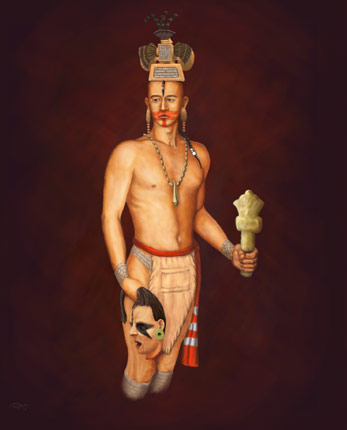
| Chromesun, Mississippian priest (digital painting) |
What happened to America’s first megacity?

But this sprawling Native American metropolis from the Mississippian culture vanished long before European settler-colonial invaders arrived in North America. What happened?
This Indigenous city’s enigmatic rise and fall has inspired countless theories and has long captivated the imaginations of archeologists.
- [The pyramids in the U.S. were beheaded (the peaks destroyed) by arriving Catholic priests and soldiers who did not want to face up to what amazing advanced technology the Indigenous non-humans had developed with their amazing architecture and alignments, so they were tortured, killed en masse in a slow genocide that continues to this day along with cultural erasure.]
Now, cutting-edge scientific research offers a glimmer of hope in unraveling the mystery of Cahokia's disappearance.
Hosted by Joe Hanson from Be Smart, Overview uses stunning 4K drone footage to reveal the natural and human-made marvels shaping our planet -- literally from a 10,000-foot view.
Take an augmented reality tour of Cahokia courtesy of SA Creative:
sacreative.com. play.google.com/store/apps/de...
apps.apple.com/us/app/cahokia...
PBS Member Stations rely on viewers like to support local stations: to.pbs.org/DonateTerra. Subscribe to PBS Terra so as to never miss an episode bit.ly/3mOfd77
and keep up with PBS Terra on:
Facebook: pbsdigitalstudios, Tiktok: pbsterra,
Instagram: pbsterra.
- Take the PBS Digital Studios annual survey: to.pbs.org/2024SurveyOverview
Sunday, November 24, 2024
Skulls found at Sefer Tepe (Gobekli)
 |
| What do the Sefer Tepe skulls look like, space alien, earthling human, or hybrid? |
Sefer Tepe skulls found? 2024 excavation update and new pictures

Sources
- researchgate.net/publicat...
- researchgate.net/figure/T...
- tastepeler.org/en/yerlesmeler...
- dainst.blog/the-tepe-tele...
- megalithic.co.uk/article....
Thursday, October 24, 2024
Kazakhstan: Tomb of Scythian Prince
Kazakhstan: The Tomb of the Scythian Prince

- The Buddha was born a Scythian (Shakyian, Saka) prince in the Indo-Scythian region of Sakastan (Gandhara, modern Afghanistan). See the work of maverick Indian historian Dr. Ranajit Pal, particularly his breakthrough work Alexander. In Proto-India (Magadha and other kingdoms), the Buddha was considered a "foreigner" because he was a Saka (Scythian, Shakya, Sakai) and treated as such, particularly much later by Sri Shankara who created a systematic "Hinduism" (Indus-ism) out of the ancient indigenously Indian Vedic (Indus Valley Civilization "knowledge books") and Brahminical (Brahmanism) traditions of the Brahmin priests.
These mysterious people, intrepid horsemen and women, have left a real desire for archeological discovery. From the 1st millennium BC onwards, the Scythians constituted a moving and formidable empire established in the vast Eurasian steppes.
The only traces they left us of their existence and significance are their graves: the kurgans (barrows, tumuli, cairns, tells, stupas like the unimaginable Takht-e Rostam, Afghanistan).
In April 1999, a Franco-Italian and Kazakh scientific team announced the exceptional discovery in Kazakhstan of a 2,400-year-old Scythian tomb.
A true archeological treasure, the contents of the tomb reveal, among other things, 12 horses entirely harnessed in gold, whose precious adornment testifies to the social rank of the deceased, whom they accompany to their final resting place.
All the objects discovered are unique and shed new light on the life of the mysterious people of intrepid horsewomen and men. More
AWARDS: Youth Jury Prize, Researchers' Film Festival 2001, Nancy (France) Special Jury Mention, Filmobidos Festival, Obidos, Portugal - May 2001 Best Archaeological Film Award, Human Adventure Festival 2001, Castellana Grotte (Italy) Grand Jury Award, Nyon Archaeological Film Festival 2001 (Switzerland) Audience Award, Nyon Festival, Switzerland - March 2001 Bronze Medal, New York Film Festival 2001, (USA) Scientific Adventure Grand Prize, Scoop Festival 2000, Angers (France)
- imineo Documentaries, YouTube, Sept. 27, 2024; Amber Larson and Dhr. Seven (eds.), Wisdom Quarterly
Tuesday, October 8, 2024
Ancient pyramid mound builders in USA


Independent researcher Fritz Zimmerman (moundbuilder.blogspot.com) has spent 12 years in the field investigating 700 mound and earthwork sites in the Ohio Valley, USA.
He appeared on Coast to Coast on Oct. 7, 2024, to discuss his findings with dullard host G. Noory. Zimmerman shares his research into burial mounds (akin to Buddhist stupas) and archeological sites, which he says are home to Shadow People, cryptids, ancient dwarf races (wee people), giants, UFOs, and more.
Elaborating on the mounds' historical context, Zimmerman reveals that they date back as early as 800 BC, making them some of the oldest in the nation.
According to Zimmerman, some of the mounds and earthworks are associated with ancient giants, the people known as the Amorites who controlled Babylon from 2000 BC to 1600 BC.
"One of their calling cards," he says, "was advanced mathematics...they knew pi and the square roots of numbers" and discovered the Pythagorean theorem of triangles 1,000 years before ancient Greek Pythagoras.
- What about the massive prehistoric American city of Cahokia? The Cahokia Mounds is the site of a pre-Columbian Native American city that existed circa 1050–1350 CE [3] directly across the Mississippi River from present-day St. Louis. The state archaeology park lies in southwestern Illinois between East St. Louis and Collinsville [4]. The park covers 2,200 acres (890 ha), or about 3.5 square miles (9 km2), and contains about 80 human made mounds, but the ancient City of Cahokia was much larger. At its apex around 1100 CE, the city covered about 6 square miles (16 km2), included about 120 earthworks in a wide range of sizes, shapes, and functions, and had a population of between 15,000 and 20,000 people. More
Zimmerman suggests that the Amorites were called the Nephilim in the Bible and that they initially came to America to mine copper. He theorizes that these giants eventually intermingled with Native human tribes like the Dakota Sioux, leading to their eventual disappearance.

At the top of Fort Hill in southern Ohio, at a four-foot stone wall "that undulates like a great serpent," Zimmerman once saw a large black mass that was humanoid in shape, which initially seemed about 8 feet tall but then grew in height as it moved toward the trees.
Other witnesses at the site also reported seeing the shadow figure, he reports. One reason such entities would be at the site is that "the mounds were a portal that connected the living with the dead," he notes.
A man who lives near a burial mound told Zimmerman that his car was surrounded by strange cryptids that looked like giant hamsters -- about 30 of them that seemed menacing.
The infamous cryptid creature known as Mothman that multiple witnesses saw in West Virginia in the 1960s may actually be the ancient winged Babylonian demon called Pazuzu, Zimmerman adds. AUDIO: coasttocoastam.com/show/2024-10-07-show
Subscribe to:
Posts (Atom)