Showing posts with label mexican pyramid. Show all posts

Saturday, March 1, 2025

World's largest pyramid in Guatemala?


El Mirador ("The Viewpoint or Lookout") is the biggest pyramid in the world, according to Mel Gibson who heard it from archeologist Richard Hansen. Yet, we are told Mexico's Cholula Pyramid is the world's largest -- larger than the famous ones on the Giza Plateau in Egypt, or the many in Sudan (formerly Nubia along the Nile River) known as the Nubian pyramids, or the 200 or more in China, or all the ones we're not told about in Alaska, Antarctica, Mars, the Moon, and all over the planet, like the new one recently discovered in Peru at Caral Supe. Of course, larger ones may exist in Bosnia or Indonesia (Gunung Padang), one being mirrored by the world's largest excavated Buddhist temple in the world, Borobudur in Java, which is likely smaller than the colossal Mes Aynak in formerly Buddhist Afghanistan with stupas but no pyramids yet, even though one pyramidal stupa was recently discovered in Central Asia. Interestingly, according to American Rick Fields in A Narrative History of Buddhism in America, the country next to Mexico called Guatemala is named after Gautama the Buddha. Buddhist missionaries reached the Americas before Columbus and Christianity, as demonstrated in American Edward P. Vining's 1895 classic An Inglorious Columbus, which makes the connection to Afghanistan and Afghan Buddhist missionaries along with Chinese pilgrim Hwui Shen. That the country should be so advanced -- like the stone temples all through the jungles of Buddhist Cambodia (Angkor Wat, Siem Reap, etc.) -- is not entirely without explanation.
  • Joe Rogan, Mel Gibson; Richard Hansen; Dhr. Seven, Pat Macpherson, Pfc. Sandoval. Xochitl (eds.), Wisdom Quarterly

Monday, November 25, 2024

America's 1st pyramid megacity: Cahokia

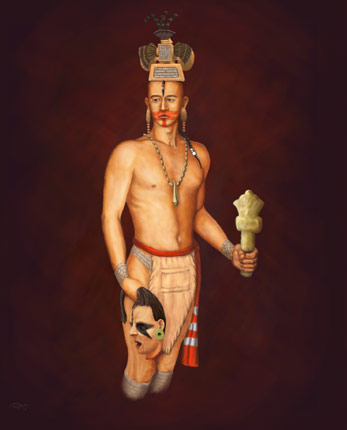
Chromesun, Mississippian priest (digital painting)

What happened to America’s first megacity?
(PBS Terra) Nov. 21, 2024: Overview. In its prime, Cahokia was a prosperous mega-city with a population similar to London’s.

But this sprawling Native American metropolis from the Mississippian culture vanished long before European settler-colonial invaders arrived in North America. What happened?

This Indigenous city’s enigmatic rise and fall has inspired countless theories and has long captivated the imaginations of archeologists.
  • [The pyramids in the U.S. were beheaded (the peaks destroyed) by arriving Catholic priests and soldiers who did not want to face up to what amazing advanced technology the Indigenous non-humans had developed with their amazing architecture and alignments, so they were tortured, killed en masse in a slow genocide that continues to this day along with cultural erasure.]
Now, cutting-edge scientific research offers a glimmer of hope in unraveling the mystery of Cahokia's disappearance.

Hosted by Joe Hanson from Be Smart, Overview uses stunning 4K drone footage to reveal the natural and human-made marvels shaping our planet -- literally from a 10,000-foot view.

Take an augmented reality tour of Cahokia courtesy of SA Creative: sacreative.com. play.google.com/store/apps/de... apps.apple.com/us/app/cahokia...

PBS Member Stations rely on viewers like to support local stations: to.pbs.org/DonateTerra.  Subscribe to PBS Terra so as to never miss an episode bit.ly/3mOfd77 and keep up with PBS Terra on: Facebook: pbsdigitalstudios, Tiktok: pbsterra, Instagram: pbsterra.

Tuesday, October 29, 2024

American discovers Mayan city in Mexico


(ABC News Australia) A doctoral student has unexpectedly uncovered a lost Mayan city hidden under the jungle canopy in Mexico, examining data from advanced laser light scanning system called LiDAR. Tulane University’s Luke Auld-Thomas says his team found over 6,000 [the BBC and others report 7,000] buildings and structures that resemble pyramids, palaces, reservoirs, sports fields, and causeways in the abandoned metropolis US researchers have dubbed "Valeriana."

Ancient Mayan city discovered in Mexico jungle by accident | BBC News

(BBC News) Oct. 29, 2024: A huge Mayan city has been discovered centuries after it disappeared under jungle canopy in Mexico. Archeologists found pyramids, sports fields, causeways [giant roads] connecting districts, and amphitheaters in the southeastern Mexican state of Campeche. The hidden complex -- which they have called Valeriana -- is believed to be second in density only to Calakmul, thought to be the largest Maya site in ancient Latin America. The team discovered three sites in total, which are the size of Scotland's capital Edinburgh, “by accident” when one archeologist browsed data on the internet.

Subscribe to BBC News: bit.ly/1rbfUog. For more news, analyses, and features, visit: bbc.com/news. #MayanCity #Mexico #BBCNews

Archeology breakthrough as US student discovers huge Mayan city in Mexico by accident
Mexico is an ancient empire
CAMPECHE, Mexico - A student has discovered a huge Mayan city centuries after it disappeared in a Mexican jungle by accident.

American Luke Auld-Thomas, a Ph.D. student at Tulane University in New Orleans, USA, was analyzing publicly available data when he found the buried world, which has since been named “Valeriana.”

The hidden city was discovered using LiDAR, a remote sensing method that is used to examine the surface of the earth [with ground-penetrating radar to see through the foliage]. Archeologists use the technology to try and identify previously unrecorded sites.

As these surveys are normally quite expensive to conduct, researchers need to prioritize areas where Mayan settlements are already known to exist.

However, Auld-Thomas and his team realized they could use data from a 2013 LiDAR survey initially commissioned for monitoring carbon levels in Mexican forests.

“I was on something like Page 16 of Google Search and found a laser survey done by a Mexican organization for environmental monitoring,” Auld-Thomas told the BBC. More

"Lost Maya city Valeriana discovered in Mexico: Ancient pyramids and culture explored"
(Explore Wonders) Premiered Oct. 29, 2024: Discover the lost Maya city Valeriana, recently unearthed in the jungles of Campeche, Mexico. This incredible archeological find features ancient pyramids, sports fields, and complex urban planning that reveals the rich history and culture of the Maya civilization.

This video explores: How the accidental discovery was made by future archeologist Luke Auld-Thomas using advanced LiDAR ("light detecting and ranging") technology. The significance of Valeriana is reshaping our understanding of Maya urban life and its role as a major civilization center.

Impressive architectural features include pyramid temples, plazas, and ancient ball courts, giving us insights into how this discovery changes our view of ancient societies and their responses to climate change and environmental challenges.

Valeriana challenges the idea that tropical regions were inhospitable to ancient civilizations. This discovery highlights the complexity and sophistication of Maya culture.

[This video seems to have been made with AI, judging by the language and voiceover.] #Maya #LostCity #Valeriana #Mexico #AncientCivilization #Pyramids #Lidar #Archaeology #MayaCulture #HistoricalDiscovery #Mesoamerica #AncientHistory

Tuesday, October 15, 2024

50,000-year-old American pyramids: Cuba

Just as ancient Egyptians built massive pyramids along the Nile, ancient Americans built Cahokia
Latin American wonders hidden in the jungle
Look at a map of the USA. The Gulf of Mexico is shown differently in each. Cuba is massive, as big as Florida, but is often minimized. All maps are politicized, which is odd since we now have low-flying satellites 20 miles up that can photograph and give us a real picture. But all "space photos" are manipulated CGI (computer generated images). They are warped, shrunken, expanded, enhanced, etcetera. There are 50,000-year-old pyramids underwater between the continental U.S. and the island nation. The mainland has Cahokia with its pyramid "mounds" in St. Louis, Missouri. A hop over the Gulf, Mexico has extraordinary pyramids in the Yucatan Peninsula and Veracruz.
Mexico, though called Mesoamerica, is in North America and is full of ancient pyramids

Wednesday, October 2, 2024

Biggest pyramid: Bosnia, Indonesia, Mexico?


We all "know" the world's largest pyramid is in Cairo, Egypt, at Giza. But that's wrong, and no one says that but popular. The world's largest officially recognized pyramid (not tallest but largest) is a massive structure that size of a small mountain in Cholula, Mexico, at the ruins of a Mesoamerican archeological site the Spanish Catholics tried to bury it, literally. It is so massive that to hide it, they threw mud and dirt all over it and built a Catholic church on top. Oddly, the same thing was done by Muslims as Islam conquered Java, Indonesia, and could not believe the advanced architecture of a massive Buddhist pyramid now called the Borobudur Buddhist temple. It is the size of a hill. Unable to replicate it, move it, or destroy it even though it used no mortar but was fitted together with precisely cut stone blocks, Islamic conquerors simply buried it in mud and soil. It remained lost until centuries later a British surveyor inspected the site and realized that that hill should not be there. He climbed it, dug a bit, and found the magnificent structure. It was excavated and stands as the largest Buddhist temple in the world. (It pales in comparison to the square mile of the unexcavated Mes Aynak Buddhist temple complex in ancient Gandhara, modern Afghanistan, that is a gold and copper mine full of rare earth minerals and leased by the Chinese who would have razed it for its mineral treasures had it not been that metal prices tanked on the world market before it could begin its destruction. The USA left Afghanistan so devastated that it is understandable that Muslim Afghanistan, the poorest country in the world at the time, accepted much-needed foreign currency and capital infrastructure investments. The Chinese built a town and a railroad at Mes Aynak for the resource extraction, and now they are only waiting for the world to need more cell phones and electronics to drive the price up. Apparently, Russia or some industrial concern discovered pellets of rare earth minerals littering the nearby seafloor. But Indonesia boasts a much larger and older pyramid, one the size of a mountain. It is disputed, in spite of the cut stones littering the area, with geologists and archeologists speculating that it has to be a natural formation because, who could have built such an ancient and massive structure. But there it is.

It may be comparable in size and age to the discovery in Bosnia with its Pyramid of the Sun and Moon and other, like Mexico's undisputed grand boulevard of pyramidal temples in Mesoamerica.

Monday, August 19, 2024

Stone map to lost Maya city in Mexico

Archaeologists discovered an ancient stone slab with 123 hieroglyphic symbols in Mexico, revealing founding of a town in 569 AD and details about Maya rulers (jopstock /Getty)
.
An archeological find in Mexico revealed a stone slab with 123 hieroglyphic symbols that, in part, describe the founding of a town in 569 AD.

The slab was located on the floor of what was once a pool at the Nohoch Mul Pyramid. Details about ancient Maya rulers are also featured on the slab.

A stone slab covered with 123 hieroglyphic cartouches discovered at an ancient Maya pyramid in Mexico might not be a treasure map to a lost city, but it comes incredibly close.
.
The discovery — located in the archeological zone of Cobá on what is now the eastern side of the Yucatán Peninsula — came from the bottom of what was once a pool. The large stone slab measures a full 118 square feet and features a panel containing 123 hieroglyphic characters carved directly onto the rock.
Experts are just beginning to understand the stories these symbols tell, but they already know that at least part of the slab describes the founding of the town of Keh Witz Nal on May 12, 569 A.D., according to a translated statement from the National Institute of Anthropology and History. Just where the lost Maya city — the name for which translates to “Deer Mountain” — once existed remains a mystery.

Cobá took its place in Maya culture no earlier than 100 B.C. and enjoyed a continuous life as a city until about 1,200 A.D. Known as the “city of chopped water,” the site may have had up to 50,000 residents at one time, and still features the largest pyramid in Mexico — the Nohoch Mul pyramid.
  • Related video: Ancient glyphs discovered on massive stone slab detail untold secrets of Mayan city (Amaze Lab)
As archeologists continue to uncover more of Cobá — slowly working their way through the buildings and monument sites covered in soil, jungle, and salt — crews discovered a causeway at the pyramid that led to the former pool.

Once discovered, crews began a cleaning process to remove the muck covering the L-shaped slab that was carved to fit the piece of stone. Restoration included the injection of lime mortar fillers to fight off any further water damage. The team also made three-dimensional models of the glyphic text to allow for deeper study off-site.

In addition to the information regarding Keh Witz Nal, the team believes that they have uncovered the name of an additional Cobá sovereign — K’awiil Ch’ak Cheen.

This is the first time experts have seen the name, and it should help them fill gaps in the dynastic sequence of the region. The finding of the name also allows experts to confirm that, of the 14 city-state rulers identified at Cobá so far, it was common to adopt the name of the Maya god of lightning, K’awiil. Ancient rulers may have believed that the name gave them additional attributes as protectors of the site.

As experts decipher additional pieces of the 123 cartouches, they hope to learn more about the region — and, just maybe, figure out where Deer Mountain actually is. More: Archaeologists found a mysterious ancient stone that could lead to a lost Maya city (msn.com)
  • Tim Newcomb, Popular Mechanics via MSN, 8/16/24; Crystal Quintero, Pfc. Sandoval, CC Liu (eds.), Wisdom Quarterly

Sunday, June 23, 2024

Prehistoric mound site in Jalisco, Mexico


Los Guachimontones ("The Guachi Mounds") is a prehistoric UNESCO World Heritage site in Jalisco, Mexico, known for its circular step pyramids called guachimontones 40 kms west of Guadalajara.

The Teuchitlan Culture, who built Los Guachimontones, had no writing system and their language and name remain unknown.

Adventurous visitors can explore ancient archeological sites in the Tequila Valley, including Los Guachimontones, on a guided tour that visits the pre-Hispanic cultures and rituals of the region.

Mexico is full of prehistoric cities and other ancient attractions. One of the most overlooked prehistoric sites in Mexico is Los Guachiontones located in the center west of the country.

This is a destination that combines one of Mexico's most mysterious and overlooked ancient civilizations with its historic Tequila (Mezcal) Valley, where the valleys are blue with the agave plant.

There are many other ancient sites in Mexico worth exploring. Large ancient cities like Teotihuacan with its pyramids just outside of Mexico City and impressive cities like Chichen Itza with its massive pyramid, The Castle or El Castillo, in the Yucatan Peninsula may get all the attention, but there is much more to see.


Visiting Mexico's mysterious circular pyramids | Guachimontones Day Trip
(Clau Chases Colors) May 28, 2022: GUACHIMONTONES Today's video is a day trip from Guadalajara, Mexico. See amazing circular pyramids at Los Guachimontones archeological site and the colorful small town of Teuchitlan.

Los Guachimontones, Teuchitlan culture
What are we not told about ancient sites hidden from site and closed off to the public?
.
Los Guachimontones dates from the Late Formative and Classic Period (that spanned from around 300 BC to 450 AD). Los Guachimontones is the largest prehistoric site found in the Mexican state of Jalisco, which is full of German immigrants.

This region of Mexico is famous for its agave and Tequila Valleys. Period: Approx. 300 BC to 450 AD Los Guachimontones is the largest of several dozen Teuchitlan Culture sites.

These sites are noted for the number and size of their ceremonial buildings. The Teuchitlan culture seems to have been composed of multiple cultures with a number of commonalities.

It is difficult to know much about them as they lacked a writing system. It is not known what language they spoke or even what they called themselves; the name "Teuchitlan" is from the nearby town and that name came from later Nahuatl-speaking migrants to the area. More


Tour "Pyramids Guachimontones"
Map of China's Fusang (US)
The local Tour Pyramids Guachimontones (gdltours.com) explores ancient pre-Hispanic cultures from more than 2,000 years ago. Visitors explore what flourished in the region 2,000 years ago. The tour also delves into the cultural, mythological, and archeological history of these sites. Attractions include the round pyramids and entrance to the Interpretive Center with a knowledgeable tour guide.

What is the Buddhist connection?
How the Swans Came to the Lake
As we have covered many times before, Buddhism has been in Mexico, Mesoamerica, California, and the US Southwest longer than Christianity has been in the Americas. This shocking fact is revealed in Rick Fields' How the Swans Came to the Lake: A Narrative History of Buddhism in America (Shambhala Publications). But far more important and shocking is the 1885 publication of An Inglorious Columbus by Edward Payson Vining about how Chinese and Afghan Buddhist monks "discovered" America long before Christopher Columbus arrived in the Caribbean and making it no farther. And long before the Spanish Catholic Conquistadors forced Catholicism on the Natives by the sword. Buddhism had a tremendous influence on the art and culture of the Americas. But, for example, the shocking fact that Buddhist artifacts were allegedly found by hired explorer Kincaid of the Smithsonian in the Grand Canyon. We are not told very much, instead fed a narrative that controls us. But these texts and others show the sudden influence of an external culture coming and advancing 

Thursday, June 20, 2024

Alberto slams Texas, Louisiana, Mexico (live)


'I've never seen anything like this before': Alberto storm surge floods Texas campground
(FOX Weather) June 20, 2024: San Luis Pass County Park was flooded by storm surge from Tropical Storm Alberto. Park Superintendent Mike Mullenweg joins FOX Weather to discuss how the campground is progressing on Thursday. #foxweather #tropics


(ABC News) Tropical Storm Alberto slams Gulf Coast, June 19, 2024: A tropical storm warning is in effect in both Texas and Louisiana after the first named storm likely to become a hurricane hits Mexico and the states across the Gulf like Texas and Louisiana.


Breaking: Tropical Storm Alberto hammers Mexico and South Texas | LiveNOW
(FOX LiveNOW from FOX) Started streaming June 20, 2024: Tropical Storm Alberto approaches the Mexican Gulf Coast this morning with sustained winds of 50 MPH.  The first Atlantic named storm of the season is also expected to dump lots of water on South Texas as it moves ashore.


@LiveNOWFOX on Twitter: https://twitter.com/livenowfox Raw and unfiltered. Watch a non-stop stream of breaking news, live events and stories across the nation. Limited commentary. No opinion. Experience LiveNOW from FOX.

Reading genetic info of ancient Mexicans

The great Pyramid of the Sun in ancient Teotihuacan, Mexico (Malkowo/wiki)
.
Reading the genetic information of the ancient Teotihuacans of Mexico
Mexico is nearly as diverse as Alta California.
(Science X) All present-day and ancient Mesoamericans (the people of Mexico, Belize, Guatemala, El Salvador, Honduras, Nicaragua, Costa Rica) belonged to haplogroups A2, B2, C1, D1, and D4, says Dr. Fuzuki Mizuno (phys.org).

Teotihuacan was one of the largest metropolitan centers in ancient Mexico/Mesoamerica in the pre-Columbian era.
Where is Teotihuacan? (wiki map)
Six ancient individuals unearthed from Teotihuacan City in Mexico between the third and seventh centuries AD were examined in a study led by Dr. Fuzuki Mizuno at the Toho University School of Medicine.

Scientists have determined the entire mitochondrial DNA sequences of these ancient Teotihuacans, revealing their genetic diversity.
We have very sophisticated screenings.
Additionally, this study demonstrates the dependence of Teotihuacans on maize [early pre-Monsanto Frankenfood corn] as their primary food source.

Teotihuacan City was established in the northeastern Basin of Mexico around the second century BC and flourished the most in the fourth century AD, exerting a significant cultural influence throughout Mesoamerica.

I'm sure Dr. Mizuno will be peer-reviewed.
In studying ancient societies, DNA analysis of individuals excavated from archaeological sites has provided critical insights into the lives of those who lived there.

However, the success of ancient DNA analysis is highly dependent on preserving the DNA samples. The Teotihuacan region is not favorable for preserving ancient DNA because of the climate, highly fluctuating temperature and humidity, and the properties of volcanic ash soil.

Shadow: The Temple of the Feathered Serpent, Teotihuacán, México (Diego Delso)
.
In the analysis of stable isotope ratios (δ13C and δ15N), the six ancient samples from Teotihuacan were mapped to an area indicating the intake of stable isotopes through a staple maize diet. Black circles represent Teotihuacans. Green, Blue, and Orange indicate pre-maize, transitional maize, and staple maize diets, respectively. Reference data for stable isotope analysis of ancient Mesoamericans were obtained from Kennett et al. (2020). Credit: Dr. Fuzuki Mizuno

Pyramid of the Moon, Avenue of the Dead
Therefore, there have been few studies of ancient DNA in this area. Recent developments in next-generation sequencing and technical advances in molecular biology have revolutionized the analysis of ancient DNA.

In this study, Dr. Mizuno and colleagues employed this state-of-the-art technology to investigate Teotihuacan society and its genetic origins. More: Reading genetic information of ancient Teotihuacans
  • Science X Staff (phys.org) via MSN.com, 6/20/24; Crystal Quintero, Xochitl, Pfc. Sandoval, CC Liu (eds.), Wisdom Quarterly

Tuesday, June 18, 2024

Walk like Mayan in Mexico: ET pyramids?

Mexican pyramids in Teotihuacan, the Pyramid of the Sun (MSN)

Pyramids but not as we know them (©J.Enrique Molina/Alamy)
.
The UMS is an ancient civilization and empire.
The pyramids of Mexico take the basic principles of the traditional pyramidal structure to the next level. Some are stepped. Others are covered with niches. Most are topped by temples. One in Chichen Itza was built so that the shadow of a giant reptilian serpent appears to be slithering up its staircase during equinoxes.

Mexican History (B. Wellman)
Click through this gallery to see the incredible feats of ancient engineering to learn the extraordinary stories behind them:
We didn't have sex with ETs; they had sex...

Archaeologists discover what no one was supposed to see
Mexican who plays an alien (Lynda Carter Cordova)
Miscegenation is a kind of sex, one that is often forbidden. The uncovering of new artifacts does not always lead to a clearer understanding of the past. They often deepen the mystery. Some discoveries raise more questions than they answer. Each new find adds to the complexity of our historical narrative. MSN

DISCLAIMER: The content presented in is intended solely for entertainment purposes. Information draws on facts, rumors, and fiction, so viewers should not interpret any part of this content as factual or definitive. Enjoy responsibly. For copyright matters, please contact via email.

The USA never invaded Mexico but did invade Spain's empire and steal land for itself.
I'm La Mexican Barbie with a bullied brain, searching for a future but I'm just a game.
.
Who built this empire and civilization?
Even when mummified space alien extraterrestrial bodies are on display, we turn away.
.
Most "Mexicans" today are a blend of DNA
Could one of the oldest Mexican pyramids, the Great Pyramid of La Venta in Tabasco be a Buddhist-style stupa or burial mound (barrow, tumulus, kurgan)? The pyramid is on the island of La Venta, and while it may be the least spectacular of Mexico’s great pyramids, it is probably the most ancient. 

Just across the Gulf from Louisiana, USA, is Mexico's Yucatan and El Castillo pyramid


Ethnic Realities of Mexican Americans
It seems like nothing more than a 100-foot-high mound of earth and clay, but it is the focal point of La Venta's ceremonial plaza, an ancient Olmec Empire city that flourished on the island between 800 and 400 BC. Archaeologists have speculated that it may well house the tomb of a great Olmec ruler, possibly not fully human. More

The Buddhist Connection
How the Swans Came to the Lake: A Narrative History of Buddhism in America
Priestess cross-legged, 300-600 AD, Veracruz, Mexico
(Feb. 8, 2022) Americans Rick Fields and Benjamin Bogin have earned 4.7 out of 5 stars with 9 ratings (4.8 stars with 44 ratings in previous edition). A modern classic unparalleled in scope, this sweeping history unfolds the story of Buddhism's spread to the West.

How the Swans Came to the Lake opens with the story of Asian Buddhism, including the life of the historical Buddha and the spread of his teachings, or Dharma, from proto-India to Southeast Asia, Afghanistan (Gandhara), China, Korea, Japan, Tibet, and elsewhere.

Mayan statue in meditation (dreamstime.com)

Zen Mind, Beginner’s Mind
Coming to the modern era, the book tracks how Western colonialism in Asia served as the catalyst for the first large-scale interactions between Buddhists and Westerners.

Author Rick Fields discusses the development of Buddhism in the West through key moments such as Transcendentalist fascination with Eastern religions; immigration of Chinese and Japanese people to the United States; the writings of D. T. Suzuki, British Californian Alan Watts, and members of the Beat movement; the publication of Zen Mind, Beginner’s Mind by Shunryu Suzuki; the arrival of Tibetan lamas in America and Europe; and the influence of Western feminist and social justice movements on Buddhist practice.

Xōchipilli (Aztec God of art, games, dance...) Mayan art

FREE: An inglorious Columbus
This fortieth anniversary edition features both new and enhanced photographs as well as a new introduction by Fields’s nephew, Buddhist Studies scholar Benjamin Bogin, who reflects on the impact of this book since its initial publication and addresses the significant changes in Western Buddhist practice in recent decades. More