Showing posts with label tooth relic. Show all posts

Thursday, April 17, 2025

What are Buddhist relics, 'stupas'?


Buddhist Stupa: What we know about Buddhist burial mound reliquaries
(Bodhisattva) Everything anyone needs to know about stupas might be found here. Stupas are some of the oldest structures venerated in India [and Central Asia long before that]. Until a thousand years ago the entire region of the Indian subcontinent from Afghanistan (ancient Gandhara) to formerly Buddhist Bangladesh was dotted with thousands of stupas, large and small. Sacred relics (sarira) are placed inside of them.


Now only a few survive that are also in very bad condition. Why were these stupas made in the first place? What is the significance of stupas in Buddhism? What role did they play in the spread of Buddhism? Why is this stupa different from that one and that one and this one? How are they different from each other apart from basic structural differences? Why have abandoned stupas in India been continuously targeted by treasure hunters for centuries? What was placed in stupas that is of such interest to the treasure hunters?

NOTE: The Buddha did not "die," which means rebirth. He ended samsara.


CHAPTERS
  • 0:00 - Intro
  • 1:18 - Origin of stupas
  • 3:55 - Types of stupas
  • 6:18 - Architecture of stupas
  • 11:52 - Rituals, pilgrimage, perambulation
  • 15:46 - Global expansion and evolution of stupas

Let's find out more about stupas and understand their significance so that the world can appreciate and preserve them better. Origin of stupas, different types, architecture, significance, and global expansion and evolution of stupa architecture. This is a comprehensive video on the subject. #Buddha #Stupa #Buddhism
  • Bones of the Buddha; Bodhisattva; Amber Larson, Dhr. Seven (eds.), Wisdom Quarterly

Friday, February 1, 2019

The Buddha's relics on view (Feb. 2-10)

MahaStupa.org/showings; Dhr. Seven, CC Liu, Crystal Q. (eds.), Wisdom Quarterly


All are welcome to view the relics and receive New Year blessings (mahastupa.org)
.
The 10,000 Buddha Relics Collection Exhibit
I'll meditate and leave relics.
The 10,000 Buddha Relics Collection includes sacred remains of the historical Shakyamuni Buddha as well as tens of thousands of brightly colored crystals said to have been found among his and others' cremation ashes. These "relics," known as shariras in Sanskrit, will be on display with those of his family and close male and female disciples. Many people experience powerful energy when meditating in the presence of the Buddha’s relics. Those who are sincere will receive what they wish.
 
Close up of colorful pearl-like relics.
This rare free exhibit will be held at the all NEW Wei Mountain Temple, formerly a large Presbyterian church at 7732 Emerson Place, Rosemead, CA 91770, (626) 766-1009, rather than their former home, the nearby and related Lu Mountain Temple. 
  • Facebook event
  • Saturday, February 2, 2019-Sunday, Feb. 10th 
  • Free showings: 10:00 am-7:00 pm 
  • Meditation hours: 9:00 am-10:00 am and 7:00-8:00 pm. *Meditation instruction available on request.
  • Lion Dance Feb. 2 and Feb. 10th at 10:00 am 
  • New Year Chanting Feb. 2, 9:00 am

Wednesday, November 22, 2017

Keystone spills Dakoka pipeline oil!

Ashley Wells, Seth Auberon (eds.), Wisdom Quarterly; Amy Goodman (democracynow.org)

 
To say we told you so would be futile. We told you, the whole world told you, DAPL promoters. It's as if you wanted this to happen and knew that it would based on your track record . So this can come as no surprise. But now the land is fouled and, as was foretold, the "black snake" is ruining the waters and land and animals. Thanks, Wells Fargo Bank who financed the deal. Thanks, Trump, who rammed it through to be pro-business and anti-environment.
There has been a major oil leak from the Keystone 1 pipeline in South Dakota. The pipeline’s operator, TransCanada, says 210,000 gallons [possibly a gross understatement by the company responsible for the environmental catastrophe] of oil leaked on Thursday [Nov. 16, 2017] near the town of Amherst.

It is the largest Keystone spill to date. The leak comes just days before authorities in Nebraska are scheduled to make a key ruling that could decide the fate of the proposed Keystone XL pipeline.

Environmental and indigenous  [Native American] groups have long warned about the dangers of pipeline leaks. Tom Goldtooth, executive director of the Indigenous Environmental Network:
Tom Goldtooth: “We just caught wind yesterday of the Keystone XL 1 spill. It’s something that we’ve been saying all along, as Native, as indigenous peoples, that every pipeline is going to spill, is going to leak.” More

    Saturday, February 6, 2016

    Lunar New Year's RELIC Tour, 2016

    Wisdom Quarterly; Lu Mountain Temple (MahaStupa.org)
    Lunar New Year Exhibit
    The collection’s newest acquisitions, relics of the Burning Lamp Buddha and Kassapa Buddha, will be on display. The very sacred teeth and finger bone of the Buddha will also be exhibited. All are welcome to experience their peace and bliss, to meditate or pray and receive auspicious blessings for the new year.
    • Feb. 6-Feb. 14, 2016, 10:00 am - 7:00 pm
    • Lu Mountain Temple, Los Angeles
    • 7509 Mooney Dr., Rosemead, CA 91770, (626) 280-8801
    "Relics" are cremation remains with inexplicable properties such as multiplication,.

    Sunday, August 25, 2013

    Enlightenment Mystery: Relics (video)

    Ashley Wells, CC Liu, Dhr. Seven, Amber Larson, Wisdom Quarterly with Dr. Rei Rei, Ven. Chandananda (labuddhistvihara.org), Roshi Albrizze (pasadharma.org); MahaStupa.org
    These exquisite crystalline formations are relics of various body parts (mahastupa.org)
       
    Ancient stupa (reliquary), Thailand (Andyzart)
    We filed in early in the afternoon, returning from a Dharma meeting at the doctor's house where we were looking at the Dalai Lama's book Beyond Religion. Whoever is ghostwriting is doing a great job, or Tibet's spiritual leader is making great progress in his English. Who needs religious labels? All we need are... ethics? We're still on the part where India is being exalted for its religious diversity and tolerance.

    Relics (shariras) resemble pearls and glass beads with new growths (mahastupa.org)
     
    Multiplying cluster of relics (photo gallery)
    Last Sunday was the August full-moon observance day (uposatha). All of the white-clad Sinhalese devotees observing the Eight Precepts at the Los Angeles Buddhist Vihara filed in behind us. The Sri Lankan Theravada abbot, Ven. Dhammarama Mahathera, was at their head. And the abbot of Lu Mountain Monastery, author and sacred relic custodian Ven. Master YongHua (author of The Chan Handbook: The Learner's Guide to Meditation), was overjoyed to explain the evidence.

    Joyful child plays with monk in Ladakhi temple, Buddhist India (Vincenzo Rossi/flickr)
     
    Fragrant tooth relic (BLI)
    When the fragrant (and still growing) sacred tooth relic was placed under the nose of American Zen teacher Jeff Albrizze, he fell into a reverie re-experiencing past lives, seeing himself back as a monk stirring a great pot. It seemed to be the heat, but he later explained he was powerfully shaken. Dr. Rei, with psychic abilities, felt a purifying presence and joyful light beings. The rest of us were convinced by the Abbot Master YongHua's impromptu presentation. Wrongly harboring doubt and vening pessimistic views that lead others to wrongly doubt is serious demerit (unwholesome karma) with the potential of leading one to worlds of misery.
     
    Crystal tray of colorful shariras
    A healthy skepticism leads one to investigate rather than doubt. The abbot went on to say how fortunate we all were: With the relics at hand, they will be videotaped multiplying to help us overcome our skeptical doubt, one of the most serious and harmful hindrances on the path to enlightenment.
    Why I beleeb in Justin Beiber!

    Wednesday, July 24, 2013

    The Buddha's relics found? (documentary)

    Dhr. Seven, Mara Schaeffer, Wisdom Quarterly; MrGiakoumisCY, National Geographic; Sister Vajira and Francis Story, The Last Days of the Buddha (DN 16: 6.12-29)
    The Buddha's cremation ceremony (people.opposingviews.com)
    "Bones of the Buddha" - American documentary investigating the possible discovery of a portion of the Buddha's cremation relics a century ago in India.
     
    Ancient stupa in Sanchi, India
    12. And when the Buddha had passed away, simultaneously with his final-peace (parinirvana) there came a tremendous earthquake, dreadful and astounding, and thunder rolled across the sky.
      
    13. ...Brahma Sahampati [a high divinity living in the Brahma world, who originally along with Sakka, king of the devas, appealed to the newly enlightened Buddha not to go into seclusion but to teach the Dharma to the world (MN 26)] uttered this stanza:
     
    All must depart; all beings living
    Must shed their compound forms.
    Yes, even one, a master such as he, 
    A peerless being, powerful in wisdom, 
    The Enlightened One, has passed away.
     
    14. ...Sakka, king of the devas, uttered this stanza:
     
    Transient are all compounded-things, 
    Subject to constant arising and falling; 
    Having come into existence, they pass away; 
    Good is the peace when [this painful process] ceases.
     
    15. ...Ven. Anuruddha [the elder brother of Ven. Ananda, who possessed the supernormal power of reading minds] uttered this stanza:
     
    No movement of the breath, but with steadfast heart, 
    Free from any trace of craving and tranquil --
    So the Sage comes to the end. 
    By mortal pangs unshaken, 
    Mind (heart), like a flame extinguished, finds release.
    16. ...Ven. Ananda [who was not yet enlightened but at most a stream enterer] uttered this stanza:
     
    Then there was terror, 
    And hair stood on end when he, 
    The All-Accomplished One, 
    The Buddha, passed away.
     
    17. Then when the Blessed One had passed away, some ascetic disciples not yet freed from passion lifted up their arms and wept; some, flinging themselves on the ground, rolled from side to side and wept, lamenting: "Too soon has the Blessed One come to final-peace (nirvana)! Too soon has the Happy One come to final-peace! Too soon has the Eye of the World vanished from sight!"
     
    But others who were (enlightened and thus) freed from passion, mindful and clearly comprehending, reflected in this way: "Impermanent are all compounded-things. How could it be otherwise?"
     
    18. Ven. Anuruddha addressed his fellow monastics: "Enough, friends! Do not grieve, do not lament! For has the Blessed One not declared that with all that is dear and beloved there must be change, separation, and severance? Of that which is born, come into being, compounded (fabricated, composed of parts, put together), and therefore being subject to decay, how can one say: 'May it not come to dissolution!'? The devas, friends, are aggrieved."
     
    "But, venerable sir, of what devas is Ven. Anuruddha aware?"
     
    "There are devas, friend Ananda, in space and on Earth who are worldly-minded; with dishevelled hair they weep, with uplifted arms they weep; flinging themselves on the ground, they roll from side to side, lamenting: 'Too soon has the Blessed One come to final-peace! Too soon has the Happy One come to final-peace! Too soon has the Eye of the World vanished from sight!' But those devas who are freed from passion, mindful and clearly comprehending, reflect in this way: 'Impermanent are all compounded-things. How could it be otherwise?'"
     
    19. Ven. Anuruddha and Ven. Ananda spent the rest of the night talking about the Dharma. Then Anuruddha said to Ananda: "Go now, friend Ananda, to Kusinara, and announce to the Mallas: 'The Blessed One, Vasetthas, has passed away. Do now as you see fit.'"
     
    "So be it, venerable sir." Ananda prepared himself in the forenoon and, taking his bowl and robe, went with a companion into Kusinara.
     
    20. At that time the Mallas of Kusinara had gathered in the council hall to consider that very matter. And Ananda approached them and announced: "The Blessed One, Vasetthas, has passed away. Do now as you see fit."
     
    And when they heard these words, the Mallas with their children, their spouses, and the spouses of their children, were sorely aggrieved, aggrieved at heart and afflicted; some, with their hair all dishevelled, with arms upraised in despair, wept; flinging themselves on the ground, they rolled from side to side, lamenting: "Too soon has the Blessed One come to final-peace! "Too soon has the Happy One come to final-peace! Too soon has the Eye of the World vanished from sight!"

    Homage to the Remains 
    21. Then the Mallas of Kusinara gave orders: "Gather now all the perfumes, flower-garlands, and musicians in Kusinara." And the Mallas, with these, and with many sets of cloth, went to the Sal Tree Grove, the resort of the Mallas, and approached the body of the Blessed One. 
     
    The devas join hte Mallas (Wisdom Matrix)
    Having approached, they honored the body of the Blessed One with dance, song, music, flower-garlands, and perfume. And erecting canopies and pavilions, they spent the day showing respect, honor, and veneration to the body of the Blessed One. 
     
    Then the thought came to them: "Now the day is too far spent for us to cremate the body of the Blessed One. Tomorrow we will do it."
     
    For a second day, and a third, fourth, fifth, and sixth day, they paid homage to the body of the Blessed One with dance, song, music, flower-garlands, and perfume. And erecting canopies and pavilions, they spent the day showing respect, honor, and veneration to the body of the Blessed One.
     
    But on the seventh day the thought came to them: "We have paid homage to the body of the Blessed One with dance, song, music, flower-garlands, and perfume, and have shown respect, honor, and veneration; let us now carry the body of the Blessed One southward to the southern part of the town and beyond, and let us there cremate the body of the Blessed One south of town."
     
    And eight Mallas from the foremost families bathed from the crown of their heads. Wearing new clothes they thought, "We will lift the body of the Blessed One" and tried to do so, but they could not.

    22. Then the Mallas consulted Anuruddha, saying: "What is the cause, Ven. Anuruddha, what is the reason that these eight Mallas...cannot lift the body?"
     
    "Vasetthas, you have one purpose, but the devas have another."
     
    "Then what, venerable sir, is the purpose of the devas?"

    "Vasetthas, your purpose is this: 'We have paid homage to the body of the Blessed One...now let us carry it southward to the southern part of town and beyond, and let us cremate the body of the Blessed One south of town.' 
     
    "'But the purpose of the devas, Vasetthas, is this: 'We have paid homage to the body of the Blessed One with celestial dance, song, music, flower-garlands, and perfume, and have shown respect, honor, and veneration; let us now carry the body of the Blessed One northward to the northern part of town; and having carried it through the northern gate, let us go through the center of town, and then eastward to the east of town; and having passed through the east gate, let us carry it to the Makuta-bandhana Memorial (cetiya) of the Mallas, and there let us cremate the body of the Blessed One.'"
     
    "As the devas wish, venerable sir, so let it be."
     
    23. Thereupon the whole of [the village of] Kusinara, including the dust bins and rubbish heaps, were covered knee-deep in [extraterrestrial, celestial, heavenly] mandarava flowers. And homage was paid to the body of the Blessed One by the devas as well as the Mallas of Kusinara. 

    With dance, song, music, flower-garlands, and perfume, both divine and human, respect, honor, and veneration were shown. And they carried the body of the Blessed One northward to the northern part of town; and having carried it through the north gate, they went through the center of town, and then eastward to the east of town; and having passed through the east gate, they carried the body of the Blessed One to the Memorial of the Mallas, and there laid it down.
     
    Amaravati, Andra Pradesh, India, stele (Musee Guimet)
    24. Then the Mallas of Kusinara said to Ananda: "How should we act, Ven. Ananda, respecting the body of the Tathagata?"
     
    "After the same manner, Vasetthas, as toward the body of a universal monarch."
     
    "But how, Ven. Ananda, do they act respecting the body of a universal monarch?"
     
    "The body of a universal monarch, Vasetthas, is first wrapped round with new linen, and then with teased cotton wool. And again it is wrapped round with new linen, and again with teased cotton wool, and so it is done up to 500 (read "a large number") layers of linen and 500 of cotton wool. When that is done, the body of the universal monarch is placed in an iron oil-vessel, which is enclosed in another iron vessel and a funeral pyre is built of all kinds of perfumed woods, and so the body of the universal monarch is cremated. And at a crossroads a burial mound (stupa) is raised for the universal monarch. So it is done, Vasetthas, with the body of a universal monarch.
     
    "And even, Vasetthas, as with the body of a universal monarch, so should it be done with the body of the Tathagata [the Buddha]. And at a crossroads also a memorial mound should be raised for the Tathagata. And whoever shall bring to that place garlands or incense or sandalwood paste, or pay reverence, and whose mind (heart) becomes calm there -- it will be to that being's well being and happiness for a long time."

    Imaginative Burmese depiction: the funeral pyre (Dr. Donald Stadtner/archaeology.lk)
     
    25. Then the Mallas gave orders: "Gather now all the teased cotton wool of the Mallas!" And the Mallas of Kusinara wrapped the body of the Blessed One round with new linen...and they built a funeral pyre of all kinds of perfumed woods, and upon it they laid the body of the Blessed One.
     
    26. Now at that time Ven. Maha Kassapa [the Buddha's great Brahmin disciple who convened the First Council as if to make of the Buddha's Dharma a formal "religion"] was journeying from Pava to Kusinara together with a large company of monastics. And on the way, he stepped aside from the highway and sat down at the foot of a tree.
     
    A certain Ajivaka came by, on his way to Pava, holding a mandarava flower from Kusinara. Maha Kassapa saw the Ajivaka coming from a distance, and as he drew close he spoke to him: "Do you know, friend, anything of our teacher?"
     
    "Yes, friend, I know. It is now seven days since the ascetic Gautama passed away. From there I have brought this mandarava flower."
     
    27. Thereupon some monastics, not yet freed from passion, lifted up their arms and wept; some, flinging themselves on the ground, rolled from side to side and wept, lamenting...

    28. At that time, Ven. Subhadda [not the wanderer who was the last to convert], who had renounced only in his old age, was seated in the assembly. [He gave vent to this wrong view:] He addressed the monastics, saying: "Enough, friends! Do not grieve, do not lament! We are well rid of that Great Ascetic. Too long, friends, have we been oppressed by his saying: 'This is fitting for you; that is not fitting for you.' Now we shall be able to do as we wish. And what we do not wish, that we shall not do."
     
    Ven. Maha Kassapa then addressed them: "Enough friends! Do not grieve, do not lament! For has not the Blessed One declared that with all that is dear and beloved there must be change, separation, and severance? Of that which is born, come into being, compounded, it is subject to decay. How can one say: 'May it not come to dissolution!'?" 
    • [This remark by this wayward monk later impelled Maha Kassapa to call the First Council to organize and systematically authenticate the Buddha's teachings, leading to the formation of a formal "religion."] 
    29. Now at that time four Mallas of the foremost families, bathed from the crown of their heads and wearing new clothes, with the thought: "We will set alight the Blessed One's pyre," tried to do so but could not. And the Mallas spoke to Anuruddha: "What is the cause, Ven. Anuruddha, what is the reason that these four Mallas...cannot?"
     
    "Vasetthas, you have one purpose, the devas [invisible fairies] have another."
     
    "Then what, venerable sir, is the purpose of the devas?"
     
    "The purpose of the devas, Vasetthas, is this: 'Ven. Maha Kassapa is on his way from Pava to Kusinara together with a large company of the Buddha's monastic disciples. Let not the Blessed One's pyre be set alight until Ven. Maha Kassapa has paid homage at the feet of the Blessed One.'"
     
    "As the devas wish, venerable sir, so let it be." More

    Monday, July 22, 2013

    Cremating the Buddha's body (sutra)

    Dhr. Seven, Wisdom Quarterly; Sister Vajira and Francis Story (DN 16: 6.30-43)
    Modern memorial mound (stupa) and tower (pagoda), Thailand (Anekphoto/flickr.com)
    The Bone-Relics of the Buddha
    The Last Days of the Buddha (Long Discourses of the Buddha, Sutra 16)
    Sanchi stupa (discoverthetrip.com/D.M. Razdan)
    ...30. Ven. Maha Kassapa approached the pyre of [the Buddha] the Blessed One at the Memorial of the Mallas in Kusinara. 
     
    He arranged his upper robe on one shoulder, and with clasped hands raised in salutation, he circumambulated three times the pyre, keeping his right side toward the Blessed One's body, and he paid homage at the feet of the Blessed One.

    The large number of monastics with him did the same.
     
    When homage had been paid by Ven. Maha Kassapa and the monastics, the pyre of the Blessed One burst into flames by itself [as if set alight by the devas/fairies who had previously been preventing it from being lit].
     
    31. And it came about that when the body of the Blessed One had been cremated, no ashes or particles were to be seen of what had been skin, tissue, flesh, sinews, and fluid; only bones remained. 

    Just as when purified ghee or oil is burned, it leaves no particles or ashes behind, even so when the body of the Blessed One had been burned, no ashes or particles were to be seen of what had been skin, tissue, flesh, sinews, and fluid; only bones remained. And of the many linen wrappings, only two were not consumed, the innermost and the outermost.

    [Where these venerable "Shrouds of Kusinara" are is unknown, whereas the slightly fire damaged "Shroud of Turin," which may or may not be authentic, is housed and venerated in Turin, Italy. Now Science Shines New Light on Shroud.]

    The Buddha's last words to the nuns, monks, devas, lay followers, and other well wishers gathered around him in rural Kusinagar. (NOTE: Monastic is here improperly translated only as "monk" as if to suggest only male disciples were present.)
     
    32. When the body of the Blessed One had been cremated, water rained down from the sky and extinguished the pyre of the Blessed One, and from the sal trees water came forth, and the Mallas of Kusinara brought water scented with many kinds of perfumes, and they too extinguished the pyre of the Blessed One.
     
    The Mallas of Kusinara laid the relics of the Blessed One in their council hall and surrounded them with a lattice-work of spears and encircled them with a fence of bows. There for seven days they paid homage to the relics of the Blessed One with dance, song, music, flower-garlands, and perfume, and showed respect, honor, and veneration to the relics of the Blessed One. 

    Partition of the Relics
    Fire spirit (archive.coasttocoastam.com)
    33. Then King Ajatasattu of Magadha, son of the Videhi queen, came to know that at Kusinara the Blessed One had passed away. And he sent a message to the Mallas of Kusinara: "The Blessed One was of the warrior caste, and I am too. I am worthy to receive a portion of the relics of the Blessed One. I will erect a memorial mound over the relics of the Blessed One and hold a festival in their honor."
     
    34. And the Licchavis of Vesali came to know that at Kusinara the Blessed One had passed away. And they sent a message to the Mallas of Kusinara: "The Blessed One was of the warrior caste, and we are too. We are worthy to receive a portion of the relics of the Blessed One. We will erect a memorial mound over the relics of the Blessed One and hold a festival in their honor."
     
    35. And the Shakyas of Kapilavastu (Sakyas of Kapilavatthu) came to know that at Kusinara the Blessed One had passed away. And they sent a message to the Mallas of Kusinara: "The Blessed One (Shakyamuni) was the greatest of our clan. We are worthy to receive a portion of the relics of the Blessed One. We will erect a memorial mound over the relics of the Blessed One and hold a festival in their honor."
     
    36. And the Bulis of Allakappa... We will erect a memorial mound over the relics of the Blessed One and hold a festival in their honor."
     
    37. And the Kolis of Ramagama... We will erect a memorial mound over the relics of the Blessed One and hold a festival in their honor."
     
    38. And the Vethadipa Brahmin came to know that at Kusinara the Blessed One had passed away. And he sent a message to the Mallas of Kusinara: "The Blessed One was of the warrior caste, and I am a Brahmin. I am worthy to receive a portion of the relics of the Blessed One. I will erect a memorial mound over the relics of the Blessed One and hold a festival in their honor."
     
    39. And the Mallas of Pava...We will erect a memorial mound over the relics of the Blessed One and hold a festival in their honor."

    The Mallas of Kusinara built this memorial mound (stupa), but it may not be the original if "Kusinara" (Kushinagar) is in fact situated far to the west as Dr. Ranajit Pal claims.
     
    40. But when they heard these words, the Mallas of Kusinara addressed the assembly: "The Blessed One has passed away in our township. We shall not part with any portion of the relics of the Blessed One." Then the Brahmin Dona spoke to the assembly:
     
    One word from me, I beg you, sirs, to hear!
    Our Buddha taught us ever to forbear; 
    Unseemly would it be should strife arise 
    And war and bloodshed, over the custody 
    Of his remains, who was the best of humans! 
    Let us all, sirs, in friendliness agree
    To share eight portions -- so that far and wide
    Mounds may rise, and seeing them, humankind 
    Confidence in the All-Enlightened One will find!
     
    "So be it, Brahmin! Divide the relics into eight equal portions yourself."
     
    And the Brahmin Dona said to the assembly: "So be it, sirs." And he divided justly into eight equal portions the relics of the Blessed One. Having done so, he addressed the assembly: "Let this urn, sirs, be given to me. Over this urn I will erect a memorial mound, and in its honor I will hold a festival." And the urn was given to the Brahmin Dona. [This could very well be the urn uncovered in the National Geographic documentary "Bones of the Buddha" assuming they were recovered in what was once ancient Vethadipa, India.]

    Could this be the urn upon which Dona the Brahmin erected a mound? (Nat Geo/PBS)
    41. Then the Moriyas of Pipphalivana came to know that at Kusinara the Blessed One had passed away. And they sent a message to the Mallas of Kusinara: "The Blessed One was of the warrior caste, and we are too. We are worthy to receive a portion of the relics of the Blessed One. We will erect a memorial mound over the relics of the Blessed One and hold a festival in their honor."
     
    The Mallas of Kusinara replied: "There is no portion of the relics of the Blessed One remaining; the relics of the Blessed One have all been divided. But take from here the ashes." And they took from there the ashes.
     
    42. And King Ajatasattu of Magadha, son of the Videhi queen, erected a memorial mound over the relics of the Blessed One at Rajagaha, and in their honor held a festival. 
     
    The Licchavis of Vesali... The Shakyas of Kapilavastu... The Bulis of Allakappa... The Kolis of Ramagama... The Brahmin of Vethadipa... The Mallas of Pava... The Mallas of Kusinara... The Brahmin Dona erected a memorial mound over the urn [of bone relics], and in its honor held a festival [in Vethadipa]. And the Moriyas of Pipphalivana erected a memorial mound over the ashes at Pipphalivana, and in their honor held a festival.
     
    So it came about that there were eight memorial mounds for the relics, a ninth for the urn, and a tenth for the ashes. And thus it was in the days of old.
     
    The Ramagama relics enshrined in a stupa (memorial reliquary mound) in Ruwanweli Maha Seya, Sri Lanka island (dipa), off the southern tip of India (Walkalia/wiki)
      
    43. Eight portions there were of the relics of
    The All-Seeing One, the greatest of humans. 
    Seven in Jambudipa are honored, and 
    One in Ramagama by kings of the Naga race.
    One tooth is honored in the
    One in the realm of Kalinga[?],
    And one by the Naga kings.
    Through their brightness this bountiful Earth
    With its most excellent gifts is endowed; 
    For thus the relics of 
    The All-Seeing One are best honored 
    By those who are worthy of honor -- by devas and Nagas
    And lords of humans, by the highest of humankind. 
    Give honor with clasped hands! For hard indeed it is 
    Through hundreds of ages to meet an All-Enlightened One!
    • Commentary ascribes these verses to the "Elders of Tambapanni Island" (Sri Lanka).

    Wednesday, November 7, 2012

    Why do we have wisdom teeth?

    Frank J. Jerome, D.D.S, Tooth Truth (New Century Press, pp. 370-371); Wisdom Quarterly
    The Buddha had 40 magnificent teeth, straight and white, partly because he was born in the East, partly because they are part of the major Marks of a Great Man (KanikaBadwal).

      
    Why do we have wisdom teeth? This is a question many patients ask. We have wisdom teeth for the same reason we have front teeth. 
      
    Have you ever asked, "Why do we have front teeth?" Probably not, because they do not cause problems. So the question should be, "Why do wisdom teeth cause problems?"

    Are they left over from caveman days when our mouths were bigger and will they eventually disappear from human beings? These are possibilities, but it is much more probably that the problem is cause by us. The truth may be found by looking at people in other countries, countries with a more natural diet than ours.

    Teeth in Other Countries
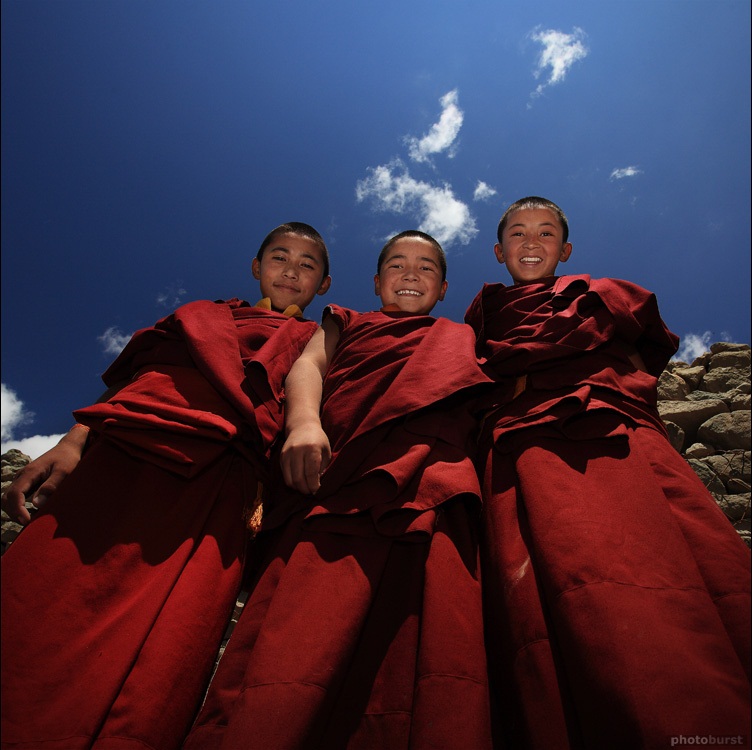
    Novices, Ladakh, Buddhist India (Sayid Budi)
    When Dr. Weston Price toured the world in the 1930's, he found that it was the influence of Western diet that had the most to do with the improper growth of the body, including the jaws which hold the teeth.

    When the jaws do not develop to their full size, they are too short to hold all 32 teeth. The last ones in are the wisdom teeth, and there is no room left.

    This crowding is also seen with the eye-teeth (canine or cuspid), which may come in like tusks in people with small arches. We do not wonder if we will be losing our eye-teeth through evolution.

    If you consider the full meaning of this information, you will understand this this same lace of space caused by our diet is the reason that millions of American teenagers continue to need braces year after year.

    Have you ever wondered how the billions of poor people around the world get along without an orthodontist to handle all their crooked teeth? For the most part they don't need them because their teeth are not crooked. 

    Having orthodontists to fix our ids is not a luxury Americans can afford because we are a rich, but because our diet causes the crowded teeth. And the more generations that are on the Western diet, the worse the problem becomes. The solution has been know for generation but the only response by the dental schools is to produce more orthodontists. (See "Braces.") [Prevention first then treatment.] More
      
    Dr. Hulda Clark [Cure For All Diseases] has sparked a growing debate on the way diseases are treated. Her one-woman crusade to help people escape the archaic methods of many medical practices has take root. ...Her claim is that the body is self-healing, once we can clean up the body of toxins, bacterial invasion, poor nutrition, and parasites [which her device detects and eliminates], is echoed throughout the literature. She has joined earlier voices against the toxic effects of dental materials (p. 35).

    Why are American teeth crooked, decaying?

    "How Are Teeth Damaged?" (Tooth Truth by Frank J. Jerome, D.D.S., pp. 199-200)
    Famous Budai, the fat happy smiling Mahayana monk or "Buddha" (shutterstock.com)
     
    Dr. Weston Price [westinaprice.org] was a highly respected research dentist who worked in the first 40 years of the 19th century. For several decades he was employed by the American Dental Association (ADA) as head of its research programs. [He produced volumes of valuable work for them.]

    After leaving his post at the ADA, he traveled the world. Taking photographs of native people in Polynesia and other remote areas, he was able to show the influence of the Western (American) diet [or SAD: Standard American Diet] on children in the same families raised before sugar and white flour were introduced and those born after its introduction.
       
    "I thought cavs and crooked teeth was normal!"
    The children exposed to sugar and white flour had dental disease and their faces were narrower, causing bad bites with crowded, crooked teeth.

    In some places, when the Western diet stopped being available, children born after the previous native diet was resumed were again healthy, just as the older children and the parents. Dr. Price's book about his observations of dietary influences on growth and decay, Nutrition and Physical Degeneration, has become a classic in nutritional literature.

    "Ah, no more vivisection on us!" (funnycats4u)
    Dr. Francis Pottenger, M.D. did dietary experiments, using cats. When fed Western diets (human foods), the kittens grew with all the problems we exhibit including allergies and deformed dental arches. When these kittens became adults, he fed them their natural diet, and it took five generations before their kittens were completely healthy.. When the experiments were extended by feeding the cats the Western diet for three more generations, none of the kittens survived to breed. These experiments suggest that after long exposure to the Western diets, the facial deformities common in America -- the long, narrow faces with crowded, crooked teeth -- will become more common...