
Showing posts with label smile. Show all posts
Showing posts with label smile. Show all posts
Saturday, February 14, 2026


Friday, October 3, 2025
World Smile Day: A Path to Happiness


 |
| Buddhism's Seinfeld: funny Ajahn Brahm |
History of World Smile Day

 |
| Has this symbol always existed? |
Popularity for this symbol exploded into the world of popular culture. It’s every artists’ dream for their work to be respected and recreated and few symbols have had quite the legacy that Harvey’s creation has had. More: nationaltoday.com
Smiling animals brighten our day

If looking for something to brighten an otherwise dreary winter day, look no further than these adorable animals. Looking at their cheery grins will no doubt put a smile on the face that watches them, too. These smiling animals will brighten the day
Buddhism: There is no way to happiness. Why? Happiness is the way

 |
| I let go, surrendered, and blissed out on the mat. |
When at a Buddhist monastery or on a Buddhist retreat, it's not uncommon to ask, "How do I attain meditative absorption (jhana)?" Another word for it is "zen" or dhyana and dharana on a yoga retreat. But there's no answer. One is taught a technique but no way to achieve the thing one strives for. Why?
 |
| I have a theory. - What is it? - Do the GOOD. |
I went to the room of the greatest jhana teacher in the world, and I pressed him, "What's the secret?"
He didn't know what I meant, he said. He didn't even know what I was talking about, he claimed. Then I thought, he's given me an opening. Here's my chance. I better ask very carefully:
"How does one meditate...successfully? What I mean is, how does one attain absorption? How does one get to..." He looked at me like I was kidding and when he saw that I was not, as if by rote, he gave me the basic instructions:
- Sit up straight, but not too straight, relax, bring your attention under your nose to the breath, remain aware of each and every in-breath and out-breath that is happening. Don't do anything but give your undivided attention to that breath (composed of an in-portion and out-portion). Just that. [Then what? - Then nothing, just that. - No, but there has to be something more; it can't be just that. - Just do that (in addition to keeping silent, following the Eight Precepts, and always keeping the breath in mind except when asleep) and then report to me what happens during the daily interview sessions. Try it. It's very simple, but there's nothing easy about it. So keep at it.]
 |
| Bare awareness (mindfulness/sati) is a start. |
"Oh, that," he said. "I don't know that." I thought he was joking, a real effort to make an American-style joke, and I didn't know why he wasn't telling me. He knew I was sincere. He knew I had been striving all month long. Then I applied more pressure than probably anyone would ever dare to apply.
I wasn't leaving without an answer: "What do you mean you don't know? Who better than you? If you don't know, who could possibly know?"
Then he stunned me, as he often did with the directness of his insight and his willingness to share his knowledge with me? "I don't know because I do not read minds. People come to me. I give them the instructions. And some of them come tell me what is happening, and I guide them from there."
 |
| You asked him what?! Did he throw you out? |
"That I do not know. I just know they do. And when they do, I can help them, guide them to go deeper. But how they get to it in the first place, that I do not know." [These aren't exact quotes, just the gist of the conversation, which only lasted a few desperate minutes as I pushed and pushed.]
As he said this, I realized I had asked him this before, after sitting with him in Asia at his massive monastery, where it seemed everyone was succeeding and attaining. I asked him and pushed him a little on the matter with someone sitting by me to catch what I might be missing, two Americans sincerely wanting to experience what Buddhist texts write about, what the Buddha taught, what sutras say happens.
At that time he looked at us and perceiving our sincerity said one strange word, his guess as to what it was distilled down to ONE thing as if it could ever be just one thing distinguishing success from just sitting. That word was parami. She smiled next to me, but I grimaced, perplexed. "'Parami?' The Sanskrit word paramita?"
"Yes," he answered, but he was actually talking about the Pali (and therefore Theravada Buddhist) form of the word parami. In either case, it means "perfection," but the Sanskrit is a diluted Mahayana term of six factors, whereas the historical Buddha always taught TEN intentional actions (deeds, karma).
My teacher clarified. What he imagined (from what he heard from many of his successful students reporting to him) was that they remembered doing skillful deeds in the past, and he concluded that those past skillful deeds were coming to fruition as they sat. And that's why some succeeded and not others.
 |
| What kinds of questions are these? You are silly. |
(What I was really getting at was, WHAT ACTIONS CAN SOMEONE DO NOW OR WHILE ONE IS SITTING IN MEDITATION, ANXIOUS FOR SOMETHING TO HAPPEN, TO MAKE IT HAPPEN?)
That he didn't know, so I had to undertake a lifelong journey of trying to figure it out. Of course, it will have something to do with the Factors of Absorption (jhananga, "limbs of jhana"). Leigh Brasington figured this much out, having had the insight that happiness is the way:
 |
| Right Concentration: Practical Guide to the Jhanas |
Now it makes sense that what I had always been looking for was a carrot or apple in front of the horse (mule, donkey, jackass). I could only neigh in realizing it: THE GOAL is not this happiness because THIS HAPPINESS is the way to relaxing, letting go, unstriving, surrendering, unclutching, dropping hangups, persisting without grasping or clinging, shikantaza ("just sitting"), not setting up a goal and striving for it. Why? It's because those blissful states of meditation and their attendant stillness, mindfulness, and progress towards insight are NATURAL. They arise. We don't "do" them. We can't do them. We don't know how and do not have that power.
But if we relax and just watch with vigilance, stillness, steadiness, persistence, we are cultivating the Factors of Absorption and other factors of the 37 Requisites of Enlightenment, which are categorized into seven groupings.
- One is reminded of a very important thing the Buddha once explained to someone. When talking about the Bodhisatta, himself at the stage of still being a seeker of enlightenment, he once realized that he could neither strive too hard or be negligent. Doing either, he sank as if in a great ocean (samsara), but not striving and not being negligent, he made progress. What could this mean either than the Middle Way of avoiding extremes, of persisting but not pushing, of cultivating but not disturbing the peace or giving in to apathy, listlessness, or despair?
- Thai Forest Tradition arahant Ajahn Maha Boowa seems to be suggesting the same thing here (translated by the American intellect Ven. Thanissaro): "The tactics [techniques] given by each of the Buddhas to the world are called the Dhamma [Truth] of the doctrine. These aren't the genuine Dhamma. They're tactics [methods] — different offshoots — actions and modes displayed by the genuine Dhamma, means for letting go and striving, teaching us to let go, teaching us to strive using various methods, saying that the results will be like this or that. As for the genuine Dhamma of results in the principles of nature, that's something to be known exclusively in the heart of the person who practices. This Dhamma can't really be described correctly in line with its truth. We can only talk around it. And particularly with release [nirvana, liberation, freedom]: This can't be correctly described at all, because it's beyond all conventions and speculations. It can't be described. Even though we may know it with our full heart, we can't describe it. Like describing the flavor [of a soup using only words to someone who has yet to simply taste it]." From Things As They Are.
 |
| Smile, be happy. Don't overdo it; just let it be. |
 |
| Like that, Lisa, just like that. Hold it. |
What is the way to bodhi? The Seven Factors of Enlightenment. What is the way to those factors? The preceding factors of the 37 Requisites of Enlightenment. How does one do any factor? It's probably a good idea to be happy. How does one even begin to dream to do that? Smile.
Tuesday, April 22, 2025
Earth Day 2025 with Space Smiley Face
Earth Day 2025

Tuesday, March 4, 2025
The Buddha Smiles (cartoons)


.
The Buddha Smiles: A Collection of Dharmatoons

.
 |
| The Buddha Smiles: Collection of Dharmatoons |
The Buddha Smiles is a delightful gathering of Mari Gayatri Stein’s cartoons, or "Dharmatoons" as she calls them.
Q: Most religious leaders don't, but the Buddha smiles? A: Yes, he is always depicted with a subtle smile, what one might describe as a gentle smirk if the connotation were not misleading. He is at ease, at peace, at rest, able to dip into the Fruits of Recluseship, namely, the bliss of the absorptions (jhanas, the eight attainments, right samādhi) at will and transcend even that supersensual happiness to touch the transcendent bliss of nirvana, the end of all unhappiness. Moreover, he smiles when he sees a noteworthy thing, of which his attendant monk, Ven. Ananda, will later inquire. The Buddha's smile acts as a signal in many sutras, an invitation to for Ananda to inquire what brought the smile about. It is unclear if the smile happened to the Buddha, as it does to us when something strikes us as funny, interesting, or curious or if the Buddha flashed it specifically to be asked what had struck him.
Cambodian novice caresses the Buddha's smile - Buddhist psychology (Abhidhamma) describes the hasituppāda-citta, literally the "mind-moment (citta) or consciousness (viññāna) producing mirth (smile)."
- It is found in the Abhidhammattha Sangaha as a name for the joyful mind-consciousness element (mano-viññāna-dhātu, see Table I. 72) arising as functional consciousness independent of karma (i.e., kriya or kiriya-citta), only in the arahant (Appendix) (Ven. Nyanatiloka, Buddhist Dictionary entry hasituppāda edited by Dhr. Seven).
- The Buddha is full of happiness (sukha), having found and repeatedly tested and confirmed the escape from all misery (dukkha) here and now and hereafter, namely, access to the absorptions and nirvana-with-remainder at any moment and nirvana-without-remainder once the body passes.


 |
| Clever cartoon collection by David Sipress, comic featured in The New Yorker |

 |
| Zen Comics (Ioanna Salajan) |
The Buddha Smiles gently teaches the nature of Buddhist thought through cartoons on the Four Noble Truths, The Noble Eightfold Path, and the nature of the Five Hindrances along the path.
 |
| Zen Comics, No. 2 |
Comics communicate the Zen spirit perfectly. Laughter deflates pretension, and a good rap on the head sometimes transcends so-called logic (the hubris of rationality and reason). In the words of Zen, "Nothing is left for you but to laugh!"
 |
| (Dan Piraro's comic strip Bizarro) |
- The Buddha Smiles
- Mari Gayatri Stein: DavidSipress.com; Dan Piraro's Bizarro; Dhr. Seven, Shauna Schwartz, Ashley Wells (eds.), Wisdom Quarterly
Saturday, September 21, 2024
Everything ZEN? "Optimistic nihilism" - Nothing matters, but it's OK
 |
Do what you did to Bart to me, Lisa. I want to be Big Fat Buddha. - His name is Budai, Dad, and he's NOT the Buddha. He is a jolly bodhisattva with a big candy sack . - Ooh, Santa Budai! |

 |
| Maha Kassapa smiles at a flower. |
Is optimistic nihilism a healthy way of life? In the Hitchhiker's Guide to the Galaxy, the original BBC Radio series before the books, there's a very funny scene in an exchange between the human, Arthur Dent, and a stranger on the planet of Magrathea, a mythical planet that builds planets and therefore couldn't possibly exist. But here it is.
The stolen ship, The Heart of Gold, which is powered by the new infinite improbability drive, has found it. (Zaphod Beeblebrox, the president of the galaxy, stole it when he was meant to be launching it so he could carry out this secret plan, which first includes getting here to Magrathea).
The crew has entered and left poor Arthur on the surface, where he runs into the Magrathean Slartibartfast, who builds planets and who made the fjords of Earth. He is now working on Earth Mark II.
 |
| "Don't panic" (Douglas Adams) |
Arthur, reflecting in this way, asks Slartibartfast a philosophical question about the meaning of life, the universe, and everything. Slartibartfast gives a very strange answer.
The question runs something like, "What's the meaning of it all?"
 |
| Zen Master Bart* or Lisa Simpson? (Matt Groening) |
happy than right any day."
"And are you?" Arthur interjects with awe.
"No," Slartibartfast laments, "that's where it all falls down of course."
It's a nice philosophy but he -- and one suspects most of us -- can't live up to it. We'd far rather be happy than right, but we are neither happy nor right.
(It sort of gives a boost to those of us who'd far rather be right than happy, though, sadly, we're not right either most of the time, and as for happy? Fuhgeddaboudit.)
So what's the chance any of us are going to pull off this optimistic nihilism?
Optimistic? Okay, if we can manage it or set it as our default option and not worry. Nihilism? Easy, for some of us, all bleak, depressive, laughing at Woody Allen quips at the absurdity of things. WATCH
How to be happy and get saved?

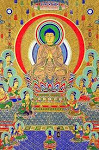 |
| Cosmic Amitabha [God] Buddha |
These attributes really are aspirations of Zen Buddhism, according to Alan Watts. The reason for it seems rooted in Taoism more than in what the historical Buddha taught. But it all comes down to a great division that occurred in Mahayana Buddhism, the great Tariki versus Jiriki Debate, whether salvation (enlightenment, awakening, spiritual liberation, emancipation, moksha, freedom, nirvana) is to be attained by our power (efforts) or other power (the efforts of something extrinsic), by our force or an outside force).
 |
| What patriarchal Mahayana Buddhism needs is a Goddess of Compassion, a Mary: Guanyin |
.
 |
| The historical Buddha Gautama (Gandhara) |
This is never what the Buddha taught, but it makes more philosophical sense: Since we can't by our own power, we need to engage a Higher Power (like Amitabha Buddha, Mother Mary/Bodhisattva of Compassion Kwan Yin, other Cosmic Buddhas, God, or who knows) and hitch our train to that.
 |
| Hey, and this tulku bodhisattva? |
That's the thinking, Alan Watts explains, and that's why Pure Land Buddhism (Nichiren Shōshū) from Japan and China, Imperial Holy Roman Catholicism, Christianity (Jesus freaks), Islam, some New Age teachings...are all so popular. Will it be us doing or other doing?
Christianity as afterthought
 |
| Super Friends: Buddha, Krishna, Mo, Yeshua, Aquaman, Moses, Laozi, Joe Smith (South Park) |

 |
| Misquoting Jesus (Bart Ehrman) |
Christians hypocritically say ONLY Jesus saves -- but to be saved, WE have to ask, repent, plead for the Holy Spirit to take possession of us and live our lives for us as the driver, be born again, get on God the Father's good side, pray and petition for His "grace," which is a "gift" that can only be given and never earned -- as if all the behaving and other stuff weren't work and earning it.
 |
| Savior? Now younger, nicer, whiter, easier! |
Works (intentional karma, deeds) mean nothing? Clearly, they mean something. But Imperial Christianity (Protestant movements and the worldwide Catholic Church) wants to keep everyone in bondage and call that being "saved."
 |
| Compassionate Kwan Yin Bodhisattva |
When you're up in heaven singing in a heavenly choir praising the Almighty God of the Universe, the great Creator, the doer, maker, thinker, and power of everything for an eternity, then you'll be happy?
No thanks. who wouldn't rather be a Buddhist, Independent, or New Ager to understand and make our own way to freedom and the end of all suffering (nirvana), to enlightenment in this very life and the deathless (amata)?
- Dhr. Seven, Ashley Wells, Ananda (Dharma Buddhist Meditation), Wisdom Quarterly
Thursday, April 25, 2024
The Buddha smiled. Is it bad to laugh?
 |
| The Buddha of Kapilavastu, Gandhara (now Bamiyan, Mes Aynak, Kabul, Afghanistan) |

 |
| Shiva gains samadhi and is done. |
Them thinking I'm crazy does not make it wrong nor worry me in the least. But disturbing others, all right, that's true. "How about smile and quietly giggle? It can only help."
"Why would that help?"
"Because enlighten up. This [meditating] is about letting go. It's not about struggling, muscling, and over-exerting. It was exactly because of those things that Siddhartha could NOT for years become the Buddha."
In the allegory that is the Buddha's life story, Prince Siddhartha renounces the throne and palace, leaves home, leaves the country (ancient Gandhara/Indo-Scythia/Saka and the seasonal capital of Kapilavastu), and heads East to proto-India to find a guru/yogi. He learns under him, masters what that meditator is teaching, and becomes disappointed with the summum bonum, goes to another, same thing happens, then sets off on his own to practice more severe austerities for penance and purification as so many have done down the ages, all of which fails. He only succeeds in calm-and-insight -- in real awakening -- when he stops being afraid of the blissful meditative absorptions (jhanas, samma-samādhi, right stillness), which lead to purification. But he doesn't stop there. That's only the foundation. With that calm, he practices insight (systematic mindfulness on four subjects, four foundations, four topics: body, feelings, mind, and mind-objects). That leads to the realization of Dependent Origination, remembering past lives, and then the great awakening.
The Buddha (Victoria & Albert)

Ven. Vimalaramsi (formerly Mr. Marvel Logan), an almost universally decried American monk in Missouri (except that Armstrong), was right about one thing:
In meditation, when the mind wanders and we bring it back, it is essential to smile and release (then re-smile before beginning again), simply watching without resentment or built-up tension.

If a tennis player misses and grunts before serving again, it is crucial to smile and not overdo it. Overdoing it will lead to another mistake, whereas rebalancing and approaching the game with a sense of perspective and calm leads to a flow state. Stressing, worrying, needing, clinging -- these are no way to meditate (and will not even work in a sporty game of tennis).
Tension builds up around forehead and the temples when one struggles too much and strains. Smiling releases that tension so one can regain one's composure.
 At the Forest Refuge Retreat Center outside of Boston (in Barre, Massachusetts), when the great Enlightened Master was leading a long retreat, he would give a Dhamma talk most nights.
He would often cause us to laugh. And sitting on a mat in the front row to see only him, or on a chair in the back to see everyone and him in context, it became obvious to me that he was getting addicted to being funny.
 It's as if there were a pleasurable spurt of dopamine in his brain when he could make everyone in the room crack up.
The only problem was, he only had one go-to joke. And it wasn't funny. But cutting through the tension, it never failed to evoke some kind of comedic reaction -- except when he used it too soon after a major spike in laughter.
The joke, the quip really, went something like: "You come to Asia and find out."
- Retreatant: "What is the meaning of life?"
- Sayadaw: "You come to Asia and find out."
- Audience: *LOUD LAUGHTER*
- Retreatant: "How can anyone possibly sit in meditation for eight hours in one day?"
- Sayadaw: "You come to Asia and find out."
- Retreatant: "When you say that people see atomic particles (kalapas) with their third eye (mind) or perceive individual mind-moments (cittas) with their own conscious perception, you don't really believe that?"
- Sayadaw: "You come to Asia and find out."

 |
| Samatha, Jhana, and Vipassana |
He has an international reputation for running a tight ship of strict morality and long hours of meditation --
- Ten Precepts for everyone (with monks living by 227 and 1,000 more minor rules of etiquette),
- and a schedule of 90-minute sitting meditation sessions,
- adding up to 8 or 12 hours of sitting a day, sometimes more,
- with every waking moment spent in mindful silence
- unless speaking to ask questions during a brief personal interview to report on progress or resolve a difficulty,
- or when unconsciously sleeping;
- we had no yoga nidra, so what the mind did when it drifted off to sleep was the mind's own business,
- but up to that moment of losing consciousness, it was all mindfulness all the time.
I have stayed at that forest meditation center more than once, deep in the jungles of Middle Burma (military coup and authoritarian Myanmar), and it is that way. Only, it's not enforced by force.
 |
| Laugh? Not on your life. Grimace |
In the world outside the precincts of the monastic grounds (within which there is a nunnery on one side and a monastery on the other side with more than 500 living and striving there), Myanmar's military police might do anything from lockup a dissident in Insein Prison, to manhandle a disorderly person, or shoot protesters with live rounds, which is odd because Asia is so nice, so reserved, so loathe to make a scene.
- The Dept. of Psychology at UC Berkeley offered a course on humor; I was terrified to take it, thinking that if it got deconstructed and intellectualized, I would no longer be able to laugh. That was probably right, but I yearned for insights as to why we as humans laugh. It is not all about "humor" itself. It's social. People laugh in groups, to appease, to feel bonded, and because a train of thought going one place is suddenly derailed. The transition is endured or enjoyed with laughter, as if we hit reset. Go to a comedy club. It's much funnier when full, regardless of who's performing. It should matter who's up on stage, but it hardly matters as long as others are laughing, and we get caught up in that group mind. I didn't take the class. I oftentimes still wish I had.
 |
| The West taught me to laugh. It's fun! |
Misbehaving Western tourists are well tolerated, whereas anyone who grew up there just wouldn't think to act like an entitled Karen or Ken or even express emotion.
Songkran (Burmese New Year, like Holi celebrations in India, are the exception, when one might get splashed with water to peals of laughter or dusted with colorful powders to the delight of the crowds).
Of course, India in general can get quite unruly with its occasional communal violence and spirited love of cricket and Bollywood movies. I have never, in all my time in India, seen a dance break out on the street as it does in every other scene of every movie ever made by Bollywood.
But I did see men stand up and dance inside the orderly movie theater when a Bollywood film was playing, and a particularly catchy song came on. That was a shock as no one complained to the management to flog him into order with bamboo reeds or even looked over. It was public dancing. They won't kiss in public, and they never used to kiss on screen, but somebody might stand up and show appreciation of a pop song. Maybe, unlikely, but maybe.
This is no place for joking, no place to be silly, no place for pranks, or too much mirth. If ones cries out, "Oh the pleasure, oh the pleasure!" that might be alright. People will look into the matter, and if it's piti (rapture, joy, bliss), then it's an understandable exclamation. But anything else is frowned upon. Smile, smile all the time; those who frown, who are dour and grave are doing monasticism wrong. Doing it that way is a natural impulse, but success comes from relaxing, releasing, letting go and letting nature take its course.
Anyone who can laugh at life, who smiles often, is catching on. Sure, there's horror. Samsara, like Mara, can be very serious, nothing to scoff at. But don't sweat the small stuff.
This is Forest Tradition Buddhism following all the rules of the historical Buddha.
The Buddha always lived in bamboo groves, gardens, woods, forests, jungles, the wilderness, or high on a hilltop (e.g., at Eagles Peak, Rajagaha). Even when he came to a prosperous city, he would stay the night just outside in a monastic encampment in a sylvan place or sala (open air hall with a roof to protect from rain used by wandering ascetics and travelers).
 |
| Smiling is one thing, very good, but laughing? |
So I asked, "Is it wrong to laugh?" It's not as if it's willful. It's spontaneous when something is funny, even if one has a quirky or dark sense of humor. I was told that the Buddha didn't go around laughing like a madman. Be that as it may, he smiled a lot. Of course, if one reads carefully, he always smiled for a reason. It was a prompt for his attendant to ask about it later.
And Ananda was dutiful in always asking when provoked it. To which the Buddha would answer with an insight, recognition, or memory of something that happened there, oftentimes something others did not see or recognize. It might have been a ghost undergoing karmic consequences or rich and privileged youths squandering their opportunity to progress in this lifetime.
He once saw a man and noted that
- if he had renounced the worldly life and taken up this spiritual practice at a young age, he would by now be fully enlightened,
- if he had taken up the practice a little later, he would be a non-returner (never having to return to this world and fully awakening in another better world),
- and if he takes up the practice in old age, he will become a stream-enterer,
- but if he reached old age and did not practice, he would again be reborn like dice being thrown in the air (Who knows how they will land?) without making any progress at all.
It was further pointed out to me, as has often happened, that the Buddha told his son, Ven. Rahula, who ordained as novice monk or samanera (little recluse, probationary wandering ascetic) at the age of 7, not to lie, not even for the sake of a joke or prank. Ven. Rahula was notorious for joking around. The Buddha smiled but saw danger in too much horsing around, too much distraction and diversion, too much joking and not taking things seriously, or lying and falsifying the truth to get a laugh.
- The "Enlightenment Tree" differs with different buddhas
- Dhr. Seven, Ananda (Dharma Buddhist Meditation), Ashley Wells (ed.), Wisdom Quarterly
Subscribe to:
Posts (Atom)

























































