
Showing posts with label self liberation. Show all posts
Showing posts with label self liberation. Show all posts
Saturday, February 14, 2026


Monday, December 9, 2024
We must surely be learning? (Beatles)
The Beatles "While My Guitar Gently Weeps (2018 Mix)"
There's no comparison to Beatle George Harrison, who wrote and sings this masterpiece, while nearly all the credit for the band's greatness goes to the other two competing with each other, and no one even remembers Pete Best. What about Ringo? Who?
LYRICS: I look at you all, see the love there that's sleeping / While my guitar gently weeps / I look at the floor and I see it needs sweeping / Still, my guitar gently weeps // I don't know why nobody told you / How to unfold your love / I don't know how someone controlled you / They bought and sold you // I look at the world and I notice it's turning / While my guitar gently weeps / With every mistake, we must surely be learning / Still, my guitar gently weeps / I don't know how you were diverted / You were perverted, too / I don't know how you were inverted / No one alerted you / I look at you all, see the love there that's sleeping / While my guitar gently weeps / (I look) Look at you all / Still, my guitar gently weeps / Oh, oh / Yeah, yeah
We weep for the world -- steeped in ignorance, the root of all harm, giving rise to greed (lust) and aversion (fear), liking and disliking, the Roots of Good and Evil. Who cares if someone is good or evil? That person is going to care when the RESULTS come around. Karma really brings about what we experience, what we are experiencing now. So it is vital to grasp what "karma" means and what it doesn't. The greatest karma meme ever sums it up, a picture of credit card with the slogan: "Karma: It's everywhere you're going to be." (That's based on an old credit card commercial, which if people have never seen it because the successful marketing campaign ended a long time ago, may not get the impact of why it's a clever meme and a vital message/warning. If we knew that everything was going to follow us, none of it unseen or forgotten, we might behave differently, very differently. But we think we're getting away with everything, think there is nothing to come of this (what we do, say, and think). Pink Floyd has a great song about this from the CD Animals called "Sheep."
- What do you get for pretending the danger's not real?
- Meek and obedient shall follow the leader
- down well-trodden corridors into the Valley of Steel
- What a surprise, a look of terminal shock in your eyes!
- Now things are really what they seem
- No, this is not a bad dream
Friday, November 29, 2024
PUNK: Dead Kennedys: 'Life Sentence'?
For this ditty, singer-lyricist Jello Biafra fronts the classic San Francisco punk rock ensemble the Dead Kennedys (DKs), talking about our lives and the way we sell out to The Man (school, work, bank, not literal jails just figurative ones) without realizing it.
LYRICS: "Life Sentence"
Used to be a partner-in-crime
Now you say you ain't got the time
Gotta get serious, gotta plan
Gotta pass those entrance exams!
Oh my gosh, it's your senior year
All you care about is your career
[CHORUS]
It's your life sentence, life sentence
Life sentence, life sentence
You're squelching your emotions
All you talk about is those times
You don't do what you want to
But you do the same thing every day!
No sense of humor
But such good manners
Now you're an adult
You're boring!
[Chorus]
The walls (ah ah) are closing in
You stayed (ay ay) too long in school
I'd rather stay a child and keep my self-respect
If being an adult means being like you
Ah, ah
Are you really you, you, you?
You, you, you
You, you, you
Are you really you? No!
You're a chained-up dog fenced in a yard
Don't say much, you can't go far
Pace and forth, you're getting sick
Run too fast, it'll snap your neck!
Say you'll break out, you never do
You're just another ant in the hill
[Chorus]
- Jello Biafra (alternativetentacles.com), DeadKennedys.com; Seth Auberon, Pfc. Sandoval, Sheldon S. (eds.), Wisdom Quarterly
Monday, September 2, 2024
Ego Death [by DMT] with Alan Watts (A7x)

Alan Watts: Ego death will save the world
 |
| Whoa, look at all the colors and eyes of...Huh? |

Seeing no danger in an illusory ego, want an ego?
Here's an ego to cling to and take a flying leap.


 |
| Scary looking aluminum cauldron of jungle potion: vine, bark, and plant matter: Ayahuasca |
Ego death w/ M Shadows (Avenged Sevenfold)
 |
| i Was as God, All-Seeing One, alpha, omega |
What does DMT (toad venom or 5-MeO-DMT, soma, LSD, psilocybin, ayahuasca, Syrian rue, harmaline, iboga, ibogaine, Special K, ergot, peyote, San Pedro cactus, etc.) have to do with anything?
There are powerful entheogens in the outside world that mimic things like DMT that our brains produce. A flood of them, particularly of the Spirit Molecule DMT, can for a moment give us a vision of reality.
If calm-and-insight meditation is the reliable way there, entheogens are the unreliable, irregular, "accidental tourist" way of traveling.
For the nonbeliever, they can make a believer out of one quite quickly. The path is just the same as it was, but now it becomes clearer to the one on the path that it is real and that this journey (to bliss, to the end of all suffering) is necessary without delay.
Drugs are not the Buddha's path

 |
| Colonic first then get to practicing, Krystle Cole |
The problem is the ego, but the ego is only a construct and not actually real no matter how much we wish it were so that it could go on forever or be annihilated right now and release us from this interminable merry-go-round.
- It's crazy to think there's not a "self" since our whole experience of the world is through a self (personality, ego, POV, paradigm, set of memories, atman, soul). It is not correct to say there is NO self. There is a self in a conventional sense, of course. It is in the ultimate sense that there is no self. This is the distinction. So we may "find ourselves," "lose ourselves," store up karma (deeds), bear the result of our actions (deeds), and so on. What is there then? There are Five Aggregates (form, feeling, perception, formations, consciousness) clung to as a self. AHA! Who or what clings? Form forms, feeling feels, perception perceives, mental formations form, and consciousness is conscious. This is not a speculation but rather an observable fact to a mind purified by samadhi (stillness, coherence) that systematically practices the Four Foundations of Mindfulness (satipatthana). It is not a joke, noy a philosophy, not a belief, not a paradox, not a mystic experience. It is verifiably true. And to be free, the Truth must be seen. The Truth sets one free of wrong views, delusions, and ignorance.
 |
| What about MAPS and Awake Project? |
There is no need to take a substance, a red pill to snap out of The Matrix. It may temporarily work, and we may see a world of spirits (Dracos, Archons, devas, ogres, ghouls, reptilians, Pleiadeans, asuras), but it won't last.
It is far better to systematically relax and still the mind, collect its faculties, concentrate its powers to the point of samadhi (a coherent state of superconsciousness, stillness, clarity). Then we can begin.
The Buddha's contribution to the world was going from this point (samadhi) to enlightenment/awakening (bodhi). Samadhi is not awakening; it is far from it.
The Three Poisons of greed (clinging), hatred (aversion), and delusion (ignorance) still exist, though temporarily suppressed or attenuated and made so subtle as to not be noticed. But they remain in a latent state. They must be rooted out, cut off at the root. We need not cut them; wisdom cuts them. Knowing-and-seeing cuts them. This is why it is not enough to theoretically understand and "get it." Direct experience is necessary -- or a great deal of saddha (confidence, conviction, faith).
- It's hard to imagine that faith alone, the path of the great many of the world's inhabitants, could ever do anything, but it does seem to be able to do one thing -- to put us on the Path and impel us. With faith we can go forward and come see for ourselves rather than remaining lost in doubt and perplexity, skepticism and endless questioning.
The Three Poisons (greed, hatred, delusion) must be cut off at the roots. Then knowledge-and-vision of the Truth arises. The "ego" (self or soul construct, these functionally integrated Five Aggregates, which are all processes not enduring realities) will be seen for what it is and what it is not.
This is a lasting and durable solution to letting go of all things clung to as a "self" that lead to suffering. And what again is clung to that leads to so much suffering? They are the Five Aggregates, Skandhas, Heaps: form (physical elements); feelings, perceptions, mental formations, and [the process of] consciousness(es).
Taking these to be an eternal soul, a self, the property of a self, something separate from a self, the constituents of an actual self, all such wrong views lead to pain (dukkhata) and suffering (dukkha), rebirth and more ignorance (confusion, misunderstanding, not knowing, uncertainty, not-seeing, etc.).
Has one ever met a stable and enlightened shaman or drug dependent person? No because the way of shamanism and drug abuse leads to oddity and imbalance, seeing so much of the invisible and not being able to integrate it or let it go.
For all one's progress in seeing all there is, the fundamental problems have not been addressed or solved.
But a wandering ascetic, a Buddhist monastic living in accordance with the Monastic Code of Discipline (Vinaya), the Patimokkha, practicing in accordance with the Buddha's Dharma for calm and insight, that person realizes what is real and what is not and is thereby liberated here and now in this very life.
There's no comparison between lifestyles, the route (maze) of drugs or the Middle Path to enlightenment.
If drugs were needed, the Buddha and subsequent arhats would have revealed that. What is needed is "clear seeing" (vipassana) built atop a stabile foundation of samadhi (absorbed stillness and concentration).
- Alan Watts via Metamorphosis (YouTube), Jan. 4, 2021; Dhr. Seven, Amber Larson, Pat Macpherson, (eds.), Wisdom Quarterly
 |
| Dharma Buddhist Meditation (meetup.com) |
Wednesday, February 1, 2023
How to Love Oneself (Thich Nhat Hanh nun)
Plum Village App, 12/7/22; CC Liu (ed.), Ananda (Dharma Buddhist Meditation), Wisdom Quarterly
How to Love Oneself: A Dharma Talk by Sister Dang Nghiem

- #DharmaTalk #PlumVillageApp #mindfulness
"I say, it is okay. I am here. I am going to take good care of you. It is okay. Relax. I am safe now. I love you. I love you."
The talk is a compelling invitation to come home to ourselves and to start to love ourselves truly: our body, our feelings, our mental formations, our perceptions, our consciousness [the Five Aggregates clung to as self]. Knowing how to love ourselves brings the deepest joy.
Sister Dang Nghiem dedicates this talk to all tweens and teens, but the talk is valuable for people of all ages.
🎙 The actual Dharma Talk starts at Minute 3:30.
📌 Recorded on December 31, 2021, at Deer Park Monastery, USA, during the Holidays Retreat "Joy in Oneself, Joy in the World."
🎙 Sister Dang Nghiem (Sister D) ➛ plumvillage.org/people/dharma...
🎥 Created by Evermind Media ➛ evermind.media for Deer Park Monastery ➛ deerparkmonastery.org 🎥 This talk may also appeal as an introduction to healing our inner child by Sister Dang Nghiem ➛ youtube.com/watch...
This is one of the many Dharma talks included in the (completely free) Plum Village App ➛ plumvillage.app Enjoy! 🙏
#mindfulness #DharmaTalk #howtoloveoneself #meditation #PlumVillageApp
Sunday, November 20, 2022
There is no self (sutra)
Ven. Nanamoli, Three Cardinal Discourses of the Buddha edited by Dhr. Seven, Wisdom Quarterly
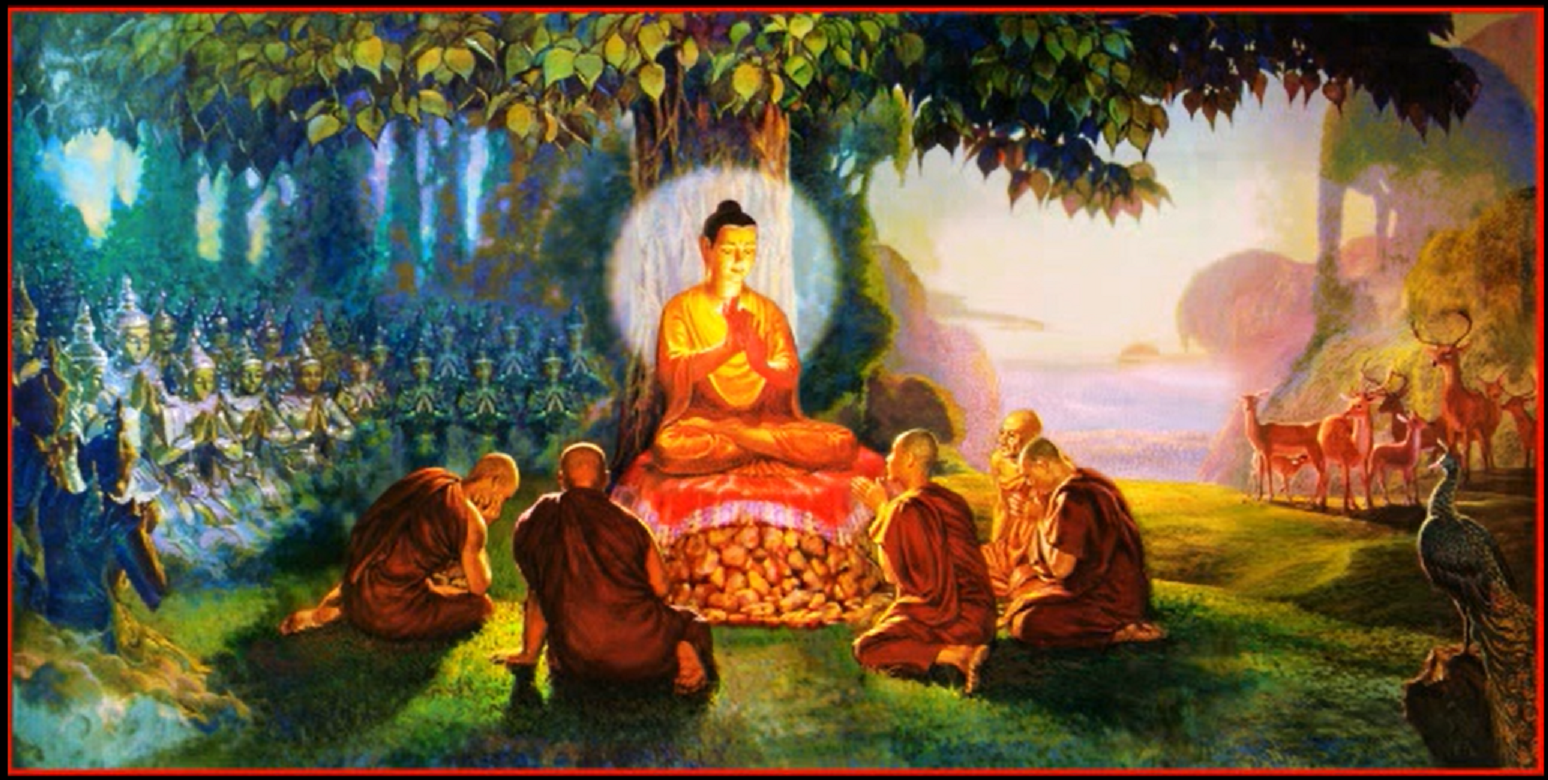
Thus have I heard. On one occasion the Blessed One (the Buddha) was living at Benares (Varanasi, India), at the Deer Park at the Resort of Seers. There he addressed the wandering ascetics [called] the Group of Five: "Meditators."
"Venerable sir," they replied. Then the Blessed One said this:
"Meditators, form is not-self. Were form self then this form would not lead to affliction, and one could get from form: 'Let my form be thus, let my form be not thus.'
"Since form is not-self, it leads to affliction, and none can get from form: 'Let my form be thus, let my form be not thus.'
"Meditators, feeling is not-self...
"Meditators, perception is not-self...
"Meditators, determinations are not-self...
"Meditators, consciousness is not self. Were consciousness self then this consciousness would not lead to affliction, and one could get from consciousness: 'Let my consciousness be thus, let my consciousness be not thus.'
"Since consciousness is not self, it leads to affliction, and none can get from consciousness: 'Let my consciousness be thus, let my consciousness be not thus.'
"Meditators, how do you conceive of it, Is form permanent or impermanent?"
— "Impermanent, venerable sir."
"Now is what is impermanent painful or pleasant [disappointing or fulfilling]?"
— "Painful, venerable sir."
"Now is what is impermanent, what is painful since it is subject to change, fit to be regarded thus: 'This is mine, this is I, this is my self'"?
— "No, venerable sir."
"Is feeling permanent or impermanent?...
"Is perception permanent or impermanent?...
"Are determinations [mental formations like will or intention] permanent or impermanent?...
"Is consciousness permanent or impermanent?"
— "Impermanent, venerable sir."
"Now is what is impermanent pleasant or painful?"
— "Painful, venerable sir."
"Now is what is impermanent, what is painful since it is subject to change, fit to be regarded thus: 'This is mine, this is I, this is my self'"?
— "No, venerable sir."
"So, meditators ANY kind of form whatsoever -- whether past, future, or presently arisen, whether gross or subtle, whether in oneself or external, whether inferior or superior, whether far or near -- must be regarded thus with right view as to how it actually is: 'This is not mine, this is not I, this is not my self.'
"Any kind of feeling whatsoever...
"Any kind of perception whatsoever...
"Any kind of determination whatsoever...
"Any kind of consciousness whatsoever -- whether past, future or presently arisen, whether gross or subtle, whether in oneself or external, whether inferior or superior, whether far or near must be regarded thus with right view as to how it actually is: 'This is not mine, this is not I, this is not my self.'
"Meditators, when a noble [arya, enlightened] follower who has heard (the truth) sees thus, that person
- finds estrangement in form,
- finds estrangement in feeling,
- finds estrangement in perception,
- finds estrangement in determinations,
- finds estrangement in consciousness.
"When one finds estrangement, passion fades out. With the fading out of passion, one is liberated. When liberated, there is knowledge that one is liberated. One understands: 'Rebirth is exhausted, the supreme life has been lived out, what can be done has been done, of this there is no more beyond.'"
That is what the Blessed One said. The meditators were glad, and they approved of his words.
Now during this utterance, the hearts of the meditators of the Group of Five were liberated from taints through clinging no more [which is to say, they awakened, were enlightened, were liberated from suffering]. — SN 22.59
Explanation

- earth (hardness),
- water (cohesion),
- fire (temperature),
- air (distension and motion),
- [along with the negative aspect of space (what does not appear, what is not evident, what delineates matter)].
It is also defined as "that which is being worn away" (ruppati), thus underlining its general characteristics of instability, impermanence, and fading away.
NOT-SELF: Together with the Four Ennobling Truths (truths leading to enlightenment), this truth of all things being impersonal is taught only by buddhas. Anatta (not-self) is a general characteristic (a universal mark of existence) without exception.
The characteristic of impermanence does not become apparent because, when rise and fall are not given attention, it is concealed by continuity:
(1) The characteristic of pain (dukkha) does not become apparent because, when continuous oppression is not given attention, it is concealed by shifting postures (changing from one posture to another, waking and sleeping).
(2) The characteristic of not-self does not become apparent because, when resolution into the various elements (that compose whatever some "thing" is) is not given attention, it is concealed by compactness (the opposite of the truth, which is that all things are composite and single things in and of themselves). — Path of Purification (Visuddhi-magga Ch. XXI).
Self-identification (identifying with things that are not self) and hunger for permanence and bliss form the principal manifestations of craving (tanha = desire, lit. thirst), guided by view that is wrong because it is not in conformity with ultimate truth.
When confronted with the contradictions and the impossibility of identifying with any of the Five Categories of Clinging's objects, craving seeks to satisfy this need by imagining a "soul" (individual or universal self).
But since no such soul, however conceived, escapes falling within the Five Categories of Clinging's objects, this solution is always doomed to failure.
Similarly, any attempt to identify self with nirvana must always fail for the same reason.
Nirvana conceived as identical (with self) or (self) as apart from it (emanence) or inside it (immanence), or nirvana conceived as "mine" is misconceived (MN 1).
This does not prevent an Awakened One from using conventional speech current in the world in order to communicate clearly with others, but one does it without misapprehending it, as is shown in the Dhammapada:
Self is savior of self;
What other savior could there be?
For only with (one-) self well tamed
One finds the savior hard to find.
Only by self is evil done,
Self-born and given being by self,
Oppressing one who knowledge lacks
As grinding diamond does a stone.
— (Dhammapada, Verses 160-1)
Similarly with the expression "in oneself" (ajjhattam) in the Second Sutra, this is simply a convenient convention for the focus of the individual viewpoint, not to be misapprehended.
A monastic heard the Buddha saying, as in the Second Sutra here, that the Five Categories are "not mine," and so on, and wondered:
"So it seems form is not-self; feeling, perception, determinations, and consciousness are not-self. What self, then, will the action done by a not-self affect?"
He was severely rebuked by the Buddha for forgetting the conditionedness (dependently originated nature) of all things (MN 109).
"It is impossible that anyone with right view should see any idea as self" (MN 115). "Whatever philosophers and deities (devas) see self in its various forms, they see only the Five Categories [clung to as self], or one or other of them" (SN 22.47).
FEELING: (vedana, sensation, impression) this is always confined strictly to the affective feelings of (bodily or mental) pleasure and pain with the normally ignored neutral feeling of "neither-pain-nor pleasure." These can be subdivided in various ways.
PERCEPTION: (sañña) means simply recognition.
DETERMINATIONS: a great many different renderings of this term are current, the next best of which is certainly "[mental] formations." The Pali word sankhara (Sanskrit samskara) means literally "a construction" [a fabrication] and is derived from the prefix sam (con) plus the verb karoti (to do, to make).
Compare the Latin conficere from con plus facere (to do), which gives the French confection (a construction).
The Sanskrit word means ritual acts with the purpose of bringing about a good rebirth.
As used in the Pali language by the Buddha, it covers any aspects having to do with action, willing, intending, motive, making, planning, using, choice, and so on (anything teleological). Of these, contact (phassa) is often placed at the head of lists defining it. Otherwise defined as bodily, verbal, and mental action (deeds, karma).
CONSCIOUSNESS: (viññana) is here the bare "being conscious" left for consideration when the other Four Categories have been dealt with.
It is only describable in individual plurality in terms of the other four categories, as fire is individualized only by the fuel it burns (see MN 38 and MN 109). Otherwise, it is regarded as an infinite (MN 111) dependent upon the contemplation of it as such.
It is only impermanent, impersonal, and unable to ever satisfy (anicca, anatta, dukkha) because however it arises, it can only do so dependent on the other categories, that is, on conditions that are themselves impermanent, unsatisfactory, and not-self.
It never arises unless accompanied by co-nascent [simultaneously arising] perception and feeling. It has six "doors" (see under Eye and Mind) for cognizing its objective fields and no more.
ESTRANGEMENT: the Pali noun nibbida and its verb nibbindati are made up of the prefix nir in its negative sense of "out" and the root vid (to find, to feel, to know intimately).
Nibbada is thus a finding out. What is found out is the intimate hidden contradictoriness in any kind of self-identification based in any way on these things (and there is no way of determining self-identification apart from them — see NOT-SELF). Elsewhere the Buddha says:
Whatever there is there of form, feeling, perception, determinations (mental formations), or consciousness, such ideas one sees as impermanent, as subject to suffering (and never a source of fulfillment but only disappointment), as a sickness, as a tumor, as a barb, as a calamity, as an affliction, as an alienation, as a disintegration, as a void, as not-self (impersonal).
One averts one's heart from those ideas, and for the most peaceful, the supreme goal (nirvana), one turns one's heart to the deathless element, that is to say, the stilling of all mental determinations, the relinquishment of all substance, the exhaustion of craving, the fading of passion, cessation, extinction (MN 64).
The "stuff" of life can also be seen in this way. Normally the discovery of a contradiction is for the unliberated mind a disagreeable one.
Several courses are then open. It can refuse to face it, pretending to itself to the point of full persuasion and belief that no contradiction is there. Or one side of the contradiction may be unilaterally affirmed and the other repressed and forgotten.
Or a temporary compromise may be found (all such expedients being haunted by insecurity). Or else the contradiction may be faced in its truth and made the basis for a movement towards full liberation from all suffering.
So, too, on finding estrangement, two main courses are open — either the search, leaving "craving for self-identification" intact, can be continued for sops to allay the symptoms of the sickness, or else a movement can be started in the direction of a cure for the underlying sickness of craving, and liberation from the everlasting hunt for temporary solutions, whether for oneself or others.
In this sense alone, "Self-protection is the protection of others, and protection of others self-protection" (Satipatthana Samyutta). More
Wednesday, November 2, 2022
I am that I am? Buddhism's No-Self Teaching
Seekertoseeker.com (YouTube), Oct. 9, 2021; Dhr. Seven (ed.), Wisdom Quarterly

 |
| "I Am That" | about a nun's awakening to life | Prime Video (amazon.com) |
 |
| I thought I was consciousness itself. Isn't it so? |
It is to reach the end of all disappointment, suffering, pain, and unhappiness.
To answer this is to explore the Buddha's teaching of the Five Aggregates (skandhas or khandhas), the categorical constituents of the ego, self, or soul:
- form (body)
- feeling (sensation)
- perception (cognition)
- formations (will)
- consciousness (awareness).
This teaching is variously called anatta (Pali), anatman (Sanskrit), no-self, non-self, impersonality, soullessness, egolessness.
The essence of the teaching is that enlightenment (bodhi, awakening) and liberation (moksha, nirvana) come about when one realizes that every view of the self we can have is a wrong view.
When one lets go of grasping, of falsely identifying with the contents of experience, only then can one put an end to all suffering (dukkha) once and for all. That is bliss, this is peace, that is ultimate truth and happiness the Buddha called nirvana.
- Why did God call itself “I AM THAT I AM”? (chicagobible.org)
- Hebrew: "I will become whatsoever I will become"/"Whatever"
- Facebook: facebook.com/groups/32571...
- Website: seekertoseeker.com
- To learn more about the Five Aggregates (pancha khandha) as found in the original Buddhist texts, visit: accesstoinsight.org
- For an in-depth study into the Buddhist no-self doctrine, see:
- Identity and Experience by Sue Hamilton
- Selfless Persons by Steven Collins
Saturday, October 15, 2022
Female Sex Speech is forbidden!
Reyhan Şahin ("Sex") TRANSIT Your Homeland is Our Nightmare (German Dept., UC Berkeley), Didem Uca (trans.); CC Liu, Ashley Wells (eds.), Wisdom Quarterly, 12/4/21 posted by Jon Cho-Polizzi
.png)
 |
| Talk it out, or act it out. Therapy or oddity. |
It is still an absolute social taboo for women to discuss their sexuality outside of a man-made pornographic context, female sexuality that simply does not conform to the objectifying gaze and conventions of men.
I term this Female Sex Speech. To what extent is Female Sex Speech accepted in our societies?
To many, the open discussion of sexuality via Female Sex Speech feels like a bona fide Ottoman [Turkish] slap in the face.
It is quite common to enjoy when a singer moans softly in her songs, like in Jane Birkin and Serge Gainsourg’s “Je t’aime,” for one thing, because it was a long time ago (1969), and for another, because it was in French.
But when a female rapper roughly describes in German how she wants to be satisfied, they suddenly think: “Oh god oh god, how can she do that? Independent female pleasure!” Her Turkish background plays a decisive role in this indignation, as they expect everything of her — everything but aggressive sexuality.
They try to shield themselves from it, holding their hands in front of their faces. “Aaahhh! Help! The Monster Snatch is coming!” All for naught. Smack! P-spritz right in the mouth. Like bukkake, but rather than coming from a mélange of sticks, it comes from one single sn*tch.
In my case, it comes from a German sn*tch with a Turkish (im)migration biography. From a Kanakin who started at the bottom and now has a doctoral (Ph.D.) degree, from an educational climber who can rap and dole it out, aka from Dr. Bitch Ray.

People can be racialized and marginalized on the basis of gender, ethnic background, or appearance — and sometimes all of these at once.
For instance, a Muslim woman who wears a headscarf and grows up in a non-Muslim majority society faces marginalization and discrimination not only because of her ethnic background (e.g., Turkish, Kurdish, Arab) and her religious affiliation (visible, among other reasons, due to her headscarf), but also because she is gendered as female.
She may be marginalized once more within her own particular Muslim community because she wears a fashionable or relatively revealing style of headscarf.
Whether they wear headscarves or not, many women face the harsh judgment of the outside world when they get dolled up or wear makeup.
 |
| Dating due to proximity: dangers of the office. |
I, too, am constantly subjected to lookist* discrimination and exclusion, particularly because of my flashy, promiscuous, and unconventional way of dressing and/or my unusual makeup.
- *Lookism represents the structural discrimination and exclusion of people on the basis of preordained forms of physical appearance, body, clothing, and looks.
Even today, a well put-together woman in academia who wears makeup and stylish clothing is presumed to be an incompetent scholar.
There are thus many examples of intersectional discrimination. Yet, to return to our topic of discussion, there still remains an important means of discrimination that has until now been overlooked in both the popular and academic discourse: Female Sex Speech.
The stigma of sex as an interSEXional form of discrimination is the most invisible of all. You can never prove it. No one has studied it. But it is omnipresent and clings to you your whole life. It clings to you like a case of the clap [gonorrhea] you can never quite kick.
Sociologist Erving Goffman describes stigmatization as a kind of link between a characteristic and a stereotype. The stigma is the point at which the virtual and the actual — that is, the true social identity of a stigmatized person — diverge.
In the case of Female Sex Speech, it seems that there is an extreme form of divergence at play, much like splayed legs baring a squirting c*nt. It’s such a drag when a person who has been discredited due to her stigmatized sexuality reveals other, wholly irreconcilable personal attributes, such as a serious occupation, a special hobby, or a particular cultural background. Plus sex, sex, sex!
That really turns them off because there is just no way all of this could fit together!
 |
| Beware of strangers with candy in parks. |
A phenomenon particular to Female Sex Speech is that it provokes the most extreme reactions. It not only incites maximum hate speech, but also seems to trigger male rape fantasies.
As though there were a formula that read: Female Sex Speech = Shitstorm10 + Rape Culture Activation. I could fill books with hateful rape culture comments:
“D*mb sl*t, you need to get f*cked to d*ath with a hard d*ck” sets a mind-bogglingly imaginative standard for what can be found in countless permutations. More (Warning, it gets worse, much worse)
Thursday, September 15, 2022
Release emotions in 15-minutes (video)
The Mindful Movement, July 22, 2018; Eds., Wisdom Quarterly
Working with Emotions: 15-Min Guided Meditation to Release Suppressed Emotions


Meditation written by Mollie Raymond and read by Sara Raymond. Music Credit: "Eternal Hope" by Kevin MacLeod (ending song).
WARNING: Do not listen to while driving. Meditation is a powerful tool to support healing. But it is not a substitute for medical care. Consult a doctor or trusted health professional if needed.
RESOURCES:
Members Oasis unlimited access to all AD FREE Mindful Movement Meditations and hypnosis practices: Exclusive members only content and live classes added every month.
themindfulmovementcourses... #workingwithemotions
RECORDINGS: Purchase favorite meditation and hypnosis practices from the Mindful Movement. Listen anytime, anywhere with no internet access necessary. themindfulmovement.com/record...
- RELEASE ANXIETY: themindfulmovementcourses...
- REGAIN CONFIDENCE: themindfulmovementcourses...
- HEALING HYPNOTHERAPY: themindfulmovementcourses...
- PERSONALIZED HYPNOTHERAPY: themindfulmovementcourses...
Six-week move and meditate for self-care program: themindfulmovementcourses...
More info about organic, healing CBD products here: themindfulmovement.greencompa...
FREE 21-day movement and meditation commitment program. start now! themindfulmovementcourses...
FREE 7-day Foundations of Meditation Course: themindfulmovementcourses...
More from the Mindful Movement:
Stress and anxiety relief: youtube.com/playlist...
Relief from chronic pain: youtube.com/playlist...
Sleep meditations: youtube.com/playlist... Tips for Living Mindfully: youtube.com/playlist...
🙏 The Mindful Movement is happy to provide these meditations, podcasts, and videos free of charge. We don't ask for anything in return but to make a donation, please know that whatever is offered will be received with much gratitude. themindfulmovement.com/donations
Connect with The Mindful Movement community of like-minded people on Facebook and on Instagram.
Featured playlist
7 videos
Working with Emotions
The Mindful Movement.
Sunday, September 4, 2022
Surprising age when Americans are happiest
MSN.com; Ashley Wells (ed.), Wisdom Quarterly


 |
| We're extended family living together. |
When are we happiest in life?
We all have our ideas. What does social science in a survey say?
Perhaps it is during the full bloom of our youth or when we are raising our children, or at the full moon or when we suddenly get rich, famous, influential, powerful, or fall in love. Maybe it's when we finally give it all up, stop being self-interested, internally renounce, and set off to awaken and become enlightened and liberated.
Or maybe happiness comes at last in our golden years.
Recently, AARP teamed up with National Geographic Partners and asked more than 2,500 adults to put themselves in one of two camps,
very happy or not too happy.
It then divided the respondents into age groups to determine the time of life when people are most likely to be happy.
The following is what they discovered about each age group. It’s not the usual blah, blah, blah. More
- Cheerleaders were sexually abused by coaches in South Carolina, new lawsuit alleges
- How we ruin our relationships without even realizing it
- Liz Truss is England's new prime minister (usatoday.com)
- Medieval ‘vampire’ discovered trapped with sickle to stop her rising from the dead (msn.com)
- A psychologist shares the 7 signs of a narcissistic parent: 'It's a toxic way to raise your kids' (msn.com)
- Ex-Pres. Donny Trump may have sold classified documents, should be 'arrested': Kirschner
Subscribe to:
Posts (Atom)

























































