Showing posts with label nanamoli thero. Show all posts

Tuesday, September 16, 2025

Why practice Recollection of Death?

I didn't have to suffer? Robert Redford lost both sons: The darkest days of his life
BREAKING: Hollywood legend Robert Redford dead at age 89
.
I am become Death (on TV)
"Recollection of death" (maranānussati) is one of the ten recollections treated in detail in the Path of Purification (Vis.M. VIII):

The Buddha taught: ''Recollection of death, developed and frequently practiced, yields great reward, great blessing, has deathlessness (amata) as its goal and objective. But how may such recollection be developed?

"As soon as the day declines, as the night vanishes and the day is breaking, the meditator reflects:

I'm indestructible and strong.
One reflects, "Truly, there are many possibilities for me to die: I may be bitten by a serpent or be stung by a scorpion or a centipede, and thereby I may lose this life. This would be an obstacle for me. Or I may stumble and fall to the ground, or the food I eat may not agree with my health. Or [the humors] bile, phlegm, and piercing gases [bodily winds] may become disturbed. Humans or ghosts may attack me, and I may lose my life. This would be an obstacle for me."

Then a meditator considers thus: "Are there still to be found in me unsubdued unskillful, unwholesome things which, if I should die today or tonight, might lead me to greater suffering?"

Now, if one understands that this is the case, one should use one's utmost resolution, determination, energy (viriya), effort, endeavor, steadfastness, attentiveness, and clear-mindedness (sati-sampajanna) in order to overcome these harmful, unwholesome things" (A VIII, 74).

What does the Path of Purification advise?

Redford's children die tragically
In the Path of Purification (Vis.M. VIII) it is said: "One who wishes to develop this meditation should retreat to solitude [a private, quiet place], and while living secluded one should wisely reflect: 'Death will come to me! The vital energy will be cut off!' Or [recall,] 'Death! Death!'

"To one who does not wisely reflect, sorrow may arise by thinking about [recalling] the death of a loved one, just as it does to a mother while thinking of the death of a beloved child.

"Again, by reflecting on the death of a disliked person, joy [schadenfreude] may arise -- just as enemies while thinking about the death of their enemies.

"Through thinking about the death of a neutral (indifferent) person, however, no emotion will arise, just as none arises in a worker whose work consists of cremating dead bodies at the sight of a dead body.

"By reflecting on one's own death fright may arise...just as at the sight of a murderer with drawn sword one becomes filled with terror.

Death, be not proud.
"Therefore, whenever seeing here or there slain or other dead [formerly living] beings, one should reflect on the death of such deceased persons who once lived in happiness.

One should rouse one's attentiveness, emotion, and knowledge and consider thus: 'Death will come, and so on.

Only in one who considers in this way, will the Five Hindrances (nīvarana) be repressed. Through the idea of death, attention becomes steadfast, and the exercise reaches [meditative] neighborhood-concentration (upacāra-samādhi).

According to the Path of Purification (Vis.M. VIII), one may also reflect on death in the following various ways:
  • One may think of Death [personified] as a murderer with a drawn sword standing in front of oneself;
  • or one may bear in mind that all happiness ends in death;
  • or that even the mightiest beings on this earth are subject to death;
  • or that we must share this body with all innumerable worms and other tiny beings [microbes] residing throughout the intestines and tissues;
  • or that life is something dependent on in-and-out breathing, and bound up with it; or that life continues only as long as the elements, food, breath, etc. are properly performing their functions; or that nobody knows when, where, and under what circumstances, death will take place, and what kind of fate we have to expect after death; or, that life is very short and limited. As it is said: 'Short, indeed, is this life of men, limited, fleeting, full or woe and torment; it is just like a dewdrop that vanishes as soon as the sun rises; like a water-bubble; like a furrow drawn in the water; like a torrent dragging everything along and never standing still; like cattle for slaughter that every moment look death in the face" (A. VII, 74).
Path of Purification (Nyanamoli)
The meditator devoted to this recollection of death is at all times indefatigable and gains the realization of disgust with regard to all forms [31 planes] of existence, gives up delight in [samsara, endless rebirth], detests evil [that traps one in experiencing the results of miserable karma], does not hoard up things, is free from stinginess with regard to the necessities of life.
  1. And the realization of [radical] impermanence (anicca) becomes familiar.
  2. And through pursuing it, the idea of disappointment (dukkha).
  3. And the impersonal (anattā) nature of all things becomes present to one....
Free from fear and bewilderment will one pass away at death. And should that person not yet realize the Deathless State [full enlightenment, nirvana, arahantship] in this lifetime, one will at the dissolution of the body attain to a happy course of existence (Vis.M. VIII).
  • See Buddhist Reflections on Death by V. F. Gunaratna (Wheel 102/103)
  • Buddhism and Death by M.Q.C. Walshe (Wheel 260)
  • Ven. Nyanatiloka, Buddhist Dictionary, maranānussati based on Path of Purification (Vis.M. VIII), edited by Dhr. Seven, Wisdom Quarterly

Thursday, July 25, 2024

Secret Teachings of Theravada Buddhism


The Secret Doctrine
If there were a book that had all of the secret teachings of Theravāda Buddhism, the Path of Purification (Visuddhimagga) would be it.

This compendium explains all of the good stuff, like:
  • how to attain samādhi (super consciousness, coherent stillness, purified concentration);
  • how to attain psychic powers, including knowing and seeing past lives.
  • it includes the stages of insight and wisdom that one needs to reach nirvana.
Knowing and Seeing
Books do not get more complete than this. One can read a FREE and condensed version of this path in a book called Knowing and Seeing by Ven. Pa-Auk Sayadaw (amazon.com), who teaches the exact method based on the Path of Purification. Find the free PDF link here.

If one wishes to know more about mindfulness-of-breathing (ana-pana-sati), Ven. Nyanamoli wrote a small book that contains information from both the Path of Purification and what some say is its predecessor the Path to Freedom (Vimuttimagga). It can be found free at urbandharma.org or in book form at this amazon.com link.

Basically, there are no secrets in Early Theravāda Buddhism because the historical Buddha proclaimed that he was not teaching a "secret" doctrine but one who offered his Dharma (his Doctrine and Discipline) openly to those wise enough to hear it.

There are, however, texts that are not well known (until now). We should never have to pay for such teachings because they are priceless and if people paid the price of it, no one would be able to afford it. Be wary if anyone asks for payment for these sacred Teachings.

All of the content inside Knowing and Seeing can be learned at Pa-Auk Meditation Centers. There is no charge at these centers, not for food, teachings, or lodging.

Best of luck, and please let me know how things go!

Bhikkhu Subhuti
  • Buddhaghosa compiling the texts in Sri Lanka
    Wikipedia
    (edited by WQ): Visuddhimagga (The Path of Purification), is the "great treatise" on Theravada Buddhist doctrine compiled by Ven. Buddhaghosa in approximately the 5th century in Sri Lanka. It is a comprehensive manual condensing and systematizing the theoretical and practical teachings (vada) of Gautama Buddha as they were understood by the "elders" (theras) of the Great Monastery in Anuradhapura, in ancient Sri Lanka. It is described as “the hub of a complete and coherent method of exegesis (explanation) of the Three Baskets (Tipitaka), using the Abhidhamma method as it is called. It sets out detailed practical instructions for the purification of mind. It is considered the most important [commentarial] Theravada text outside of the threefold canon of the scriptures. Its structure is based on the Rathavinita Sutta (the “Relay Chariots Discourse,” MN 24), which describes the progression from the purity of discipline to the final destination of nirvana in seven steps. Its contents strongly resemble the material found in brief in an earlier treatise called the Path to Freedom (Vimuttimagga). [This is because both are thought to be written by the same author, one as a draft or outline and the other with all of the details added.]

Monday, February 6, 2023

Karma of Body/Behavior Modification (sutra)

Ven. Ñanamoli Thera (trans.), Kukkuravatika Sutta: "The Dog-Duty Ascetic" (MN 57 PTS: M i 387); Ananda (Dharma Buddhist Meditation), Ashley Wells, Dhr. Seven (eds.), Wisdom Quarterly
Look at my white dog, Babe - I see! He's so cute! - Want to touch it? - NO, no, I'm good.

Werewolf, a man becomes a lycanthrope or canine wolfman (Lucas Cranach) 
.
Introduction
(Bhikkhu Khantipalo)
I shapeshift into a monster (WWMT)
There were some strange people around in the Buddha's days believing some strange things — but that is just like our time when people hold the oddest and most unbalanced ideas.

In this sutra we meet some people who believed that by imitating animals they would be find salvation (liberation, enlightenment, awakening, sparing themselves further rebirth so as to make an end of suffering in this very life).

Is lesbianism harmful karma? You can't ask that!
They're still with us, too. Belief is one thing, action another. While beliefs sometimes influence actions, for others beliefs are quite separate from what actions are taken. But the Buddha says all intentional actions (volitions, motivated deeds) -- whether manifesting as mere thoughts, turning into speech, or bodily acts -- however expressed, are karma and lead the doer to experience results of these actions sooner or later.

In this discourse the Buddha classifies karma into four groups:
  1. dark with a dark results
  2. bright with a bright results
  3. dark and bright with a dark and bright results
  4. neither dark nor bright with a neither dark nor bright results.
Madonna Monster at the Grammys (NYPost)
Dark (unskillful, harmful, bad) karma does not [when it finally comes to fruition] give a bright (happy) results, nor does bright (beneficial) karma lead to dark (miserable) results.

Karma can be mixed, where an action is willed and done impelled by a variety of motives, some good, some bad. A kind of karma also exists that gives up attachment to and interest in the other three and therefore leads beyond the range of karma.
SUTRA: "The Dog-Duty Ascetic"
I want a blind dog because I can't see.
1. Thus have I heard. On one occasion the Blessed One [the Buddha] was living in the Koliyan country, there in a town of the Koliyans called Haliddavasana.

2. Then Punna, a Koliyan and an ox-duty ascetic, and also Seniya a naked dog-duty ascetic, went to the Blessed One, and Punna the ox-duty ascetic paid homage to the Blessed One and sat down respectfully to one side, while Seniya the naked dog-duty ascetic exchanged greetings with the Blessed One and, when the courteous and amiable talk was finished, sat down to one side curled up like a dog.

When Punna the ox-duty ascetic sat down, he asked the Blessed One: "Venerable sir, this naked dog-duty ascetic Seniya does what is hard to do: He eats his food when it is thrown on the ground. That dog-duty has long been taken up and practiced by him. What will be his [karmic] destination? What will be his future course [of rebirth as a result of this habit]?" [1]

"Enough, Punna, let it be. Do not ask that."

[But a second and third time Punna asked again.]

"Well, Punna, since I cannot persuade you when I say, 'Enough, Punna, let it be. Do not ask that,' I shall answer.

3. "Here [within this Teaching], Punna, someone develops the dog duty fully and unreservedly. One develops the dog habit fully and unreservedly. One develops the dog mind fully and unreservedly. One develops dog behavior fully and reservedly.

Having done that [having willed and carried out this karma], on the dissolution of the body, after death, one reappears in the company of dogs. But if one's view is such as this: 'By this virtue or duty or asceticism or religious life I shall become a (great) shining one or some (lesser) shining one,' that is wrong view in his case.

I thought we'd be reborn as oxen. - Shut up, Punna.
Now there are two destinations for one with wrong view, I say -- hell or the animal womb. So, Punna, if his dog duty is perfected, it will lead him to the company of dogs. If it is not, it will lead him to hell."

4. When this was said, Seniya the naked dog-duty ascetic wept and shed tears. Then the Blessed One said to Punna, the Koliyan and ox-duty ascetic:

"Punna, I could not persuade you when I said, 'Enough Punna, let it be. Do not ask that.'"

"Venerable sir, I am not weeping that the Blessed One has spoken thus. This dog duty has long been taken up and practiced by me. Venerable sir, there is this Punna, a son of the Koliyans and an ox duty ascetic: that ox-duty has long been taken up and practiced by him. What will be his destination? What will be his future course [of rebirth]?"

"Enough, Seniya, let it be. Do not ask that." [But a second and third time Seniya asked.]

"Well, Seniya, since I cannot persuade you when I say, 'Enough, Seniya, let it be. Do not ask that,' I shall therefore answer you." More

Sunday, November 20, 2022

There is no self (sutra)

Ven. Nanamoli, Three Cardinal Discourses of the Buddha edited by Dhr. Seven, Wisdom Quarterly

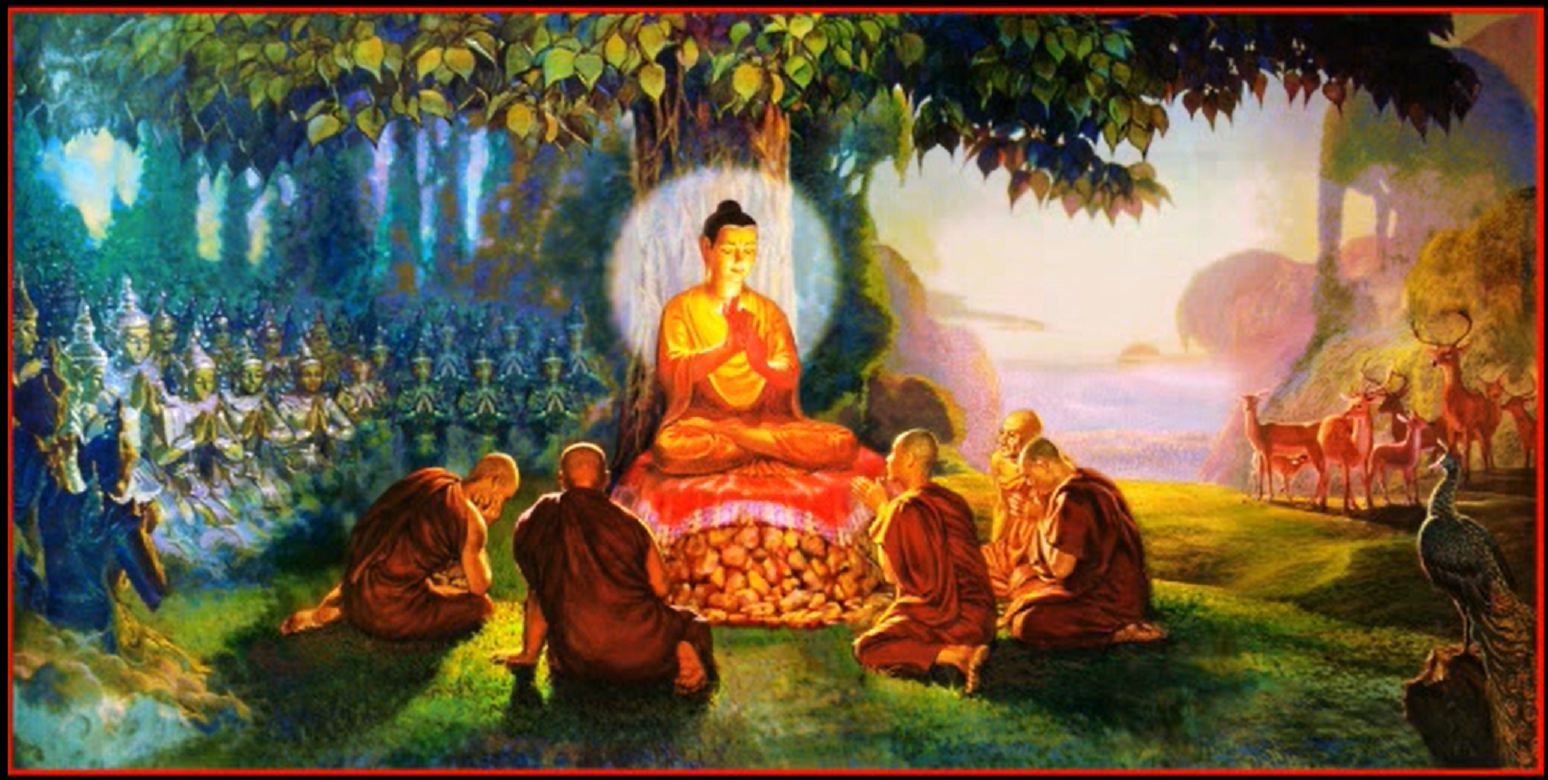
Thus have I heard. On one occasion the Blessed One (the Buddha) was living at Benares (Varanasi, India), at the Deer Park at the Resort of Seers. There he addressed the wandering ascetics [called] the Group of Five: "Meditators."

"Venerable sir," they replied. Then the Blessed One said this:

"Meditators, form is not-self. Were form self then this form would not lead to affliction, and one could get from form: 'Let my form be thus, let my form be not thus.'

"Since form is not-self, it leads to affliction, and none can get from form: 'Let my form be thus, let my form be not thus.'

"Meditators, feeling is not-self...

"Meditators, perception is not-self...

"Meditators, determinations are not-self...

"Meditators, consciousness is not self. Were consciousness self then this consciousness would not lead to affliction, and one could get from consciousness: 'Let my consciousness be thus, let my consciousness be not thus.'

"Since consciousness is not self, it leads to affliction, and none can get from consciousness: 'Let my consciousness be thus, let my consciousness be not thus.'

"Meditators, how do you conceive of it, Is form permanent or impermanent?"

— "Impermanent, venerable sir."

"Now is what is impermanent painful or pleasant [disappointing or fulfilling]?"

— "Painful, venerable sir."

"Now is what is impermanent, what is painful since it is subject to change, fit to be regarded thus: 'This is mine, this is I, this is my self'"?

— "No, venerable sir."

"Is feeling permanent or impermanent?...

"Is perception permanent or impermanent?...

"Are determinations [mental formations like will or intention] permanent or impermanent?...

"Is consciousness permanent or impermanent?"

— "Impermanent, venerable sir."

"Now is what is impermanent pleasant or painful?"

— "Painful, venerable sir."

"Now is what is impermanent, what is painful since it is subject to change, fit to be regarded thus: 'This is mine, this is I, this is my self'"?

— "No, venerable sir."

"So, meditators ANY kind of form whatsoever -- whether past, future, or presently arisen, whether gross or subtle, whether in oneself or external, whether inferior or superior, whether far or near -- must be regarded thus with right view as to how it actually is: 'This is not mine, this is not I, this is not my self.'

"Any kind of feeling whatsoever...

"Any kind of perception whatsoever...

"Any kind of determination whatsoever...

"Any kind of consciousness whatsoever -- whether past, future or presently arisen, whether gross or subtle, whether in oneself or external, whether inferior or superior, whether far or near must be regarded thus with right view as to how it actually is: 'This is not mine, this is not I, this is not my self.'

"Meditators, when a noble [arya, enlightened] follower who has heard (the truth) sees thus, that person
  • finds estrangement in form,
  • finds estrangement in feeling,
  • finds estrangement in perception,
  • finds estrangement in determinations,
  • finds estrangement in consciousness.
"When one finds estrangement, passion fades out. With the fading out of passion, one is liberated. When liberated, there is knowledge that one is liberated. One understands: 'Rebirth is exhausted, the supreme life has been lived out, what can be done has been done, of this there is no more beyond.'"

That is what the Blessed One said. The meditators were glad, and they approved of his words.

Now during this utterance, the hearts of the meditators of the Group of Five were liberated from taints through clinging no more [which is to say, they awakened, were enlightened, were liberated from suffering]. — SN 22.59
 
Explanation
FORM
: Pali rupa (what appears, appearance, matter, the evident, in particular this body). As the first of the Five Categories (or Five Aggregates) clung to as self, it is defined in terms of the Four Great Elements, namely:
  1. earth (hardness),
  2. water (cohesion),
  3. fire (temperature),
  4. air (distension and motion),
  5. [along with the negative aspect of space (what does not appear, what is not evident, what delineates matter)].
From these are derived all secondary phenomena such as persons, features, shapes, and so on: These are regarded as secondary because, while form can appear without any of them, they cannot appear without form.

It is also defined as "that which is being worn away" (ruppati), thus underlining its general characteristics of instability, impermanence, and fading away.

NOT-SELF: Together with the Four Ennobling Truths (truths leading to enlightenment), this truth of all things being impersonal is taught only by buddhas. Anatta (not-self) is a general characteristic (a universal mark of existence) without exception.

The characteristic of impermanence does not become apparent because, when rise and fall are not given attention, it is concealed by continuity:

(1) The characteristic of pain (dukkha) does not become apparent because, when continuous oppression is not given attention, it is concealed by shifting postures (changing from one posture to another, waking and sleeping).

(2) The characteristic of not-self does not become apparent because, when resolution into the various elements (that compose whatever some "thing" is) is not given attention, it is concealed by compactness (the opposite of the truth, which is that all things are composite and single things in and of themselves). — Path of Purification (Visuddhi-magga Ch. XXI).

Self-identification (identifying with things that are not self) and hunger for permanence and bliss form the principal manifestations of craving (tanha = desire, lit. thirst), guided by view that is wrong because it is not in conformity with ultimate truth.

When confronted with the contradictions and the impossibility of identifying with any of the Five Categories of Clinging's objects, craving seeks to satisfy this need by imagining a "soul" (individual or universal self).

But since no such soul, however conceived, escapes falling within the Five Categories of Clinging's objects, this solution is always doomed to failure.

Similarly, any attempt to identify self with nirvana must always fail for the same reason.

Nirvana conceived as identical (with self) or (self) as apart from it (emanence) or inside it (immanence), or nirvana conceived as "mine" is misconceived (MN 1).

This does not prevent an Awakened One from using conventional speech current in the world in order to communicate clearly with others, but one does it without misapprehending it, as is shown in the Dhammapada:

Self is savior of self;
What other savior could there be?
For only with (one-) self well tamed
One finds the savior hard to find.

Only by self is evil done,
Self-born and given being by self,
Oppressing one who knowledge lacks
As grinding diamond does a stone.
— (Dhammapada, Verses 160-1)

Similarly with the expression "in oneself" (ajjhattam) in the Second Sutra, this is simply a convenient convention for the focus of the individual viewpoint, not to be misapprehended.

A monastic heard the Buddha saying, as in the Second Sutra here, that the Five Categories are "not mine," and so on, and wondered:

"So it seems form is not-self; feeling, perception, determinations, and consciousness are not-self. What self, then, will the action done by a not-self affect?"

He was severely rebuked by the Buddha for forgetting the conditionedness (dependently originated nature) of all things (MN 109).

"It is impossible that anyone with right view should see any idea as self" (MN 115). "Whatever philosophers and deities (devas) see self in its various forms, they see only the Five Categories [clung to as self], or one or other of them" (SN 22.47).

FEELING: (vedana, sensation, impression) this is always confined strictly to the affective feelings of (bodily or mental) pleasure and pain with the normally ignored neutral feeling of "neither-pain-nor pleasure." These can be subdivided in various ways.

PERCEPTION: (sañña) means simply recognition.

DETERMINATIONS: a great many different renderings of this term are current, the next best of which is certainly "[mental] formations." The Pali word sankhara (Sanskrit samskara) means literally "a construction" [a fabrication] and is derived from the prefix sam (con) plus the verb karoti (to do, to make).

Compare the Latin conficere from con plus facere (to do), which gives the French confection (a construction).

The Sanskrit word means ritual acts with the purpose of bringing about a good rebirth.

As used in the Pali language by the Buddha, it covers any aspects having to do with action, willing, intending, motive, making, planning, using, choice, and so on (anything teleological). Of these, contact (phassa) is often placed at the head of lists defining it. Otherwise defined as bodily, verbal, and mental action (deeds, karma).

CONSCIOUSNESS: (viññana) is here the bare "being conscious" left for consideration when the other Four Categories have been dealt with.

It is only describable in individual plurality in terms of the other four categories, as fire is individualized only by the fuel it burns (see MN 38 and MN 109). Otherwise, it is regarded as an infinite (MN 111) dependent upon the contemplation of it as such.

It is only impermanent, impersonal, and unable to ever satisfy (anicca, anatta, dukkha) because however it arises, it can only do so dependent on the other categories, that is, on conditions that are themselves impermanent, unsatisfactory, and not-self.

It never arises unless accompanied by co-nascent [simultaneously arising] perception and feeling. It has six "doors" (see under Eye and Mind) for cognizing its objective fields and no more.

ESTRANGEMENT: the Pali noun nibbida and its verb nibbindati are made up of the prefix nir in its negative sense of "out" and the root vid (to find, to feel, to know intimately).

Nibbada is thus a finding out. What is found out is the intimate hidden contradictoriness in any kind of self-identification based in any way on these things (and there is no way of determining self-identification apart from them — see NOT-SELF). Elsewhere the Buddha says:

Whatever there is there of form, feeling, perception, determinations (mental formations), or consciousness, such ideas one sees as impermanent, as subject to suffering (and never a source of fulfillment but only disappointment), as a sickness, as a tumor, as a barb, as a calamity, as an affliction, as an alienation, as a disintegration, as a void, as not-self (impersonal).

One averts one's heart from those ideas, and for the most peaceful, the supreme goal (nirvana), one turns one's heart to the deathless element, that is to say, the stilling of all mental determinations, the relinquishment of all substance, the exhaustion of craving, the fading of passion, cessation, extinction (MN 64).

The "stuff" of life can also be seen in this way. Normally the discovery of a contradiction is for the unliberated mind a disagreeable one.

Several courses are then open. It can refuse to face it, pretending to itself to the point of full persuasion and belief that no contradiction is there. Or one side of the contradiction may be unilaterally affirmed and the other repressed and forgotten.

Or a temporary compromise may be found (all such expedients being haunted by insecurity). Or else the contradiction may be faced in its truth and made the basis for a movement towards full liberation from all suffering.

So, too, on finding estrangement, two main courses are open — either the search, leaving "craving for self-identification" intact, can be continued for sops to allay the symptoms of the sickness, or else a movement can be started in the direction of a cure for the underlying sickness of craving, and liberation from the everlasting hunt for temporary solutions, whether for oneself or others.

In this sense alone, "Self-protection is the protection of others, and protection of others self-protection" (Satipatthana Samyutta). More

Monday, October 28, 2019

The Crazy Dogman (sutra)

Ven. Ñanamoli (trans.), Kukkuravatika Sutra: "The Dog-duty Ascetic" (MN 57) intro by Ven. Khantipalo (accesstoinsight.org); 222paranormal; Dhr. Seven, Pat Macpherson (eds.), Wisdom Quarterly
(Aug. 28, 2016) The Dogman is described as a 7-ft. tall, blue- or amber-eyed canine with the torso of a human. This monstrous creature (werewolf or lycanthrope) has been sighted all over the world as far back as recorded history. It is said that it shows up in 10 year cycles ending in 7. Many types have been described from canine to more Sasquatch-like. Listen: 222paranormal.libsyn.com.
.
Doggy eats man, puppy chews toy, rrr.
Thus have I heard. Once the Blessed One [the Buddha] was living in the Koliyan country in a Koliyan town called Haliddavasana.

Then Punna, son of the Koliyans and an ox-duty ascetic, and Seniya -- a naked dog duty ascetic -- went to the Blessed One, and Punna paid respect to the Blessed One and sat down to one side, while Seniya the naked dog-duty ascetic exchanged greetings with the Blessed One. And when this courteous and amiable talk was finished he, too, sat down to one side and curled up like a dog. When Punna the ox-duty ascetic sat down, he asked the Blessed One: 

"Venerable sir, this naked dog-duty ascetic Seniya does what is hard to do: He eats his food when it is thrown on the ground. That dog duty has long been taken up and practiced by him. What will be his [karmic result and] destination? What will be his future course [of rebirth in samsara, the wheel of life and death, the continued wandering on of beings]?"

"Enough, Punna, enough. Let it be. Do not ask that," the Blessed One replied.

But a second... and a third time Punna the ox-duty ascetic asked the Blessed One...

"Well, Punna, since I cannot dissuade you by sayng, 'Enough, Punna, enough. Let it be. Do not ask me that,' I shall therefore tell you.

"Here, Punna, someone develops the dog-duty fully and unstintingly, develops the dog-habit fully and unstintingly, develops the dog-mind fully and unstintingly, develops dog-behavior fully and unstintingly.

"Having done that, on the dissolution of the body, after death, that person reappears in the company of dogs. But if his view is such as this: 'By this virtue or duty or asceticism or spiritual life I shall become a (great) god [brahma] or some (lesser) god [deva],' that is wrong view in this person's case. Now there are two destinations for one with wrong view, I say, perdition or the animal womb.

"So, Punna, if [Seniya's] dog duty is perfected, it will lead him to the company of dogs; if it is not, it will lead him to perdition."

When this was said, the naked dog-duty ascetic Seniya wept and shed tears.

Then the Blessed One said to Punna: "Punna, I could not dissuade you by saying, 'Enough, Punna, enough. Let it be. Do not ask that.'"

[Then the dog-duty ascetic Seniya said:] "Venerable sir, I am not weeping because the Blessed One has spoken thus. Still, this dog duty has long been taken up and practiced by me. Venerable sir, there is this Punna, son of the Koliyans and an ox-duty ascetic: The ox duty has long been taken up and practiced by him. What will be his destination? What will be his future course?"

"Enough, Seniya, enough. Let it be. Do not ask that." But a second... and a third time Seniya the naked dog-duty ascetic asked the Blessed One.

"Well, Seniya, since I cannot dissuade you by saying, 'Enough, Seniya, enough. Let it be. Do not ask that,' I shall therefore tell you."... [The same result obtains.]

When this was said, Punna, son of the Koliyans and an ox-duty ascetic, wept and shed tears. Then the Blessed One said to the naked dog duty ascetic Seniya: "Seniya, I could not dissuade you by saying, 'Enough, Seniya, enough. Let it be. Do not ask that.'"

[Then Punna said:] "Venerable sir, I am not weeping because the Blessed One has spoken thus. Still, this ox duty has long been taken up and practiced by me. Venerable sir, I have confidence in the Blessed One thus: 'The Blessed One is capable of teaching me the Dharma in such a way that I may abandon this ox duty and that this naked dog-duty ascetic Seniya may abandon that dog duty.'"

"Then, Punna, listen and heed well what I shall say."

"Yes, venerable sir," he replied. The Blessed One said:

"Punna, there are four kinds of karma proclaimed by me after my realization with direct knowledge. What are the four?
  • There is dark karma with dark ripening
  • There is bright karma with bright ripening
  • There is dark-and-bright karma with dark-and-bright ripening, and
  • There is karma that is not dark and not bright with neither-dark-nor-bright ripening that conduces to the exhaustion of karma.
"What is dark karma with dark ripening? Here someone produces a (karmic) bodily process (bound up) with affliction [defiled action expressed through body, speech, or mind], one produces a (karmic) verbal process (bound up) with affliction, one produces a (karmic) mental process (bound up) with affliction.

"By so doing one reappears in a world with affliction. When that happens, afflicting contacts [unpleasant "touches" through eye, ear, nose, tongue, body, mind] touch one. Being touched by these, one feels afflicting feelings entirely painful as in the case of beings in perdition.

So a being's reappearance is due to a being: One reappears owing to the karmas one has performed. When one has reappeared, contacts touch one. Thus do I say beings are heirs of their karmas. This is called dark karma with dark ripening.

"And what is bright karma with bright ripening?" More
Top 7 Sightings of Wolfmen in Penn


(Monstrum Athenaeum, July 2015) Whether classified as a yet-to-be identified cryptid (cryptozoological specimen) or a werewolf, the Pennsylvania Dogman has resurfaced again in [2015] to remind us that this cryptid isn’t going anywhere... The most recent sighting, documented on the Stranger Eons website, occurred in July and was reported anonymously by a man from Penfield, Pennsylvania. On his way home, the witness encountered the creature late in the day along Mountain Run Road. More

LiveScience on Lycanthropes
Benjamin Radford (LiveScience,10/30/12)

Werewolves: Lore, Legend, and Lycanthropy
Lon Chaney, The Wolf Man, 1941 (IDB)
Werewolves (literally "man-wolves") are shape-shifting creatures with unusual speed, strength, reflexes, and senses. They can be found in countless books, films, and TV shows, from the horror classic "The Wolf Man," to the "Twilight" and "Underworld" series.

Though werewolves often play second fiddle to vampires and zombies in terms of pop culture man-monsters, they have a long and rich history.

Traditionally, there were several ways a person could become a werewolf. In her book Giants, Monsters, and Dragons, folklorist Carol Rose notes that:

"In ancient Greece it was believed that a person could be transformed by eating the meat of a wolf that had been mixed with that of a human and that the condition was irreversible." Centuries later other methods were said to create werewolves, including "being cursed, or by being conceived under a new moon, or by having eaten certain herbs, or by sleeping under the full moon on Friday, or by drinking water that has been touched by a wolf."

It was also widely believed that werewolves could dress in a special, protective wolf skin, though they had to remove it at daybreak and hide it. If their magical pelt were found and taken from the werewolf-in-human-form, he or she could be killed.

A similar theme appears in the Scottish and Irish folklore of the selkies — creatures who spend their lives in the cold ocean as seals but can transform into human form by shedding their pelts. If they do so, they must hide their pelts. For if they are found they can't change back into seals and must live on land with the fishermen who possess their skins....

"Real" werewolves
True Tale of Dogman (documentary)
Though the full moon was originally only one of many possible causes of lycanthropy, it was the one that stuck in the public's mind. Today, many people still associate the moon with werewolves and madness.

Some who work in police and emergency medical services have anecdotally claimed that full moon nights are busier, crazier, and more dangerous than other nights. This perception may be rooted more in psychology and imagination than reality: carefully controlled studies have not found good evidence supporting this idea. Furthermore, there is no known mechanism by which the moon would somehow influence a person's mind to make him or her more dangerous — except of course for their own imaginations and expectations.

Today, werewolves are [thought] to be mythical creatures found in fiction instead of lurking in the dark woods, but that was not always the case. Not so long ago, belief in werewolves was common.

Overall, there was little difference between the killings and activities of wolves and werewolves: both would hunt at night, attacking sheep or livestock, and sometimes humans. The main difference was, of course, that the werewolf changed into human form at some point... More

Saturday, May 4, 2019

In search of "self"

Ven. Nanamoli, Three Cardinal Sutras; Amber Larson, Dhr. Seven (eds.), Wisdom Quarterly
Who am I? Who have I been? Will I be again? Who will I be? These are foolish questions that lead to no profit. What is suffering, its origin, its cessation, the path to its cessation? These are wise questions that lead to enlightenment here and now, in this very life (WQ).
 .
The Heart Sutra tells us that the ultimate truth is that there is NO self. What there is are Five Aggregates clung to as self. They are form, feeling, perception, formations, and consciousness. And they are EMPTY -- that is, devoid of self.

Warm for my form? This is "my" body.
FORM: The Pali word rupa means "form, what appears, appearance" [physical body]. It is the first of the Five Aggregates that make up SELF, who we are.

Form is defined in terms of the Four Great Elements, namely earth (the quality of hardness), water (cohesion), fire (temperature), and air (distension and motion), along with the negative aspect of space (what does not appear).

From these are derived the secondary phenomena such as persons, features, shapes, and so on. They are regarded as "secondary" because form can appear without any of them but they cannot appear without form.

Form is also defined as "that which is being worn away" (ruppati), thus underlining its general characteristics of impermanence and instability.
Vipassana leads to liberating insight.
NOT-SELF: Together with the Four Noble Truths, the ultimate truth of the impersonal nature of all phenomena is taught only by buddhas. Not-self (anatta) is shown as a general characteristic of all phenomena without exception.

The characteristic of impermanence does not become apparent because, when rise and fall are not given attention, impermanence is concealed by continuity.

The characteristic of disappointment/pain does not become apparent because, when continuous oppression is not given attention, it is concealed by the postures (changing from one posture to another, waking and sleeping, to become comfortable).

The characteristic of not-self does not become apparent because, when resolution into the various elements (that compose all that is) is not given attention, it is concealed by compactness [not seeing that things, in fact, are compounds of various constituents rather than compact entities].
—The Path of Purification, Visuddhimagga, Ch. XXI

Self-identification [identifying various constituents -- such as form, feeling, perception, formations, and consciousness -- as a "self"] and hunger for permanence and bliss form the principal manifestations of craving, guided by wrong view -- wrong because it is not in line with the ultimate truth of things.

When confronted with the contradictions and impossibility of self-identification with any of the Five Aggregates of Clinging's objects, craving seeks to satisfy this need by imagining a soul (or self that is individual or universal).

But since no such self or soul, however conceived, can escape falling within the Five Aggregates of Clinging's objects, this solution is always doomed to failure.

Similarly any attempt to identify self with nirvana must always fail for the same reason. Nirvana conceived as identical (with self) or (self), as apart from it (emanence), or inside of it (immanence), or nirvana conceived as "mine" is misconceived (MN 1).

This does not prevent a fully Enlightened One from using conventional speech that is current in the world in order to communicate. But a buddha does so without becoming confused or misapprehending it it, as is shown in the Dhammapada:

 
Self is savior of self; what other savior could there be?
For only with (one-) self well tamed one finds
the savior, hard to find. Only by self is evil done,
self born and given being by self, oppressing one who
knowledge lacks as grinding diamond does the stone.
— Dhammapada Verses 160-1

Similarly with the expression "in oneself" (ajjhattam) in the Second Discourse (Anattalakkhana Sutra), this is simply a convenient convention for the focus of the individual viewpoint, not to be misapprehended.


A meditator heard the Buddha saying, as in the Second Discourse here, that the Five Aggregates are "not mine" and he wondered; "So it seems form is not-self; feeling, perception, mental formations (determinations), and consciousness are not-self. What self, then, will the action (karma) done by the not-self affect?"
  • [In other words, "If only the not-self does the karma, what 'self' is going to experience the results of that karma?"]
That meditator was severely rebuked by the Buddha for forgetting the conditioned [dependently originated] nature of all arisen things (MN 109).

"It is impossible that anyone with right view should see any idea as self" (MN 115). And "Whatever philosophers and divinities see 'self' in its various forms, they see only the Five Aggregates or one or other of them" (SN 22.47).
 
FEELING: (vedana) this is always confined strictly to the affective feelings of (bodily or mental) pleasure and pain with the normally ignored neutral feeling of "neither-pain-nor pleasure." These can be subdivided in various ways.
 
PERCEPTION: (sañña) simply means recognition.
 
"Mind" is in the heart more than the brain.
MENTAL FORMATIONS: (sankhara) a great many different translations of this term are current, the next best of which is certainly "determinations." The Pali word sankhara literally means "a construction."

It is derived from the prefix sam (con) plus the verb karoti (to do, to make). It can be compared to the Latin conficere from con (plus) and facere (to do), which gives us the French confection (a construction).

The Sanskrit samkassa means ritual acts with the purpose of bringing about a good rebirth. As used in Pali by the Buddha it covers any aspects having to do with action, willing, making, planning, using, choice, and so on (anything teleological).

And contact (phassa) is often placed at the head of lists defining it. Otherwise defined as bodily, verbal, and mental action (karma).
 
CONSCIOUSNESS: (viññana) is here the bare "being conscious" left for consideration when the other four aggregates have been dealt with.

It is only describable in individual plurality in terms of the other four aggregates clung to as self, as fire is individualized only by the fuel it burns (see MN 38 and 109).

Otherwise it is to be regarded as an infinitude (MN 111) dependent upon the contemplation of it as such.

It is only impermanent, disappointing, and impersonal because however it arises, it can only do so in dependence on the other aggregates, that is, on conditions that are themselves impermanent, disappointing, and not-self.

It never arises unless accompanied by co-nascent perception and feeling. It has six "doors" (see under Eye and Mind) for cognizing its objective fields, but no more.
 
ESTRANGEMENT: the Pali noun nibbida and its verb nibbindati are made up of the prefix nir in its negative sense of "out," and the root vid (to find, to feel, to know intimately).

Nibbada is thus a finding out. What is thus found out is the intimate hidden contradictoriness in any kind of self-identification based in any way on these things (and there is no way of determining self-identification apart from them — see under NOT-SELF).

Elsewhere the Buddha says: Whatever there is here of [these Five Aggregates]
  1. form
  2. feeling
  3. perception
  4. formations, or
  5. consciousness
such ideas one sees as impermanent, one sees them as disappointing (subject to pain, unable to fulfill), as a sickness, as a tumor, as a barb, as a calamity, as an affliction, as alienating, as disintegrating, as void, as not-self.

One averts one's heart from these aggregates (groups, heaps). And for the most peaceful, the supreme goal, one turns one's heart to the deathless element (nirvana), that is to say, the stilling of all formations, the relinquishment of all substance, the exhaustion of craving, the fading of passion, cessation, extinction.
— MN 64
 
The "stuff" of life can also be seen this way. Normally the discovery of a contradiction is for the unliberated mind a disagreeable one. Several courses are then open. It can refuse to face it, pretending to itself to the point of full persuasion and belief that no contradiction is there.

Or one side of the contradiction may be unilaterally affirmed and the other repressed and forgotten.

Or a temporary compromise may be found (all such expedients being haunted by insecurity).

Or else the contradiction may be faced in its truth and made the basis for a movement towards liberation.

So too, on finding estrangement thus, two main courses are open -- either the search, leaving "craving for self-identification" intact, can be continued for sops to allay the symptoms of the sickness.

Or else a movement can be started in the direction of a cure for the underlying sickness of craving and liberation from the everlasting hunt for painkillers, whether for oneself or others.

In this sense alone, "Self protection is the protection of others, and protection of others is self-protection" (Satipatthana Samyutta). More