Showing posts with label perdition. Show all posts

Monday, October 28, 2019

The Crazy Dogman (sutra)

Ven. Ñanamoli (trans.), Kukkuravatika Sutra: "The Dog-duty Ascetic" (MN 57) intro by Ven. Khantipalo (accesstoinsight.org); 222paranormal; Dhr. Seven, Pat Macpherson (eds.), Wisdom Quarterly
(Aug. 28, 2016) The Dogman is described as a 7-ft. tall, blue- or amber-eyed canine with the torso of a human. This monstrous creature (werewolf or lycanthrope) has been sighted all over the world as far back as recorded history. It is said that it shows up in 10 year cycles ending in 7. Many types have been described from canine to more Sasquatch-like. Listen: 222paranormal.libsyn.com.
.
Doggy eats man, puppy chews toy, rrr.
Thus have I heard. Once the Blessed One [the Buddha] was living in the Koliyan country in a Koliyan town called Haliddavasana.

Then Punna, son of the Koliyans and an ox-duty ascetic, and Seniya -- a naked dog duty ascetic -- went to the Blessed One, and Punna paid respect to the Blessed One and sat down to one side, while Seniya the naked dog-duty ascetic exchanged greetings with the Blessed One. And when this courteous and amiable talk was finished he, too, sat down to one side and curled up like a dog. When Punna the ox-duty ascetic sat down, he asked the Blessed One: 

"Venerable sir, this naked dog-duty ascetic Seniya does what is hard to do: He eats his food when it is thrown on the ground. That dog duty has long been taken up and practiced by him. What will be his [karmic result and] destination? What will be his future course [of rebirth in samsara, the wheel of life and death, the continued wandering on of beings]?"

"Enough, Punna, enough. Let it be. Do not ask that," the Blessed One replied.

But a second... and a third time Punna the ox-duty ascetic asked the Blessed One...

"Well, Punna, since I cannot dissuade you by sayng, 'Enough, Punna, enough. Let it be. Do not ask me that,' I shall therefore tell you.

"Here, Punna, someone develops the dog-duty fully and unstintingly, develops the dog-habit fully and unstintingly, develops the dog-mind fully and unstintingly, develops dog-behavior fully and unstintingly.

"Having done that, on the dissolution of the body, after death, that person reappears in the company of dogs. But if his view is such as this: 'By this virtue or duty or asceticism or spiritual life I shall become a (great) god [brahma] or some (lesser) god [deva],' that is wrong view in this person's case. Now there are two destinations for one with wrong view, I say, perdition or the animal womb.

"So, Punna, if [Seniya's] dog duty is perfected, it will lead him to the company of dogs; if it is not, it will lead him to perdition."

When this was said, the naked dog-duty ascetic Seniya wept and shed tears.

Then the Blessed One said to Punna: "Punna, I could not dissuade you by saying, 'Enough, Punna, enough. Let it be. Do not ask that.'"

[Then the dog-duty ascetic Seniya said:] "Venerable sir, I am not weeping because the Blessed One has spoken thus. Still, this dog duty has long been taken up and practiced by me. Venerable sir, there is this Punna, son of the Koliyans and an ox-duty ascetic: The ox duty has long been taken up and practiced by him. What will be his destination? What will be his future course?"

"Enough, Seniya, enough. Let it be. Do not ask that." But a second... and a third time Seniya the naked dog-duty ascetic asked the Blessed One.

"Well, Seniya, since I cannot dissuade you by saying, 'Enough, Seniya, enough. Let it be. Do not ask that,' I shall therefore tell you."... [The same result obtains.]

When this was said, Punna, son of the Koliyans and an ox-duty ascetic, wept and shed tears. Then the Blessed One said to the naked dog duty ascetic Seniya: "Seniya, I could not dissuade you by saying, 'Enough, Seniya, enough. Let it be. Do not ask that.'"

[Then Punna said:] "Venerable sir, I am not weeping because the Blessed One has spoken thus. Still, this ox duty has long been taken up and practiced by me. Venerable sir, I have confidence in the Blessed One thus: 'The Blessed One is capable of teaching me the Dharma in such a way that I may abandon this ox duty and that this naked dog-duty ascetic Seniya may abandon that dog duty.'"

"Then, Punna, listen and heed well what I shall say."

"Yes, venerable sir," he replied. The Blessed One said:

"Punna, there are four kinds of karma proclaimed by me after my realization with direct knowledge. What are the four?
  • There is dark karma with dark ripening
  • There is bright karma with bright ripening
  • There is dark-and-bright karma with dark-and-bright ripening, and
  • There is karma that is not dark and not bright with neither-dark-nor-bright ripening that conduces to the exhaustion of karma.
"What is dark karma with dark ripening? Here someone produces a (karmic) bodily process (bound up) with affliction [defiled action expressed through body, speech, or mind], one produces a (karmic) verbal process (bound up) with affliction, one produces a (karmic) mental process (bound up) with affliction.

"By so doing one reappears in a world with affliction. When that happens, afflicting contacts [unpleasant "touches" through eye, ear, nose, tongue, body, mind] touch one. Being touched by these, one feels afflicting feelings entirely painful as in the case of beings in perdition.

So a being's reappearance is due to a being: One reappears owing to the karmas one has performed. When one has reappeared, contacts touch one. Thus do I say beings are heirs of their karmas. This is called dark karma with dark ripening.

"And what is bright karma with bright ripening?" More
Top 7 Sightings of Wolfmen in Penn


(Monstrum Athenaeum, July 2015) Whether classified as a yet-to-be identified cryptid (cryptozoological specimen) or a werewolf, the Pennsylvania Dogman has resurfaced again in [2015] to remind us that this cryptid isn’t going anywhere... The most recent sighting, documented on the Stranger Eons website, occurred in July and was reported anonymously by a man from Penfield, Pennsylvania. On his way home, the witness encountered the creature late in the day along Mountain Run Road. More

LiveScience on Lycanthropes
Benjamin Radford (LiveScience,10/30/12)

Werewolves: Lore, Legend, and Lycanthropy
Lon Chaney, The Wolf Man, 1941 (IDB)
Werewolves (literally "man-wolves") are shape-shifting creatures with unusual speed, strength, reflexes, and senses. They can be found in countless books, films, and TV shows, from the horror classic "The Wolf Man," to the "Twilight" and "Underworld" series.

Though werewolves often play second fiddle to vampires and zombies in terms of pop culture man-monsters, they have a long and rich history.

Traditionally, there were several ways a person could become a werewolf. In her book Giants, Monsters, and Dragons, folklorist Carol Rose notes that:

"In ancient Greece it was believed that a person could be transformed by eating the meat of a wolf that had been mixed with that of a human and that the condition was irreversible." Centuries later other methods were said to create werewolves, including "being cursed, or by being conceived under a new moon, or by having eaten certain herbs, or by sleeping under the full moon on Friday, or by drinking water that has been touched by a wolf."

It was also widely believed that werewolves could dress in a special, protective wolf skin, though they had to remove it at daybreak and hide it. If their magical pelt were found and taken from the werewolf-in-human-form, he or she could be killed.

A similar theme appears in the Scottish and Irish folklore of the selkies — creatures who spend their lives in the cold ocean as seals but can transform into human form by shedding their pelts. If they do so, they must hide their pelts. For if they are found they can't change back into seals and must live on land with the fishermen who possess their skins....

"Real" werewolves
True Tale of Dogman (documentary)
Though the full moon was originally only one of many possible causes of lycanthropy, it was the one that stuck in the public's mind. Today, many people still associate the moon with werewolves and madness.

Some who work in police and emergency medical services have anecdotally claimed that full moon nights are busier, crazier, and more dangerous than other nights. This perception may be rooted more in psychology and imagination than reality: carefully controlled studies have not found good evidence supporting this idea. Furthermore, there is no known mechanism by which the moon would somehow influence a person's mind to make him or her more dangerous — except of course for their own imaginations and expectations.

Today, werewolves are [thought] to be mythical creatures found in fiction instead of lurking in the dark woods, but that was not always the case. Not so long ago, belief in werewolves was common.

Overall, there was little difference between the killings and activities of wolves and werewolves: both would hunt at night, attacking sheep or livestock, and sometimes humans. The main difference was, of course, that the werewolf changed into human form at some point... More

Saturday, August 31, 2013

To save all beings from Hell (Ksitigarbha)

Dr. Rei-Rei, Ashley Wells, Dhr. Seven, Wisdom Quarterly; Web.singnet.com.sg UPDATED
Ksitigarbha Bodhisattva helping beings out of the many hells (namo-amituofuo)


INTRODUCTION
Poetry, metaphor, and myth can often express the most profound ethical, psychological, and spiritual insights and aspirations of a people or culture in a way that communicates to the imagination more immediately than a literal narrative may.
 
The impact of these literary forms lies not only in the written word, but also resonates on other more subtle waves. Perhaps they communicate more to the heart or the intuition than strictly to the intellect.
Whatever the reason, great works like India's Vedas, and Upanishads, the Mahabharata, and the Bhagavad-Gita, the Greek myths and epics, the Tao Te Ching, Zen koans and poems -- earth-treasures such as these have all helped to shape the thinking of whole civilizations for hundreds even thousands of years and thus have influenced the histories and the destinies of the peoples who inspired and absorbed them.
 
The Mahayana Buddhist discourses belong to this class of inspired world literature, giving expression as they do to many noble truths and -- with some, like the Heart Sutra, the Diamond Sutra, and the Flower Garland (Avatamsaka) Sutra -- attempting to express in a few words ultimate truths: "Form is emptiness, emptiness is form," "All that we see is a product of the mind," "All living beings are of a nature with the potential to awaken" (or become buddhas because they have an innate "Buddha Nature").
 
The Bodhisattva Ksitigarbha Vow Sutra is presented here, and whether viewed as literal, mythical, or perhaps somewhere between the two, it can take its own unique place among the sutras -- its ever-present underlying theme expressing the great universal truths of love, compassion, and interdependent responsibility for all beings.
 
The Bodhisattva Ksitigarbha Vow Sutra
Ksitigarbha and the Great Vow (HL Wang)
This Mahayana sutra was first translated from Sanskrit into Chinese in the 7th century A.C.E. T'ang Dynasty. The English here has been faithfully translated directly from the original archaic Chinese. In China this sutra has for hundreds of years been one of the most well-known and popular Buddhist sutras. But compared to such bodhisattvas as Avalokiteshvara and Manjushri, the name Ksitigarbha (Kishitigarba) appears to be relatively unknown in the West. 
 
According to one Chinese authority on Ksitigarbha, the reason for this obscurity lies in an ancient prophecy foretelling that this sutra would not be known outside of China and Tibet for 2,500 years after the time of Buddha -- until the Dharma-Ending Age -- our present age -- which would be ready to receive and understand it.
 
The sutra would then be revealed and spread to distant lands. Regardless of any mystique surrounding this explanation, the fact is that together with Avalokiteshvara, Manjushri, and Samantabhadra, Ksitigarbha is one of the most revered and celebrated bodhisattvas in China. Respectively, they personify the four basic Mahayana qualities of Great Compassion, Great Wisdom, Great Meritorious Deeds and, in Ksitigarbha, the Great Vow -- the vow to save all sentient beings, including hungry ghosts and beings in the hell(s).
 
Kwan Yin, Bodhisattva Avalokiteshvara, 1000 limbs to do all things (tibet-phala.com)
 
The literal translation of the Bodhisattva's Sanskrit name is "Earth-Store." The name in one sense indicates that any undesirable or troublesome thoughts "stored" or hidden deep in one's mind or heart may be uncovered and released with the help of Ksitigarbha's power -- thereby freeing the person from their negative influence.

A less literal translation, which more accurately communicates its complex significance to Western readers, could be to render it as "Earth-Treasure." In this freer sense his name expresses the many marvelous aspects of the Earth and his mysterious connection with it: The Earth is vast, it supports all [kinds of] living beings, it is impartial, it receives life-giving rain, it produces trees and crops, it holds all planted seeds which will ultimately ripen and come to fruition, it holds many treasures, it produces medicines for suffering humanity, it is not moved by storms.
 
Earth
Kwan Yin, Bodhisattva of Compassion (wiki)
And the Earth (Sanskrit, Bhumi), too, is in its own way a sentient being. The Earth-Treasure Bodhisattva has a deep relationship with human beings of the Earth and, moreover, with those "below" it -- the hungry ghosts (pretas) and hell beings (narakas). Because these are the most difficult to raise into a more fortunate condition, due to their previous unwholesome actions, and because of his past vow to save them all, Ksitigarbha has been known as the Teacher of the Dark Regions.
 
"If I do not go to hell to help them, who else will go?" is the famous declaration popularly attributed to Ksitigarbha. No matter what the crime or the karma, he is willing to have a connection with any being and to help free anyone from suffering.
 
The sutra is fundamentally a teaching concerning karmic retribution, graphically describing the consequences one creates for oneself by committing undesirable actions.
 
This is especially for the benefit of future beings in the Dharma-Ending Age in order to help these beings avoid making the mistakes that will cause them to be reborn in a low condition. With the motivation to help suffering beings always in mind, the sutra is [structured as] a discourse given by the Buddha in praise of the Bodhisattva Ksitigarbha and his heroic vow, and of the benefits one can receive from honoring Ksitigarbha and reading the sutra.

Presented in the form of a seemingly mythic dialogue between the Buddha and Ksitigarbha, the teaching takes place in a certain heaven called Trayastrimsa ("The World of the Thirty-Three"), in front of a vast multitude of buddhas, bodhisattvas, devas, and spirits [i.e., pretas, asuras, nagas, yakshas]. Immediately prior to his departure from this world, the Buddha manifested in Trayastrimsa so that he might repay the kindness of his mother who dwelt there by speaking the Dharma on her behalf.

[This would mean that, if it happened, it would have happened in the few moments before reclining into into final nirvana, Earth time, when the Buddha briefly traversed the meditative absorptions called dhyanas/jhanas. See The Last Days of the Buddha (DN 16).]

Ksitigarbha Sutra/《地藏王菩薩的故事》(3D 動畫/lifetv.org.tw/生命基金會)
 
So from another aspect the sutra deals with filial responsibility -- not only between oneself and one's parents, but also in an ultimate sense of a universal code of duty or responsibility for all living beings, all of whom a bodhisattva regards with the same kindness, consideration, and respect one would accord to one's own parents. This, together with the practice of acts for the good of all, is the Bodhisattva's vision. More

Friday, August 21, 2009

HELL (History Channel)


There are unfortunate destinations -- planes one may be reborn in if one's opportunistic karma comes to fruition in the next or some future life. It may surprise students of the Dharma to think of such possibilities. Unhappy abodes are cramped and crowded, whereas fortunate destinations are spacious and uncrowded. There are many worlds. And in each world, one may say there are as many experiences of it as there are individuals. The human world, for example, is not one place. It's 6.5+ billion places and constantly changing.

So, too, are planes of existence regarded as the Downfall, the Great Waste, Niraya. For once having fallen, there is often no clear cut way out. Eventually, it is one's skillful, wholesome, and profitable (kusala) karma coming to fruition that one is released. Negative influences may, however, not yet be exhausted and could continue to play themselves out. The human world is a mixed realm, where one experiences the fruit of both moderately skillful and unskillful actions willed and carried out in the past.

The Christian conception is an amalgamation and should be understood as grossly oversimplified. But it is this oversimplification of things that makes this religious tradition so compelling and popular. Few people want the details; we are satisfied with outlines writ large. Christianity (particularly as it became an offshoot of Judaism and as it morphed into an official Church in Roman Catholicism) has borrowed a great deal from Mahayana Buddhism, Zoroastrianism, Egyptian tradition, and of course Paganism (pre-Christian European beliefs). "Hell" is not unique to any one of these traditions.

Saturday, April 25, 2009

Life in Buddhist Hell(s)


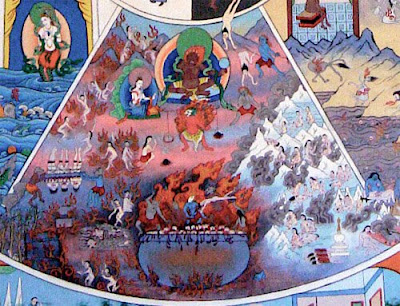
(About.com) The Hell Realm is depicted as a place partly of fire and partly of ice. In the fiery part of the realm, hell beings (narakas) are subjected to pain and torment. In the icy part, they are frozen.

Interpreted psychologically, hell beings are recognized by their acute aggression. Fiery hell beings are angry and abusive, and they drive away anyone who would befriend or love them. Icy hell beings shove others away with their unfeeling coldness. In the torment of their isolation, their aggression increasingly turns inward, and they become self-destructive. More>>
.
In fact, the idea that there are only six realms in Buddhist cosmology is a gross over simplification. The Buddha outlined 31 Planes of Existence. But this, too, is a simple outline. A closer examination of any of these general planes reveals that there are indeed many more worlds and layers within them.
.
The "Animal Realm," for example, has countless species and undersea, underground niches few people have any idea about. Similarly, the Realm of Hungry Ghosts (petas, pretas) is very diverse. The majority of planes are inhabited by devas (light beings). But the majority of beings are packed in lower realms. The hells differ, just as the celestial worlds do, according to the karma that effected rebirth there. Like the Human Realm, there are almost as many worlds as individuals to experience them. No realm is permanent but can last so long as to feel eternal.

Suggested Reading

Related Articles
The Six Realms -- Buddhist Realms of Existence and Samsara
Jizo Bodhisattva -- Jizo, Protector of Children
Weekend on the Inside: The Connections
Image Gallery: The Wheel of Life -- An Illustrated Journey
The Wheel of Life: Hungry Ghosts

Wednesday, April 22, 2009

Macabre Images of Buddhist Hell(s)


Stephanie Mee
Buddhism describes infernal planes of existence, a Great Waste, perdition.

These correspond to very weighty karma (deeds) willed and carried out. Once performed deeds wait for the opportunity to bear their result. There is not an absolute necessity of a result. But there is a remarkably strong tendency for them to bear fruit. See more in WQ's continuing coverage.

Many Christian over-simplifications and consequent misunderstandings of "hell" are based on ancient sutras that have become Eastern lore.

But there are also direct mystical visions available to rishis (seers) and contemplatives [anyone who develops profound wholesome states, meditative serenity, and the third-eye (dibba-cakkhu), which is able to directly glimpse these realms].

In the absence of direct visions, there are interpretative scenes like those surrounding Wat Kuk.

(4/22/09, The Phnom Penh Post)

"Wat [Temple] Kuk's macabre images invoke Buddhist hell"

Just outside Koh Kong City towards the Cambodian-Thai border stands Wat Mondul Seyma, a seemingly pleasant place that harbors a macabre lesson to all those who stray off the narrow path.

Wat Mondul Seyma, or Wat Kuk for short, lies among shady trees and fluttering prayer flags, a peaceful setting to gaze over the bright frescoes illustrating the life and teachings of the Buddha.

Behind the temple there is a short, unmarked path that leads down to the sea and is open to all visitors. It is beyond this path where one cannot help but feel disconnected from the peaceful surrounds of Wat Kuk.

At first glance...what looks like a lively scene of stone and concrete statues emanating from the cliff's edge.

But on further inspection, this is no ordinary scene. This is a macabre, Dante-esque vision of what will happen to those unfortunate beings whose unskilful karma leads them to be reborn in Buddhist hell. The first scene at the bottom of the path is of a group of three terrified and naked people scrambling up a tree, while a maniacally grinning demon and his barking dog wait at the bottom... More>>

Thursday, October 16, 2008

Eating Dirt: a human hell realm

Buddhist perdition -- the many "hells" briefly described -- strain credulity. However, some of these "worlds" apparently exist on earth among animals (i.e., in the ocean depths being uncovered) and among various human populations. Extraordinary forms of novel suffering present themselves from time to time in news reports, one more bizarre than the next. In this example, starving human beings are forced to resort to dust as food in Haiti.

Saturday, October 4, 2008

The Hells: Niraya ("Unhappy")


The Simpsons dealing with what is too horrible to voice (allposters.com)


Various torments, Saen Suk Buddhist temple, Thailand (http://www.payer.de/)

Hell/Underworld: Religious concepts of underworlds and hells include a thorough Buddhist concept collectively called Naraka (Pali, Niraya).

Medieval illustration of Hell in the Hortus deliciarum manuscript of Herrad of Landsberg (circa 1180)

Chinese: Diyu, Christian: Hell, Interim state, Egyptian: Duat, Germanic/Norse: Niflheim, Hel, Greek: Hades, Tartarus, Hindu: Naraka, Islam: Jahannam, Judaic: Gehenna, Sheol, Shinto: Yomi, Japanese: Jigoku.

The Great Waste or the unfortunate planes of existence in general may be unhappy, miserable, or involve torment beyond belief. They exist here and now or in the afterlife. Like the Western concept of hades or Judaism's sheol, they may or may not involve much inflicted suffering. The animal world, for example, might seem to involve less unhappiness than the human. And the human world, although counted as the lowest of the "fortunate destinations," may involve so much suffering as to merit the title "hell" from time to time. What are here being called "hells" are the various realms ranging from the animal world down to a horrific place known as Avici, with a focus on the various Nirayas.

It is incorrect to conceive of hell as strictly underground. Some "hells" are located in space, for instance the Lokantarika-niraya (SA.ii.442f.; DhsA.297f) and the Asurabhavana (where beings cast out of one heaven landed and took up residence). The fact of the matter is that there is great variety and diversity. The purpose of hells, as with all worlds, is simply to provide suitable conditions and circumstances for the experiencing of karmic results, which are almost always mixed, athough Avici itself refers to "uninterrupted" torment.


Graphic depictions making hell real have been popular. While they may lend themselves to exaggeration and poetic license, they may also approximate visions of some existing reality.

Some Buddhist hells are fiery and painful, and torment is inflicted by wardens. Some are cold and gloomy. The Realm of Hungry Ghosts is pathetic and desperate, with hunger, exposure, and few prospects. The Naraka/Niraya world is the name given to one of the worlds of greatest suffering in Buddhist cosmology. Earth-prison, limbo, shadow realm, nether region, underworld, purgatory, perdition, demonic plane, inferno all might describe layers of these unfortunate destinations.
Niraya (nir+aya) means "devoid of happiness." According to Buddhism there are several woeful states where beings exhaust unskillful karma. They are not eternal worlds of endless suffering -- but they must seem that way to the beings there. The difference between interminable and indeterminate must seem academic when hope is lost and the results seem to far outweigh the deeds that gave rise to them.

Nevertheless, with the exhaustion of the unwholesome (akusala) karma there is a possibility for the denizens residing in such states to be reborn elsewhere based on their past good actions.

  • Reference: A Manual of Abhidhamma being Abhidhammattha Saṅgaha of Bhadanta Anuruddhācariya (ed. in the orig. Pāli text with English transl. and explanatory notes by Nārada Mahā Thera, 5th rev. ed. Kuala Lumpur: Buddhist Missionary Soc., 1987).
Various torments, Wat Saen Suk, Thailand (http://www.payer.de/).

Nirayas: the Hells
Various lists of Nirayas are found in various Buddhist texts. In the Commentary to the Jātaka* there occurs the following list: Sañjīva, Kālasutta, Sanghāta, Jālaroruva, Dhūmaroruva, Mahāvīci, Tapana, Patāpana.

The Samyutta and Anguttara Nikāyas and the Sutta Nipāta contain a different list: Abbuda, Nirabbuda, Ababa, Atata, Ahaha, Kumuda, Sogandhika, Uppala, Pundarīka, Paduma (S.i.149; A.v.173; SN.p.126; see also Dvy. 67).

The Commentaries explain (e.g., AA.ii.853) that these are not separate Nirayas but specified periods of suffering in Avīci (the great hell). The Devadūta Sutra (M.iii.185) of the Middle Length Sayings (Majjhima Nikāya) contains yet another list: Gūtha, Kukkula, Simbalivana, Asipattavana, and Khārodakanadī. Other names also occur sporadically (e.g., Khuradhāra (J.v.269), Kākola (J.vi.247), Sataporisa (J.v.269), and Sattisūla (J.v.143).

The most fearful of the Nirayas is, however, the Avīci-mahā-niraya (see s.v. Avīci).

*J.v.266, 271; the same list is found in Dvy.67, except that Raurava is substituted for Jalaroruva and Mahāraurava for Dhūmaroruva.
  • Reference: Malalasekera, G. P. Dictionary of Pāli Proper Names. Pali Text Society, 1974.

Niraya is the name given to one of the multilayer worlds of greatest suffering in Buddhist cosmology. Niraya is usually translated into English as "hell" or "purgatory." It differs from the hells of Western religions in at least two important respects. First, beings are not sent to there as the result of any divine judgment or punishment; second, the length of a being's stay is not eternal, though it is usually very long.

Instead, a being is reborn there as a direct result of his or her previous karma (actions of body, speech, and mind) and resides there for a finite length of time until that karma has achieved its full result. After this karma is used up, one will be reborn in another world as a result of an earlier karma that had not yet ripened. Karma means action or doing; whatever one does, says, or thinks is a karma.

The mentality of a being in the hells corresponds to states of extreme fear and helpless anguish in humans. Physically, Niraya is thought of as a series of cavernous layers which extend below Jambudvīpa ("India" or the "human realm" in general) into the earth. There are several schemes for enumerating these hells and describing their torments. One of the more common is that of the Eight Cold Hells and Eight Hot Hells, which are described below.

Cold Hells

Arbuda – the "blister" hell. This is a dark, frozen plain surrounded by icy mountains and continually swept by blizzards. Inhabitant of this plain arise fully grown and abide life-long naked and alone, while the cold raises blisters on their bodies. The length of life in this world is said to be the time it would take to empty a barrel of sesame seed if one only took out a single seed every hundred years.

Nirarbuda – the "burst blister" hell. This world is even colder than the one above, and here the blisters burst open, leaving the beings' bodies covered with frozen blood and pus.

Aṭaṭa – the hell of shivering. Here the beings shiver in the cold, making an aṭ-aṭ-aṭ sound with their mouths.


Hahava – the hell of lamentation. Here the beings lament in the cold, going "ha, ha" in pain.

Huhuva – the hell of chattering teeth. Here the beings shiver as their teeth chatter, making the sound "hu, hu."


Utpala – the "blue lotus" hell. Here the intense cold makes the skin turn blue like the color of an utpala waterlily.

Padma – the "lotus" hell. In this hell the blizzard cracks open the frozen skin leaving one raw and bloody.

Mahāpadma – the "great lotus" hell. Here the whole body cracks into pieces and the internal organs are exposed to the cold and they also crack.

Each lifetime in these hells is twenty times the length of the one before it.

Hot Hells
Sañjīva – the "reviving" hell. In this hell the ground is made out of hot iron heated by an immense fire. Beings in this hell appear fully grown, already in a state of fear and misery. As soon as the being begins to fear being harmed by others, their fellows appear and attack each other with iron claws. Otherwise, the attendants of Yama appear and attack the being with many fiery weapons. As soon as the being experiences an unconsciousness like death, they are suddenly restored to full health and the attacks begin again. Other tortures experienced in this hell are having melted metal drop on them, being sliced into pieces, and suffering from the heat of the iron ground. Life in this hell is 162*1010 years long. It is said to be 1000 yojanas [7,000 miles] beneath Jambudvīpa and 10,000 yojanas [70,000 miles] in each direction.

Kālasūtra – the "black thread" hell. Here, in addition to the torments mentioned above, black lines are drawn upon the body, and Yama's servants cut the beings upon the lines with fiery saws and sharp axes. Life in this hell is 1296*1010 years long.

Saṃghāta – the "crushing" hell. This hell is also upon a ground of hot iron, but is surrounded by huge masses of rock that smash together and crush the beings to a bloody jelly. When the rocks move apart again, life is restored to the being and the process starts again. Life in this hell is 10,368*1010 years long.

Raurava – the "screaming" hell. Here beings run here and there looking for refuge from the burning ground. When they find an apparent shelter, they are locked inside it as it blazes around them, while they scream inside. Life in this hell is 82,944*1010 years long.

Mahāraurava – the "great screaming" hell. It is similar to Raurava but with greater pains. Life in this hell is 663,552*1010 years long.

"The Scream" -- a series of expressionist paintings by Norwegian artist Edvard Munch, depicting an agonized figure against a blood red sky. The original German title given to the work by Munch was Der Schrei der Natur ("The Scream of Nature"). The Norwegian word skrik is usually translated as scream, but is cognate with the English "shriek." Occasionally, the painting has been called The Cry. In his diary dated 22.01.1892, Munch described his inspiration for the image thus: "I was walking along a path with two friends—the sun was setting—suddenly the sky turned blood red—I paused, feeling exhausted, and leaned on the fence—there was blood and tongues of fire above the blue-black fjord and the city—my friends walked on, and I stood there trembling with anxiety—and I sensed an infinite scream passing through nature.

Tapana – the "heating" hell. Here Yama's servants impale the beings on a fiery spear until flames issue from their noses and mouths. Life in this hell is 5,308,416*1010 years long.

Pratāpana – the "great heating" hell. The tortures here are similar to Tapana, but the beings are pierced more bloodily with a trident. Life in this hell is 42,467,328*1010 years long. It is also said to last for the length of half an antarakalpa.

Avīci – the "uninterrupted" hell. Beings are roasted in an immense blazing oven with terrible suffering. Life in this hell is 339,738,624*1010 years long. It is also said to last for the length of an antarakalpa.

These hells by no means exhaust the tale of possibilities. Some sources reckon five hundred or even hundreds of thousands of different hells. In Chinese Buddhist texts, the numbers and types of hells were elaborated in a variety of creative ways; see Di Yu for examples of this sort of treatment. Tibetan Dharmapala at the Field Museum in Chicago, Illinois Yama is the name of the Buddhist god and judge of the dead, who presides over the Buddhist hells or purgatories. Although ultimately based on the god Yama of the Hindu Vedas, the Buddhist Yama has developed.

According to Puranic cosmography, the earth is divided into seven concentric island continents (sapta-dvipa vasumati) separated by the seven encircling seas, each double the size of the preceding one. Similar to the division of the human world, the hells are conceived of as subdivided underground layers even as this conception is not always applicable.

The sufferings of the dwellers in the hells often resemble those of hungry ghosts (Pretas), and the two types of being are easily confused. The simplest distinction is that beings in hell are confined to their subterranean world, while the hungry ghosts are free to move about. A hungry ghost is a kind of ghost associated with hunger common to many religions.

The Hells in Buddhist literature
Descriptions of the hells are a common subject in some forms of Buddhist commentarial and popular literature as a caution against the fate that befalls evildoers and an encouragement to virtue.

The Mahāyāna Sūtra of Bodhisattva Kṣitigarbha (Dìzàng or Jizō) graphically describes the sufferings in hell and explains how ordinary people can transfer merit in order to relieve the sufferings of the beings there. Ksitigarbha Bodhisattva is often known in Japanese as JizÅ or in Chinese as Dizang, is a popular Mahayana Buddhist Bodhisattva, usually depicted as a monk.

The traditional Chinese Buddhist story of Mulian explains how this disciple of of the Buddha spiritually journeyed to one hell to help his mother, who had been reborn there, obtain a better rebirth. Maudgalyayana (Pali: Mahamoggallana; Jp: Mokuren; Ch: Mohemujianlian), also known as Mahamaudgalyayana, was one of the Buddha Shakyamuni's disciple foremost in supernatural powers.

The Japanese monk Genshin began his Ōjōyōshu ("Essentials of Salvation") with a description of the suffering in hell. Tibetan Lamrim texts also included a similar description. Genshin (942-1017) was the most influential of a number evangelists active during the eleventh and twelfth centuries in Japan.

Chinese Buddhist texts considerably enlarged upon the description of hell (Dì Yù), detailing additional hells and their punishments, and expanding the role of Yama and his helpers, Ox-Head and Horse-Face. In these texts, hell became an integral part of the otherworldly bureaucracy which mirrored the Imperial Chinese administration. Feng Du (Traditional Chinese: pinyin) is the realm of the dead in Chinese mythology.