Showing posts with label worlds. Show all posts

Thursday, April 25, 2024

Getty Museum: Greek, Maya, Moche (LA)

(Plan your visit: getty.edu)

FEATURED EXHIBITION Picture Worlds Greek, Maya, and Moche Pottery (Runs until July 29, 2024)
Art of the Americas and the Old World
GETTY VILLA, Malibu, Los Angeles: Plan a visit to see mighty deities, brave heroes, and fantastic beings adorn the terracotta vessels of the ancient Greeks in the Mediterranean, the Maya in Central America, and the Moche of northern Peru.

This exhibition juxtaposes these three distinct ceramic traditions and explores the ways in which painted pottery served as a dynamic means of storytelling and social engagement.


This exhibition is presented in English and Spanish. Esta exhibición se presenta en inglés y en español. More: getty.edu
Generous support provided by Jeffrey P. Cunard and the Getty Patron Program Additional support from Charles and Ellen Steinmetz in honor of Professor Christopher B. Donnan. SELECTED WORKS Plate with Hunters Shooting a Supernatural Bird, Maya, 600–900 CE. Terracotta. Museo Maya de Cancún, Secretaría de Cultura-Instituto Nacional de Antropología e Historia. Image: © D.R. Secretaría de Cultura-INAH- MEX. Ignacio Guevara Explore the Exhibition Discover more about the dynamic picture worlds of the Greeks, Maya, and Moche
  • Getty.edu; Crystal Q., CC Liu (eds.), Wisdom Quarterly

Tuesday, August 8, 2023

American girl remembers past life in Egypt

LMN, July 12, 2023; Amber Larson, Ananda (DBM), Dhr. Seven (eds.), Wisdom Quarterly
.
Young girl reborn (reincarnated) from an ancient world | The Ghost Inside My Child
Reliving Past Lives (Dr. Helen Wambach, PhD)
(LMN) What if your 11-year-old daughter, son, nonbinary imp, or the wise elder fairy-being born of your womb remembered being from a place no one until modern times even knew existed (a place called Heracleion now sitting underwater), and she remembered the dead language and could spell it, too?

In this episode of The Ghost Inside My Child, a young American girl remembers once living a past life in an ancient island civilization on the tip of Egypt with major Ancient Greek influenced that was ruined by a massive earthquake that science only discovered in the year 2000 under the sea off the tip of modern Egypt, a place heavily influenced by the Ancient Greek civilization, a place also called Thonis.
See more in this clip from The Ghost Inside My Child, Season 1, Episode 9, "Ancient Flood and Confederate Blood."

Thonis Herakleion: The Sunken City of the Pharaohs

(Geographics) The Mediterranean is home to many mysteries and wonders, natural beauties and human made. There's lots to be found at the bottom of the sea. Who knew the Ancient Greeks influenced the Ancient Egyptians in any way? Credits: Host Simon Whistler. Author Arnaldo Teodorani. Producer Jennifer Da Silva. Executive producer Shell Harris.

Subscribe for more from The Ghost Inside My Child and other great LMN shows: mylt.tv/3aTTVPI. Check out exclusive LMN content: Website (mylifetime.com), facebook.com/LMN, twitter.com/LMN.

With a diverse mix of original movies and series, LMN is the entertainment destination for women [no men allowed, except for allies and must be accompanied by a real woman, whatever that may be and however one may define that as their is no objective measure anyone dare mention] to connect to powerful stories and experience real emotion.

LMN is currently the top network among women in 85 million homes or fewer. LMN is a division of A+E Networks, a joint venture of the Disney-ABC Television Group and Hearst Corporation. LMN #TheGhostInsideMyChild

Thursday, December 14, 2017

Meditate on dead bodies (Body Worlds: Pulse)


Body Worlds: PulseDiscover the west coast debut of the largest BODY WORLDS exhibition in a decade, with new real dead human bodies!

Come experience inventor Dr. Gunther von Hagens’ BODY WORLDS: Pulse -- a convergence of aesthetic anatomy, health, and wellness.
 
This special exhibition presents real human bodies in sickness and health. Discover the human body's vulnerabilities and potential,and many of the challenges the human body faces as it navigates the 21st century.

We love being naked. Plastinate us, too!
More than 200 plastinated specimens of real human bodies -- including whole bodies, translucent slices, and organs -- are curated and presented in galleries that feature the different systems of the body.

The locomotive, nervous, respiratory, circulatory, digestive, and reproductive systems are revealed in precise detail through Dr. von Hagen’s invention of plastination, providing a glimpse into the human anatomy that was once only available to medical practitioners.

Don't worry, kids. These corpses are clean, sterile, soaked in plastic, and look real nice.
AUTOPSY: Theravada Buddhist monks contemplate naked female corpse: lust evaporates
If only you could have seen our pretty skins!
Featured plastinates include an obese body slice, a smoker’s black lung, a liver with cirrhosis, and hardened arteries that show the impact of ill health.
 
In contrast, dancers, sports figures, and a pregnant woman bearing life illustrate how bodies function when lifestyles support good health and well-being.
 
Through interactive multimedia, guests can explore the wonders of the human body and marvel at its elegance and complexity.
 
Discover what makes YOU move, what makes you tick, and what makes you unique in the largest BODY WORLDS exhibition in a decade. More

Tuesday, February 16, 2010

Dimensional Spheres and Nirvana


(BBCWorldwide) Scientists discuss what sort of life could be found in the 11th dimension. With talk of worlds of lightning bolts, electricity, unstable atoms, and more -- from the BBC show "Parallel Universe." It is full of mind-bending theories to set imaginations racing.

The Buddha gives illustrates the way in which the goal of Buddhist practice -- nirvana -- is set apart from all conditioned phenomena:

“Monastics, there is a state where there is no earth, no water, no fire, no air; no base consisting of the boundlessness of space, no base consisting of the boundlessness of consciousness, no base consisting of the boundlessness of nothingness, no base consisting of the boundlessness of neither perception nor non-perception; neither this world nor another world nor both; neither sun nor moon.

"Here, monastics, I say there is no coming, no going, no staying, no ceasing, no rising. Not fixed, not movable, it has no support [i.e., the mind finds no foothold]. Just this is the end of suffering” (Udana).

What is interesting about this list is that it not only negates worldly phenomena but also other-worldly phenomena [such as the exquisite pleasure and bliss of the jhanas], which meditators might get fixated on. Earth, air, fire, and water are the four primary elements (the characteristics of material), out of which matter and "things" are composed.

So in negating those elements, as well as he sun and moon, it is clear that nirvana is unlike any world we are familiar with or can conceive of -- yet it is knowable. It can be experienced. The passage goes on to say, it is “neither this world nor another world nor both.” This cuts off identification of nirvana with any world including the form and formless heavens.

Buddhist cosmology views the cosmos as divided into three realms: the realm of desire, the realm of [fine material] form, and the formless realm [which is purely mental]. These three realms consist of all the many regions wherein one undergoes Samsara, the cycle of birth and death. The realm of desire encompasses the many hellish worlds, the planes of hungry ghosts, animals, humans, fighting titans (asuras), and the first six of the many celestial worlds in space. ("Seventh heaven" and more lie just beyond those spheres).

The realm of desire is so called because all the beings within it are primarily motivated by their desire for sensual pleasures. And it is within the realm of desire that they reap the rewards of their profitable and unprofitable deeds (karma).

The realm of form consists of 18 higher celestial worlds, which correspond to the four states of jhana (Sanskrit, dhyana; Japanese, Zen) or meditative absorption beyond access concentration. More>>

Friday, October 16, 2009

31 Planes of Existence (charts)

Susan Elbaum Jootla (Buddhist Publication Society, Wheel 414/416)

Tibetan mandala Kalachakra cosmogony (buddismnews.blogspot.com)

The Buddhist universe consists of thirty-one planes of existence (see chart). Every being lives on one or another of these planes. After death all beings, except arahants, will be reborn in a realm and under circumstances that accords with their karma — their volitional actions of body, speech, and mind willed and accumulated in that or any previous existence.

The lowest area (Planes 1-11) is called the Sensuous Sphere; sense experience predominates. Next comes the Fine-material Sphere (12-27) attained by practicing the fine-material absorptions (rupa-jhanas). Above that is the Immaterial Sphere (28-31) attained by practicing the immaterial absorptions (arupa-jhanas).

Although humans appear to be rather low on the scale, many intelligent deities long for rebirth on this plane. Why? The human world provides the best opportunity to practice the Dharma and attain liberation: On the lower four planes, little progress can be made because suffering is gross and unrelenting and the opportunity to perform deeds of merit is rarely gained. The very bliss of the higher planes beclouds the universal characteristics of all phenomena (impermanence, unsatisfactoriness, and the lack of any lasting, controlling self). And without fully comprehending these principles, there is no motivation to develop the detachment from the Round of Rebirth that is essential to liberation.

Saturday, April 25, 2009

Life in Buddhist Hell(s)


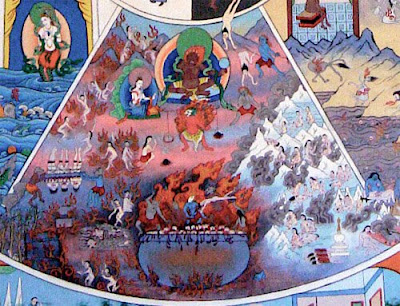
(About.com) The Hell Realm is depicted as a place partly of fire and partly of ice. In the fiery part of the realm, hell beings (narakas) are subjected to pain and torment. In the icy part, they are frozen.

Interpreted psychologically, hell beings are recognized by their acute aggression. Fiery hell beings are angry and abusive, and they drive away anyone who would befriend or love them. Icy hell beings shove others away with their unfeeling coldness. In the torment of their isolation, their aggression increasingly turns inward, and they become self-destructive. More>>
.
In fact, the idea that there are only six realms in Buddhist cosmology is a gross over simplification. The Buddha outlined 31 Planes of Existence. But this, too, is a simple outline. A closer examination of any of these general planes reveals that there are indeed many more worlds and layers within them.
.
The "Animal Realm," for example, has countless species and undersea, underground niches few people have any idea about. Similarly, the Realm of Hungry Ghosts (petas, pretas) is very diverse. The majority of planes are inhabited by devas (light beings). But the majority of beings are packed in lower realms. The hells differ, just as the celestial worlds do, according to the karma that effected rebirth there. Like the Human Realm, there are almost as many worlds as individuals to experience them. No realm is permanent but can last so long as to feel eternal.

Suggested Reading

Related Articles
The Six Realms -- Buddhist Realms of Existence and Samsara
Jizo Bodhisattva -- Jizo, Protector of Children
Weekend on the Inside: The Connections
Image Gallery: The Wheel of Life -- An Illustrated Journey
The Wheel of Life: Hungry Ghosts

Monday, October 6, 2008

Note on Lifespans


Beings suffer in woeful states and enjoy pleasant worlds in accordance with their karma. Their age-limit differs according to the gravity of the unskillful/skillful deed. Some are short-lived, and some are long-lived.

Queen Mallika, wife of King Pasenadi of Kosala, for instance, suffered in a woeful state for only seven days. On the other hand, Devadatta -- who attempted to kill the Buddha, cause a schism in the Sangha, and encouraged Prince Ajatasattu to kill his father (the stream-enterer King Bimbisara) among other things -- is destined to suffer for an aeon.

At times, earthbound deities live for only seven days."

Reference: A Manual of Abhidhamma (a translation by Ven. Narada of the Abhidhammattha Saṅgaha of Bhadanta Anuruddhācariya (ed. of the original Pāli text) with English transl. and explanatory notes by Nārada Mahā Thera. 5th rev. ed., Kuala Lumpur: Buddhist Missionary Society, 1987.

Lifespan or life term (Pali, kappa) refers to the practical maximum length of life in various worlds under normal circumstances. Whereas it is said that Gautama Buddha could have lived an "aeon" (kappa) if he wished, it makes more sense to understand the term as "normal lifespan" in that instance. He passed away at 85 when, if Ananda had requested him, he could have lived to 120, which was the normal maximum life term at that time. It seems that 120 is still the lifespan in the human world, perhaps having already dropped to 100.

Clearly, this is neither an average nor an absolute ceiling. This being the case, when cosmological detail like lifespans of demigods, high divinities, or denizens of the unfortunate destinations are given, they should be understood as gross generalizations. Individual circumstances vary as discussed above.

Furthermore, the measurement is difficult since lifespans on earth used to be much longer. In Buddhist Birth-Stories: Jataka Tales translated by C.A.F. Rhys Davids (translated from Prof. V. Fausboll's edition of the Pali text by Mrs. Rhys Davids, p. 81 ff.) is "the story of the lineage." It details the lives of previous buddhas, their chief disciples, lifespans, heights, and so on. Surprisingly, since these buddhas appeared aeons (inconceivably long periods) ago in the human world, they were much taller and lived much longer, even 80,000 years.

Therefore, our assumptions about human life are not accurate, and cannot be generally stated, how much less the details of other worlds? Any time spent in a hell of torment (rather than simply the miserable hells) would seem an eternities. The elapsing of an age, epoch, or world-cycle is inconceivable even under normal circumstances, all the more under duress.