Tuesday, July 16, 2024
Prophet predicted Trump's shooting in March
Friday, October 21, 2022
Veils get thin, Dead are here again (video)
![]() |
| Let's celebrate and chase the ghosts away. |
![]() |
| ♫ Spooky Podcasts | iHeart |
- 00:00 - Intro: What is this fest?
- 00:21 - Why is it called that?
- 01:12 - How to Celebrate it?
- 02:04 - 8 Things to NEVER DO!
Monday, March 7, 2016
KARMA: Two brothers win same lottery, but...
![]() |
| The purpose of life in the USA is to get money, hoard money, live for money...then lose it. |
Bob Stocklas will take home just $7, it's true but will get to keep it all, whereas James faces a lot of taxes.
Senior District Judge James Stocklas, 67, discovered he and two friends had won the $291 million jackpot Friday, after he wrapped up a month-long fishing holiday with his brother and sister-in-law in the Florida Keys.| The cause of winning the lottery is karma, so winning late in life is a curse. Had one instead won early in a rebirth in a good destination, the same karma could have paid off over an aeon (kappa) in a better world. Better to store up much merit for later (Sayalay Susila). |
SUTRA: "The Brief Exposition of Karma"
![]() |
| The Buddha was not called a "Buddhist" in ancient India; he was called a karmavadin, a "teacher of the results of action." (Norton Simon Museum, Pasadena (Artfan70/flickr.com). |
Many of us want: long life, health, beauty, power, riches, high birth, wisdom, or at least some of these things. The Buddha teaches that they do not appear by chance. It is not our "luck" that we are healthy, or another's lack of it that s/he is foolish.
Although it may not be clear to us now, all such inequalities among beings come about because of the karma they have made (willed, carried out, and thereby stored up for themselves) individually. Each person reaps his/her own fruits (and mental resultants).
KARMA INVOLVES CHOICE: So if one is touched by short life, sickliness, ugliness, insignificance, poverty, low birth, or foolishness and one does not like these things, there is no need to just accept that things are the way they are. The future need not be like that! Provided one makes the right kind of karma now.
Knowing what karma to make and what not to make is the mark of a wise person. It is also the mark of one who is no longer drifting aimlessly but has some direction in life and some control over the sort of events that will occur.
THE SUTRA
1. Thus have I heard. On one occasion the Blessed One was living at Savatthi in Jeta's Grove, Anathapindika's Park.
Then Subha the student (Brahmin), Todeyya's son, went to the Blessed One and exchanged greetings with him. And when the courteous and amiable talk was finished, he sat down respectfully to one side. When he had done so, Subha the student said to the Blessed One:
2. "Master Gautama [a Brahmin's respectful form of address for the Buddha], what is the reason, what is the condition, why inferiority and superiority are met with among human beings, among humankind? For one meets with short-lived and long-lived people, sick and healthy people, ugly and beautiful people, insignificant and influential people, poor and rich people, low-born and high-born people, foolish and wise people. What is the reason, what is the condition, why superiority and inferiority are met with among human beings, among humankind?"
3. "Student, beings are owners of karmas (actions willed and carried out), heirs of karmas; they have karmas as their progenitor, karmas as their kin, karmas as their homing-place. It is karmas that differentiate beings according to inferiority and superiority."
4. "I do not understand the detailed meaning of Master Gautama's utterance spoken in brief without expounding the detailed meaning. It would be good if Master Gautama taught me the Dharma so that I might understand the detailed meaning of Master Gautama's utterance spoken in brief without expounding the detailed meaning."
"Then listen, student, and heed well what I shall say."
"Even so, Master Gautama," Subha the student replied. And the Blessed One said this:
Deeds and results
5. "Here, student, some man or woman is a killer of living beings, murderous, bloody-handed, given to blows and violence, merciless to living beings. Due to having performed and completed such karmas, on the dissolution of the body, after death, s/he reappears in a state of deprivation, in an unhappy destination, in perdition, even in hell(s).
![]() |
| Various "hells" in Buddhist and Hindu cosmology |
"This is the way that leads to short life, that is to say, to be a killer of living beings, murderous, bloody-handed, given to blows and violence, merciless to living beings.
6. "But here some man or woman, having abandoned the killing of living beings, abstains from killing living beings, lays aside the rod and the knife, is considerate and merciful, and dwells compassionate for the welfare of all living beings.
"Due to having performed and completed such karmas as this, on the dissolution of the body, after death, one reappears in a happy destination, even in a heavenly world.
"If, on the dissolution of the body, after death, instead of reappearing in a happy destination, in a heavenly world, one comes again to the human state [because of some intervening bad karma], one is long-lived wherever one is reborn.
"This is the way that leads to long life, that is to say, to have abandoned the killing of living beings, to abstain from killing living beings, to lay aside the rod and the knife, to be considerate and merciful, and to dwell compassionate for the welfare of all living beings.
7. "Here, student, some man or woman is one who harms beings with hands or with clods or with sticks or with knives. Due to having performed and completed such karmas, on the dissolution of the body, after death, one reappears in a state of deprivation...
"If instead one comes again to the human state, one is sickly wherever one is reborn. This is the way that leads to sickness, that is to say, to be one who harms beings with one's hands or with clods or with sticks or with knives.
![]() |
| Death (Yama) rules samsara: Sense Sphere |
"If instead one comes again to the human state, one is healthy wherever one is reborn. This is the way that leads to health, that is to say, not to be one who harms beings with hands or with clods or with sticks or with knives.
9. "Here, student, some woman or man is angry, much given to rage. Even when little is said, one is furious, angry, ill-disposed, resentful, one shows ill-temper, hate, and surliness. Due to having performed and completed such karmas [as fuming and/or expressing anger], on the dissolution of the body, after death, one reappears in a state of deprivation...
"If instead one comes again to the human state, one is ugly wherever one is reborn.
"This is the way that leads to ugliness, that is to say, to be furious, angry, ill-disposed, resentful, and to show ill-temper, hate, and surliness.
10. "But here some man or woman is not angry or much given to rage. Even when much is said, one is not furious, angry, ill-disposed, resentful, nor does one show ill-temper, hate, or surliness. Due to having performed and completed such karmas, on the dissolution of the body, after death, one reappears in a happy destination...
"If instead one comes again to the human state, one is beautiful wherever one is reborn. This is the way that leads to beauty, that is to say, not to be angry or given to much, and even when much is said, not to be furious, angry, ill-disposed or resentful, or to show ill-temper, hate, or surliness.
11. "Here, student, some man or woman is envious; one envies, begrudges, and harbors envy about others' gains, honor, veneration, respect, salutations, and offerings. Due to having performed and completed (willed and carried out) such karmas, on the dissolution of the body, after death, one reappears in a state of deprivation...
"If instead one comes again to the human state, one is insignificant wherever one is reborn. This is the way that leads to insignificance, that is to say, to be envious, to envy, begrudge, and harbor envy about others' gain, honor, veneration, respect, salutations, and offerings.
12. "But here some man or woman is not envious, does not envy, begrudge, or harbor envy about others' gain, honor, veneration, respect, salutations, and offerings. Due to having performed and completed such karmas, on the dissolution of the body, after death, one reappears in a happy destination...
"If instead one comes again to the human state, one is influential wherever one is reborn. This is the way that leads to influence, that is to say, not to be envious, not to envy, begrudge, or harbor envy about others' gain, honor, veneration, respect, salutations, or offerings. More
Saturday, August 31, 2013
To save all beings from Hell (Ksitigarbha)
![]() |
| Ksitigarbha Bodhisattva helping beings out of the many hells (namo-amituofuo) |
- Special Ksitigarbha Service, Sept. 1, 2013
- Ling Yen Temple, Etiwanda, California
![]() |
| Ksitigarbha and the Great Vow (HL Wang) |
![]() |
| Kwan Yin, Bodhisattva Avalokiteshvara, 1000 limbs to do all things (tibet-phala.com) |
![]() |
| Kwan Yin, Bodhisattva of Compassion (wiki) |
[This would mean that, if it happened, it would have happened in the few moments before reclining into into final nirvana, Earth time, when the Buddha briefly traversed the meditative absorptions called dhyanas/jhanas. See The Last Days of the Buddha (DN 16).]
Thursday, November 17, 2011
Sex with animals tied to penile cancer in men
Wednesday, May 25, 2011
Sex life of the ancient Buddhist nun Isidasi
Isidasi, Uppalavanna, Janapada Kalyani, Khema, Prajapati... beautiful Buddhist nuns seem to be the norm now as before.In the city of Pataliputta, treasured
on Earth for its glorious flowers,
there were two wandering nuns from the Buddha's own Sakya clan.
One was Isidasi Bhikkhuni, the other Bodhi Bhikkhuni,
both of them virtuous, skilled in meditation, wise,
and freed from painful vices.
They walked for alms, ate dana [charitable donations of food],
washed their earthenware bowls,
and found a place to rest and share their stories.
Bodhi the nun: "You're still beautiful, Isidasi.
Your youth has not yet faded.
What dreadful vision drove you
to renounce the world?"
In that place she told her tale to teach the truth of the Buddha's path. Isidasi the nun replied to Bodhi:
"Hear why I am a wandering nun:
In the great city of Ujjeni,
my father was a merchant of great repute.
I was his only daughter,
deeply loved and pampered.
"A wealthy merchant sent noblemen
from the city of Saketa
to arrange a marriage for his son.
And my father gave me to be that merchant son's wife.
"Day and night I humbled myself
to honor my in-laws.
My training made me bow
my head down at their feet.
When I saw my husband's
sisters and brothers,
I cringed and crept away
to free my seat for them.
I kept fresh-cooked food and drink
and spiced appetizers ready
to serve their demands.
"I woke early every morning
to scrub my hands and feet
before I crossed the threshold

to receive my husband's blessing.
Like a slave girl,
I took combs and scented oils
and my mirror to groom him.
I cooked his rice gruel,
I washed his bowl,
I waited on this husband
like a mother doting on her son.
"Though I was diligent and humble,
meticulous and virtuous
in serving him,
my husband despised me!
He begged his parents,
'Give me your leave.
I must go away. I will not stay
in this house with Isidasi!'
"'Don't speak this way, son!
Isidasi is intelligent and wise,
diligent, meticulous.
Why does she not please you, son?'
"'She does me no harm,
but I will not stay with Isidasi.
I detest her! Enough!
Give me leave, I must go away! '
"My husband's parents
heard his words and questioned me:
'How did you offend him?
Confide what really happened.'
"'I committed no offense or harm
or ever answered his cruel words.
I don't know what I did
to make my husband hate me.'
"They took me back
to my father's house.
'To keep our precious son,
we sacrifice this goddess.'
"Then my father married me
into another wealthy house. The second merchant took me
for half the dowry of the first.
I lived in that house
for barely a month,
serving him like a slave until he sent me back.
"Then my father snared a Buddhist ascetic
on his alms round in front of my father's house; he said,
'Be my daughter's husband!
Throw away your robe and bowl and cup! [You will get
a beautiful wife, riches, and this house in return.]'
"He stayed for only two weeks
before he begged my father:


'Give me my robe and bowl!
I'll wander for alms again!'
"My parents and my family
beseeched him:
'What have we neglected?
Quickly, name your every want!'
"He answered, 'I only want enough to feed myself.
I will not stay in this house
with Isidasi!'
They released, him and he left.
"I brooded in my solitude [contemplating how death
would be better than this humiliation]:
'I'll tell them I'm going to die
unless I can renounce and become a wandering nun.'
"Then the great Buddhist nun Jinadatta Bhikkhuni
came walking for alms
to my father's house. She was
disciplined, wise, and virtuous.
"I rose when I saw her
and offered her my seat.
I bowed at her feet
and offered her charity.
I served her fresh-cooked food
and drink and spicy appetizers.
"When she had eaten I said,
'Lady, I want to be a nun.'
My father argued: 'My child,
you may follow the Buddha's path
by offering food and drink to wandering ascetics and brahmins.'
"I pleaded in tears, begging his blessing:
'I must destroy
the unprofitable karma I have done [in past lives]!'"
Isidasi then reported what she had realized in her advanced meditation, which revealed a pattern extending over her eight preceding lifetimes.]
"When I was 16
the son of this merchant
noticed my maiden youth
and took me.
He had another wife,
who was virtuous and ethical,
in love with her husband.
"I sowed discord between them."
[Prior to that, according to the Buddhist nun and modern Abhidharma scholar Sayalay Susila, Isidasi was reborn as a man, a charming goldsmith who seduced and took delight in seducing many men's wives. Without realizing it, he hurt husbands and broke up families. As a result, he was reborn in the niraya (hellish planes of existence where he suffered horribly in ways too terrible for most modern readers to believe). After a very long time -- suffering exponentially more than the suffering he had caused -- he was reborn in the animal realm as an infant male monkey. When brought before the alpha male, that monkey leader immediately bit off the infant's genitals as if sensing and wishing to prevent future rivalry. Thereafter, he was reborn as a hermaphrodite, then again as a female, all stemming from making a habit of sexual misconduct in that former life. The story of past lives relating to her present misery continues in a former life as a female.]
"As a result I was reborn.
The fruit of seven former lives
made three husbands scorn me,
even though I served them like a slave.
I have ended all this now. "
Pandaka: Sex Addiction and Perversion

Sexual Addiction and Perversion
Wisdom Quarterly (ANALYSIS)
Ananda -- the Buddha's cousin, attendant, and chief memorizer of sutras -- was said to be a paแนแธaka in one of his many previous lives. What often goes unsaid is how many past lives we have led. The same was said of the Buddhist nun Isidฤsฤซ (from the "Pslams of the Sisters" or Therigatha, inspired verses of enlightened Buddhist nuns).- Pandaka is variously and unsatisfactorily translated as eunuch, homosexual, or hermaphrodite. The best translation might be "pervert," compulsive sex maniac, transgendered compulsive permiscuous sex maniac, rake, rogue, or wanton libertine often bi or pansexual.
- How many past lives? There is no counting the number of many past lives living beings have endured in this dismal and abysmal "continued wandering on" that is samsara, the Cycle of Birth and Death. If one were to gather up all the bones from past births in physical form on Earth, the pile would be larger than the highest mountain. The amount of blood shed as beings reborn in dense form only to be beheaded as animals and criminals exceeds the amount of water in the great oceans. The Buddha gives many similes hinting at the incomprehensible number of rebirths already endured.
For example, they may have been molested, traumatized, or otherwise abused setting them on a perilous trajectory of sexual misconduct, prostitution, disease, child molesting, bestiality, sexual addiction, treachery, drug abuse, and so on.
There was certainly a time when homosexuality was unthinkable. However, what is neglected in most discussions, is that what is "homosexual" changes. Our modern American definition does not have an equivalent. The Western world does not agree what this term means even now. This country does not agree on what it means from location to location, and our definition changes over time.

While this may be hard for many readers to fathom, because after all we are talking about modern America, others may be sympathetic to the fact that behavior in prison, jail, same sex schools, slumber parties, during prepubescent experimentation, early developmental phases, or drunken episodes follows different rules.
Most Americans probably do not think simple same sex attraction is "perverted." But that is only a recent development. Male homosexuality is often treated as worse or more offensive than equivalent female behavior. Various reasons are given for this, but all of these are social constructs not "natural" categories.
We applaud girl-on-girl kissing; does that mean it is not homosexual (lesbian) or not "perverted." It used to be.
With males, the case is more ludicrous. In prison, in various cities, and in the minds of many Americans, "homosexuality" is not as much about states (behavior) so much as traits (character). So one could engage in gay activities and not consider oneself gay.
For example, the one on top is "straight" and "masculine" and "virile," whereas the bottom (recipient) is "bent" and "effeminate" and "weak." The absurdity -- our hypocrisy -- is that attributions flip depending on the act, in this case going from intercourse to oral sex.
Pandaka is most frequently translated as "eunuch." But eunuch in India, even today, does not mean what eunuch means to European and North American ears.
- One of the few books that covers this sensitive topic is Buddhism, Sexuality, & Gender edited by Ignacio Cabezon
Saturday, May 8, 2010
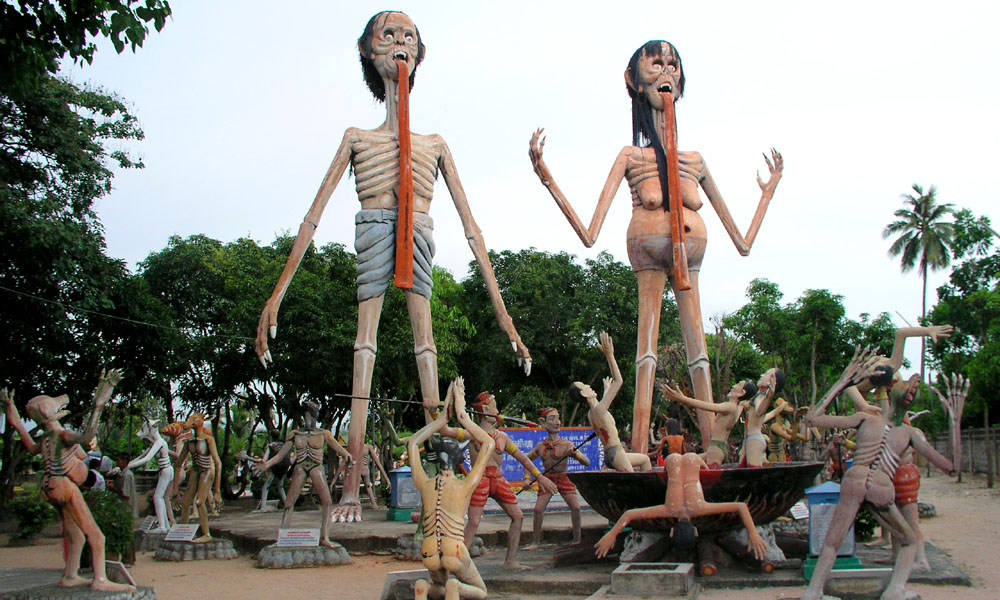
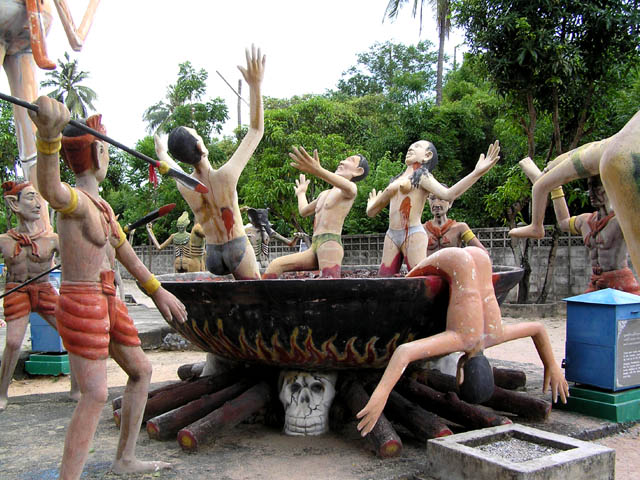
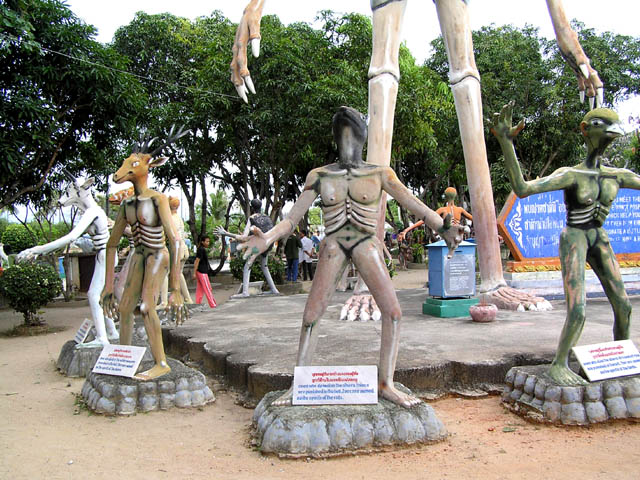
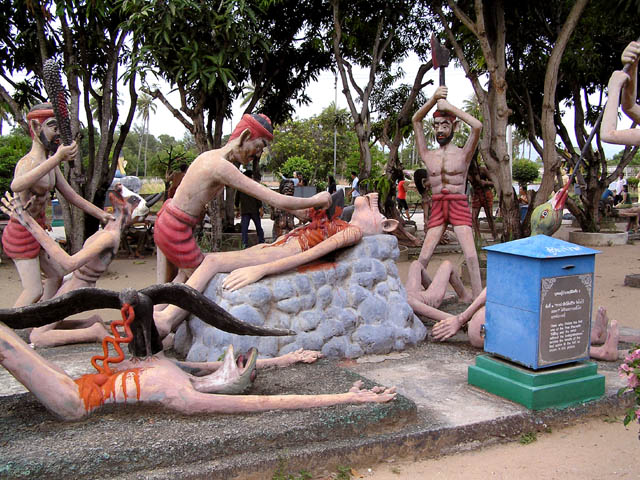
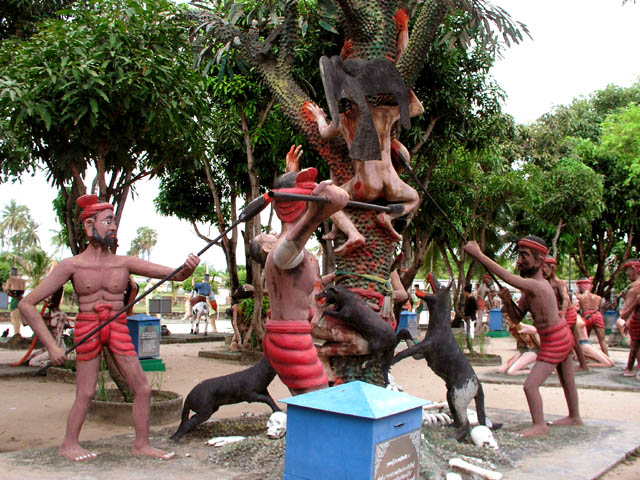
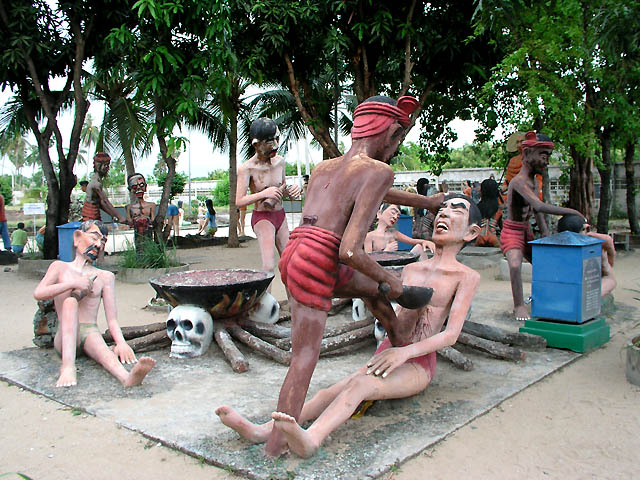
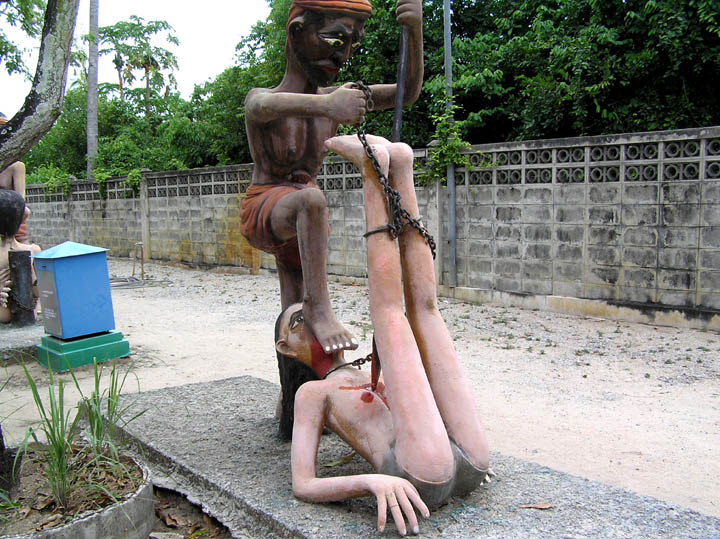
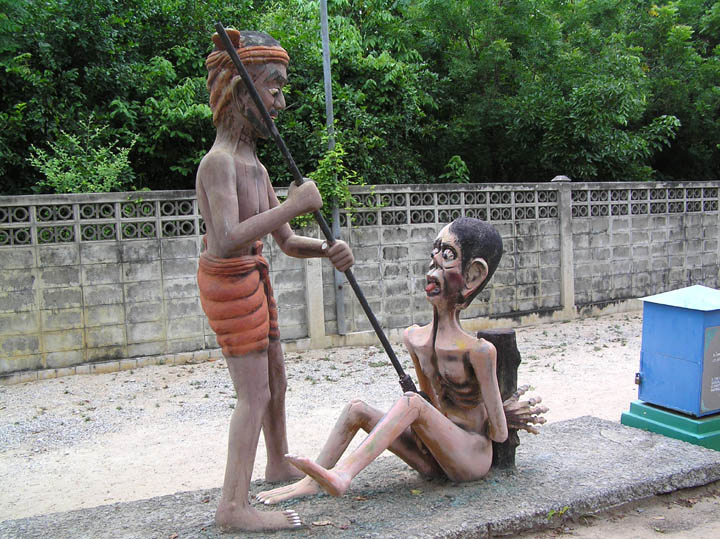
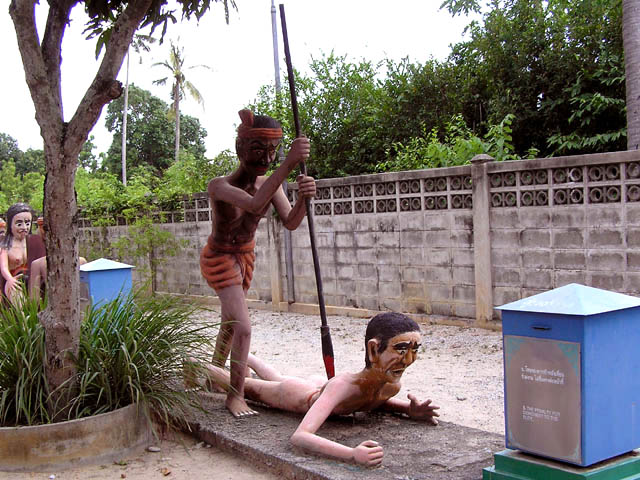
Buddhist Hells in Thailand
Tuesday, November 10, 2009
Destination Truth: Yeti Hairs
BHUTAN, Himalayas -- The Destination Truth team may have stumbled upon a very promising find. If you follow the show, then you’ll remember when the team discovered the infamous “Yeti footprint” about two years ago and made some headlines. Now on their third season, DT reveals another possible important find. Hair from an unknown primate from the Bhutan nation. This season’s finale offered the world the possibility that maybe there is more than just legend when it comes to Bigfoot, Yeti, Yowie, and the rest. Josh Gates sent the hairs to a forensics lab in Texas to be examined by Dr. Melba Ketchum. She ran a few tests and ran the findings against a database. The hairs seems to score high on the Human panels. Dr. Ketchum concluded that the hairs recovered from Bhutan were from a primate. An unknown primate. More>>
- Bigfoot Sighting (BleacherReport.com)
Friday, August 21, 2009
HELL (History Channel)
There are unfortunate destinations -- planes one may be reborn in if one's opportunistic karma comes to fruition in the next or some future life. It may surprise students of the Dharma to think of such possibilities. Unhappy abodes are cramped and crowded, whereas fortunate destinations are spacious and uncrowded. There are many worlds. And in each world, one may say there are as many experiences of it as there are individuals. The human world, for example, is not one place. It's 6.5+ billion places and constantly changing.
So, too, are planes of existence regarded as the Downfall, the Great Waste, Niraya. For once having fallen, there is often no clear cut way out. Eventually, it is one's skillful, wholesome, and profitable (kusala) karma coming to fruition that one is released. Negative influences may, however, not yet be exhausted and could continue to play themselves out. The human world is a mixed realm, where one experiences the fruit of both moderately skillful and unskillful actions willed and carried out in the past.
The Christian conception is an amalgamation and should be understood as grossly oversimplified. But it is this oversimplification of things that makes this religious tradition so compelling and popular. Few people want the details; we are satisfied with outlines writ large. Christianity (particularly as it became an offshoot of Judaism and as it morphed into an official Church in Roman Catholicism) has borrowed a great deal from Mahayana Buddhism, Zoroastrianism, Egyptian tradition, and of course Paganism (pre-Christian European beliefs). "Hell" is not unique to any one of these traditions.
Wednesday, April 22, 2009
Macabre Images of Buddhist Hell(s)

Wat Mondul Seyma, or Wat Kuk for short, lies among shady trees and fluttering prayer flags, a peaceful setting to gaze over the bright frescoes illustrating the life and teachings of the Buddha.
Behind the temple there is a short, unmarked path that leads down to the sea and is open to all visitors. It is beyond this path where one cannot help but feel disconnected from the peaceful surrounds of Wat Kuk.
At first glance...what looks like a lively scene of stone and concrete statues emanating from the cliff's edge.