
Showing posts with label piti. Show all posts
Showing posts with label piti. Show all posts
Wednesday, February 4, 2026


Friday, October 3, 2025
World Smile Day: A Path to Happiness


 |
| Buddhism's Seinfeld: funny Ajahn Brahm |
History of World Smile Day

 |
| Has this symbol always existed? |
Popularity for this symbol exploded into the world of popular culture. It’s every artists’ dream for their work to be respected and recreated and few symbols have had quite the legacy that Harvey’s creation has had. More: nationaltoday.com
Smiling animals brighten our day

If looking for something to brighten an otherwise dreary winter day, look no further than these adorable animals. Looking at their cheery grins will no doubt put a smile on the face that watches them, too. These smiling animals will brighten the day
Buddhism: There is no way to happiness. Why? Happiness is the way

 |
| I let go, surrendered, and blissed out on the mat. |
When at a Buddhist monastery or on a Buddhist retreat, it's not uncommon to ask, "How do I attain meditative absorption (jhana)?" Another word for it is "zen" or dhyana and dharana on a yoga retreat. But there's no answer. One is taught a technique but no way to achieve the thing one strives for. Why?
 |
| I have a theory. - What is it? - Do the GOOD. |
I went to the room of the greatest jhana teacher in the world, and I pressed him, "What's the secret?"
He didn't know what I meant, he said. He didn't even know what I was talking about, he claimed. Then I thought, he's given me an opening. Here's my chance. I better ask very carefully:
"How does one meditate...successfully? What I mean is, how does one attain absorption? How does one get to..." He looked at me like I was kidding and when he saw that I was not, as if by rote, he gave me the basic instructions:
- Sit up straight, but not too straight, relax, bring your attention under your nose to the breath, remain aware of each and every in-breath and out-breath that is happening. Don't do anything but give your undivided attention to that breath (composed of an in-portion and out-portion). Just that. [Then what? - Then nothing, just that. - No, but there has to be something more; it can't be just that. - Just do that (in addition to keeping silent, following the Eight Precepts, and always keeping the breath in mind except when asleep) and then report to me what happens during the daily interview sessions. Try it. It's very simple, but there's nothing easy about it. So keep at it.]
 |
| Bare awareness (mindfulness/sati) is a start. |
"Oh, that," he said. "I don't know that." I thought he was joking, a real effort to make an American-style joke, and I didn't know why he wasn't telling me. He knew I was sincere. He knew I had been striving all month long. Then I applied more pressure than probably anyone would ever dare to apply.
I wasn't leaving without an answer: "What do you mean you don't know? Who better than you? If you don't know, who could possibly know?"
Then he stunned me, as he often did with the directness of his insight and his willingness to share his knowledge with me? "I don't know because I do not read minds. People come to me. I give them the instructions. And some of them come tell me what is happening, and I guide them from there."
 |
| You asked him what?! Did he throw you out? |
"That I do not know. I just know they do. And when they do, I can help them, guide them to go deeper. But how they get to it in the first place, that I do not know." [These aren't exact quotes, just the gist of the conversation, which only lasted a few desperate minutes as I pushed and pushed.]
As he said this, I realized I had asked him this before, after sitting with him in Asia at his massive monastery, where it seemed everyone was succeeding and attaining. I asked him and pushed him a little on the matter with someone sitting by me to catch what I might be missing, two Americans sincerely wanting to experience what Buddhist texts write about, what the Buddha taught, what sutras say happens.
At that time he looked at us and perceiving our sincerity said one strange word, his guess as to what it was distilled down to ONE thing as if it could ever be just one thing distinguishing success from just sitting. That word was parami. She smiled next to me, but I grimaced, perplexed. "'Parami?' The Sanskrit word paramita?"
"Yes," he answered, but he was actually talking about the Pali (and therefore Theravada Buddhist) form of the word parami. In either case, it means "perfection," but the Sanskrit is a diluted Mahayana term of six factors, whereas the historical Buddha always taught TEN intentional actions (deeds, karma).
My teacher clarified. What he imagined (from what he heard from many of his successful students reporting to him) was that they remembered doing skillful deeds in the past, and he concluded that those past skillful deeds were coming to fruition as they sat. And that's why some succeeded and not others.
 |
| What kinds of questions are these? You are silly. |
(What I was really getting at was, WHAT ACTIONS CAN SOMEONE DO NOW OR WHILE ONE IS SITTING IN MEDITATION, ANXIOUS FOR SOMETHING TO HAPPEN, TO MAKE IT HAPPEN?)
That he didn't know, so I had to undertake a lifelong journey of trying to figure it out. Of course, it will have something to do with the Factors of Absorption (jhananga, "limbs of jhana"). Leigh Brasington figured this much out, having had the insight that happiness is the way:
 |
| Right Concentration: Practical Guide to the Jhanas |
Now it makes sense that what I had always been looking for was a carrot or apple in front of the horse (mule, donkey, jackass). I could only neigh in realizing it: THE GOAL is not this happiness because THIS HAPPINESS is the way to relaxing, letting go, unstriving, surrendering, unclutching, dropping hangups, persisting without grasping or clinging, shikantaza ("just sitting"), not setting up a goal and striving for it. Why? It's because those blissful states of meditation and their attendant stillness, mindfulness, and progress towards insight are NATURAL. They arise. We don't "do" them. We can't do them. We don't know how and do not have that power.
But if we relax and just watch with vigilance, stillness, steadiness, persistence, we are cultivating the Factors of Absorption and other factors of the 37 Requisites of Enlightenment, which are categorized into seven groupings.
- One is reminded of a very important thing the Buddha once explained to someone. When talking about the Bodhisatta, himself at the stage of still being a seeker of enlightenment, he once realized that he could neither strive too hard or be negligent. Doing either, he sank as if in a great ocean (samsara), but not striving and not being negligent, he made progress. What could this mean either than the Middle Way of avoiding extremes, of persisting but not pushing, of cultivating but not disturbing the peace or giving in to apathy, listlessness, or despair?
- Thai Forest Tradition arahant Ajahn Maha Boowa seems to be suggesting the same thing here (translated by the American intellect Ven. Thanissaro): "The tactics [techniques] given by each of the Buddhas to the world are called the Dhamma [Truth] of the doctrine. These aren't the genuine Dhamma. They're tactics [methods] — different offshoots — actions and modes displayed by the genuine Dhamma, means for letting go and striving, teaching us to let go, teaching us to strive using various methods, saying that the results will be like this or that. As for the genuine Dhamma of results in the principles of nature, that's something to be known exclusively in the heart of the person who practices. This Dhamma can't really be described correctly in line with its truth. We can only talk around it. And particularly with release [nirvana, liberation, freedom]: This can't be correctly described at all, because it's beyond all conventions and speculations. It can't be described. Even though we may know it with our full heart, we can't describe it. Like describing the flavor [of a soup using only words to someone who has yet to simply taste it]." From Things As They Are.
 |
| Smile, be happy. Don't overdo it; just let it be. |
 |
| Like that, Lisa, just like that. Hold it. |
What is the way to bodhi? The Seven Factors of Enlightenment. What is the way to those factors? The preceding factors of the 37 Requisites of Enlightenment. How does one do any factor? It's probably a good idea to be happy. How does one even begin to dream to do that? Smile.
Thursday, August 7, 2025
How to enter first jhana (Michael Taft)

How to Jhana — with Michael Taft

(Michael Taft Nondual Meditation) June 12, 2020: Jhanas (lit. "meditations") are special states of deep absorption that make a wonderful setup for doing awakening practices.
 |
| There is no way to happiness because happiness is the way |
Jhanas are meant to be enjoyable, and it's very important not to approach jhana in a mood of grasping, tightness, or struggle. Don't try too hard!
How to
Instead, approach jhana in a mood of pleasure, joy, gratitude, kindness, and openness.
Learning to do jhana is an excellent way to supercharge your vipassana (insight) practice, or to stabilize the mind for nondual (advaita) awareness practices.
- 00:03 - Introduction
- 1:24 - The Setup for Jhana (getting focused, and allowing piti to arise)
- 9:16 - Entering the First Jhana (moving attention to the piti, then resting until unification occurs)
- 12:39 - Three Things that Can Happen Next (including going into the second jhana)
- 16:28 - How Jhana Can Change Your Life
- 20:49 - Books and other resources
Support the creation of more videos like this contributing on Patreon: michaeltaft.
- Michael Taft: deconstructingyourself.com
What is jhana?
It is unbroken attention (sustained attention) on something detached from the five senses, something like a nimitta ("sign" in meditation).

- For more information on working with nimittas, take a look here: Working with a nimitta in meditation
- For more on the jhana factors [of absorption], take a look here: Learning to discern the jhana factors
Tuesday, July 29, 2025
Practical Guide to Deep Meditative States

How to strengthen concentration through jhāna with Shaila Catherine

"Concentration"? What does samadhi really mean? The Pali texts describe this quality of mind as "internally steadied, composed and settled, unified." It is a coherent mind, a unification of the mind with the object, a stillness of mind free of distraction, undistractedness, collectedness, and focused attention that produces a profound stability of mind. It is the factor that lands on the meditation object, penetrates it, and stays there. We stay attentive with the object, not dispersed, dissipated, scattered, or agitated. We experience it with cohesion and coherence, internal strength, often very pleasant (states linked to bliss, happiness, equanimity, a joy born of seclusion or withdrawal of the senses) associated with tranquility, calm, ease, peacefulness, stillness, rapture, bliss, deep and profound equanimity. Fixed focus (appana samadhi) is a single focus on any one of a variety of different objects. There is another called momentary concentration (kannica samadhi).
The Buddha in samadhi at Gal Vihara, Sri Lanka

The Jhanas: A Practical Guide to Deep Meditative States
 |
| The Jhanas: A Practical Guide |
Experience new levels of joy, calm, and clarity with this revised and enhanced edition of the bestselling Focused and Fearless.
The Pali word jhana (Sanskrit dhyana) literally means “to meditate.” It also refers to a traditional series of states of meditative absorption, each deeper than the last, in which the mind is undistracted by sensation, thoughts, or moods.
Shaila Catherine’s friendly, wise approach, blended with contemporary examples and pragmatic "how to" instructions that anyone can try, shows meditators (and non-meditators) how to attain these extraordinary states with relative ease.
But jhana practice is about much more than just meditation or concentration [the misleading word most often used to translate samadhi]; it offers a complete path toward bliss, fearlessness, and true awakening.
From the introduction:
 |
| It's so natural, laypeople can reach it with ease. |
Jhanas are states of deep rest, healing rejuvenation, and profound comfort that create a stable platform for transformative insight.
 |
| Beyond Distraction: Five Ways |
This new edition of the meditation classic clarifies crucial points and offers twenty-one additional exercises, making this a great book for both those new to jhana practice and those looking to deepen their practice. The Jhanas: A Practical Guide to Deep Meditative States
- Buddhist Meditation Teacher Shaila Catherine
- Shaila Catherine (Amazon.com)
- AllYouCanBooks.com
- Shaila Catherine, Bhante, Dhamma Centre, March 6, 2021 (Dharma talk); Dhr. Seven, Amber Larson (eds.), Wisdom Quarterly
Saturday, July 5, 2025
The Buddha and his father, who was right?

The newborn prince
 |
| Son, I will be reborn a monk in the Pure Abodes |
Asita was a sage who lived in the jungles close to the Himalayan foothills. He spent his days meditating in a hut there, when one morning he saw and heard the woodland fairies (devas) rejoicing by singing and dancing.
Inquiring, he learned that a baby boy had been born to King Suddhodana and Queen Maya and that this prince would one day become a supremely enlightened teacher surpassing all other beings. Hearing this, the sage Asita was delighted and hurried to Kapilavatthu to see the king.
When King Suddhodana saw Asita, he was very happy that his old teacher had come to see his baby, even before a message was sent informing him of the birth of his firstborn son. The king brought the prince to show him to the wise old sage so the sage could examine him and make a prediction about the little one’s future.
However, when he held the baby, his little feet touched the Brahmin’s head dress (jathah). Surprised at this, the sage took hold of his tiny feet and saw by the lines of his soles that this baby will definitely become a supremely enlightened one.
 |
| I am sure he will choose his Quest. |
However, Asita’s delight quickly changed into sadness when he realized that by the time this baby would become fully awakened, he himself would have passed away from the human realm to an Immaterial Sphere world known as the “realm of neither perception nor perception” or neva-sagna na-sagna yathana.*
- *The mind is so subtle at this stage of absorption (jhana) that the karma of attaining it leads to rebirth in this realm. See the 31 Planes of Existence. Consciousness here is so subtle that it can hardly be said to be perception at all, but it is certainly not non-perception. The meditative practice of jhana, later classified by the Buddha as "right concentration" or samma-samadhi (extreme stillness of mind) brings this rebirth about. However long lasting such a rebirth is, it is not permanent and is not nirvana.
 Nevertheless, the prediction was made that this baby would one day become a supremely enlightened teacher, a buddha. The prince was named Siddhattha (Sanskrit Siddhartha, which literally means “Doing good to the world” or “Wish fulfilled”).
On the seventh day after Prince Siddhattha’s birth, his mother Queen Maya passed away.
- Thereafter, her younger sister and second wife of the king, Queen Pajapati, adopted the prince and looked after him like her own son. (She eventually had two children of her own, Nanda and Sundari Nanda, but always gave Prince Siddhattha the most attention over his siblings).
What happened 29 years later?
 |
| After 29 years of living in luxury, spoiled rotten, carefree, Prince Siddhartha sees Death. |
.
 |
| The Bodhisatta was on a mission to awaken |
So to ensure that he went on to exercise rule over the whole known world (at least Jambudipa), it was advisable to protect the prince from hardship.
The father so loved his son and so wanted him to be a great king that he decided to shelter him and dote on him and give him everything he could want, spoiling him for 29 years.
 |
| At 29, Prince Siddhartha left it all behind. |
- IMAGES of The Great Renunciation (รูปภาพ - พระพุทธศาสนา :: Dhammajak.net)
 |
| Letting go into absorption, he practiced insight |
Now his mind was temporarily released from the defilement, purified, and ready to practice clear seeing (vipassana) through mindfulness of the body, feelings, mind, and mind-objects. He took of his initial question that led him on this quest, "Why is the cause of suffering?" Practicing Dependent Origination, he traced back present suffering to its causes and conditions in previous lives, on account of karma and its results, all the way back to ignorance.
Forward and back, he went until he made a breakthrough in understanding, in knowledge and vision, directly knowing-and-seeing for himself. He awakened to the utmost under his bodhi ("enlightenment") tree and eventually agreed to teach after doubting if anyone would understand or put in the effort to purify their knowledge and vision and thereby gain the same liberation he had won.
- Dhammajak.net; Gotama the Buddha | Vipassana Research Institute; Dhr. Seven, Pat Macpherson, Ananda (Dharma Buddhist Meditation) (eds.), Wisdom Quarterly
Friday, December 6, 2024
The Contentment Sutra (SN 16.1)
 |
| 150 inspiring quotes on the quality of contentment for spiritual progress (quote.cc) |
.
 |
| Long Discourses of the Buddha |
In this spirit, here is British translator of Wisdom Publications' The Long Discourses of the Buddha (Digha Nikaya) Maurice Walshe:
SUTRA: "Contentment"
"Meditators, Kassapa [1] here is content with any old patchwork robe. He praises contentment with any robe, and he commits no offense of rule or etiquette [2] on account of his wardrobe.
"If he has no robe, he worries not; if he has, he enjoys the use of it without clinging or foolish attachment, committing no offense, aware of the danger [of developing attachment and clinging] he wisely avoids it [3].
"Kassapa is content with whatever food offerings he gets... whatever lodgings... whatever medicinal requisites... he enjoys the use of these without clinging or foolish attachment, committing no offense, aware of the danger, he wisely avoids it.
"Therefore, meditators, train yourselves in this way: We will be content with whatever robe... food offerings... lodgings... medicines... that we might get... We will enjoy the use of them without clinging or foolish attachment, committing no offense, aware of the danger, we will wisely avoid it.
"Meditators, I exhort you all using Kassapa as the example, or someone like Kassapa. Exhorted in this way, practice to gain the goal" [4].
NOTES
1. Maha (Great) Kassapa, one of the Buddha's chief disciples who later became the leader of the Monastic Sangha, who convened the First Buddhist Council, organized the Dhamma into a religion after the Buddha's final nirvana, and who was declared by the Buddha as the foremost in the practice of the sane ascetic practices.
2. Unlike, for example, the Buddha's half-brother, the princely monk Nanda (SN 21.8).
3. Nissara napañño: literally, "wise as to liberation."
4. Tathatta: the state of "thusness" or "suchness," nirvana (nibbana). With a different suffix there is the almost equivalent term tathata, found mainly in Mahayana texts, but also occurring in The Path of Purification (VM XVII, 6), etc., where it means "the state of being really so."
2. Unlike, for example, the Buddha's half-brother, the princely monk Nanda (SN 21.8).
3. Nissara napañño: literally, "wise as to liberation."
4. Tathatta: the state of "thusness" or "suchness," nirvana (nibbana). With a different suffix there is the almost equivalent term tathata, found mainly in Mahayana texts, but also occurring in The Path of Purification (VM XVII, 6), etc., where it means "the state of being really so."
- Maurice O'Connell Walshe (trans.), Santuttham Sutta: "Discourse on Contentment" (SN 16.1 PTS: S ii 194 CDB i 662), with Pali title based on the PTS (Feer) edition; edited by Dhr. Seven, Wisdom Quarterly
Saturday, September 21, 2024
Everything ZEN? "Optimistic nihilism" - Nothing matters, but it's OK
 |
Do what you did to Bart to me, Lisa. I want to be Big Fat Buddha. - His name is Budai, Dad, and he's NOT the Buddha. He is a jolly bodhisattva with a big candy sack . - Ooh, Santa Budai! |

 |
| Maha Kassapa smiles at a flower. |
Is optimistic nihilism a healthy way of life? In the Hitchhiker's Guide to the Galaxy, the original BBC Radio series before the books, there's a very funny scene in an exchange between the human, Arthur Dent, and a stranger on the planet of Magrathea, a mythical planet that builds planets and therefore couldn't possibly exist. But here it is.
The stolen ship, The Heart of Gold, which is powered by the new infinite improbability drive, has found it. (Zaphod Beeblebrox, the president of the galaxy, stole it when he was meant to be launching it so he could carry out this secret plan, which first includes getting here to Magrathea).
The crew has entered and left poor Arthur on the surface, where he runs into the Magrathean Slartibartfast, who builds planets and who made the fjords of Earth. He is now working on Earth Mark II.
 |
| "Don't panic" (Douglas Adams) |
Arthur, reflecting in this way, asks Slartibartfast a philosophical question about the meaning of life, the universe, and everything. Slartibartfast gives a very strange answer.
The question runs something like, "What's the meaning of it all?"
 |
| Zen Master Bart* or Lisa Simpson? (Matt Groening) |
happy than right any day."
"And are you?" Arthur interjects with awe.
"No," Slartibartfast laments, "that's where it all falls down of course."
It's a nice philosophy but he -- and one suspects most of us -- can't live up to it. We'd far rather be happy than right, but we are neither happy nor right.
(It sort of gives a boost to those of us who'd far rather be right than happy, though, sadly, we're not right either most of the time, and as for happy? Fuhgeddaboudit.)
So what's the chance any of us are going to pull off this optimistic nihilism?
Optimistic? Okay, if we can manage it or set it as our default option and not worry. Nihilism? Easy, for some of us, all bleak, depressive, laughing at Woody Allen quips at the absurdity of things. WATCH
How to be happy and get saved?

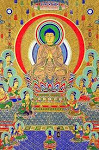 |
| Cosmic Amitabha [God] Buddha |
These attributes really are aspirations of Zen Buddhism, according to Alan Watts. The reason for it seems rooted in Taoism more than in what the historical Buddha taught. But it all comes down to a great division that occurred in Mahayana Buddhism, the great Tariki versus Jiriki Debate, whether salvation (enlightenment, awakening, spiritual liberation, emancipation, moksha, freedom, nirvana) is to be attained by our power (efforts) or other power (the efforts of something extrinsic), by our force or an outside force).
 |
| What patriarchal Mahayana Buddhism needs is a Goddess of Compassion, a Mary: Guanyin |
.
 |
| The historical Buddha Gautama (Gandhara) |
This is never what the Buddha taught, but it makes more philosophical sense: Since we can't by our own power, we need to engage a Higher Power (like Amitabha Buddha, Mother Mary/Bodhisattva of Compassion Kwan Yin, other Cosmic Buddhas, God, or who knows) and hitch our train to that.
 |
| Hey, and this tulku bodhisattva? |
That's the thinking, Alan Watts explains, and that's why Pure Land Buddhism (Nichiren Shōshū) from Japan and China, Imperial Holy Roman Catholicism, Christianity (Jesus freaks), Islam, some New Age teachings...are all so popular. Will it be us doing or other doing?
Christianity as afterthought
 |
| Super Friends: Buddha, Krishna, Mo, Yeshua, Aquaman, Moses, Laozi, Joe Smith (South Park) |

 |
| Misquoting Jesus (Bart Ehrman) |
Christians hypocritically say ONLY Jesus saves -- but to be saved, WE have to ask, repent, plead for the Holy Spirit to take possession of us and live our lives for us as the driver, be born again, get on God the Father's good side, pray and petition for His "grace," which is a "gift" that can only be given and never earned -- as if all the behaving and other stuff weren't work and earning it.
 |
| Savior? Now younger, nicer, whiter, easier! |
Works (intentional karma, deeds) mean nothing? Clearly, they mean something. But Imperial Christianity (Protestant movements and the worldwide Catholic Church) wants to keep everyone in bondage and call that being "saved."
 |
| Compassionate Kwan Yin Bodhisattva |
When you're up in heaven singing in a heavenly choir praising the Almighty God of the Universe, the great Creator, the doer, maker, thinker, and power of everything for an eternity, then you'll be happy?
No thanks. who wouldn't rather be a Buddhist, Independent, or New Ager to understand and make our own way to freedom and the end of all suffering (nirvana), to enlightenment in this very life and the deathless (amata)?
- Dhr. Seven, Ashley Wells, Ananda (Dharma Buddhist Meditation), Wisdom Quarterly
Subscribe to:
Posts (Atom)

























































