Showing posts with label nihilism. Show all posts

Saturday, September 21, 2024

Everything ZEN? "Optimistic nihilism" - Nothing matters, but it's OK

Do what you did to Bart to me, Lisa. I want to be Big Fat Buddha. - His name is Budai, Dad, and he's NOT the Buddha. He is a jolly bodhisattva with a big candy sack . - Ooh, Santa Budai!
Maha Kassapa smiles at a flower.
Is optimistic nihilism a healthy way of life? In the Hitchhiker's Guide to the Galaxy, the original BBC Radio series before the books, there's a very funny scene in an exchange between the human, Arthur Dent, and a stranger on the planet of Magrathea, a mythical planet that builds planets and therefore couldn't possibly exist. But here it is.
The stolen ship, The Heart of Gold, which is powered by the new infinite improbability drive, has found it. (Zaphod Beeblebrox, the president of the galaxy, stole it when he was meant to be launching it so he could carry out this secret plan, which first includes getting here to Magrathea).

The crew has entered and left poor Arthur on the surface, where he runs into the Magrathean Slartibartfast, who builds planets and who made the fjords of Earth. He is now working on Earth Mark II.

"Don't panic" (Douglas Adams)
Arthur Dent can't believe his ears, a reference to Earth so far out in space? Earth really is significant and special! But now it's all gone, destroyed by the Vogons.

Arthur, reflecting in this way, asks Slartibartfast a philosophical question about the meaning of life, the universe, and everything. Slartibartfast gives a very strange answer.

The question runs something like, "What's the meaning of it all?"

Zen Master Bart* or Lisa Simpson? (Matt Groening)
Slartibartfast replies, "I say, 'Hang the sense of it'! I far rather be 
happy than right any day."

"And are you?" Arthur interjects with awe.

"No," Slartibartfast laments, "that's where it all falls down of course."

It's a nice philosophy but he -- and one suspects most of us -- can't live up to it. We'd far rather be happy than right, but we are neither happy nor right.

(It sort of gives a boost to those of us who'd far rather be right than happy, though, sadly, we're not right either most of the time, and as for happy? Fuhgeddaboudit.)

So what's the chance any of us are going to pull off this optimistic nihilism?

Optimistic? Okay, if we can manage it or set it as our default option and not worry. Nihilism? Easy, for some of us, all bleak, depressive, laughing at Woody Allen quips at the absurdity of things. WATCH

How to be happy and get saved?
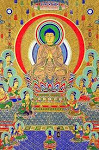
Cosmic Amitabha [God] Buddha
*Does anyone remember that episode of The Simpsons when a psychologist decides that Bart is the healthiest person in Springfield? The doctor finds Bart the most "Zen." He's spontaneous, unpremeditated, artless, authentic, speaks his mind. He's so healthy everyone decides to be like him, and Bart hates it. Suddenly his uniqueness is taken away.

These attributes really are aspirations of Zen Buddhism, according to Alan Watts. The reason for it seems rooted in Taoism more than in what the historical Buddha taught. But it all comes down to a great division that occurred in Mahayana Buddhism, the great Tariki versus Jiriki Debate, whether salvation (enlightenment, awakening, spiritual liberation, emancipation, moksha, freedom, nirvana) is to be attained by our power (efforts) or other power (the efforts of something extrinsic), by our force or an outside force).

What patriarchal Mahayana Buddhism needs is a Goddess of Compassion, a Mary: Guanyin
.
The historical Buddha Gautama (Gandhara)
The historical Buddha taught a path of our own efforts, but many later Mahayana Buddhists deviated back to the world-popular path of blind faith, intense devotion, petitioning a higher power to do it for us.

This is never what the Buddha taught, but it makes more philosophical sense: Since we can't by our own power, we need to engage a Higher Power (like Amitabha Buddha, Mother Mary/Bodhisattva of Compassion Kwan Yin, other Cosmic Buddhas, God, or who knows) and hitch our train to that.

Hey, and this tulku bodhisattva?
In Mahayana, everyone will be saved eventually because a great Bodhisattva is going to see to it before attaining buddhahood and his own emancipation.

That's the thinking, Alan Watts explains, and that's why Pure Land Buddhism (Nichiren Shōshū) from Japan and China, Imperial Holy Roman Catholicism, Christianity (Jesus freaks), Islam, some New Age teachings...are all so popular. Will it be us doing or other doing?

Christianity as afterthought
Super Friends: Buddha, Krishna, Mo, Yeshua, Aquaman, Moses, Laozi, Joe Smith (South Park)

Misquoting Jesus (Bart Ehrman)
It's funny that those who are adamant that some other power must save us still have a lot for us to do, as if we were saving ourselves.

Christians hypocritically say ONLY Jesus saves -- but to be saved, WE have to ask, repent, plead for the Holy Spirit to take possession of us and live our lives for us as the driver, be born again, get on God the Father's good side, pray and petition for His "grace," which is a "gift" that can only be given and never earned -- as if all the behaving and other stuff weren't work and earning it.

Savior? Now younger, nicer, whiter, easier!
Jeesh, what kind of scam? Most will do all that work and still not get it because their efforts weren't good enough. "Works without faith are dead" or something? "Not by thine own works art thou saved"?

Works (intentional karma, deeds) mean nothing? Clearly, they mean something. But Imperial Christianity (Protestant movements and the worldwide Catholic Church) wants to keep everyone in bondage and call that being "saved."

Compassionate Kwan Yin Bodhisattva
When you're up in heaven singing in a heavenly choir praising the Almighty God of the Universe, the great Creator, the doer, maker, thinker, and power of everything for an eternity, then you'll be happy?

No thanks. who wouldn't rather be a Buddhist, Independent, or New Ager to understand and make our own way to freedom and the end of all suffering (nirvana), to enlightenment in this very life and the deathless (amata)?

Wednesday, July 29, 2020

The three-part cure for Covid-19 (video)

America's Frontline Doctors (bitchute.com); Pfc. Sandoval, Seth Auberon (eds.), Wisdom Quarterly

The alternative to Google Corporation's YouTube
An ad hominem (against or "to the person") argument ignores the information and attacks the source or some aspect of the source instead. Dr. Stella Immanuel, MD is a practicing physician in Houston, Texas, who has successfully treated over 350 coronavirus (SARS-2, COVID-19) patients with commonplace drugs (she names them) and the supplemental mineral zinc. She's also some kind of Christian evangelist, witchdoctor, pastor, and superstitious Cameroonian that believes what her culture taught her. Science and epidemiology in the field are not good enough for her critics until the gatekeepers show some double-blind studies to prove what they want proven and ignore what they want ignored. This disease is going to be a big money-maker, the biggest.

"Masks do not prevent Covid," she says. But these commonplace malaria drugs do. Yet they're suppressed, banned, tested at toxic levels, proving that there are forces out there attempting to profit from this epidemic/pandemic scare. Dr. Tony Fauci (NIH), Bill Gates (WHO), and others will make millions, and Big Pharma will make billions from government contracts for harmful vaccines that do not provide immunity but are nonetheless "better than nothing."

Who gets VAXXED out of fear perhaps deserves the medical consequences one is not allowed to sue the pharmaceutical companies for injuries due to their multinational-corporation legal immunity. They are the smart profiteers. Consumers are the guinea pigs having their health compromised by allopathic toxins and iatrogenic treatments that "cure" nothing.

Friday, January 3, 2020

How Goth became Goth (video)

Trash Theory, 12/19/19; South Park; CC Liu, Seth Auberon, Crystal Q. (eds.), Wisdom Quarterly


Before Bauhaus: How Goth Became Goth
"Goth" is many things -- a Germanic tribe, a style of architecture, a type of literature, a style of film. It's a youth movement. What ties these together is a sense of dark romanticism.

But despite the counterfeit Marilyn Manson and My Chemical Romance infamy for the adoption of a gothic appearance or fashion sense, their music could not traditionally be classified goth.

To quote Sasha Geffen of Pitchfork: “[Goth] songs were marked by echoes, distortion, minimal guitar lines, and an arch taste for the macabre; their electroshocked hair, smears of black eyeliner, and dark clothes only reinforced the vibe.”

So while any youth dressed in black with a fondness for obvious smeared makeup can be dubbed “goth,” it doesn't mean the affectation reveals what sort of music is being listened to, which is not necessarily goth. Appearance is a separate thing from the sonic template.

So as the nights grow increasingly cold and dark, join Trash Theory in discovering how the world got to the point where goth became a defined genre with its own look, sound, and lyrical content.

The goth sound ran from the darkness of "I Put a Spell on You" by Screamin Jay Hawkins in 1956, "The End" by The Doors in 1967, and "All Tomorrow's Parties" by Nico and the Velvet Underground, through "Dead Babies" by Alice Cooper, "In Every Dreamhome, a Heartache" by Roxy Music, "Third Uncle" by Brian Eno, "Human Fly" by the Cramps, "Unknown Pleasures" by Joy Division, ending with "A Forest" by The Cure and "Bela Lugosi's Dead" by Bauhaus, this is "How Goth Became Goth."

SOUNDTRACK
Yutaka Hirasaka – "Lost Melody" (yutakahirasaka.bandcamp.com)
Pracs – "Kilt and Cutter" (soundcloud.com/pracs)
Stars As Lights - "Days, Weeks, Years Gone By" (starsaslights.bandcamp.com)
Stars As Lights - "The Sound of Our Hearts" (starsaslights.bandcamp.com)
Patricia Taxxon – "Bellstep" (patriciataxxon.bandcamp.com)
Patricia Taxxon – "Pieces of Me" (patriciataxxon.bandcamp.com)
Stars As Lights – "Hand On Heart" (starsaslights.bandcamp.com)
Luar - "Anchor" (soundcloud.com/luarbeats)

Wednesday, November 27, 2019

Thursday, June 26, 2014

Sufism is Buddhism with Islam

Dhr. Seven, Amber Larson, Ashley Wells, CC Liu, Wisdom Quarterly; Mac Graham (wholelifemagazine.com), Nevit O. Ergin (Inner Traditions); Ranajit Pal; Wikipedia edits
The tomb of the great Sufi poet Rumi in Turkey, the land that bridges East and West
Sufism is the mystical school of Islam heavily influenced by Buddhism and Brahmanism. Here the famous spiritual poet Rumi is seen depicted, not accidentally, in a Buddha-like posture (art-arena.com). In Buddhism a shaman in "trance" (shramana in blissful absorption called jhana, dhyana) is an ecstatic "dervish" in Sufism.

.
Further proof that the Buddha's influence was so far ranging as to be imponderable comes in the form of the new book, The Sufi Path of Annihilation by Nevit O. Ergin.

Just as the key to Buddhist enlightenment (bodhi) is comprehending and penetrating with insight the truth of egolessness (anatta) so, too, in Sufism.

It is the illusion of "self," the "ego," "pride" that must be realized. In Buddhism the "self" (atta, atman) is the "soul," and this leads to a great deal of confusion about what no-self or no-soul means.
 
Conventionally, there is a self and soul in Buddhism, no matter what anyone says, but this "self" is not ultimately real, not eternal, not even existing for two consecutive moments. So in an ultimate sense, there is no self, no ego, no soul. How? See below. 

Early Sufi "saints" were Buddhists
Ranajit Pal, Ph.D. (ranajitpal.com)
The most famous Sufi writer of all, Rumi
The legacy of the historical Buddha (Siddhartha Gautama) is clearly seen in Persian literature: The resounding humanism of Jalaluddin Rumi, Hafeez (Hafiz), Attar, Omar Khayyam, and Amir Khosrow cannot be grasped without the call of [monastic] brotherhood called for by the Buddha and echoed by Alexander [the Great] and Emperor Asoka/Diodotus [a "warrior caste" noble ksahtriya/satrap west of India]
 
Sufism is known to be a universal form of wisdom that has very ancient roots. That fanā' (annihilation) of the Sufis is almost identical to the nirvāņa (complete freedom from suffering and rebirth) of the Buddhists, moksha (a general name for "liberation") of the Hindus [and the Jains and generally all the Dharmic traditions of greater India], kephalia of the Manichaeans, and Kaivaya of the Jains is due to their common origin in Indo-Iran [proto-Persia].
 
A very large number of Sufi saints were from Khorasan and Karman-Baluchistan where Buddhism once flourished. As W. Ball realized, the caves at Chehelkhaneh and Heydari are linked to Buddhism. In fact, these may also be linked to Mitraism/Mithraism [the religion of Mithras that underpins so much of modern Christianity]. 
 
The poignant story of Ibrahim ibn Adham of Balkh (see Farooqui, the Travel of Adham to Balkh), one of the earliest Sufis, closely parallels the life history of Gautama Buddha and has been immortalized in the legend of Baarlam and Josaphat (story of the Bodhisat). This was a great religious document that highlights piety, and in many cultures it marked the beginning of literature. More
 
Dawn of Religions in Afghanistan-Gandhara-Punjab
Lands of the Indus Valley Civilization
Sir Aurel Stein found a Buddhist site at Kuh-e Khwaja in Seistan in 1916. There were many Buddhas before Siddhartha Gautama.

[How many is open to question, for while the Theravada school regularly interprets kalpa to mean an "aeon," an incomprehensible period of geological time, it also has another meaning in Pali: a normal lifespan (kappa) for the age, which at the time of the Buddha was a period of 120 years. This means that the historical Buddha was the only teacher to awaken to the utmost in millions of years, whereas Jain and other teachers spoke of being one in a series of ford finders or conquerors (tirthankaras or jinas) helping others cross over to the liberated state as defined in each dharma, the goal of Buddhism being unique but all glossed as the same, i.e., rebirth in some permanent heavenly state.]

This implies that Buddhism was as old as Zoroastrianism [and the Vedas, etc.]. Early Buddhism was closely linked to Brahmanism (there being no such thing as "Hinduism" yet), Zoroastrianism [Zoroaster/Zarathustra possibly having been a titan, who opposed the devas esteemed in Buddhist texts and the Vedas], and Judaism that originated in Afghanistan-Baluchistan-Gandhara. More
Who was Ibrahim ibn Adham?
Forest ascetic Ibrahim bin Adham with devas (IMP)
Ibrahim ibn Adham (إبراهيم بن أدهم), circa 718-782, AH circa 100-165 [Note 1], see at left) is one of the most prominent of the early ascetic Sufi saints.
 
The story of his conversion is one of the most celebrated in Sufi legend -- a prince renouncing his throne and choosing asceticism closely echoing the legend of Gautama Buddha [2].
  • 1. Richard Nelson Frye, The Cambridge History of Iran: The period from the Arab invasion to the Saljuqs (CUP, 1975, p. 450)
  • 2. Muslim Saints and Mystics, Attar (trans.) A.J. Arberry intro. on Ebrahim ibn Adham; Encyclopedia of Islam, Ibrahim ibn Adham
Sufi tradition ascribes to Ibrahim countless acts of righteousness, and his humble lifestyle, which contrasted sharply with his early life as the King of Balkh (itself an earlier center of Buddhism).

As recounted by Abu Nu'aym, Ibrahim emphasized the importance of stillness [calm derived from "serenity" meditation or Buddhist samatha?] and meditation [wisdom derived from "insight" meditation or Buddhist vipassana?] for asceticism.

Rumi extensively described the legend of Ibrahim in his Masnavi. The most famous of Ibrahim's students is Shaqiq al-Balkhi (died 810). More
The concept of anatta as a doctrine is unique to Buddhism. No other teacher but a buddha teaches it. If Sufism understands it, it is because they received it from Buddhism. If it has been misunderstood or misconstrued as Annihilationism, the destruction of an existing self, then it is no Egolessness Doctrine.
 
In the Tradition of RUMI and Master Hasan...
Mac Graham (reviewer), Whole Life Times (wholelifemagazine.com, June 2014)

BkRev-SufiPath-lores
The Sufi Path of Annihilation (Inner Traditions)
Author Nevit O. Ergin mingles his cryptic contemporary short stories with sayings of Master Hasan Lutfï Shushud and the immortal verses of Rumi to reveal the barest essence of the Itlak Sufi path.
 
Our perceptions [saññā], we learn, are based on a lifetime’s accumulation of conditioned habit [sankhāra, mental formations such as our intentions or root motivations], primarily in eating and breathing.

Manipulation of these two functions through fasting and zikr (breath-control [yogic pranayama which was displaced by mindfulness of in and out breathing in Buddhist insight practices]), along with a steady, slow acknowledgement of life’s suffering [dukkha] and illusion [maya], brings release [moksha] from dualistic perception [Brahminical/Hindu non-dualism], annihilation [nirodha, extinction in stages] of the self [atta, atman], and revelation of essence beyond God -- that, “We are the beloved; God [Brahma/Brahman] is the lover.”
 
(wholelifemagazine.com)
This dualistic perception can be an obstacle to Itlak’s deep and slippery slope truth. Such mysteries require an oblique and indirect approach to replace the panaceas or placebos of religion and philosophy.

We can only approach our truest nature [Three Marks or Characteristics of Existence: anicca, dukkha, anatta, the truth that all things that exist are impermanent, incapable of fulfilling us, and impersonal] and meaning through annihilation of even those institutions that intend to guide us. [Compare with the Buddha's message in the Kalama Sutra].
 
Prepare to grapple with our most basic assumptions in this sweet, simple, and completely annihilating [liberating since there is no "thing" that could be annihilated other than ignorance and distress] adventure.
 
Shams al-Ma'arif (Danieliness/wiki)
Like much mid-eastern religion and mysticism, Itlak Sufism seems couched in suffering and denial [just as the Buddha approached ultimate Truth by negating our common assumptions using negating conventional language that is misleading to modern readers who may mistake it as pessimistic or nihilistic].

However, the goal -- [the realization of] nothingness [framed in later Mahayana Buddhism as "emptiness" (shunyata), the ultimate "perfection of wisdom," which is the liberating realization of ANATTA], absence -- transcends any such negation.

With annihilation of the [illusion of a] self, essence [the luminous quality of the heart/mind, primordial consciousness, which the Buddha analyzed (dissected, divided, broke down) in many ways: viññāna, citta, cetasikas, mental states (sankharas), mental factors, mana, nāma, manas, conceit, attention] expresses its hidden [timeless] being, allowing one to “die before one’s chronological death” or die to the illusory world.

Otherwise, as Rumi notes, we are just “a morsel for the ground.”

No self?
Wisdom Quarterly (ANALYSIS)
Hinduism: We are drops merging
The Buddha was not a materialist, nor was he an annihationist nor was he an eternalist. Even if these three categories seem to exhaust all possibilities, all three are nevertheless "wrong views" (miccha ditthi) based on very deep seated assumptions and errors.

To untangle this impossible situation is easy: There are two kinds of language, conventional and ultimate. Conventionally, there if of course a self; it is self evident! We can identify with and designate anything as "self," but if we examine it, we are almost always talking about one or more of these five things: our bodies, sensations, perceptions, mental formations (like our volitions), and consciousnesses (associated with these five senses with the mind as sixth).

However, ultimately, no such self is there; it falls away when analyzed (broken down and penetrated with insight). A materialist is one who believes only in matter, which includes most modern, "reasonable," scientific types. We know there's more, but we will admit no such knowledge because we think Science says that there's nothing more. (To believe this we have to ignore all of the science that says it does. See what David Wilcock, formerly Edgar Cayce, has uncovered in this regard at divinecosmos.com).

Monday, December 16, 2013

All Civilizations (and Self) Must Fall (video)

Dhr. Seven and Amber Larson, Wisdom Quarterly
(B1) The seafaring Aegean civilization (a general term for the Bronze Age civilizations of Greece around the Aegean Sea, the Minoan, Mycenaean or Crete, the Cyclades, and the Greek mainland) destroyed ancient Egypt. Crete is associated with the Minoan civilization from the Early Bronze Age around 1200 BCE.

One facet of the universe, along with being ultimately impersonal and disappointing, is that it is impermanent. This radical flux, or constant state of change, leads to a wearing away of larger structures, such as entire human civilizations. They may last thousands of years, but that is of course only in the sense of continuity. They, in fact, do not last two consecutive days. This is the ever present change or flux the Buddha refers to as anicca. 

The ancient Greek and Egyptian civilizations fused at Thonis-Heracleion (Hilti)
 
Insight into this is liberating when it leads to dispassion and letting go, accompanied by the realization that it is in a sense unreal as well. All formations (compounded things, composites, constructions, fabrications) are unreal. What is true for the micro is true for the macro. The Buddha focused on psychological phenomena, on what we regard as "self," those things we feel closest to and identify with. On a grander scale and much more obvious to our investigations is the fact that large things fall apart, dissolve, crumble away. If we cannot accept that this happens to the greatest of humans, the most glorious "gods" (brahmas and devas in space), the loftiest of plans, it will be very hard to accept the fact that -- and this is verifiable through vipassana -- it is true of I, me, and mine.

Monuments in Egypt are far older than ancient Egypt. They actually go back 10,000+ years, but to say so and show the evidence is to step into the realm of "forbidden" archeology.
 
(AW) "The True Story of Troy" documentary: It's the site of history's most legendary war and the Western world's oldest "adventure" story. According to myth it began with a rigged beauty contest and ended with a giant wooden Trojan horse unleashing utter destruction. Now archaeologists and literary detectives and military analysts are uncovering evidence suggesting the war was really waged. From archaeological trenches at ancient Troy and the citadel fortress of King Agamemnon from Homer to Hollywood, we search for Troy.
 
Khmer King Yayavarmann VII, Bayon temple, Angkor Wat, Cambodia (platonkohphoto/flickr)
  
End of Khmer Rouge (Hanumann/flickr)
When Buddhism ultimately says there is "no soul" (anatta) it is not aligning with materialistic science and its annihilationist view of the afterlife -- that we all die and it ends here in a pile of ashes. 

When Buddhism conventionally says there is a "soul" (atta), it is not aligning with Abrahamic religions and their eternalist view of the afterlife -- that we all die and it continues from here because an imperishable part of us goes on to one more rebirth in heaven or hell.

Who am I? Five Aggregates
Ultimately, that amalgamation of heaps of (1) form (the four primary material elements) and the four primary components of mentality), (2) feeling, (3) perception, (4) mental formations, and (5) consciousness we call body and mind, the "soul" or "self" is ultimately not what it seems.
 
Some of the treasures recovered from the Greco-Egyptian civilization (Franck Goddio)
  
These are opposite views, so how could the Buddha not side with either? That's a logical fallacy surely? It may seem like a paradox or sophistry. But we can rest assured that it is neither. When we realize for ourselves the reality we, too, can get to sounding like mystic or Zen koan writer. It really is not this way, and it really is not the other way either. Indeed, there is no self (ultimately speaking), and there are countless rebirths. We do not die at death...except that we are dying at every single moment, and physical death is one of those moments, too. There is continuity. But what "continues" or seems to continue is not the exact same thing, is not some imperishable "soul" as Hindus, Jains, and the Abrahamic faiths maintain. 

Khmer (Cambodian) Empire may have come to Olmec Mesoamerica

Buddha, Ladakh, Likir Gompa (Ifphotos/flickr)
Buddhism is unique in this assertion -- that there is no ego, no personality, nothing to cling to. Letting go is NOT possible by an act of will. Only liberating-insight can bring it about. Fortunately, it is also possible to gain an intellectual grasp of the Teaching, the Dharma, but a mere intellectual grasp will never do to reach enlightenment. 

We must know-and-see, that is, directly experience the truth. And the truth will set us free from the illusion we currently feel so utterly trapped by. Only insight into the truth can do it, and for mindfulness of body, sensations, mind, and phenomena to produce liberating-insight, we need a great deal of calm, serenity, tranquility.

If we are motivated by disappointment (dukkha), suffering, a strong desire to escape, this craving may do more to ultimately obstruct us just as it helped get us very far along the Path. We need not "want" the truth to be true. The truth is true regardless. And if the heart/mind is calm, absorbed, purified by concentration and applies these four kinds of intensive mindfulness, it will produce insight. One of the most amazing things the Buddha ever said occurs in the discourse on the Four Foundations of Mindfulness. It ends with the Buddha guaranteeing that whosoever practices correctly according to these instructions for seven years...not even seven years but just seven days will surely break through to the truth, will surely gain at least one of the stages of enlightenment and thereby make an end to all suffering.

Wednesday, May 16, 2012

The ultimate Buddhist word


What is the ultimate word of peace in Buddhism? It would have to be NIRVANA. 

Nirvana -- cooling, blowing out a fire, slaking thirst, quenching craving, the deconstruction of all formations -- is a verb, a process, an undoing of suffering.

Nirvana is not a place, or "emptiness" (śhūnyatā), or nothingness, which exist. There is, for example, a sphere corresponding to the seventh meditative absorption, the third formless realm called the void or nothingness (ākiñcaññāyatana). Confusing the ultimate with these conditioned states is a harmful wrong view. It is a nihilistic view.

Nirvāna is peace, a positive, desirable, unconditioned state. While it cannot be adequately described, it can be experienced consciously in this very life. It is not something one waits to see after death like the heavens.

Nirvana is not death (marana). The enlightened do not die because to die is to be reborn somewhere at sometime. It is always incorrect to speak of the Buddha "dying." He did not die. It is correct to say that he attained final peace (parinirvana). It is not a matter of semantics, not a euphemism for death.

Nirvana is completely different. All that we we saw of "the Buddha" that was passing away was always passing away, was always dying even as it arose. To say that he died automatically (logically and linguistically) posits that he existed in some ultimate sense.

But non-self (anatta) explains that we do not exist in anything but a conditional, dependently originated way. There is no self in the Five Aggregates (form, feeling, perception, formation, consciousness) and no self apart from them.
  • Nirvana is the deathless (unconditioned) state.
  • "Nirvana is the highest happiness" (Dhammapada 204).
  • "Where there is not anything, where nothing is grasped, there is the Isle of No-Beyond. Nirvāṇa do I call it -- the utter extinction of aging and dying."
  • "There is an unborn, unbecome, unmade, unformed. If there were not that unborn, unbecome, unmade, unformed, there would be no freedom and release from the born, become [dynamic being], made, formed to be discerned. But precisely because there is an unborn, unbecome, unmade, unformed freedom and release from the born, become, made, formed is discerned" (Verses of Uplift, Udana VIII.3).
  • "‘The liberated mind/heart (citta) which does not cling’ means nirvana” (MN 2-Att. 4.68).

Monday, August 31, 2009

Buddhism and Quantum Physics

Christian Thomas Kohl (Special to WQ on Buddhism and Quantum Physics)Nagarjuna

EAST MEETS WEST
What is reality? The mindsets of the modern world provide and oscillate between four answers:

  1. The traditional Abrahamic (Jewish, Islamic, and Christian) religions speak about a creator that holds the world together. It represents the fundamental reality. If it were separated from the world for even a moment, the world would disappear immediately. The world can only exist because this creator is maintaining and guarding it. This mindset is so fundamental that even many modern scientists cannot deviate from it. The laws of nature and elementary particles now supersede the role of the creator.
  2. René Descartes takes into consideration a second mindset, wherein the subject or a subjective model of thought is fundamental. Everything else is only derived from it.
  3. According to a holistic mindset, the fundamental reality should consist of both subject and object. Everything should be one. Everything should be connected with everything else.
  4. A very modern mindset neglects reality. It could be called instrumentalism. According to this way of thinking, concepts do not reflect a single reality in any one way. Concepts have nothing to do with reality but only with information.

Buddhism refuses these four concepts of reality. It was therefore confronted with the critical reproach of being nihilistic.

If there is neither a creator, nor laws of nature, nor a permanent object, nor an absolute subject, nor in both, nor none, what is there to believe in? What remains that can be considered a fundamental reality?

The answer is simple. It is so simple that we barely consider it being a philosophical statement: Things depend on other things. A "thing" is dependent on its cause(s). There is no effect without a cause and no cause without an effect. There is, for instance,

  • no fire without fuel
  • no action without an actor
  • no actor without action.

Things are dependent on other things. They are neither identical with each other, nor do they break up into objective and subjective parts. This Buddhist concept of reality [known as Dependent Origination] is often met with disapproval and considered incomprehensible. But there are modern modes of thought with points of contact.

For example, there is a discussion in quantum physics about fundamental reality. What things are fundamental in quantum physics?

  • particles
  • waves
  • field of force
  • law of nature
  • mindsets
  • information

Quantum physics came to express itself by certain key concepts: complementarity, interaction, and entanglement. According to these, there are no independent but only complementary quantum objects. They are at the same time both waves and particles. Quantum objects interact with others, and they show evidence of entanglement even when they are separated by great distances.

Without being observed philosophically, quantum physics has created a physical concept of reality. According to that concept the fundamental reality is an interaction of systems that interacts with other systems and with its own components.

This physical concept of reality does not agree on the four aforementioned approaches. If the fundamental reality consists of dependent systems, then its basics can neither be independent and objective laws of nature nor independent subjective modes of thought. The fundamental reality cannot be a mystic entity nor can it consist of information only.

The concepts of reality in Buddhism surprisingly parallel quantum physics.