There is a mind-door, greenish in hue, near the heart. This heart-mind seems to be the physical base of consciousness, not the brain in the cranium. When meditating, attention can be adverted to the area around the heart. There there is a mirror reflecting experience, consciousness, awareness. If the "mind" were in the brain or the head, it seems attention would be placed there to find it. But it is very much down closer to what in the West we refer to as the seat of our emotions. The Buddha did not specify a physical base for vijñāna (consciousness) or manas (in Early Buddhism). However, he seems to have been well aware of the practical application of locating this base for the sake of realizing the ultimate nature of mind-and-matter (nama-rupa), ultimate mind (a stream of cittas) and ultimate materiality (a stream of kalapas). But this is for advanced practitioners of Buddhist meditation rather than philosophers and speculators. For those, perhaps Zen no-mind would be better or the compelling mind-only (Yogachara) view.
Between and around the billions of neurons in the human brain is an equally vital scaffold, the extracellular matrix (ECM).
An interlinked net of proteins and sugars that surrounds brain cells, the ECM is more than simple structural support; changes in the ECM can regulate complex brain functions including memory, learning, and behavior.
But studies of the brain's ECM have been limited by the lack of tools to observe dynamic changes to its structure.
Now, a new genetic labeling tool developed by University of Utah Health researchers Dr. Igal Sterin, Ph.D. and Dr. Sungjin Park, Ph.D. has revealed new patterns in brain ECM in mice, including differences in the amount of matrix deposited on different types of neurons.
A major advantage of the tool is that it can detect changes in the ECM over time, giving new insights into how the brain develops.
In biology, the extracellular matrix (ECM) [1, 2] also called intercellular matrix (ICM), is a network consisting of extracellular macromolecules and minerals, such as collagen, enzymes, glycoproteins, and hydroxyapatite that provide structural and biochemical support to surrounding [brain] cells [called neurons] [3, 4, 5]. Because multicellularity evolved independently in different multicellular lineages, the composition of ECM varies between multicellular structures; however, cell adhesion, cell-to-cell communication, and differentiation are common functions of the ECM [6]. More: extracellular matrix
The new tool has two main parts -- a protein that binds to the main ingredients of the brain ECM fused to another protein that irreversibly sticks to a variety of synthetic fluorescent dyes.
When scientists introduced the tool into neurons, it bound to the surrounding matrix. They then added a fluorescent dye to make matrix structures visible.
Using this tool, the researchers were able to watch as ECM was deposited over time in cultured rodent brain cells, making out dense clusters of matrix that appeared on only certain neurons and at different times.
Fluorescent microscopy image of a section of mouse brain, where green is a conventional brain ECM marker. Magenta is the new tool developed by the researchers. Credit: The Journal of Neuroscience (2024). DOI: 10.1523/JNEUROSCI.0666-24.2024.
The Origins and History of Consciousness (Erich Neumann)
Is science slowly stumbling on the fact that "consciousness" is impersonal and continues after death? We wouldn't like to think so because that does not accord with what is comfortable, and science doesn't ask big questions with easy answers.
*Sarcasm* What? It's not the pinnacle of evolution and existence, the greatest thing in the universe, the end all be all proving that souls exist and are invincible and immortal?
The shocking truth (anatta) is too much to handle for most people, who invariably misinterpret it to mean that things are eternal or things are annihilated, and there's no other possibility. Imagine if both extremes in view were wrong. They are. We neither carry on through death forever, nor are we annihilated at death. Spiritists and materialists both have it wrong.
Hidden Spring (Mark Solms)
Things are dependently originated. What arises does so dependent on conditions (so they do not really arise except as an illusion with the illusory marks of permanence, fulfillment, and personality).
In fact, we find, the three opposite Marks of Existence (ti-lakkhana) are present. Ultimately, "things" that arise dependent on causes and conditions are impermanent, disappointing, and impersonal.
Brain is not base of consciousness, which pervades all things we are conscious of. Anencephaly
.
Physics of Expanded Consciousness
But will science ever come to that conclusion? Not likely. The goal of science is not enlightenment and liberation from the round of rebirth and suffering. (How can something even be said to be "reborn" if it cannot, like a moving river, be said to persist unchanged for two consecutive moments? It can).
Isn't it amazing what mushrooms can do? Sure, there are magic mushrooms, but Fly agaric (Amanita muscaria) is even more powerful in shamanic applications.
Then there are the Sixties, provided courtesy of LSD and cannabis. Who knew that the ergot on rye grain is a fungus? Fungi is mushroom, which is the fruiting body of the organism rooted in mycelia (the invisible matting underground that sends up mushrooms and makes the forest a natural "internet," playfully referred to as the Wood Wide Web.
Ergot fungus on rye and other grains such as barley is what was isolated to make LSD, lysergic acid diethylamide. The Spirit Molecule DMT plays into this, who knows, but it must because it is so widespread in nature and in the middle of our brains at the point called the third eye (pineal gland), which seems to be the transducer and modulator between worlds, the illusory one and the one behind it.
If we're in a matrix, how does anyone know except that they have had a taste of the real thing, the more real Dreamland or Spirit World from fevered dreams and spiritual visions? Who can say? But we are not seeing the world that is really here, only a tiny slice of the band of visible light and intriguing shadow.
How to avoid possession by Mara
When people take an entheogen, a psychedelic, their pupils dilate, that is, open up. It is as if they are now taking in more light and trying to capture it all with eyes wide open. It's a wider sliver of the band, into what we could call invisible light.
Why can we call it that? If ordinary consciousness and physical eyes see these wavelengths, this much of the range, what must dilated pupils and activated occipital lobes be able to take in? LSD is expanding the range, which is why Freak Street (Nepal) fashions and shamanic regalia are so colorful.
Shamanic healing with entheogenic plants
Is mold a mushroom? It is a fungus, and in common parlance we use "mushroom" to refer to all fungi. Lichen is a strange symbiotic combination of algae (chlorophyll) and (cyano-) bacteria and although assumed to be fungal growth on the sunny side of rocks is actually something else altogether. Yeast is a fungus, so it's not so strange that LSD (from grain used in the making of bread) would be, too.
PBS (video); TEXT: Pat Macpherson and Dhr. Seven, Wisdom Quarterly
They stand at the periphery waiting, clinging. They passed away with strong attachments.
The REAL reason behind addictions and how to get over them
I don't know how it began. I was molested.
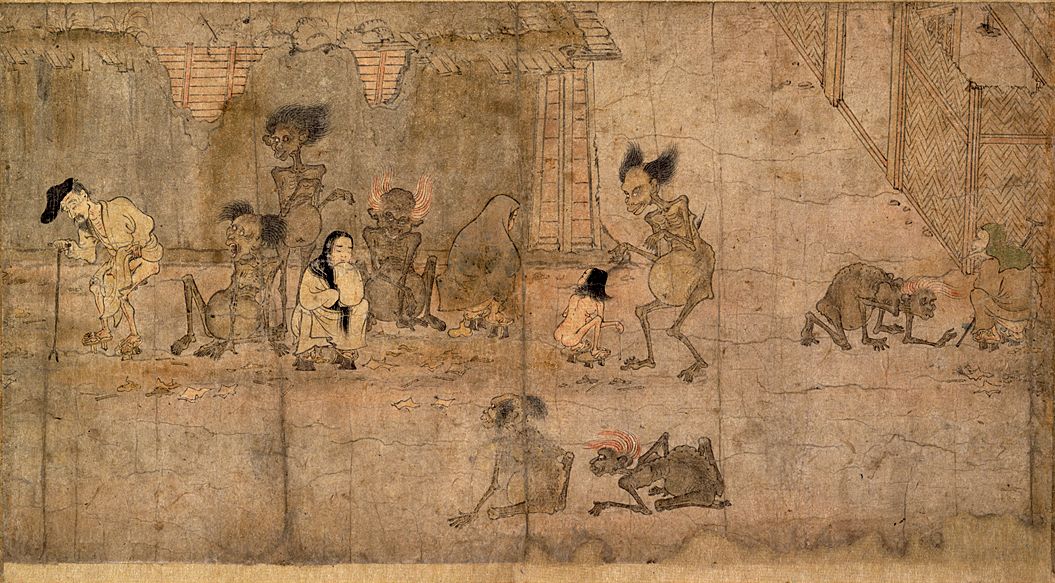
(Asangoham) April 26, 2024: Tibetan Vajrayana Buddhism includes within its teachings a very interesting concept, that of the "hungry ghost," known as yidags in Tibetan [preta in Sanskrit, peta in Pali].
Dr. Gabor Mate used this idea in his research
One possible form of hungry ghost can be a person who has died while still in the midst of intense craving, attachment, or an insatiable addiction.
Tibetan Buddhists believe that at death one sheds only the physical or gross form; the subtle and causal forms of the body remain [in a changing state of flux, just as they changed and were in flux during life].
This means that while one is now [temporarily] free of the gross or physical body, one is still in the grip of the subtle body, or mind, that was “made” during that and previous lifetimes.
The causal body will retain the seed of the addiction and carry it into the next life if it is not purified.
Thus, those who die in the grip of addiction or craving or attachment often remain in the physical plane as disembodied hungry ghosts.
The Wisdom of Trauma
[Dr. Gabor Mate, Canadian addiction medical specialist and star of Zeitgeist, contends that there are NO addictive substances or activities. Many people are indeed addicted and unable to stop; there is no doubt about that. Dr. Mate treats them daily and set up Canada's first compassionate care center to help them. But it turns out the real problem is an interaction of factors. IF substances and activities were "addictive," then everyone who partook would become addicted. This does not happen. Q: What then is the underlying cause?
When the Body Says No
A: Susceptibility brought on by childhood trauma. If a person who was abused takes a nonaddictive substance like alcohol, meth, fentanyl, MSG, sugar, heroin, crack, cocaine, or marijuana (which flood the brain with feelgood dopamine, endorphins, and neurotransmitters) then addiction quickly sets in. But it cannot be substance. It is that substance in that person. So as a society we abuse our children then condemn them for the easy-to-access coping mechanism they resort to to self-soothe. It's a double-bind, a Catch 22, a fully Belgium (HHGTTG) situation. Ghosts get trapped this way, and then they are trapped (in bondage), and then for a long time lost "in the realm of hungry ghosts" (Buddhism's peta loka). Knowing this, seeing this, one adheres to the Five Precepts, for one who preserves the Five Precepts is preserved by the Five Precepts. Otherwise, after the ghost realm, which is the beginning of the downfall (niraya), the great waste, one continues down to the hells, where there is no apparent way out. Good karma now will help a great deal then. So make merit (punya).]
Is Dr. Gabor Mate a secular Jewish Buddhist or a Buddhist Jew? (drgabormate.com)
.
I want what I want when I want it. I'm hungry.
That is, such beings are still gripped by insatiable addiction but now without the physical body that would give them any chance of satiating that addiction.
Those with the ability to perceive disembodied spirits can perceive hungry ghosts.
These people claim that in those places such as the “red light” districts of many cities where people gather to drink, have sex (engage in prostitution), or use intoxicants -- three of the most common pursuits of human addiction -- hungry ghosts can be seen to congregate, often in great numbers.
Addiction is complex.
It transcends mere substance or behavioral abuse.
Addiction is defined as a chronic and relapsing disorder.
It is characterized by compulsive seeking, continued use, and a lack of control.
This continues in the face of and despite severe adverse consequences.
The brain is dependent on neurochemicals.
Fundamentally, addiction involves changes in the brain's reward system.
Repeated exposure to addictive substances or behaviors leads to neuroadaptations.
This adaptation diminishes the brain's sensitivity to natural rewards (such as dopamine) and compels/drives one in the compulsive pursuit of the addictive stimulus.
In the digital age, behavioral addictions related to technology and social media have also begun to take hold. #addictions#hungryghosts#zen
DISCLAIMER 01: All ideas expressed on this channel are for entertainment and general information purposes only. There is no advice on what an individual should or should not do. Any response made by anyone after hearing this communication is their interpretation and is their responsibility. Ideas expressed by this channel should not be treated as a substitute for medical advice or professional help. If expert assistance or counselling is needed, the services of a competent professional should be sought.
Dr. Andy Huberman, Tom Bilyeu, 9/23/21; Pat Macpherson, Dhr. Seven (eds.), Wisdom Quarterly
Dopamine detox: Take back control of life and stop laziness! | Dr. Andrew Huberman
(Tom Bilyeu) As for dopamine, people have been obsessing and hearing about this neurochemical and its role in human behavior for years. We may think of it as the "feel-good happy hormone," or we may associate it with addiction, love, lust, and sex.
As our lives convert over to a totally digital experience that is with us everywhere we are in the form of a cell phone, dopamine detox has even started gaining in popularity.
Dr. Andrew Huberman from the Huberman Lab is here again to unpack some of the more surprising discoveries and uses of dopamine. He compares dopamine to a biological "currency" that plays a role in human desire for more and more (Buddhist craving and clinging, not being able to let go even in the face of suffering/disappointment).
Dopamine is the catalyst pushing humanity forward exploring things like cryptocurrency and pushing our limitations and what is possible, but is all of that for the sake of pleasure and feeling good?
Dr. Huberman breaks down the balance of pain and pleasure, arousal and relaxation, and gives us the insight we need to start regulating our body’s dopamine release.
If we thought dopamine was all about feeling good, Dr. Huberman is about to reveal why it’s more about what motivates us in the pursuit of something greater.
“When I say dopamine is the universal currency of everything, what I mean is, it's driving the motivation to develop new currencies.” [3:08]
“Celebrating the win more than the pursuit, it actually sets you up for failure in the future.” [16:00]
“If you can start to register that craving, and that friction and that desire, that almost kind of low level of agitation, sometimes high level of agitation...that's dopamine” [17:54].
“Your capacity to tap into dopamine as a motivator, not just seeking dopamine rewards, that is infinite.” [19:34]
“It's the craving that makes me feel alive. So it's the state of wanting that is in and of itself, the pleasurable act.” [22:37]
“It doesn't matter if it's Bitcoin or Ethereum, it doesn't matter if it's putting rockets on other planets, it doesn't matter if it's building the first automobile, it's the same currency.” [25:27]
And so we go back to this example of the person who's not motivated and can't get off the couch and doesn't want to do anything. Well, this is the problem. Remember the rat experiment? They are effectively the rat with no dopamine..." [27:47]
“Dopamine itself is not the reward. It's the buildup to the reward, and the reward has more of a kind of opioid bliss like property.” [29:51]
“The more pain you experience, the more dopamine you can achieve. If you get back on the avenue of pursuit.” [30:58]
“I would say addiction is a progressive narrowing of the things that bring you pleasure, and I don't like to comment too much on enlightenment...but a good life is a progressive expansion of the things that bring you pleasure, and even better is a good life is a progressive expansion of the things that bring you pleasure and includes pleasure through motivation and hard work.” [32:55]
“If you think about most of the growth in life comes from these rigidly externally imposed schedules and we hate them. But they are where we learn restraint.” [52:42]
Join Tom Bilyeu's Discord community to catch all the amazing things being worked on (impacttheory.com/discord). Get direct access to Tom and the team PLUS exclusive content, offers, and much more. Jump on in and get started on becoming legendary.
Very understandably these days, the person we long to be -- and already are, deep down -- could be covered over with distractions, stresses, frustrations, and fears.
But we’ve all had a sense of being calm and clear, loving and happy, wide open and fully present. The good news is that we can develop these qualities further in a step-by-step path of personal practice.
Join Dr. Rick Hanson on September 10 for An Introduction to Neurodharma Online Workshop. Discover this path and learn practical methods based on modern brain science and ancient wisdom. This live, daylong workshop will explore how to:
Dr. Robert H. Lustig, M.D., M.S.L. (robertlustig.com); Ananda (DMI), Jen, Wisdom Quarterly
Dr. Robert Lustig, M.D. is professor emeritus of pediatrics at the University of California at San Francisco (UCSF). He specializes in the field of neuroendocrinology, with an emphasis on the regulation of energy balance by the central nervous system. His research and clinical practice has focused on childhood obesity and diabetes. Dr. Lustig holds a B.A. from MIT and a Ph.D. in medicine from Cornell University Medical College, and a Master’s of Studies in law from U.C. Hastings College of the Law. Dr. Lustig has fostered a global discussion of metabolic health and nutrition, exposing some of the leading myths that underlie the current pandemic of diet-related disease. He believes the food business, by pushing processed food loaded with white sugar, has hacked our bodies and minds to pursue pleasure instead of happiness -- fostering today’s epidemics of addiction and depression. Yet by focusing on real food, we can beat the odds against depression, sugar, processed food, obesity, and disease. More
The Buddha says that just as in the great ocean there is but one taste, the taste of salt, so in this Dharma (the Buddha's doctrine and discipline) there is but one taste, the taste of freedom.
The taste of freedom that pervades the Buddha's teaching is the taste of spiritual freedom, which from the Buddhist perspective means freedom from suffering.
In the process leading to liberation from suffering, meditation is the means of generating the inner awakening required for freedom.
The methods of meditation taught in the Theravada Buddhist tradition are based on the Buddha's own experience, forged in the course of his own quest for enlightenment.
They are designed to recreate in the disciple who practices them the same essential enlightenment that the Buddha (the "Enlightened One") himself attained when he sat beneath the bodhi tree, the awakening to the liberating Four Noble Truths.
The various subjects and methods of meditation expounded in the ancient Theravada Buddhist scriptures -- the Pali language canon and its commentaries -- divide into two interrelated systems.
One is called the development of serenity (samatha-bhavana), the other the development of insight (vipassana-bhavana).
The former -- the development of tranquility -- also goes under the name of development of concentration (samadhi-bhavana), the latter the development of wisdom (pañña-bhavana).
The practice of serenity meditation aims at developing a calm, coherent, concentrated, collected, unified mind/heart as a means of experiencing inner-peace and as a basis for wisdom.
The practice of insight meditation aims at gaining a direct understanding of the real nature of phenomena. More
I was molested when I was a child. That's why I'm depressed and doctors can't cure me.
Lost Connections: Uncovering the Real Causes of Depression -- and the Unexpected Solutions
OMG, they've been lying to us to sell us pills
From the science journalist and New York Times bestselling author of Chasing the Scream comes a radically new way of thinking about depression and anxiety.
What really causes depression and anxiety -- and how can we really solve them? Award-winning journalist Johann Hari suffered from depression since he was a child and started taking anti-depressants when he was a teenager.
He was told that his problems were caused by "a chemical imbalance" in his brain.
As an adult trained in the social sciences, he began to investigate whether this was true -- and he learned that almost everything we have been told about depression and anxiety is wrong.
Across the world Hari found social scientists who were uncovering evidence that depression and anxiety are not caused by a chemical imbalance in our brains.
In fact, they are largely caused by key problems with the way we live today.
Hari´s journey took him from a mind-blowing series of experiments in Baltimore, to an Amish community in Indiana, to an uprising in Berlin.
Once he had uncovered nine real causes of depression and anxiety, they led him to scientists who are discovering seven very different solutions -- ones that work.
It is an epic journey that will change how we think about one of the biggest crises in our culture today.
His TED talk -- "Everything You Think You Know About Addiction is Wrong" -- has been viewed more than 21 million times and revolutionized the global debate. This book will do the same for our view of depression.RAVE REVIEWS!
“If you have ever been down, or felt lost, this amazing book will change your life. Do yourself a favor -- read it now.”
– Elton John
“Lost Connections offers a wonderful and incisive analysis of the depression and alienation that are haunting American society.”
– Hillary Rodham Clinton
“Wise, probing and deeply generous Hari has produced a book packed with explosive revelations about our epidemic of despair... I am utterly convinced that the more people read this book, the better off the world will be.”
– Naomi Klein
“A brilliant, stimulating, radical take on mental health.”
– Matt Haig
“This book is a game changer.”
– Davina McCall
“A prescient and compassionate Rosetta Stone for those trying to understand mental illness. Beautiful.”
– Russell Brand
“Extraordinary...A highly personal book, written with humility, humor and candor, it nonetheless heralds a crucial new discussion about our mental health -- and health of the world we've created for ourselves… I honestly couldn't put it down. What a stunning piece of work.”
– Brian Eno
“As with his book on drugs, Johann Hari has delivered a remarkable tour de force on a difficult, complex and controversial subject and made the reader think anew.”
– Alastair Campbell
“This is a bold and inspiring book that will help far more than just those who suffer from depression. As Hari shows, we all have within us the potential to live in ways that are healthier and wiser.”
– Arianna Huffington
“An exquisitely lucid treatise on why no person is, has been or ever should be an island. This book is the most exciting thing I've read this year. From slightly seedy to suicidal -- however you are feeling -- read this book and it will honestly help you to understand which roads we must walk if we want to see true, lasting change.”
– Emma Thompson
“A vital, compelling and eye-opening examination of the myths we have been taught to believe about depression and anxiety... Hari again proves that he is one of the world's most important and most enlightening thinkers and social critics.”
– Glenn Greenwald
“This is an astonishing book, that transforms our understanding of one of the crucial issues of our times. Johann Hari asks the big questions and provides the big answers -- answers that have been neglected for far too long. You cannot fully understand this great curse of our age until you have read it.”
– George Monbiot
“Johann Hari has written a book that could actually make us happy. It is very important everyone read this book and do what he says as quickly as possible.”
– Simon Amstell
“A beautiful book from the person that brilliantly once said “the opposite of addiction is connection” and who now explores and offers some solutions to our disconnection.”
– Jemima Khan
“This is an extraordinary, elegant exploration of a timely problem. It is written with wit and elan and provides a devastating analysis of our society that is both shocking and profound.”
– Dr. Max Pemberton of The Daily Mail
“A bold call for a complete re-evaluation of what is causing the western epidemic of mental illness.”
– Isabel Hardman, Sunday Times
“You might think Lost Connections is a self-help title but in reality it's a book that aims to change society, not individuals… Lost Connections is an important and controversial book because it asks questions about the biggest problems we have in the world.”
All materials on this site are submitted by editors and readers. All images, unless otherwise noted, were taken from the Internet and are assumed to be in the public domain.
In the event that there is still a problem, issue, or error with copyrighted material, the break of the copyright is unintentional and noncommercial, and the material will be removed immediately upon presented proof.
Contact us by submitting a comment marked "private."
Do not follow this journal if you are under vinaya or parental restrictions. Secure protection by Sucuri.
Wisdom Quarterly: American Buddhist Journal is licensed under a Creative Commons Attribution-Noncommercial-Share Alike 3.0 United States License. Permissions beyond the scope of this license may be available at creativecommons.org/about/licenses.


.jpg)