Showing posts with label bombay tragedy. Show all posts

Sunday, August 9, 2026

Poor Sad Mother Pat: A Buddhist Tragedy

.
Nun called the "Preserver of the Discipline"
Central Asian Scythian, Gandhara
Patacara was the beautiful daughter of a very wealthy merchant in Savatthi (Sarvasti).

When she was 16 years old, her parents locked her up in a penthouse (the top floor) of a seven-story tower surrounded by guards to prevent her from keeping company with any young men.

In spite of this extreme precaution [or perhaps because of it], Patty became involved in a sexual affair with a male servant in her parents' house.
 
When her parents had arranged a suitable marriage for her with a young man of appropriate social standing and means, she decided to elope with her low-class lover instead.

She escaped from her prison tower by disguising herself, and the young couple went to live in a village far away from Savatthi.

Her new husband farmed, and now the young wife had to do all the menial chores that had formerly been carried out by her parents' servants. So she began to reap the results (phala, fruits) of her karma (actions).
 
When she became pregnant, she begged her husband to return her to her parents' house to give birth [in accordance with ancient Indian custom], saying to him that a father and mother always have a soft spot in their hearts for their child, no matter what she has done.
 
I'm marrying for love. Take that, parents!
However, her husband refused on the grounds that her parents would surely subject him to torture or imprisonment.

When she realized that he would not give in to her pleas, she decided to make her way to her parents by herself.

When the husband found her gone and was told by the neighbors of her decision, he followed her and tried to persuade her to return. However, she would not listen to him.
 
Before they could reach Savatthi, birth pains started, and soon a baby son was born. As there was no more reason to go to her parents' house, they turned back and resumed their family life in the village.
 
Sometime later she became pregnant again. And again, she pleaded with her husband to take her home to her parents. Again, he refused. And again, she took matters into her own hands and started off on the journey, carrying her older child. When her husband followed her and pleaded with her to return with him, she would not listen and instead continued on her way.

A fearful storm arose out of season with thunder and lightning and incessant rain. Just then her birth pains started, and she asked her husband to find her some sort of shelter.

The husband went off in search of material for a shelter and set about to chop down some saplings.
 
No one need die from a venomous bite. Metta prevents it. Khandha Paritta is the antidote.
Dead, rigid from lack of cultivating metta
A venomous snake (naga) bit him just then, and he instantly fell dead. 

Patty waited and waited in vain. After having suffered birth pains, a second son was born to her. Both children screamed at the top of their lungs because of the buffeting of the storm. So the mother protected them with her own body all night long.

In the morning she placed the newborn baby on her hip, gave a finger to the older child to suck on, and set out on the path her husband had taken saying, "Come, dear child, your father has abandoned us."

But after a few steps, she found her husband lying dead, his body cold and rigid. She wailed and lamented and blamed herself for his untimely death.
 
She continued on her journey to her parents' house, but when she came to the Aciravati river, it was swollen waist-deep on account of the rain. She was too weak to wade across with both children, so she set the older child on the bank and carried the baby across to the other side.

What sort of tasty flesh is on that shore?
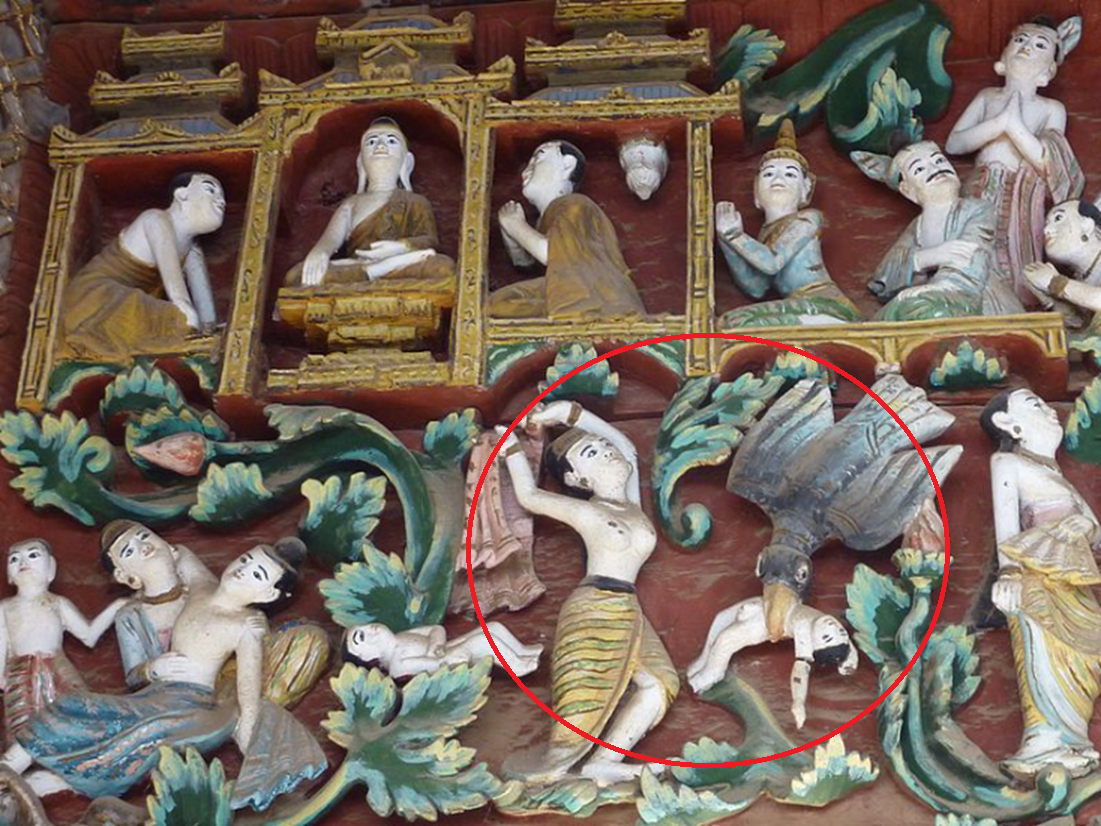
When she returned to fetch the firstborn and bring him across, she only reached midstream. Then an eagle saw the helpless newborn and flew to snatch its tender flesh. It came swooping down, and in spite of Patty's cries and screams, the eagle (garuda) flew off with the baby in its talons.
 
The older boy saw his mother stop in the middle of the river and heard her loud yells. He thought she was calling him to come, so he started out after her, and he was immediately swept off by the powerful current.
 
Wailing and lamenting, Patty went on her way, half crazed by the triple tragedy that had befallen her, losing husband and all her children in a single day.

As she came nearer to Savatthi, she met a traveler who was just coming from the city. She inquired about her family from him, but at first he refused to answer her. When she insisted, the traveler finally had to tell her that her parent's house had collapsed in the recent storm, killing them both as well as her brother. Their cremation was just taking place.
 
When she heard this, her reason left her. Her grief was too much to bear. She tore off her clothes, wandered around weeping and wailing, not knowing what she was doing or where she was going.

People seeing her naked pelted her with stones and rubbish and chased her off.
  
At that time the Buddha was staying at Jeta Grove in millionaire's monastery. He saw Patty approaching from afar and recognized that in a past life she had made an earnest resolve to become a nun well versed in the Dharma.

Therefore, he instructed his disciples not to obstruct her, but to let her enter and come near him.


As soon as she was close to the Buddha, through his supernatural powers, she regained her right mind. She then suddenly became aware that she was naked, and in her embarrassment, she crouched on the ground.
 
One of the lay followers tossed her a cloak, and after she wrapped herself in it, she bowed at the Buddha's feet. She then recounted to him the series of tragedies that had befallen her.
 
The Awakened Teacher listened to her with great compassion then made it clear to her that the painful experiences she had gone through were only tiny drops in the impermanent [and ultimately impersonal] ocean of sorrow (samsara) in which all beings drown if they are attached to what ceaselessly rises and falls.

He told her that all through many existences, she had already wept more tears over the loss of dear ones than could be contained in the waters of the world's four oceans. He said:
But little water do the oceans four contain
compared with all the tears that humans have shed
by sorrow smitten and by suffering distraught.
Woman, why heedless do you yet remain?
This exposition of the Awakened One penetrated her heart/mind so deeply that at that very moment she was able to completely grasp the impermanence of all conditioned things (i.e., dependently arisen phenomena/things that utterly depend on constituent factors for their existence).

When the Enlightened One had finished his teaching, she had attained the certainty of future liberation by realizing stream-entry (the first stage of enlightenment).

She thereafter practiced diligently and soon realized final deliverance through full enlightenment. Then she declared:
With ploughs the fields are ploughed;
With seed the earth is sown;
Thus wives and children feed;
So young men win their wealth.
Then why do I, of virtue pure,
doing the Master's Teaching,
neither lazy nor proud,
nirvana [liberation] not attain?
Having washed my feet
I watched that water,
noticing the foot-water
flowing from high to low.
With that the heart/mind was calmed
just as a noble, thoroughbred horse.
Having taken my lamp,
I went into my hut,
inspected the sleeping place
then sat upon the couch.
Having taken a pin
I pushed the wick right down, and
just as the lamp went out,
so all delusion of the heart went, too.
Therigatha (Psalms of the Nuns) 112-116
It had been enough for her to see the water trickle down the slope to recognize the whole of existence, each life a longer or shorter trickle in the flood of craving.

There were those who lived a short time like her children, those who lived a little longer like her husband, and those who lived even longer like her parents. But all underwent constant change, in a never-ending rising and falling. This thought-process gave her so much detachment that she attained to total freedom of the heart the following night.

The nun who became the keeper of the discipline
The Buddha later declared Patty (Ven. Patacara) foremost "The Keeper of the Disciplinary Code" (Bhikkhuni Vinaya) among all the nuns.

Ven. Patacara thereby became the female counterpart of the Buddhist monk Ven. Upali, formerly Prince Siddhartha's lowly royal barber.

That she had chosen the "Rules of Monastic Conduct" as her central discipline is easy to understand, because the results of her former indulgences had become bitterly obvious to her.
 
She learned in the Sangha that an intensive study of the monastic rules was necessary and self-purifying for monastics. It brought with it the security and safety of self-discipline. She learned not to become complacent or lazy when comfortable, or anxious and confused when suffering.

Because of her own experiences she had gained a deep understanding of the human predicament and could be of great assistance to her fellow nuns.
 
She was a great comfort to those who came to her with difficulties. The nun Ven. Canda said that Ven. Patacara showed her the right path out of attachment and helped her to achieve liberation (Thig. 125).

Another nun, Ven. Uttara II, reported how Ven. Patacara spoke to a group of nuns about right conduct and discipline:
Having established mind
One-pointed, well-developed
Investigate formations
As other, not as self.
— Thig. 177
Ven. Uttara took Ven. Patacara's words to heart and said:
When I heard these words —
[Ven.] Patacara's advice,
After washing my feet —
I sat down alone.
— Thig. 178
Thereby this nun, too, was able to attain to the three "True Knowledges" (te-vijja) and final liberation (nirvana). In the Verses of the Elder Nuns we have a record of Ven. Patacara's instructions to the nuns and their resulting gains:
Having taken flails
Young men thresh the corn.
Thus wives and children feed.
So young men win their wealth.
So likewise as to the Buddha's Teachings,
From doing which there is no remorse.
Quickly cleanse your feet
And sit you down withdrawn.
Devote yourselves to calm of mind/heart
And thus practice the Buddha's Teachings.
When they heard these words —
Ven. Patacara's instructions,
Having washed their feet,
They sat down, each one secluded,
Devoted themselves to calm of heart/mind
And thus followed the Buddha's Teachings.
In the night's first watch*
Past births were remembered;
In the middle watch of the night,
The divine eye was purified.
In the night's last watch,
They tore asunder the mass of gloom.
Having risen, they bowed at her feet,
Her instructions having done.
We shall live revering you
Like the Thirty-Three Devas do Indra [Sakka],
Undefeated in [celestial] war.
We are with Triple Knowledge true
And gone are all the taints.
Therigatha 117-121
  • [*Night in the Buddha's time was divided into three "watches," the first from 6:00-10:00 pm, middle from 10:00 pm-2:00 am, last watch from 2:00-6:00 am.]
Ven. Patacara was able to effect the change from a frivolous young girl to a theri (revered "elder" nun of at least ten rains retreats) in the Sangha quickly because from previous rebirths she had already possessed this faculty.

During the time of the previous Buddha Kassapa of the 28 mentioned by the Buddha Gautama, it is said that Ven. Patacara had been a nun and had lived the monastic life for many, many years. The insights she gained thereby had been covered over through her actions (karma) in subsequent lives.

But when the next buddha appeared in the world, she quickly found her way to him, the reason at the time being unknown to her, spurred on by her tremendous suffering. Relentlessly attracted to the Awakened One and the liberating Dharma (Teaching), she entered into the left-home life and soon attained to complete freedom. More
Sources: A1,24; Thig 112-121,125,175,178; Ap. 11 No.20; J 547

Wednesday, May 8, 2024

Buddhist tragedy unfolds in real life SoCal

When one goes insane, it sometimes makes sense to tear one's clothes off and run and yell.


Leanne Suter Image
Some of the most harrowing sutras (discourses) in Buddhism concern life, death, and motherhood. The stories are so farfetched, they seem like parables more than historical accounts. There is the heartbreaking tale of Kisa Gotami, who went insane when her only son died and she could not accept it. The Buddha cured her.

There was another mother, Patacara ("cloak-walker"), who had it worse, trying to cross a swollen river with two young children. The water was so deep, she had to set one down on the shore and carry the other over her head. But a bird swooped one away, and she began to scream in her helpless agony and impotent rage. The other child mistook those yells as calls and entered the river and was swept away.

Similarly, yesterday in post-drought California, a mother was by the river, watching her 2-year-old as her 4-year-old played by the swollen river, overrunning with spring melt after recent rains. (In fact, the Sierra Nevada mountain range got more snow a few days ago than it has all year, which is jaw dropping because there has been so much snow this year up by the American cannibals' Donner Pass). And the unimaginable happened.

Mother loses 2 babies, ages 4 and 2, after they are swept away by river in Southern California

KABC logo(ABC News, May 7, 2024) MENTONE, California - The two children were eventually found near the river's edge, according to authorities.

Snow melts, water pools, and creeks flow hard.
A 4-year-old girl and her 2-year-old brother died after being swept away by a river Tuesday during an outing with their mother, according to authorities.

The incident happened around 3:00 pm in Mill Creek near the Thurman Flats Picnic Area in San Bernardino County (in the Inland Empire) on Highway 38 outside of Mentone.

The San Bernardino County Sheriff's Department (SBCSD) said the mother was attending to her son when her daughter was taken downstream. "The mother searched for her but could not locate her," read a statement from the sheriff's department.
A mother's unbearable grief
"You're a bad mother, you're a bad mother! I mean, you're a bad boy, you're a bad boy!"
.
Mom, promise me you'll never go.
Patacara was described as the beautiful daughter of a very wealthy merchant of Savatthi, in the Kosala Kingdom. Her previous name was Roopwati, the most beautiful girl of the whole town.

Her over-protective parents used to love her dearly and provide her with every luxury. She also had a younger brother named Bharadwaj. Though she had everything, she was lonely and unhappy.

She fell in love with one of her parents' servants, Amarshanath, a young, good-looking, and innocent boy of lower social status. They had sex on a trip, she got pregnant, and they decided to run off because her parents had arranged a suitable marriage for her with a prince whom she did not love.

They eloped and hid from her parents, but when Patacara became pregnant a second time, she asked her husband to take her home to her parents. He refused, saying they would torture or imprison him. She began the journey by herself, taking her son with her. Her husband followed.

She went into labor along the way and asked her husband to find them some shelter as a heavy storm had hit the area. He went in search of wood but was bitten by a venomous snake and died instantly.

In his absence, Patacara gave birth to her second son. The next morning, she found her husband on the ground dead, his body rigid. Distraught, she blamed herself for his death.

She continued her journey back to Savatthi, but when she came to the river Aciravati, it was swollen due to the heavy rain. Unable to wade across with both children, she left the older child on the shore and carried the baby across to the further shore, intending to return for the first child.

"When she returned, her son was missing and assumed to be down river as well." The mother then hiked up to the picnic area and contacted another family member to help, but they couldn't find the children.

Authorities said it took the mother about an hour to call 911 due to limited cell phone service in the area.

Deputies from the Yucaipa Station, Sheriff's Air Rescue, Mentone Station County Fire personnel, a U.S. Forest Service Rescue Crew, and SBCSD Search and Rescue members worked together on the search.

Crews first found the girl and rushed her to a local hospital. Shortly after, they found the boy. They were both found near the river's edge, according to authorities.

The girl was sent to Redlands Community Hospital by ambulance, while the boy was airlifted to Loma Linda University Medical Center. They were pronounced dead later in the evening.

Tragedy then she meets the Buddha
I better wear a cloak
When she was midway through her return, a large bird swooped down upon the baby and flew off with it. Hearing his mother screaming in the river, the elder son thought Patacara was calling him and entered the water. He was immediately swept off by the strong current.

She had lost her beloved husband and now both of her children. She was utterly devastated. Yet, she continued towards the city, in hope of meeting her parents.

But on her way home, she was informed that her parents and brother had been killed after their house collapsed during that very storm.

Completely shattered and hopelessly stricken and depressed, Patacara went insane. She started to scream like a madwoman and undresses herself.

Seeing her naked, people begin throwing stones at her, calling her a crazy woman and torturing her. No one seemed to recognize who she was previously, the most beautiful girl in the city. She grows more aggressive and more insane day-by-day.

Whenever any sympathetic person tries to cover her nude body, she screams and tears the garments off. She gradually becomes unaware of her conduct and nudity, challenging the norms and values of her society.

She comes to be called "Patacara." People hurl abuses at her and completely ostracizing her from her village.

Meeting the Buddha

At that time the Buddha was staying in Jetavana in [the multi-millionaire] Anathapindika's monastery. Patacara, running through the city naked and not able to be consoled, bows at the Buddha's feet in a mark of respect for a wandering ascetic, describing her tragedies.

The Buddha explains what has happened to her, referring to core Buddhist doctrines. And Patacara immediately understands the real meaning of impermanence (the doctrine of radical transience of all phenomena).
  • [The other two core tenets of Buddhism are that all things are disappointing and impersonal. This grouping of three universal characteristics of all things is known as the Three Marks of Existence.]
When she is asked her name, she feels awkward. Her actual name is not Patacara. It is Roopwati, which means "beauty," but in her present condition, she is the complete opposite. So she introduces herself as Patacara ("cloak-walker").

She becomes a "stream-enterer," realizing the first stage of enlightenment or awakening.
  • [This is presumably because, having realized that all things are impermanent, so there is nothing to cling to, and letting go, she glimpses the complete freedom of nirvana from what the Buddha was teaching her.]
So she becomes a Buddhist nun (bhikkhuni) and soon attains the fourth and final stage of enlightenment (arhatship).

The Buddha declares her "foremost keeper of the Monastic Discipline (Vinaya) among the nuns," making her the female counterpart of the monk Upali.

Her interest in the "Rules of Conduct" of the monastic life is attributed to her reflections on her former indulgences. Source

Tuesday, October 3, 2023

Sicko Mode: Scott collab conquers charts

Ken Partridge (@kpartridge), Genius, 9/29/23; Sheldon S., CC Liu (eds.), Wisdom Quarterly

What's the sickest, rap or rock?
How Travis Scott and a small army of collaborators conquered the charts. In honor of hip-hop’s 50th anniversary year, Genius.com is looking back at the top artists, songs, albums, and producers of “The Genius Era,” 2009 to the present. Chances are readers or someone reader know worked on Travis Scott’s “SICKO MODE.”

The top hip-hop song of 2018 on Genius according to pageviews boasts six producers and a whopping 30 credited songwriters. Seven different voices are heard on the track, counting samples. The whole thing runs 5:12, and it features two jarring beat switches — three if we include the one that happens around 5:00 and teases a fourth section that never materializes. It’s probably the most unwieldy song to ever reach No. 1 on the Billboard Hot 100, and that may be what makes it great.

“SICKO MODE” is ostensibly a collaboration between Travis and Drake, who grabs the first and fourth verses. Drizzy — who’d worked with Scott twice before — apparently submitted his contributions at 2:00 am on August 3, 2018, the day Travis’s ASTROWORLD album came out.

This may account for the song’s abrupt first beat switch, as Drake begins rapping over an organ-driven groove by Hit-Boy and Rogét Chahayed before quickly flipping the mic to Travis, who goes hard over a tense, throbbing trap instrumental cooked up by OZ and the duo CuBeatz.

Hit-Boy and Chahayed composed their section of the song all the way back in 2016, and there’s apparently a full version of the song featuring Travis and Drake over just that beat. OZ has said that he thought the finished song’s bizarre structure would prevent it from becoming a hit.

But “SICKO MODE” is basically three songs for the price of one, and thanks to Drake’s fourth verse, there was enough intrigue to keep people talking for the rest of the year.

[Dissin the most important man alive]
This b*tch Drizzy is talking about you, Honey. - Did you just call him Drizzy? Don't do dat.
.
This MoFo right here be talkin'bout Me!
In a series of December 2018 tweets, Kanye West accused Drake — with whom he’d already been beefing — of slipping “sneak disses” into “SICKO MODE.”

Ye also blasted Travis Scott, who had a baby with his (Kanye’s) sister-in-law, Kylie Jenner, for letting it happen. There’s nothing super overt in the song, but West was likely miffed about this section:

"I still got scores to settle, man/ I crept down the block (Down the block)/ Made a right (Yeah, right)/ Cut the lights (Yeah, what?), paid the price (Yeah)/ Niggas think it’s sweet (Nah, never), it’s on sight (Yeah, what?)"

As explained in a popular tweet thread, Drake and Kanye lived in the same Calabasas neighborhood [with Justin Bieber and the Kardashians, in the suburbs of the Valley], and in order for Drizzy to roll up on West at home, he’d only need to go “down the block” and bang a right.

And then there’s the section a few seconds later, where Drake implies that his footwear partner, Nike, is better than Ye’s, Adidas (“checks over stripes”).

Drizzy then essentially calls West a has-been.

"Jesus Christ (Yeah), checks over stripes (Yeah)/ That’s what I like (Yeah), that’s what we like (Yeah)/ Lost my respect, you not a threat."

So were those lines really about Kanye? “I can’t lie to you; of course they were,” Drake told Rap Radar. “Like I said, this is a sport at the end of the day. You know from a very early point, I’ve never shied away from defending myself. And I’m also sometimes eager to engage; if I feel you want to be slick or offensive behind the scenes, I might choose to address it in music.”

So what does Travis Scott bring to “SICKO MODE”? “Who put this shit together?” he raps at the end of the song’s third verse. “I’m the glue.”

That proclamation is very much in keeping with Scott’s reputation as more of a “curator” than a traditional rapper or producer. Though the song’s refrain, which features vocals from both Swae Lee of Rae Sremmurd and late Houston rapper Big Hawk, suggests that Travis doesn’t want to be mistaken for a lightweight.

"Some-Some-Some-Someone said/ To win the retreat, we all in too deep/ Play-play-playin’ for keeps, don’t play us for weak/ (Someone said) To win the retreat, we all in too deep/ Play-play-playin’ for keeps, don’t play us for weak"

“SICKO MODE” took four months to hit No. 1 on the Billboard Hot 100, and it finally reached the summit due to some savvy maneuvering from Scott’s team. According to Billboard, the combination of a Skrillex remix, a “69-cent strategy” on iTunes, and the song’s availability on Travis’s web store in the form of a vinyl record and a bonus add-on to limited-edition tie-dyed shirts all helped to push “SICKO MODE” ahead of Ariana Grande’s “thank u, next.”

“Me and Drake been working to make something so crazy for the kids,” Travis told Billboard just after the song reached its chart peak. “It’s dope that one of our illest collaborations just went No. 1. The whole idea when we made the song was to go ‘sicko mode’…and what’s more sicko mode than going No. 1?!”

Here are the Top 10 hip-hop songs of 2018 on Genius:

1. “SICKO MODE,” Travis Scott
2. “God’s Plan,” Drake
3. “SAD!” XXXTENTACION
4. “In My Feelings,” Drake
5. “Killshot,” Eminem
6. “This Is America,” Childish Gambino
7. “FEFE,” 6ix9ine
8. “Lucky You,” Eminem
9. “The Ringer,” Eminem
10. “iLOVEFRiDAY,” Mia Khalifa.

Sunday, November 4, 2018

Funny and tragic: Being a Woman (audio)

John Horn, The Frame (SCPR.org, 11/1/18); Dhr. Seven, Crystal Q. (eds.), Wisdom Quarterly


It's the 21st century. Why the heaven are females -- who are 51% of the world's population -- being treated like this?

The Indignities of Being a Woman candidly traces the history of womanhood and investigates how much things have really changed for women.
  • AUDIO: INTERVIEW (The Frame/SCPR): Finding humor in The Indignities of Being a Woman (Minute 8:00 of the show). Comedy writers Merrill Markoe and Megan Koester take a lighthearted look at some serious topics in their new audiobook. They talk with Host John Horn about the writing and recording process.
Writers and childless comedians Merrill Markoe and Megan Koester intersperse their dry wit with their experiences of being long-suffering feminists in the modern world.

This audiobook examines what it was like to be a woman in the past versus what it's like now, when women are constantly told equality between the sexes exists even as reality proves otherwise.
  • Chapter 1: Inequality 
  • Chapter 2: Beauty 
  • Chapter 3: Sex 
  • Chapter 4: Religion 
  • Chapter 5: Marriage and Family 
  • Chapter 6: Body Image 
  • Chapter 7: Crime 
  • Chapter 8: Fashion 
  • Chapter 9: Hair 
  • Chapter 10: Medicine 
  • Chapter 11: Entertainment 
  • Chapter 12: Politics More

Friday, June 15, 2018

Buddhist TRAGEDY: poor, sad Patty!

Dedicated to the good Western nun Ven. Aloka who inspired this translation.
.
Preserver of the Discipline
I'm young, so I want to make out and elope!
Patacara was the beautiful daughter of a very wealthy merchant in Savatthi.

When she was 16 year old, her parents locked her up on the top floor of a seven-story high tower surrounded by guards to prevent her from keeping company with any young man.

In spite of this extreme precaution [or maybe because of it], she became involved in a sexual affair with a servant in her parents' house.
 
When her parents arranged a suitable marriage for her with a young man of equal social standing and means, she decided to elope with her lower class lover instead.

She escaped from the tower by disguising herself, and the young couple went to live in a village far away from Savatthi.

The new husband farmed, and the young wife had to do all of the menial chores that formerly had been performed by her parents' servants. So she reaped the results of her karma.
 
When she became pregnant, she begged her husband to take her to her parents' house to give birth [in accordance with ancient Indian custom], saying to him that father and mother always have a soft spot in their hearts for their child, no matter what she has done.
 
I'm marrying for love. Take that, parents!
However, her husband refused on the grounds that her parents would surely subject him to torture and/or imprisonment.

When she realized that he would not give in to her pleas, she decided to make her way to her parents' by herself. When the husband found her gone and was told by the neighbors of her decision, he followed her and tried to persuade her to return. However, she would not listen to him.
 
Before they could reach Savatthi, birth pains started, and soon a baby son was born. As there was no more reason to go to her parents' house, they turned back and resumed their family life in the village.
 
Sometime later she became pregnant again. And again she requested her husband to take her home to her parents. Again he refused and she took matters in her own hands and started off, carrying the older child. When her husband followed her and pleaded with her to return with him, she would not listen, but continued on her way.

A fearful storm arose out of season with thunder and lightning and incessant rain. Just then her birth pains started, and she asked her husband to find her some shelter.

The husband went searching for material for a shelter and set about to chop down some saplings.
 
No one need die from a venomous bite. Metta prevents it. Khandha Paritta is the antidote.
Dead, rigid from lack of cultivating metta
A venomous snake bit him just then, and he fell dead instantly. 

Patacara waited for him in vain. And after having suffered birth pains, a second son was born to her. Both children screamed at the top of their lungs because of the buffeting of the storm. So the mother protected them with her own body all night long.

In the morning she placed the newborn baby on her hip, gave a finger to the older child to suck on, and set out upon the path her husband had taken saying: "Come, dear child, your father has abandoned us." After a few steps she found her husband lying dead, his body rigid. She wailed and lamented and blamed herself for his death.
 
She continued on her journey to her parents' house, but when she came to the river Aciravati, it was swollen waist-deep on account of the rain. She was too weak to wade across with both children, so she left the older child on the near bank and carried the baby across to the other side.

What sort of tasty flesh is on that shore?
Then she returned to take the firstborn across. When she was midstream, an eagle saw the helpless newborn and flew in for its meat. It came swooping down, and in spite of Patacara's cries and screams, flew off with the baby in its talons.
 
The older boy saw his mother stop in the middle of the river and heard her loud yells. He thought she was calling him to come and started out after her. He was immediately swept off by the strong current.
 
Wailing and lamenting, Patacara went on her way, half crazed by the triple tragedy that had befallen her, losing husband and both sons in one day.

As she came nearer to Savatthi, she met a traveler who was just coming from the city. She inquired about her family from him, but at first he refused to answer her. When she insisted, he finally had to tell her that her parent's house had collapsed in the storm, killing both of them as well as her brother, and their cremation was just taking place.
 
When she heard that, her reason left her. Her grief was too much to bear. She tore off her clothes, wandered around weeping and wailing, not knowing what she was doing or where she was going. People pelted the naked woman with stones and rubbish and chased her out of the way.
 
Central Asian beauty, a Scythian, NE India
At that time the Buddha was staying at the Jeta Grove in Anathapindika's monastery. He saw Patacara approaching from afar and recognized that in a past life she had made an earnest resolve to become a nun well versed in the Dharma.

Therefore, he instructed his disciples not to obstruct her, but to let her enter and come near him. As soon as she was close to the Buddha, through his supernatural powers, she regained her right mind. Then she also became aware of being naked, and in her shame she crouched upon the ground.
 
One of the lay followers threw her a cloak, and after she had wrapped herself in it, she prostrated at the feet of the Buddha. Then she recounted to him the tragedy that had befallen her.
 
The Teacher listened to her with compassion then made it clear to her that these painful experiences she had gone through were only tiny drops in the ocean (samsara) of impermanence in which all beings drown if they are attached to that which rises and ceases.

He told her that all through many existences, she had wept more tears over the loss of dear ones than could be contained in the waters of the four oceans. He said:
But little water do the oceans four contain
compared with all the tears that humans have shed
by sorrow smitten and by suffering distraught.
Woman, why heedless do you yet remain?
This exposition of the Awakened One penetrated her mind/heart so deeply that at that moment she could completely grasp the impermanence of all conditioned things (dependently arisen phenomena, things that depend on constituents/factors for their existence).

When the Enlightened One had finished his teaching, she had attained the certainty of future liberation by becoming a stream-winner (the first stage of enlightenment). She practiced diligently and soon realized final deliverance through full enlightenment. She said:
With plows the fields are plowed;
With seed the earth is sown;
Thus wives and children feed;
So young men win their wealth.
Then why do I, of virtue pure,
doing the Master's Teaching,
neither lazy nor proud,
nirvana not attain?
Having washed my feet
I watched that water,
noticing the foot-water
flowing from high to low.
With that the heard/mind was calmed
just as a noble, thoroughbred horse.
Having taken my lamp,
I went into my hut,
inspected the sleeping place
then sat upon the couch.
Having taken a pin
I pushed the wick right down, and
just as the lamp went out,
so all delusion of the heart went, too.
Therigatha 112-116
It had been enough for her to see the water trickle down the slope to recognize the whole of existence, each life a longer or shorter trickle in the flood of craving.

There were those who lived a short time like her children, those who lived a little longer like her husband, and those who lived even longer like her parents. But all passed by a constant change, in a never-ending rising and falling. This thought-process gave her so much detachment that she attained to total emancipation of the heart the following night.
 
The Buddha said about Patacara that she was the foremost "Keeper of the Disciplinary Code" (bhikkhuni vinaya) among the nuns.

Patacara was thereby the female counterpart of the Buddhist monk Upali, formerly Prince Siddhartha's lowly royal barber.

That she had chosen the "Rules of Monastic Conduct" as her central discipline is easy to understand, because the results of her former indulgences had become bitterly obvious to her.
 
She learned in the Sangha that an intensive study of the monastic rules was necessary and purifying for monastics. It brought with it the security and safety of self-discipline. She learned not to become complacent or lazy when comfortable or anxious and confused when suffering.

Because of her own experiences she had gained a deep understanding of the human predicament and could be of great assistance to her fellow nuns.
 
She was a great comfort to those who came to her with difficulties. The nun Canda said that Patacara showed her the right path out of compassion and helped her to achieve liberation (Thag. 125).

Another nun, Uttara II, reported how Patacara spoke to the group of nuns about conduct and discipline:
Having established mind
One-pointed, well-developed
Investigate formations
As other, not as self.
— Thig 177
Uttara took Patacara's words to heart and said:
When I heard these words —
Patacara's advice,
After washing my feet —
I sat down alone.
— Thig 178
Thereby this nun, too, was able to attain to the three "True Knowledges" (vijja) and final liberation. In the "Verses of the Elder Nuns" we have a record of Patacara's instructions to the nuns and their resultant gains:
Having taken flails
Young men thresh the corn.
Thus wives and children feed.
So young men win their wealth.
So likewise as to the Buddha's Teachings,
From doing which there is no remorse.
Quickly cleanse your feet
And sit you down withdrawn.
Devote yourselves to calm of mind/heart
And thus practice the Buddha's Teachings.
When they heard these words —
Patacara's instructions,
Having washed their feet,
They sat down, each one secluded,
Devoted themselves to calm of heart/mind
And thus followed the Buddha's Teachings.
In the night's first watch*
Past births were remembered;
In the middle watch of the night,
The divine eye was purified.
In the night's last watch,
They tore asunder the mass of gloom.
Having risen, they bowed at her feet,
Her instructions having done.
We shall live revering you
Like the thirty-three devas do Indra,
Undefeated in [celestial] war.
We are with triple knowledge true
And gone are all the taints.
Therigatha 117-121
  • [*Night in the Buddha's time was divided into three "watches," the first from 6:00-10:00 pm, middle from 10:00 pm-2:00 am, last watch from 2:00-6:00 am.]
Patacara was able to effect the change from a frivolous young girl to a theri (revered female "elder") in the Sangha quickly because from previous births she had already possessed this faculty.

During the time of the previous buddha, Kassapa Buddha of 28 mentioned by Gautama Buddha, it is said that Patacara had been a nun and had lived the monastic life for many, many years. The insights gained thereby had been hidden through her actions in subsequent lives.

But when the next buddha appeared in the world, she quickly found her way to him, the reason unknown to her, spurred on by her suffering. Relentlessly attracted to the Awakened One and his Dharma, she entered into the left-home life and soon attained to complete freedom. More
Sources: A1,24; Thig 112-121,125,175,178; Ap. 11 No.20; J 547