WILD FOOD COOKING — edible wild plants of Southern California, Jan. 20, 2024 @ 10:00 am-2:00 pm, $45.00 – $65.00.
Learn edible wild plants of Southern California, Saturday.
We explore the local area and do our best to create a local meal provided by nature.
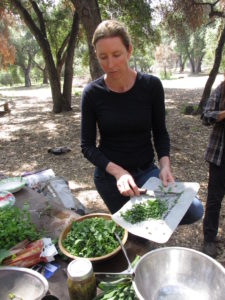
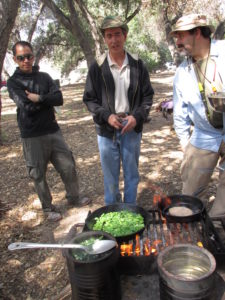
We create a meal with a salad, soup, vegetable dish, pancakes, and a drink, from plants we collect today and from plants that were previously collected. Walk is brief and leisurely, collecting plants along the way, learning how to identify food as well as other non-food plants we encounter.
Foraging has gotten popular. Learn how to ethically forage and how to properly identify wild plants. It's a great survival skill. We never know exactly what we’ll find, but we are likely to have wild greens for salad and soup, wild buckwheat for pancakes, herbs for tea, cactus, and possibly some wild fruits for a dessert item. We find out along the way on this walkabout.
THIS CLASS COUNTS TOWARDS THE ETHNOBOTANY CERTIFICATE.
Location sent out when upon registration.
$65 (senior/student $45): SchoolofSelf-Reliance.com (Events)
LUNCHTIME FORAGING WALK: We'll learn plant and mushroom identification, make a salad, and learn about our local habitat on this nature walk. Thursday, Jan. 18, 12:00-2:00 pm.
Ever wondered what sort of edible, medicinal, and otherwise useful plants grow in and around the city? We’ll explore a unique one-acre wildlife sanctuary in the foothills of Highland Park, where we will see native plants, cultivated plants, and many of the plants typical of large urban areas.
We'll learn about the food uses, natural medicines, useful fibers, and more. Discussion will revolve around sustainable/ethical foraging and collection of greens and cuttings to take home.
There is an on-site nursery to purchase various potted plants to grow in home gardens.
We’ll also make a delicious salad to taste some of the in-season wild edibles.
Native American toyon berries
It's an excellent opportunity to see and taste some of the plants that everyone living in Los Angeles area will encounter most of the time. Learn how to eat the nopal. It's great survival skills training for all ages.
Location: 5835 Burwood Ave., off Figueroa in Highland Park, near Pasadena's 134 Freeway. Free street parking. We’ll meet and walk up the dirt access road into the one-acre sanctuary.
Bring a bowl, water, and be sure to RSVP ($30-45).
Overnight, on the Roy of Hollywood Tuckman show "Something's Happening" (A, Hour 2, 12/5/23), The Herbal Highway, out of Berkeley, was playing. It's a show all about herbs and medicinal plants. The latest guest was herbalist Kat Maier (Sacred Plant Traditions).
Energetic Herbalism (Kat Maier)
Plants are the ultimate alchemists, and the land a plant calls home is part of its medicine story.
This is where apothecary and healing practice begins. When we harvest and work with a medicine, we are gathering so much more than simply the leaf, flower, or root.
Come discover the ease and grace of the oldest medicine on the planet and remember how familiar it actually is.
Experience a unique intake where Kat Maier blends her deep intuitive skills with over 30 years as a clinical herbalist and a background in biomedicine. Mentorship sessions are also available. All are sessions are virtual. Herbal students gather flowers.
Ah, the joy to be in community again. All are invited to join in person with the plants, guest teachers, and a beloved community. Take a look at our day, weekend, and three-month long series.
Variety is truly the spice of life, and that is what there is online in these offerings. Listen to Kat’s favorite topics along with wonderful guest teachers taking us into profound yet practical teachings.
Skills and support to nurture clients, their practice, and community
Creating the Container: Tending Self, Client, and Community, January – March 2024
The Heart of the Craft: Assessing the Story
April – May 2024
Sacred Plant Traditions offerings are crafted to deepen understanding and relationship with plant medicines.
We are a woman-owned business, committed to providing safe space for all members of the community. We recognize the need for and continue to deepen our own personal work around the injustices of racism, colonialism, sexism, and gender discrimination.
Sacred Plant Traditions is located on the unceded lands of the Monacan Nation, in what is now called the neighborhood of Belmont, in the town of Charlottesville, in the state of Virginia, on our one and only Planet Earth.
All are also invited to come visit our sweet UpS Botanical Sanctuary. If living on colonized/occupied land, we invite you to research the history of the land and the Indigenous people who lived, or may still live, there. One tool that may help research is the Native Land Map
Blue Zones refer to five specific places in California, Italy, Greece, Japan, and Costa Rica.
People in these 5 zones tend to live to about 100 years old, while maintaining their good health.
Dan Buettner grew up in Minnesota during the 1960s, where the Midwesterner was fed a high-carb diet of bright yellow macaroni and cheese and sweaty red dyed hot dogs [with their allowable minimum of cockroach limbs and rat feces] wrapped inside flaky croissants.
Greens, whole grains, olives, avocado, hemp-tofu
"We DIDN'T know better," he said.
But when the cyclist and storyteller started traveling around the world, and into the homes of people in locations where elders routinely live to see their 100th birthday in good health — the world's Blue Zones, as he calls them — he noticed something distinct about the ways that they were eating.
Soak and rinse them before cooking. Or sprout them. They become very digestible with no gas.
Beautiful elders: A troupe of singers and dancers in Okinawa, Japan, one of the world's five "Blue Zones," where people routinely live past 100 (Toru Yamanaka/AFP via Getty Images).
Like his own meal plans, they were all fairly high in carbohydrates, but these Blue Zone diets centered on carbs of a different kind.
"The four pillars of every longevity diet in the world are whole grains, greens, nuts, and beans," Buettner told Insider. "When you crunch the numbers, it's very clear that it's a 90% to 100% plant-based, very-high-carbohydrate diet. About 65% carbs, but not simple carbs like muffins and cakes — complex carbs." More
(CriticalHealthNews.com) Dr. Joel Wallach: Avoid all wheat, barley, rye, oats, and buckwheat, all of which have plant lectins like gluten, avenin, and fagopyrins that strip the intestines and lead to malabsorption and malnutrition
No: While the species has medicinal uses, clones are raised for low-CBD high-THC abuse.
.
Plants for Your Food Forest
ETHNOBOTANY SERIES, WILD AND USEFUL PLANTS, Session 1: Learn how to study wild plants, how to identify plant families, uses, medicinal value, how to keep records...
This is an introduction to the art of foraging, and medicinal plants. (It is part of the School of Self-Reliance's certificate and certification program).
Native American wisdom (USC)
The session begins with a walkabout, getting to know some of the common local plants. We’ll cover botany basics to have a sense of context of the types of plant groups, as well as their relationships. Instruction on use of plant press and how to make field records for own use.
Take this session by itself or sign up for all four classes. We will sample a wild food salad as part of class. Bring notebook. Price: $65 per class ($45 senior/student)
ABOUT: This channel is by a wild mushroom lover with he and his wife identifying, collecting, cooking, and sometimes preserving wild mushrooms. They've tasted nearly 50 different species of wild mushrooms in the Northeast America so far, and they'd like to extend their list to share adventures exploring nature. WARNING: Be cautious by always referring to multiple reliable sources before consuming any wild edible! Music: Roboskater by Audionautix, licensed under a Creative Commons Attribution license. Artist: audionautix.com.
It was a mild drizzle at first, but being in the watershed known as Hahamongna next to JPL, it was filling up behind the dam. Intrepid hunters braved it and were rewarded with mycelium fruit all over the foothills:
The field is too big know reliably, and apps are of little help if one wants to be sure -- particularly for consumption -- since each fruiting body goes through stages where it changes shape and color.
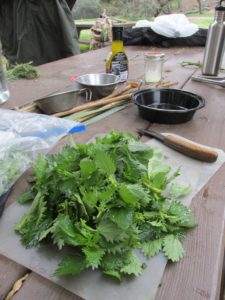
But we were sure of the blewits, collected them, and our Native vegan chef prepared them with leeks and plant-based butter in a wok, serving them over brown rice alongside stinging nettle soup (with kale, pumpkin, bok choy, rainbow chard, onion, vegan bouillon (broth), sea salt, and quality olive oil).
There were many greens blooming and ready to collect for soup and salad with dressing we brought:
(Learn Your Land) Blewits are edible mushrooms that can found during the autumn months in Pennsylvania and wet winters in California. In this video, let's identify this beautiful species in the wild. Additionally, let's look at maitake ("hen of the woods") and honey mushroom identification.
Fox News keeps making Progressives look good (accidentally)
Joanna Rothkopf
Laura Ingraham tried to attack Alexandria Ocasio Cortez, Ayanna Pressley, Rashida Tlaib, and Ilhan Omar. It backfired.
On Tuesday evening, Laura Ingraham (sorry) did a segment on her show, The Ingraham Angle (so sorry), entitled, “The Freshman Insurrection” (please forgive me).
Progressives look good on Fox (Getty/Fox).
In the segment, Ingraham discusses a new class of progressive congresswomen—specifically, Rashida Tlaib, Ayanna Pressley, Ilhan Omar, and Alexandria Ocasio Cortez. As is the case with most of Ingraham’s work, the segment is clearly meant to strike fear into the hearts of the white and retired.
But if not delivered with Ingraham’s trademark sneer, it would have actually come across as a pretty good campaign ad. More
Yes, Trump altered Acosta video
If I were president...Hillary
[The Trump administration's second most dependable liar behind Sarah Huckabee Sanders] Kellyanne Conway admitted to Fox News’s Chris Wallace Sunday that the Jim Acosta video tweeted by White House Press Secretary Sarah Huckabee Sanders was, in fact, doctored. And in so doing she coined another phrase that, although not as catchy as "alternative facts," is just as Orwellian. More + VIDEO
Alternatives germinate at the margins, sending cracks into the hardest things to change. Paved-over utopias, rise up like WEEDS (pernicious invasive species). There are things that are out of place and therefore unable to fulfill their function so go on to interrupt others' function, but there are no such things as "weeds." This analog animation and mural series is inspired by the resilience of urban weeds.
The monk and the weeds
Young novice, Burma (Anek Suwannaphoom)
There is an old apocryphal story of a Buddhist monk who wondered what the purpose of a "weed" was.
Perplexed, he went to the old meditation master and asked. The master tasked him to find a single plant that was a "weed," that is to say, one that had no beneficial medicinal use.
The young monk took the challenge and traveled the region and eventually the world in a caravan in search of one, compiling an impressive botanical catalog in the process.
He was unable to find one, not a single plant. For everywhere he went, for the people there, each plant had a benefit.
Every "weed" is a lotus waiting to be found.
What was regarded as a "weed" in one place was certainly not considered so elsewhere. When the pharmacopeia, or archives of Chinese medicine, could reflect that, every plant came into use. Even a "poisonous" plant could be medicinal when utilized correctly.
What was seen one way and regarded as so in ignorance turned out another way, the monk found again and again. With wisdom the plant realm was seen for what it was, a benefit to beings in other realms, such as the human, animal, and the unseen beings.
What's happening in gardening? The Thursday classes at the Los Angeles Arboretum (arboretum.org)
Muralist painting weeds to represent margins of society
Caron paints Platago lanceolata in SF.
(PRI) If you’re wandering around, say, Sao Paulo,
Brazil, or Athens, Greece, or San Francisco, California, you just might
stumble upon a weed grown as tall as a building…on the building, that is.
Mural artist Mona Caron (sparebeauty.com) uses city walls all over the world as
canvases for her magnified portraits of wild plants. She says they
represent what survives at the margins of society. And she wants us to
pay closer attention.
Caron lives in San Francisco but hails from the Italian part of
Switzerland. She started out her career doing sweeping bird's-eye views
of cities and has been known as the cityscape artist for a long time.
But then something happened a few years ago. She began doing the
opposite -- painting tiny things large. Specifically, it was the weeds, the little
wild plants that grow in sidewalk cracks everywhere, the plants that
people step on.
"The less attention we pay it," Caron explains, "the larger
I’m going to paint it." "I don’t paint dainty little grandmotherly botanical illustrations," Caron says. To her, weeds are plants that have power. More
(Elephant Journal) "Weeds are flowers, too, once you get to know them" (A. A. Milne). Waylon walks with leading herbalist and earth goddess Brigitte Mars (author of 19 books) and eats lawn, gets pricked by nettles, talks about the crime that is grass, and learns about how to transform urban landscapes without asking permission.
Foraging Wild Edible Plants
Foraging Edible Wild Plants of North America preceded Christopher Nyerges' latest guide on wild California plants. They're fully illustrated wild food cookbooks with color photos and recipes for the most common greens found in North America.
Many of these plants also grow worldwide. "I was really happy with the result," he says. The guide is 211 pages of wild recipes, various ways to use wild foods, their nutritional value, and ways to process these plants, with full color photos of each. There is an introductory chapter on food preparation and how to make wild spices.
A chart at the end (based on the USDA's "Analysis of Foods") demonstrates the incredible nutritional value of wild foods. The book also includes comments from people who have tasted these dishes at workshops.
Responses vary from lovers of "Earth Bread," based on seed meal from the plant lambs quarter. Earthy to some, others say it's "virile," "amazing," "deliciously wholesome and sustaining." Adventurous eater? Ready to forage and prepare wild foods? Interested in living off the land? This is a great book to begin to explore.
(Woodlands TV/Adliberate) UK naturalist John Rhyder walks in a woodland identifying plants, uses, where and when they grow, how best to eat them.
Shopping for vegetables? Hit the sidewalk, not the supermarket
Seeds are a relaxant, petals are edible. California poppy reserve, Lancaster (Boris Yaro)
Forget lettuce and spinach. Start thinking mallow, purslane, and amaranth.
Even if we've never heard of these greens, they might be all around us, according to an interesting NPR piece on urban foraging.
The story follows expert forager Sam Thayer around Washington, DC, as he plucks and nibbles uncommon salad ingredients, including "weeds" like shepherd's purse and sow thistle as well as Siberian elm seeds.
He finds them in the unlikeliest of places -- reclaiming an abandoned garden box, sprouting near chain-link fences.
Barring the risk of pesticides and city pollution, they're pretty good health and taste wise -- according to the story, more nutritious than grocery store greens. The mustard green, which has the highest known nutrient levels of any leafy green, is "high in vitamin A, beta carotene, zinc, manganese, and fiber," says one expert.
My mother always told me not to pick things off the street and certainly don't eat them. Then again, she always told me to eat my vegetables. Intrigued, I wondered if there was any nutritional value to be had on the streets of Los Angeles.
Turns out we have a few foragers on the West Coast,* too. Check out this piece from the Weekend America files on Nance Klehm, a local foraging expert.
From the L.A. Times archives, here are some wild plants, what they taste like -- and when and where to find them.
*Christopher Nyerges, School of Self-Reliance, P.O. Box 41834, Los Angeles, CA 90041, (626) 791-3217, author of How to Survive Anywhere, Enter the Forest, and Guide to Wild Foods, editor of Wilderness Way magazine for 7 years, writer of thousands newspaper articles.
Pascal Baudar specializes in gourmet dishes using wild foods, (818) 484-6822.
Jim Robertson, Aboriginal Skills, focusing on stewardship of land through wilderness education, survival skills, hikes, (310) 395-0943. j3rbrts@dslextreme.com.
Barbara Kolander does wild-food gathering and cooking workshops.
All materials on this site are submitted by editors and readers. All images, unless otherwise noted, were taken from the Internet and are assumed to be in the public domain.
In the event that there is still a problem, issue, or error with copyrighted material, the break of the copyright is unintentional and noncommercial, and the material will be removed immediately upon presented proof.
Contact us by submitting a comment marked "private."
Do not follow this journal if you are under vinaya or parental restrictions. Secure protection by Sucuri.
Wisdom Quarterly: American Buddhist Journal is licensed under a Creative Commons Attribution-Noncommercial-Share Alike 3.0 United States License. Permissions beyond the scope of this license may be available at creativecommons.org/about/licenses.