Showing posts with label overcoming delusions. Show all posts

Wednesday, November 26, 2025

Awakening (liberating insight) is normal

What if the ego (self, soul) were just to melt and disappear for a moment? Would we let go?

Awakening is totally normal, Dude. Don't go looking for special magic experiences
Wake up, Zen meditators, or it's the paddle!
(The Theory of Samsara) Premiered Nov. 27, 2025: 🧘‍♂️ Why do we all so easily fall into "spiritual delusion"? Why do we chase psychedelic highs, promises of supernatural powers, or “special” experiences instead of understanding the ordinary, unchanging nature of consciousness [and related phenomena] itself?

This video dives more deeply into the mechanics of self-deception on the spiritual path
  • How craving fuels suffering,
  • Why Western culture’s addictions make it worse,
  • Why meditators so often mistake mental fabrications for awakening.
Let's explore the Buddha’s actual teaching:
  • Craving is the root of suffering
  • Consciousness is ordinary, not something to be manufactured
  • Awakening can’t be given to us by a teacher
  • Psychedelic trips are NOT enlightenment
  • Pride, jealousy, and other delusions and fabricated identities destroy the Path
  • True realization begins with a stable, uncontrived mind.

Whether we practice Zen (jhana), Mahamudra ("great seal"), Vipassana (insight meditation), or Dzogchen (choiceless awareness), the message is the same: Stop looking for the extraordinary.

Instead, recognize the nature of mind as it is: SUCHNESS, ordinary mind — nothing to adopt, nothing to abandon.

If we want to avoid spiritual self-sabotage and cultivate a genuine path toward awakening, this is for us. Check out ultimatemeaning.org for more information.

#spiritualdelusion #buddhism #awakening #meditationpractice #dzogchen #mahamudra #ordinarymind #buddhadharma #spirituality #selfdeception #craving #suffering #mindfulness #psychedelics #nondual #zenmeditation #enlightenmentpath
  • Anand Universe Official, Is there a God? Nov. 23, 2025; The Theory of Samsara; Pat Macpherson, Dhr. Seven, CC Liu (eds.), Wisdom Quarterly 

Monday, November 24, 2025

Avoid the trap of 'spiritual delusion'


(The Theory of Samsara) Avoid falling into spiritual delusion. We need to know this if we're on the spiritual path, particularly within Tibetan Buddhism, a form of Vajrayana [a kind of Mahayana Buddhist Hinduism with yoga and lots of ritual, magic, and siddhis]

Tuesday, September 2, 2025

The Buddha: The Fire Sermon


The Fire Sermon: "All is burning"

The Fire Sermon (Buddhistdoor.net)
(Ādittapariyāya Sutta, SN 35.28) In the Pali language canon there is a discourse (sutra) called the "Fire Sermon Discourse," popularly referred to as the Fire Sermon [1].

In this discourse, the Buddha teaches that achieving liberation (vimutti, moksha) from all suffering (pain, disappointment, rebirth, and unsatisfactorinesss) through letting go everything (ALL) mind and the five senses obsessively CLING to as personal, as sources of pleasure, and/or as enduring.
This sutra is also found in the Buddhist Monastic Code (Vinaya) at Vin I 35 [5].

English speakers might be familiar with the name of this discourse due to T. S. Eliot's titling the third section of his celebrated poem "The Waste Land" as The Fire Sermon. In a footnote, Eliot states that this Buddhist discourse "corresponds in importance to the Sermon on the Mount" in Christianity [6].

Background
Let us cut off our jatas and follow this sage!
In the Pali canon's "Collection of Discourses" (Sutta Pitaka), the Fire Sermon is the third sutra delivered by the Buddha (after the first discourse, called the Dhammacakkapavattana Sutta, and the Anattalakkhana Sutta), several months after his great awakening/enlightenment, on top of Gayasisa Hill, near Gaya, in what is now India (formerly the maha-janapada Kingdom of Magadha before there was an "India").

He delivered it to 1,000 newly converted wandering ascetics (samanas) who formerly practiced a sacred fire ritual (Pali aggihutta, Sanskrit agnihotra) [7].

The 5th-century CE post-canonical Pali commentary called the Sāratthappakāsini (the Spk.), attributed to the Theravada scholar-monk Buddhaghosa, draws a direct connection between the ascetics' prior practices and this discourse's main rhetorical device:

Having led the 1,000 ascetics to Gayā's Head, the Buddha reflected, "What kind of Dhamma talk would be suitable for them?"

He then realized, "In the past they worshipped fire morning and evening. I will teach them that the 12 sense bases (āyatana) are burning and blazing. In this way they will be able to attain full enlightenment" [8]. More

Wednesday, July 16, 2025

The Age of Filth (Era of Mental Trash)


The Era of Mental Trash
(Psyfluence) July 12, 2025: Let's explore the deep crisis affecting our mind and society in the Digital Age. We live trapped in a world overwhelmed by distractions, superficiality, and mass consumption of empty content that dulls our consciousness and weakens our ability to think deeply.


We talk about the silent collapse of the modern mind, a reality where truth is shaped by algorithms, noise replaces reflection, and mediocrity is celebrated as freedom and authenticity.

Did you know this generation is being educated to obey without questioning? We are being trapped in a sweet servitude full of filters, likes, and digitally-induced dopamine addiction. But not all is lost.


There are those who resist, who seek lucidity and depth amid the filth. If you feel something inside you refuses to settle for superficiality and constant noise, this video is for you.

Join the conversation, awaken consciousness, and learn why in a world full of mental trash and why thinking has become a revolutionary act.


Remember. Don’t forget. Subscribe, like, and share so more people can open their eyes and start rebuilding authentic thought.

Sunday, June 22, 2025

My spiritual EGO (real spirituality?)

"Living is easy with eyes closed." Wake up. Don't hate me b/c I'm beautiful. Hate me for my ego.

Irah Morffi (@irahmorffi) • the most enlightened girl on internet (I mean "metaphysics researcher" who totally does not love herself and everybody's jealous of, totally not that).
I'm a limited liability corporation in Florida.
IRAH IS NOT A DOCTOR OR A MEDICAL PROFESSIONAL. No, really. She is a for-profit spiritual life coach who focuses on self-improvement. Dealing with emergencies or medical situations? Please seek medical help from professionals. The company [that is the future Irah Morffi, Inc] was founded in 2020 under LLC NYARAH INC in Plantation, Florida. (Registration number 221041595397).

High vibration living now?
The bliss (piti) of meditation as samadhi (calm meditation with absorption)
Happiness (joy) is the way to meditation: meditationsteps.org

Thursday, January 16, 2025

The Buddha: Progress of the Disciple


German born author Ven. Nyanatiloka
The Buddha taught not sudden enlightenment (satori) but gradual development of the Noble (Ennobling) Eightfold Path to bodhi:

In many discourses or sutras there occurs an identical passage that outlines the gradual course of development in the progress of the disciple. There it is shown how this development takes place gradually, in conformity with natural laws or fixed regularities of the universe, from the very first hearing of the Dharma (the Enlightened One's Doctrine), to germinating confidence/faith (saddha) and dim comprehension, up to the final realization (bodhi) of liberation (nirvana) from all suffering.

"After hearing the Dharma, one is filled with confidence, and one thinks: 'Full of hindrances is household life, a refuse heap. But the left-home life (of a Buddhist monastic) is like the open air. It is not easy, when one lives at home, to fulfill in all points the rules of the supreme life. How now if I were to cut off hair, put on saffron robes, and go forth from home to the left-home life?'

"And after a short time, having let go of one's possessions, whether they be great or small, having forsaken a circle of relations, small or large, one cuts off hair, puts on saffron robes, and goes forth from home to the left-home life.

Having thus left the world, one fulfills the monastic rules:
  1. One abstains and avoids killing living beings, having abandoned cudgel and knife, conscientious, full of sympathy, desiring the welfare of all living beings.
  2. One avoids stealing (taking what is not given)...
  3. One avoids unchastity...
  4. One avoids lying...
  5. One avoids tale-bearing...
  6. One avoids harsh speech...
  7. One avoids idle chitchat.
  8. One abstains from destroying vegetal seeds and plants.
  9. One eats only at one time of day [after dawn but before noon].
  10. One keeps aloof from dance, song, music, and visiting unseemly shows.
  11. One rejects floral adornments, perfumes, ointments, as well as any other kind of embellishments. 
  12. One avoids using high and luxurious beds and seats.
  13. One avoids accepting gold and silver...
  14. One keeps aloof from buying and selling....
  15. One contents oneself with the robe that protects one's body and with the alms bowl with which one keeps oneself alive: Wherever one goes, one is provided with these two things, just as a winged bird in flying carries along its two wings.
"By fulfilling this noble domain of virtue (sīla) one feels in one's heart an irreproachable happiness."

In what follows thereafter it is shown how the disciple watches over the five senses and the mind and by this noble restraint of the senses (indriya-samvara) feels at heart an unblemished happiness.

It is shown how in all one's actions one is ever mindful and clearly conscious and how, being equipped with this lofty virtue and with this noble restraint of the senses, and with mindfulness and clear comprehension (sati-sampajaƱƱa), one chooses a secluded dwelling.

Freeing the mind from the Five Hindrances (nīvarana), one reaches full absorption (samādhi).

Thereafter, by developing insight (vipassanā, lit. "clear seeing") with regard to the radical
  1. impermanence (anicca),
  2. disappointment (dukkha), and
  3. impersonal (anattā) nature of all phenomena of existence [summarized as the Five Aggregates clung to as self],
one finally realizes liberation from all cankers and defilements, and this certainty and assurance arises:

"Forever is liberation achieved,
This is the last time I am reborn,
No new rebirth awaits me."

Cf. D.1, 2f; M. 27, 38, 51, 60, 76; A. IV, 198; X, 99: Pug. 239, etc.

Saturday, January 11, 2025

The Zen secret to letting go


Zen Buddhism: What is Zen Buddhism, its beliefs and symbols | TheMindFool

When you seek it, you lose it | The Zen Secret to Letting Go
The Subtle Art of Not Giving a F*ck
(EinzelgƤnger) Jan. 11, 2025: What is Zen (the Japanese version of Chinese Chan) Buddhism? Let’s explore its core, several key concepts, and the practice. How does it differ from the traditional teaching of the historical Buddha (Siddhartha "Shakyamuni" Gautama) as embodied in the ancient Theravada Buddhist school and its practice of "tranquility" (jhana, dhyana, channa, chan, zen) and "insight" (vipassana, lit. "clear seeing") in this very life or through lives of striving?

Fun fact: most footage was shot during my recent trip to Kanazawa and Tokyo. This video: When You Seek It, You Lose It | The Zen Secret to Letting Go. #zen #alanwatts #taoism
  • As an American, I opt for a sudden awakening (because I ain't gots no time to be muddling through formal or intensive practice. I need to purify and clarify my inner vision and awaken ASAP!)
Where does "Zen" get all these non-Buddhist ideas? Lao Tzu's Taoism: The Art of Not Trying

Lao Tzu: The Art of Not Trying
"Hi, Catty." My Tokyo culture created this.
(After Skool) July 9, 2024: The curious Taoist celestial sage Lao Tzu was aware of a human quirk. We get so lost in our intellectual prisons that we forget the "natural" way. We force and struggle, swimming against the stream [like the historical Buddha said his Dharma or Teaching traveled, not the way of the world but something counter to it]. We do this so much that sometimes we end up farther from our goals than when we started. So what if we stopped "trying" so hard and pursued a different way, an effortless way, of getting things done? This video explores Lao Tzu and the art of not trying or what one modern American author has capitalized on in his book The Subtle Art of Not Giving a F*ck: A Counterintuitive Approach to Living a Good Life. Because if there's one thing we Americans love, it's our misconceptions of what "Zen" is, teaches, and does. Happy Kensho or Satori.

Why does Theravada waste time with effort?

Early Buddhist Studies
Theravada ("the Teaching of the Elder Enlightened Disciples of the historical Buddha") is such a drag. Why so slow, traditional monks and nuns? Get with the new program, the Hindu-fueled fast track to enlightenment and riches and everything you ever wanted. "Zen" sounds great, but it's an amalgamation that's gone off the rails.

It may be fun. It may be Taoism and Confucianism (and Shinto) with a whole lot of Vedanta and Hinduism thrown in, as is the way with Mahayana Buddhism. If only it worked as promised. What if we stripped away all the add-ons and cultural baggage? There might be nothing left but some naked Brahmanism/Hinduism.

Most of what people think is so "Buddhist" about Zen is actually Taoist. Have fun, but probably we shouldn't confuse it with or call it "Buddhism." That suggests the Buddha Shakyamuni was talking like this when he very much was not. What was he saying? His stripped-down teachings are reduced to misleading lists. The lists are good. The misleading part is that one can just memorize a list and think one knows anything.

Lists are a shorthand. They refer to very detailed teachings, most of which are not in the written texts but handed down in the teaching lineage of Theravada meditation masters. The suttas (discourses) are great for a broad understanding, and the Commentaries (like the Abhidhamma) are great for a pedantic detailed understanding (in ultimate terms), but actual practice always has been and is likely to always in the future be handed down through the practice.

Find a teacher who actually sits and teaches the art of sitting meditation, walking meditation, mindfulness, and the contemplations. The secret formula is this: Develop the jhanas (zens, dhyanas, chans, or meditative absorptions, which can be called the "meditations") to some extent, preferably to the fourth absorption, then apply the Satipatthanas or "Fourfold Setting Up of Mindfulness Practice."

Burmese Pa Auk Sayadaw (buddho.org)
That may sound fancy, but it's easy: Systematically practice mindfulness (sati) on four things: the body, feelings, mind, and mind objects. There's no need to figure it out. It is explained in the Satipatthana Sutta and the Maha Satipatthana Sutta. That's the conceptual part. The practice part is learned from an experienced teacher. There is one great one in Burma known as Pa Auk Sayadaw. Why is he great? He is a scholar-monk-practitioner. He actually did it, succeeded, and can explain it in terms of the texts. He is both a textual expert (scholar) AND a successful practitioner of it. Of what? He is a success at the practice of the Path that leads to enlightenment here and now in this very life. His greatest contribution may be that he left a line of awakened teachers able to teach -- monks (bhikkhus) and nuns (sayalays) and successful lay practitioners. They are out there.
  • (It is not true that Theravada advocates anyone take many lives; it may not be possible for everyone to reach full enlightenment in this life nowadays, but it remains true that nearly everyone can attain stream entry, the first stage of enlightenment, which assures full enlightenment in no long time, or what the Buddha promised was a maximum of seven more lives. That may sound like a long time, but compared to the countless lives we've already endured in samsara or the countless rebirths to come, it is as nothing, and it is a maximum. Most can finish in one more life, if they so wish, but now there's no hurry or stress because one is assured of no more rebirths in worlds of woe below the human plane, and one is likely destined for some very sublime and wonderful lives in the deva and brahma planes).
American Ajahn Sumedho | Buddho.org
There may be others (Thai Ajahn Chah and his Western students British Ajahn Brahm and American Ajahn Sumedho), but successful practitioner-teachers are rare. Most monastics prefer the easier route ("career") of study and teaching when it would be far better to apply those teachings to one's own life. In that way one could teach from experience and success, but this only very rarely happens.

Theravada may sound slow, but it is a back-to-basics movement about what the real Buddha, the historical human figure (rather than the Cosmic Buddhas and divine figures like Amitabha, Budai or Hotei, Guanyin or Kwan Yin, Avalokiteshvara, Ksitigarbha, and others) taught. The Buddha was not a Hindu (there was no Hinduism then) and not a Brahmin, not an advocate of the Vedas (though very familiar with them), and not an advocate of non-dualism, which many Mahayanists (acting like Hindus) equate with some kind of "enlightenment." Buddhist enlightenment is about penetrating the Four Ennobling Truths that lead one to the "noble" state of enlightenment/awakening. It is the way of direct wisdom, which is full of compassion.
  • Dhr. Seven, Amber Larson, Pat Macpherson, Wisdom Quarterly; EinzelgƤnger, Jan. 11, 2025, After Skool, July 9, 2024

Saturday, November 30, 2024

SNL Weekend Update (comedy)


SNL Weekend Update 11/30/24 | Saturday Night Live Nov. 24, 2024
(Em VĆ¢n Review) Premiered Nov. 30, 2024: #SNL #Saturdaynightlive #Weekendupdate SNL Weekend Update 11/30/24 | Saturday Night Live Nov. 24, 2024 SNL Weekend #SNL #Saturdaynightlive #Weekendupdate #Trump #SNL

Mindful not to react to politician's name

Thursday, October 31, 2024

Scare Yourself Awake (spooky Tricycle)

Scare Yourself Awake
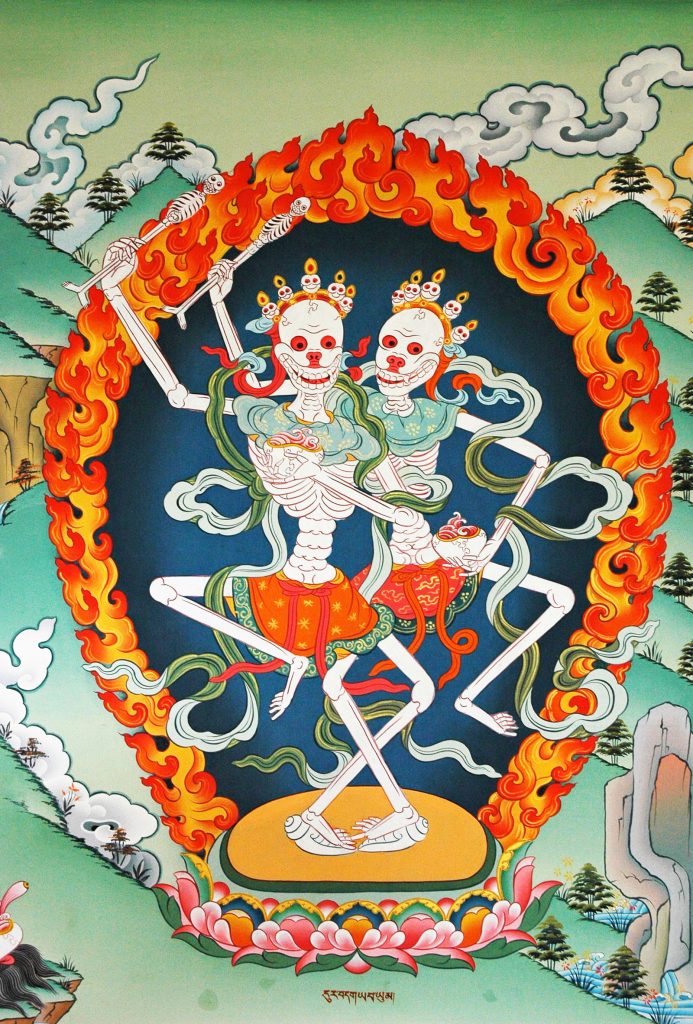
A Buddhist monastery painting of Tibetan Citipati, skeletal protector deities. Pharping, Nepal (Wonderlane/flickr.com)

Scare Yourself Awake 
Some of Tricycle magazine's spookiest reads for Halloween
(Tricycle) Today is Halloween, and here’s the chilling secret: Buddhism loves ghosts (pretas, petas). And not just the hungry kind. Demons, spirits, and other supernatural creatures abound in the Buddhist canon, and they continue to play a role in the lives of many Buddhist practitioners today.

To some skeptics, all those ghoulish beings are just "psychological" tropes, mere projections of unenlightened minds. But like any good teacher, the things that go bump in the night have a way of upending our notions about what we hold to be real and unreal.

So fill your oryoki bowls with mini Milky Ways, and descend into the hellish and haunted realms, with these seven articles from the Tricycle archives that highlight the mysterious roles that shapeshifting monsters, specters, ghosts, and zombies have played in Buddhist traditions throughout history.

For the easily frightened, a selection of articles about overcoming fear through meditation and Buddhist teachings is also included. Happy Halloween!

Buddhist Halloween Horrors
The Monsters of Buddhism—Inside and Out by Julia Hirsch
An abridged guide to Buddhist monsters and the lessons they hold about the possibility of transformation — such as the child-eating Kishimojin, who eventually purifies her karma and becomes the Buddha-endorsed guardian deity of mothers and children. Alternatively, a horror movie with a happy ending. More

How to Watch a Thai Ghost Movie by May Cat
A Thai cinephile writes about the karma-fueled haunting of the 2009 Thai horror flick Novice. A young man ordains as a novice monk but is tormented by the misdeeds (unskillful karma) of his past. In the end, the novice gets his due, and the hungry ghosts doom him to life as one of their own. More

Ghosts, Gods, and the Denizens of Hell by Prof. Donald Lopez, Jr.
Buddhist studies scholar Donald Lopez Jr. provides an introduction to [Mahayana's] six realms — including the less than desirable sectors of existence. “There are eight hot hells and eight cold hells, four neighboring hells, and a number of trifling hells,” he writes, reminding us that even though human existence is tough, it’s still the best (and only) shot we have at freedom from samsara

Treasury of Lives: Halloween Edition by Harry Einhorn
Tibetan cosmology is populated with interesting paranormal creatures, like deloks — people who died, visited the lower realms, and returned to warn those in the human realm about the punishments that await them unless they start walking an ethical path.

Also in Tibetan Buddhism is a model of fear-facing Buddhist practice in the female Master Machik Labron (1055–1149), who encouraged her students to do chƶd, tantric practice in burial grounds and other spooky places.

The Old Human Demoness by Chokey Dolma
This haunting tale by Chokey Dolma showcases the richness of Tibetan ghost stories. Once upon a time, a young monk disobeys his teacher’s order to buy meat only as given without asking for more, and he becomes marked by evil spirits. To avoid becoming demon food, the young monk travels to Lhasa and requests the aid of a mysterious old woman. Although she agrees to help hide him from the demons, the young monk eventually discovers there is more to this woman than meets the eye.

Bringing Hungry Ghosts Out of Hiding, Andy Rotman in conversation with Julia Hirsch
Andy Rotman, a scholar of South Asian religions at Smith College and one of the few academics researching the history of hungry ghosts, explains what the most wretched beings of the Buddhist cosmos can teach us about greed, suffering, and the dharma.

Into the Demon’s Mouth, by Aura Glaser
Through a modern retelling of the Buddhist story of the great Tibetan saint Milarepa and the demons who inhabited his cave, Glaser invokes Carl Gustav Jung, Chƶgyam Trungpa Rinpoche, and others to illustrate how remaining present among difficult life situations can help us to work with problems and to even learn from them. A parable with elements of horror, Glaser’s writing opens up the story so that we can learn to face our fears with clarity and kindness.

FEAR (FEAR)
Harnessing Horror Through Meditation by Biju Sukumaran
After getting stuck on Disneyland’s Space Mountain ride as a child, Biju Sukumaran has had a phobia of heights and small spaces. Recently, he started drawing from the Buddhist practices of vipassana (insight) and Tibetan chƶd meditation to face his fears of flying, horror movies and, yes, even roller coasters.

A Safe Container for Fear by Josh Korda
What does fear feel like in the body? Approaching feelings of unease, anxiety, and social discomfort with questions like these, Josh Korda suggests, can help untangle the web of fear we weave for ourselves.

Facing Fear by Lama Tsony
Coming back to the focal point of meditation (the breath, posture, or a visualization) can help us practice and move through our fears, Lama Tsony writes. Taking refuge or seeking guidance from a spiritual teacher or friend offers the support we need as we explore the uncomfortable zones of our minds.

The Terror Within by Zenju Earthlyn Manuel
In a meditation on the different ways fear has come up in her own life and practice, Zen priest, author, and artist Zenju Earthlyn Manuel uses lessons from the Heart Sutra and the Buddha’s teachings on the Five Hindrances to provide steps for breaking out of cycles of anxiety and to acknowledge the roots of our fear as a conditioned state that is accumulated over a lifetime. By providing steps for breathing into these feelings and releasing them, Manuel invites readers not to hide from their fear but to embrace it as an act of liberation. Source
  • ‘A Stomach like an Ocean, a Mouth like the Eye of a Needle’ Andy Rotman
⧫ This article was originally published on October 31, 2019. Tricycle is the leading independent journal of Buddhism in the West, where it continues to be the most inclusive and widely read vehicle for the dissemination of Buddhist views and values. By remaining unaffiliated with any particular teacher, sect, or lineage, Tricycle provides a public forum for exploring Buddhism and its dialogue with the broader culture.

View Comments Top courses Take an online Buddhism course at your own pace. The Five Spiritual Powers by: Christina Feldman, Christoph Kƶck and Jake Dartington Writing as a Spiritual Practice by: Sallie Tisdale Freeing the Mind When the Body Hurts by: Vidyamala Burch The Spiral to Freedom by: John Peacock and Akincano Weber Real Life by: Sharon Salzberg Related hungry ghost stomach ocean Teachings Karma ‘A Stomach like an Ocean, a Mouth like the Eye of a Needle’ Translated by Andy Rotman Machig Labdron Anam Thubten Teachings Fear Trample on What Challenges You By Anam Thubten faith in Buddhism Teachings Fear Faith in Buddhism By Khenpo Sodargye Subscribe Today Tricycle is more than a magazine Subscribe for access to video teachings, monthly films, e-books, and our 30-year archive. Subscribe Weekly Newsletter The latest from Tricycle to your inbox and more Your email here Donate Now Help us share Buddhist teachings Tricycle is a nonprofit that depends on reader support. Donate Topics Teachings Meditation Ideas Culture Personal Reflections News Obituaries Topic Pages Magazine Dharma Talks Film Club Podcasts Online Courses Buddhism for Beginners Daily Dharma App Events E-Books More About Customer Support Newsletters Contact Advertise Careers Terms of Service Privacy Policy Copyright 2024. Tricycle. All rights reserved. Design by Point Five and Code Rodeo. Development by Code Rodeo Subscribe Search About Log In Subscribe Teachings Meditation Ideas Culture Personal Reflections × Teachings Meditation Ideas Culture Personal Reflections Events Dharma Talks Film Club Podcasts Online Courses Buddhism for Beginners Magazine Haiku Challenge All Topics Login Subscribe for access to video teachings, monthly films, e-books, and our 30-year archive. Subscribe Tricycle is a nonprofit that depends on reader support. Donate Culture Fear Scare Yourself Awake Some of our spookiest reads for Halloween By Tricycle Oct 31, 2023