LYRICS ("In My Eyes"): You tell me you like the taste [of drugs]/ You just need an excuse/ You tell me it calms your nerves/ You just think it looks cool/ You tell me you want to be different/ You just change for the same/ You tell me it's only natural/ You just need the proof/ Did you f*cking get it? [CHORUS: It's in my eyes, it's in my eyes/ It's in my eyes, it's in my eyes/ It's in my eyes, it's in my eyes/ It's in my eyes, it's in my eyes] And it doesn't look that way to me/ In my eyes/ It doesn't look that way to me/ In my eyes// You tell me that nothing matters/ You're just f*cking scared/ You tell me that I'm better/ You just hate yourself/ You tell me that you like her/ You just wish you did/ You tell me that I make no difference/ At least I'm f*cking trying/ What the f*ck have you done? [CHORUS] And it doesn't look that way to me/ In my eyes/ It doesn't look that way to me/ In my eyes/ Thanks a lot, friends.
Rock the Vote?
Rock the Vote is a US non-profit. By registering new young voters, it aims to "channel the energy among young people around racial, economic, and health justice into one of the most powerful actions they can take: voting" [2]. The organization was founded in 1990 by Virgin Records America Co-Chairman Jeff Ayeroff to encourage young Americans to vote [3]. It is geared toward increasing voter turnout among voters ages 18 to 24 [4, 5] to join forces with mature adults ages 25 and up. Rock the Vote is known for its celebrity spokespeople and its partnership with eMpTV [6]. More
Vote yes on Data Centers to destroy environment and humanity
(Rock The Vote 2026 | Live @ Southern Lights) It's election time. Youth are underenrolled. It's time to do something about that. The Ōtepoti youth music community is going to. Together the community presents: ROCK THE VOTE live at Southern Lights Yard (outdoors) 18 Devon Street. It's an all-day music festival, reminding us that our vote counts, and our views, opinions, and voices matter. Saturday, Oct. 3, 2026, featuring: Bunchy’s Big Score, Coward, Deaf Raccoon, Dolly Possum, Grace Gemmell, Motheaten, Rheumy, Seek Help!, Sivle Talk, Sogg, Strap, Talking Furniture, the pink opaque, U-No Juno, Vagina Dry with DJ Selectors curated by Tina Turntables.
What do punks know?
(Minor Threat) "12XU" (defending LGBTQIA+ in Flex Your Head)
Turnstile started as a hardcore punk rock group. Their breakthrough third album Glow On was released in 2021, earning critical acclaim and three Grammy nominations. The band has expanded and now just calls itself "an American rock band" from Baltimore (Maryland) that formed in 2010. Turnstile consists of lead vocalist Brendan Yates, guitarist Pat McCrory, guitarist Meg Mills, bassist Franz Lyons, and drummer Daniel Fang. Their fourth album Never Enough was released in 2025 and charted in the Top 10 of five countries, including the USA. It received five Grammy nominations, making itthe first band in history to be nominated in the rock, alternative, and metal categories in the same year [2]. Turnstile won a Grammy Award for Best Metal Performance for their song "Birds" and Best Rock Album2026. More
Commonly abbreviated to hardcore or hXc, this subgenre of punk rock with its distinct subculture originated in the late 1970s. It is generally harder, faster, and more aggressive than other forms of punk music [8].
Los Angeles may be famous for hXc, but LA certainly didn't invent it singlehandedly. Its roots can be traced to other crosspollinating punk scenes in Northern California like the San Francisco Bay Area and the SoCal region, including Orange County, Hollywood, and outlying parts of the sprawling megalopolis of the City of Lost Angels.
Hardcore punk arose as a reaction against the still predominant "hippie" (wimpy peace, love, happiness) cultural climate of the time (in the late '60s, early '70s). It was also inspired by D.C., and New York punk rock and earlier proto-punk [1].
Hardcore punk generally eschews (resists, rejects, runs away from) commercialism, the established music industry, and "anything similar to the characteristics of mainstream rock" [14], which tries its darndest to garner fans, popularity, and commercial appeal in a capitalist marketplace.
Hardcore punk, on the other hand, frequently addresses social and political topics with "confrontational, politically charged lyrics" [15].
It has also influenced various music genres that in distinction to punk rock have experienced widespread commercial success, including grunge and crossover thrash metal.
Hardcore punk historian Steven Blush credits DC's Dischord Records co-owner Ian MacKaye (Bad Brains-inspired Minor Threat and Fugazi) with starting a "die-hard mindset that begat almost everything we now call Hardcore," which was virulently anti-music industry and anti-rock star [16].
An article in Drowned in Sound argues that late-1970s/early-1980s era hardcore is the true spirit of punk, because "all the poseurs and fashionistas f*cked off to the next trend of skinny pink ties with New Romantic haircuts, singing wimpy lyrics" and the punk scene now consisted of people like Minor Threat, Bad Brains, Black Flag, and Circle Jerks, dedicated to the DIY ethics [17].
Other writers have also attributed hardcore punk rock to a reaction against artsy and mellower sub-genres that punk grew into, such as post-punk and super popular new wave [2, 18]. Hardcore punk additionally broke with original punk rock song patterns and visuals, favoring lower-key aesthetics [19] that were all about getting back-to-basics. More
(Scroll Stopper Club) May 18, 2026: A man claiming to be from the future says humanity was saved by a punk band from near Seattle: Tacoma, Washington. Naturally, I investigated. This week’s Scroll Stopper is “Blast” by The Rat Utopia Experiment — a chaotic, explosive punk track that somehow turns spelling into a full-blown psychological event.
In this episode: 🐀 The REAL Rat Utopia Experiment and society collapsing 🐀 Why crowds love yelling together ("gang/group vocals") 🐀 How audience participation creates cult-level fan loyalty 🐀 Why this song absolutely rules 🐀 A songwriter tip bands should steal immediately. If listeners love discovering new music before everyone else does, welcome to the Scroll Stopper Club. 🎵 Listen to The Rat Utopia Experiment “Blast.” YouTube: @theratutopiaexperiment. Website: theratutopiaexperiment.com. Bandcamp: theratutopiaexperiment.bandcamp.com. 📸 Follow Scroll Stopper Club on Instagram: scrollstopper.club
(Blur's Dream) Dec. 10, 2025: KNUCKLEHEAD HOLLYWOOD. So, like, I brought my Sony A7R IV to Knucklehead in Hollywood. The bill consisted of M-16, Spunk, Mermaid Island, and Spray Allen. The energy at this show was wild. Shoutout the Latex Vixens for dancing during the live sets! I had a ton of fun, and the bands played super dope music. Apologies to M-16 for not filming the first half of the set. But check out Mermaid Island's SETLIST: "Freaks" 0:20 "Don’t Ask" 3:00 "He Started It" (dedicated to Hamilton Morris) 8:36 "Panic Button" 12:55 "Ice Cream" 17:20 "Sh*t Out of Luck" 24:55 "Mona Lisa" 29:09 Links: mermaidislandband, linktr.ee/mrmdisland...
(Rich Mom) April 24, 2024: Hope y'all enjoy this new series I’ve put together! Thanks so much for watching. DISCLAIMER: This video is NOT intended to be a deep dive. To learn more about the hardcore punk subculture, see @thepunkrockmba. Sellout Finn McKenty, MBA, is real groovy and I don't know why people hate him. Here's McKenty's take:
Maybe it's just by chance that an American growing up in Amerikkka would gravitate towards punk rock's aggressive musick, rebellion, DIY ethic, and freedom-oriented rock aesthetic AND also toward the Teachings of the "Awakened One" (the Buddha). After all, if we were to translate the term "Budh-ism" into English, "Awakenism" would be a great start.
The Dharmic traditions all lean towards liberation (moksha, vimutti = "freedom") and, as such, they did not really begin as "religions." They're treated as religions now, to be sure. The British colonizers imposed that way of thinking on the various dharmas or "doctrines" of India, the paths to freedom taught by famous awakening teachers. It's good to say "awakening" here instead of "awakened" because Buddhism does not recognize that everyone who is called "enlightened" actually is. What the Buddha meant by the term is very specific. In Buddhism, arahant (Sanskrit arhat) is reserved for seven kinds of livings beings (the "noble ones" or Aryans):
stream enterer (three kinds of sotapannas):
one-seeder (ekabijin)
one who will be reborn at most seven times (sattakkhattuparama)
one reborn among noble families three or four times (kolankola).
once returner (sakkadagami)
non-returner (anagami)
fully awakened (arahant). One could say there are three kinds of arhats as well since in addition to being a "fully" awakened noble disciple, one might be a "non-teaching supremely enlightened person" (pacceka-buddha) or in extraordinarily rare instances, a "supremely enlightened teacher" (samma-sam-buddha).
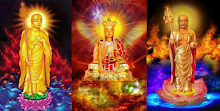
These descriptions are part of Early Buddhism, preserved in the Pali canon of Theravada Buddhism, specifically explained in The Path to Freedom (Vimutti-magga), condensed to just four kinds by lumping the three varieties of stream enterers into just one grouping in The Path of Purification (Visuddhi-magga). It seems that in these modern times, only Wisdom Quarterly cares about the distinction. Goodness knows that by borrowing from Brahmanism and Hinduism, later Mahayana movement writers have invented new categories like countless bodhisattvas, mahasattvas, and "Cosmic Buddhas" like Amitabbha, Vairocana, Ksitigarbha, and others to worship in place of taking guidance (sarana) from the historical Buddha Shakya-muni ("Sage of the Indo-Scythians/Sakas"), Siddhattha Gotama, Siddhartha Gautama.
But before actual stream entry (entering the "stream" or sota that inevitably leads to complete freedom = nirvana), there are practices and beliefs the Dharmic traditions have in common, like reaching samadhi ("stillness," "mental coherence" resulting in "superconsciousness," sublime states and transcendental realizations). In fact, many Indian traditions consider samadhi to be the ultimate goal, knowing nothing higher. The Buddha did certainly point higher, adding insight practices (vipassana) to the already known states of meditative absorptions (the dhyanas or in Pali jhanas).
Minor Threat: "I was early to finish. I was late to start. I might be an adult.
But I'm a minor at heart." Fugazi: I wait, I wait, I wait in the Waiting Room
Why does Integral (Ashtanga) Yoga teach an eightfold system, as made popular by the sage Patanjali? It is precisely because of the historical Buddha's super popularity throughout the subcontinent at that time that Patanjali thought he should formulate the Vedic, Brahminical, Hindu (a term that would not be invented for centuries) path to samadhi in the same form as the Buddha's Ennobling (lit. Enlightening) Eightfold Path. "Noble" (Arya) means "enlightened."
One has to slosh around through a lot of Western misinterpretations, explanations, practices, Eastern teachers, and etymologies to rectify one's understanding and remove the confusion that has settled on Eastern philosophy and Dharmic traditions to see it clearly. There have been many well-intentioned translators and teachers over the decades that have inadvertently muddied the water and introduced some wrong notions. It's inevitable. If one practices and practices, those misunderstanding get straightened out.
PUNK has always been about individualism, questioning, rebellion, a willingness to set off on one's own path of investigation, practice, and self-realization. No one can do it for us, and "faith" (particularly of the blind sort) is just not in the cards.
PUNK is fun and, at least in the past, was very funny. It was not profit-driven. The goal from the beginning was freedom, personal and social, to liberate oneself and others. Maybe no one agreed on what a revolution would look like, but the enemy was pretty clear: sexist/racist cops working for the economic elite to maintain the status quo, gatekeepers, authority figures, bosses, dictators, know-it-alls, the forces of oppression bearing down on our pursuit of life, liberty, and happiness.
The founding ideals of our country never promised happiness, but those ideals did very clearly say we had a right to PURSUE happiness as we saw fit. In practice, it was nothing like that, just an Animal Farm/1984-style set of tricks, being told what to believe, how to behave, what to like, what to follow, and so on. Enough of that. The hippies were right, but they were no longer getting anywhere, so the pendulum had to swing the other way. Workers had to arise. Conservatives had to knock it off. Liberals had to wake up. Somebody had to flip off the patriarchy and its father figures.
The CIA, FBI, and PTB (powers that be) were not going to let this movement succeed any more than they had any of the previous ones. They can't stop these things, but they can guide them to implode. Movements are like that. What about individuals? What about intellectuals, poets, artists, and independent thinkers? The government has a game called whack-a-mole for that. They stop this rebellion or that, but another one will take its place. It's like Jello once said in "I Am the Owl." Black Flag had something to say beyond self-defeating aggression when they sang, "Rise Above." But the hippies had something to say, too. "What the world needs now is peace, love, and understanding" and, if not, then how about anarchy, hate, and profanities. How does that strike you, Society?
If England/Britain ruined us as a colony-cum-country, it had a little something to do with the rebellion:
All materials on this site are submitted by editors and readers. All images, unless otherwise noted, were taken from the Internet and are assumed to be in the public domain.
In the event that there is still a problem, issue, or error with copyrighted material, the break of the copyright is unintentional and noncommercial, and the material will be removed immediately upon presented proof.
Contact us by submitting a comment marked "private."
Do not follow this journal if you are under vinaya or parental restrictions. Secure protection by Sucuri.
Wisdom Quarterly: American Buddhist Journal is licensed under a Creative Commons Attribution-Noncommercial-Share Alike 3.0 United States License. Permissions beyond the scope of this license may be available at creativecommons.org/about/licenses.