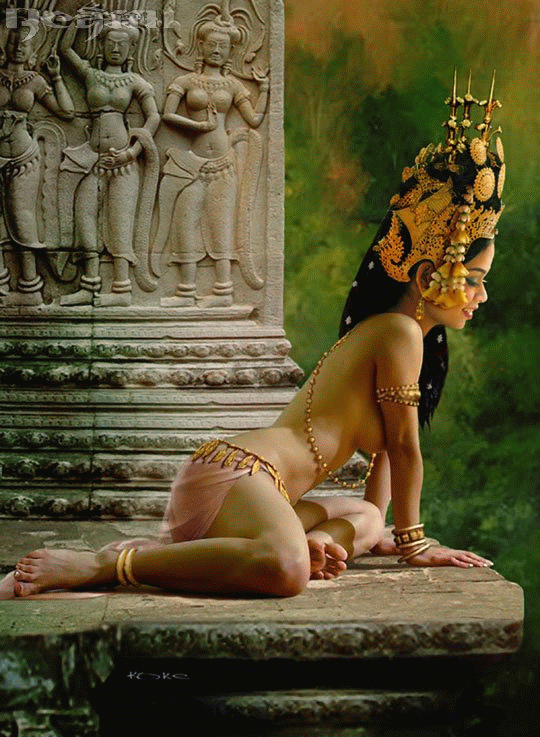
"If you live the sacred and despise the ordinary, you are still bobbing in the ocean of delusion" (Lin-Chi).
Is Buddhism a religion?Whether Buddhism is or is not a religion depends upon how you
define "religion." The Drepung Loseling Institute states:
"Like all major religions, Buddhism contains an explanation of the origin of existence, a morality, and a specific set of rituals and behaviors. ... Buddhism presents a transformational goal, a desire to improve one's situation, and a distinct moral code.
However, some definitions of "religion" require a belief in the existence of one or more deities. That would disqualify most branches of Buddhism from being considered as religious groups.
"The greatest achievement is selflessness.
The greatest worth is self-mastery.
The greatest quality is seeking to serve others.
The greatest precept is continual awareness.
The greatest medicine is the emptiness of everything.
The greatest action is not conforming with the world's ways.
The greatest magic is transmuting the passions.
The greatest generosity is non-attachment.
The greatest goodness is a peaceful mind.
The greatest patience is humility.
The greatest effort is not concerned with results.
The greatest meditation is a mind that lets go.
The greatest wisdom is seeing through appearances" (Atisha).

Overview
With [a grossly underestimated count, which for example excludes Chinese, Indian, and Nepalese populations for political reasons, of] about 365 milliion followers -- or 6% of the world's population -- Buddhism is the fourth largest religion in the world.
It is exceeded in numbers only by
Christianity,
Islam, and
Hinduism. Buddhism was founded in Northern India by Siddhartha Gautama. In the sixth century
BCE, he attained enlightenment and assumed the title
Buddha ("one who has awakened").
The Buddha was later subsumed into the Hindu pantheon in India. And with him went the separation of Buddhism and Hinduism within its birthplace. But Buddhism's universal message had already become established in Sri Lanka. From there, it expanded across Asia, evolving into two or three main forms:
Theravada Buddhism (sometimes called Southern Buddhism) "has been the dominant school of Buddhism in most of Southeast Asia since the thirteenth century, with the establishment of the monarchies in Thailand, Burma, Cambodia, and Laos."
Mahayana Buddhism (sometimes called Northern Buddhism) is largely found in China, Japan, Korea, Tibet, and Mongolia.
Vajrayāna Buddhism (a.k.a. Tantric Buddhism, Mantrayana, Tantrayana, Esoteric Buddhism, or True Words Sect) is considered a part of Mahayana Buddhism, but others view it as a third form of Buddhism.
To these might be added:
Tibetan Buddhism, which developed largely in isolation from Theravada and Mahayana because of the remoteness of Tibet.
Zen Buddhism, which developed out of the Chinese Mahayana school known as Ch'an (which comes from the Sanskrit dhyana, Pali jhana, or "meditation"; Zen is the Japanese pronunciation).
Western Buddhism, which is forming with an emphasis on meditation and the equality of the sexes. This newest form is both egalitarian and eclectic, a mix of international customs -- particularly Zen (from post-WWII exposure to Japanese culture), Theravadan (due to post-Vietnam War exposure and sudden influx of Westerners in Thailand, Burma, and Sri Lanka attracted by the teachings of Ajahn Chah, Goenka, and Bhikkhu Bodhi, and the ongoing peace efforts of exiled activist-monk Thich Nhat Hanh), and a hodgepodge of Tibetan practices (due to China's invasion of Tibet and the Dalai Lama's subsequent worldwide fame).
Buddhism is becoming increasingly popular in the West in all three forms and even evolving into a characteristically Western tradition due to its early roots and seminal scholarship in England and Germany. Since the late 19th century, modern Buddhism has emerged as a truly international movement.
This started as an attempt to produce a single form of Buddhism (without local accretions and the mixture of indigenous religious traditions) that all Buddhists could embrace.
"Aware of the suffering caused by the destruction of life, I vow to cultivate compassion and learn ways to protect lives of people, animals, plants, and minerals. I am determined not to kill, not to let others kill, and not to condone any killing in the world, in my thinking, and in my way of life" (Thich Nhat Hanh).
Buddhist traditions in the East and West
More: Sources of Buddhist information and materials

Western Buddhist Order
Ashvajit (FWBO)
The Western Buddhist Order -- or Trailokya Bauddha Mahasangha, as it is known in the East -- is an Order (Nikaya) of the worldwide community of Buddhists. It thus belongs to what is reputed to be the fastest growing religion in the West. Buddhism is even fashionable, with the Buddhist film star Richard Gere coming to be almost as well known nowadays as the Dalai Lama.
The question is sometimes asked: Is Buddhism really a religion? Actually, some people prefer not to define Buddhism as a "religion" at all. Others call it a "non-theistic religion" since it does not concern itself primarily with any personal creator God as in theistic religions. To help allay such questions and doubts, it is perhaps best to reflect upon the term by which the teaching of the Buddha is known in the East: the Buddha-Dharma. This term means the truth seen and taught by the Buddha, the awakened or enlightened one.
Buddhism is a spiritual path. It is a teaching and a way of practice. It is able to communicate (to those who are open, willing, and able to test, apply, and ultimately commit themselves to) the essentials of the spiritual experience of the historical Enlightened One, known to history as the Buddha Shakyamuni.
The experience of spiritual enlightenment (as clearly distinct from the 18th century Western "Enlightenment" period of the rationalists and spiritual skeptics) is not something that can be handed to anyone on a plate. Spiritual experience comes through personal effort and perseverance, through purifying one's morality, practicing meditation, developing wisdom. Undertaking all this in the context of spiritual commitment to the ideal exemplified by the Buddha is what is really needed.
The Buddha was the first historical person to discover the evolution of human consciousness -- the Enlightenment Principle, if you will, the principle of the path to higher human development. He communicated the truth, beauty, and peace of that experience to thousands of disciples and followers, men and women, young and old, rich and poor, healthy and disadvantaged. As a result of following the Buddha's Teachings, people became enlightened. And the vibrant testimony of their lives and words reaches down the centuries to influence and inspire us even today.

(FWBO)
"When the mind begins to become still, we then begin to truly see it. When you first try to stabilize and pacify the mind, initially it will become very busy because it’s not accustomed to being still. In fact, it doesn’t even necessarily want to become still, but it is essential to get a hold of the mind to recognize its nature. This practice is extremely important.
"...Eventually you will find yourself in a state where your mind is clear and open all the time. It is just like when the clouds are removed from the sky and the sun can clearly be seen, shining all the time. This is coming close to the state of liberation, liberation from all traces of suffering.
"...The truth of this practice is universal. It isn’t necessary to call it a religion to practice it. Whether one is a Hindu or a Muslim or a Christian or a Buddhist simply doesn’t matter. Anyone can practice this because this is the nature of the mind, the nature of everyone’s mind. If you can get a handle on your mind, and pacify it in this way, you will definitely experience these results, and you will see them in your daily life situation. There is no need to put this into any kind of category, any kind of "ism" (Gyatrul Rinpoche).