Showing posts with label Dogen Zenji. Show all posts

Friday, July 26, 2024

Why go without? Go within (Q&A)


QUESTION: When I meditate, which has both the words "me" and "I," I feel so selfish and self-absorbed, like it's all about me. So shouldn't I stop? I would rather be an explorer [astronaut] than a selfish seeker [psychonaut]. You can't argue with my logic, admit it, and let me get off this mat.

We've just scratched the surface in this direction.

Space cadet gets bored with own distractions
ANSWER: Well, Doggone, with logic like that, you really have us in a bind. I mean, we don't want you to be selfish or self-absorbed. In fact, it would be good to be selfless and fully absorbed [in the object of meditation]. With killer logic like you've laid out, we realize that we are wrong, and by "we" we mean all of us -- the Buddha, the sages, the arhats, the sadhus and sadhvis (godmen and godwomen), the rishis (seers), the jinas (pathfinders), the shamans (wandering ascetics or shramanas). We've been doing this all wrong. So what you propose is that we launch our own Asian space program out in Afghanistan or Northwest India, maybe in Mohenjo-Daro or in any case somewhere near Gandhara?

Q: I don't know what those places are.

A: Of course not, yet you're sure of which direction to head, out not in?

Q: Well, no, but...

10, 9, 8, 7, 6, 5, 4, 3, 2, 1, lift off
A: So without knowing even the general direction, you've let your mind talk you into doubt, skepticism, and more discursive thinking?

Q: Discursive?

A: Monkey Mind, going from branch to branch to branch, ceaselessly jumping around.

Q: Oh yeah, that.

A: Yet without knowing, you've never noticed how enlightened scientists are? Everyone who comes back from "space" is awake. Everyone who spends her time drinking coffee, reading data printouts, fashioning explanations is well behaved, serene, in control of their minds, inspiring, happy...

Q: No, they're none of that. They're the opposite!

A: Of course, what else would they be? Neither purifying their own minds nor encouraging others to purify theirs, they strengthen their rational powers and let everything else go to pot. They use the power of a streetlamp the way a drunk does, for support rather than illumination. They debate, they argue, they aggrandize their own theories while belittling others'. What a way to go about in search of wisdom.

Q: Yeah, well.

Calm down, Monkey. - Play with me, Homer!
A: Yeah well, what? They're harried, confused, leading others to confusion, cantankerous, amenable to nothing but argument and besting others in debates, to more and more data, rarely recognizing the biases that secretly guide their (mis-)interpretations of that "data." There is this world. Look around. Loot at it. Your lenses (all three eyes) are covered in dust, but you hope to accurately discern and make sense of what you're seeing. You have no conception of the assumptions you arrive with, like that of a "seer." That you take for granted and leave unquestioned. The suitability of the apparatus (the eye and its focus), that you leave unquestioned, with no access to assessing it.

Q: I'm starting to see.

A: Sit, turn inward, and the next time the mind misleads you to look the other direction, the direction you spent your whole life looking and trying to make sense of, note it and remain with the subject.

Q: What subject?

"Space" like dinosaurs is for kids.
A: Your subject of meditation, like the breath, or if that has been mastered (and it has not), the Elements, or the others laid out in the Four Foundations of Mindfulness Sutra. Trust that the Buddha and the arhats who confirmed his findings had something useful to say about the way to peace and enlightenment. It isn't by thinking, for if it were, all the thinkers would already be there and, by their thinking, would have talked others into seeing things their way. "Thinking" is not the way. We are really going from the ground up (rather than the top down, from experience to knowledge rather than thinking and theorizing to knowledge). It's already been done. Follow the Path.

Q: But how? It doesn't work no matter how I try!

A: Stop "trying." Start doing. Leave expectations and angst behind. The very problem you are running into is efforting, attempting to muscle it. Relax. LET GO. Let it be. You're only task is to watch. Don't think about it. See it. There it is. That is reality. Watch it unfold. What happens to a thought?

Q: It comes.

A: What else?

Q: It makes me think.

A: It makes you think? Isn't it a byproduct of your thinking?

Q: Well, yeah, but...

A: You said, "it comes." Have you ever noticed that "it goes"?

Q: Well, sure, after it hangs out a while.

Oh, this is easy. Now what? What else?
A: So don't welcome it. Simply see it. And you will see that although it comes whenever it wants to, it also goes whenever it wants to. You're not in control. When you're sitting, you're full of thoughts. But when you stand up to make sense of them, where are they? They are hardly dependable or useful. They've ruined your meditation (that is, welcoming them, conversing with them, and following them has ruined it) and then, their job done, they go away. You can't even account for them, find them now, or get back your peaceful meditation. You created this great argument against sitting and did no sitting still. The theory immediately fell apart when you ask about it, yet you cling to it as a "really good thought."

Q: I see now it wasn't.

A: And the next one won't be either. Billions have thought these thoughts, made these assumptions, thoughtlessly followed thought. Stop all that. Let it go. There's something better on the other side of confidence (the faith to believe this is not all for naught). In Zen some say, "Just be." Sort of be like that. Be content in the moment, be with the moment, just be (with it). Stop abandoning yourself. If you need inspiration for sitting, reading the lives of those who previously succeeded is inspiring, although those stories can set up expectations, hopes, and lead to frustration and a sense of futility if magic doesn't happen. Let magic happen, let it not happen, let it be.

Q: So like the Beatles.
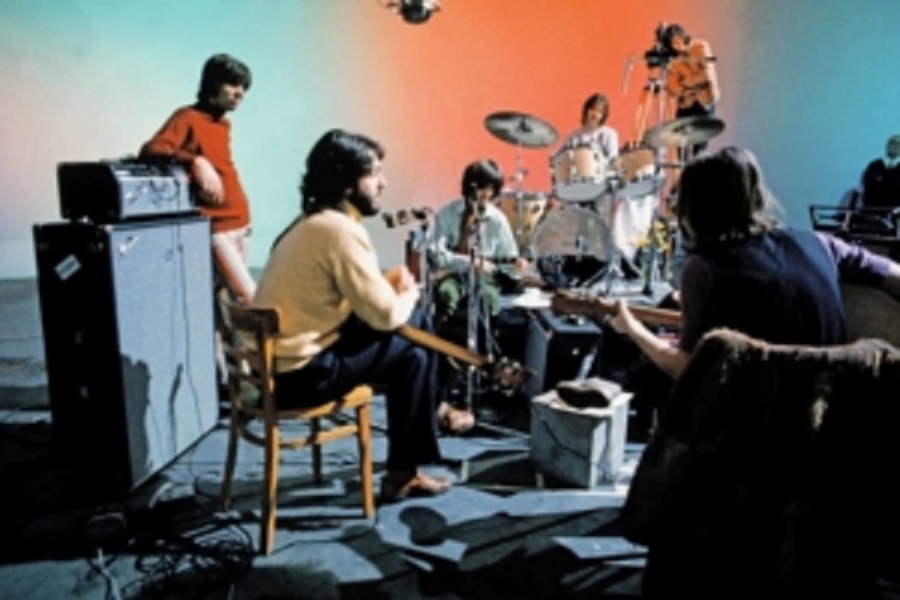
Let's make more songs to distract everyone.
A: No, but okay. Like anything. It is. Let it be. Let it be just as it is. Don't fix it. Observe it. Your strength of observation will strengthen. Beyond sitting, there are practices the whole rest of the time to make the next sit more solid. Ever be mindful. Stay with the moment. Stop abandoning this moment and attention to it. Then, when sitting, that can be done much better. Exhale. Let the inhale happen all by itself. Just watch it. Don't "do" it.

Q: I might suffocate!

A: You won't if you relax. Most of "your" breathing is being done without you most of the time. When you notice it at the beginning of the sit, it should occur to you that "you" haven't been breathing yet breathing has been happening just fine, in fact, better than if you had.

Q: What about sports?

A: What about them?

Q: The Olympics are starting in Paris.

Wednesday, September 13, 2023

Gen Z: The military ain't for me (video)

Jamesons Travels, 8/19/23; Ashley Wells, Pfc. Sandoval, Dhr. Seven (eds.), Wisdom Quarterly

Gen Z explains why they won’t join the U.S. military: NOT what you think, but worse
Go to war, and one day we'll say, "F U for your..."
(Jamesons Travels) Gen Z teen explains why they are not joining. It's not what one would think...because it's worse.

[Actually, it's better. The kids are going to be all right. They don't want to join a patriarchal rape camp system of oppression that leads to so much unskillful karma that one would be working it out for generations and millennia to come. Killing for empire, oil, control, and world domination by transnational corporations? H to the no.

Today's military is pro-LGBTQIA+. Come
rape and harass and get it from comrades.
Come back a Republican alcoholic PTSD-sufferer, broken and ignored at by the V.A., dropped into homelessness, addicted, anxious, all messed up and looking forward to a pittance for "serving" in the Chair Force droning innocents then labelling them "combatants"? The U.S. military-industrial complex has a saying, and don't let anyone tell you otherwise. It's by FEAR and goes, "Let's have a war so you can go die." Anyone who thinks YOU should join this man's army ought to go join themselves, the cowards.

Please support channel: jameson.locals.com. Make sure to look at this channel: @winstonblair. Videos used:
Why is it bad karma to battle others?
Ven. Thanissaro (trans.) accesstoinsight.org; edited by Dhr. Seven, Wisdom Quarterly

KARMA: It's everywhere you're going to be.
One needs a livelihood (a way of earning a living or way of getting the funds to survive independently, most commonly a job, but not necessarily). 

Knowing that, the Buddha advises humans to avoid unskillful karma (unwholesome deeds that lead, when their results finally ripen whether in this life or a future life, to suffering).

He defined "wrong livelihood" for people. "A follower [of my advice] abstains from five types of business. What are those five? Trade in weapons, trade in human beings, trade in meat, trade in intoxicants, and trade in poisons" (AN 5.177).

Considering the military to become a soldier? It would be good to reconsider.

SUTRA: If I die in battle, I go to [Valhalla], right?
I killed all those people for nothing, out of ignorance, fear, and hatred. Now I'm going to...
.
Wait, Valhalla is a hell not a heaven?
The headman Yodhajiva went to the Blessed One [the Buddha], greeted him with respect, and sat respectfully to one side. Sitting there, he asked:

"Venerable sir, I have heard that it is passed down by the ancient teaching lineage of warriors that 'When a warrior strives and exerts himself in battle, if others strike him down and slay him while he is striving and exerting himself in battle then, with the breakup of the body after death, he is reborn in the company of devas (shining ones) slain in battle.' What does the Blessed One have to say about that?"

"Enough, headman, set that question aside. Do not ask it." But a second time...and a third time the headman Yodhajiva asked it... 'What does the Blessed One have to say about that?"

"Headman, apparently, I am unable to get around it by saying, 'Enough, headman, set that question aside. Do not ask it.' So I will answer directly:

"When a warrior strives and exerts himself in battle, his mind is already seized, debased, and misdirected by the thought, 'May these beings be struck down or slaughtered, annihilated, destroyed. May they not exist.'

"If others then strike him down and slay him while he is striving and exerting himself in battle then, with the breakup of the body after death, he is reborn in a hell called the Realm of Those Slain in Battle.

"But if he holds such a view as, 'When a warrior strives and exerts himself in battle, if others strike him down and slay him while he is striving and exerting himself in battle then, with the breakup of the body after death, he is reborn in the company of devas slain in battle,' that is a wrong view.

"Now truthfully I say, there are two destinations for a person with wrong view, hell or the animal realm."

How could I have been so dumb to believe that?
When this was said, the headman Yodhajiva began to sob and he burst into tears.

[The Blessed One said:] "That is what I could not get around by saying, 'Headman, enough, set that aside. Do not ask it.'" 

[Yodhajiva:] "Venerable sir, I'm not crying because of what the Blessed One said to me but because for so long time I have been deceived, cheated, and fooled by that ancient teaching lineage of warriors who said that'" (SN 42.3).

Friday, June 23, 2023

What is Zen Buddhism? (video)

Let's Talk Religion, June 4, 2023; Seth Auberon, Ashley Wells (eds.), Wisdom Quarterly
How Zen is zen (jhana, dhyana, Chan)? One need not go to Asia. Focus here. Absorb now.

(Let's Talk Religion) This video continues exploring the rich spiritual tradition of Buddhism through one of its most popular and important schools, Chinese Chan/Japanese Zen.

Let's dive into the history and development of the school, as well as its characteristic teachings about meditation, koans [paradoxical riddles that pull one out of linear thinking], liberation, and Buddha-nature.

CHAPTERS
  • 00:00 Intro
  • 03:39 Basics of Buddhism
  • 04:56 East Asian Buddhism (Mahayana)
  • 13:19 The Origins of Chan
  • 17:22 Bodhidharma
  • 20:17 Teachings and Practices of Chan
  • 33:49 Chan's relationship to Taoism
  • 35:31 Later developments and subschools
  • 37:50 Japanese Zen and Dogen
  • 41:16 Chan/Zen today and conclusions
Support Let's Talk Religion on Patreon (patreon.com/letstalkreligion) or through a one-time donation: https://www.paypal.com/paypalme/letst... Also check out the Let's Talk Religion Podcast: https://open.spotify.com/show/0ih4sqt... Most of my music can be found here: Filip Holm: https://open.spotify.com/artist/2O7FL... Zini: https://open.spotify.com/artist/0jy5K... Sources/Suggested Reading: Chuang Zhi (2019). "Exploring Chán: An Introduction to the Religious and Mystical Tradition of Chinese Buddhism." Songlark Publishing. Hershock, Peter D. (2004). "Chan Buddhism". University of Hawaii Press. Red Pine (translated by) (1989). "The Zen Teachings of Bodhidharma". North Point Press. Red Pine (translated by) (2002). "The Diamond Sutra". Counterpoint. Red Pine (translated by) (2008). "The Platform Sutra: The Zen Teaching of Hui-neng". Counterpoint. Westerhoff, Jan (2009). "Nagarjuna's Madhyamaka: A Philosophical Introduction". Oxford University Press. Ziporyn, Brook (2016). "Emptiness and Omnipresence: An essential introduction to Tiantai Buddhism". Indiana University Press.  #zen #buddhism #china

Wednesday, November 23, 2022

40 Minutes of Jokes about Gen Z (Netflix)

WARNING: Gratuitous profanity, cussing (Oh you, Boomers!), nastiness, crudity, vulgarity, laughs!

40 Minutes of Jokes about Generation Z
(Netflix Is A Joke) Nov. 23, 2022. Kevin Hart, Gabriel Iglesias, Amy Schumer, Cedric the Entertainer, and others dunk on that inscrutable Gen Z. Will those "kids" never learn? It won't matter. Z2 is already on its way. Subscribe.

ABOUT: Netflix Is A Joke is the official hub of Netflix stand-up, comedy series, films, and all things funny — curated by the world’s most advanced algorithm and a depressed-yet-lovable cartoon horse. Their unlikely friendship is Netflix's story…

ABOUT: Netflix is the self-proclaimed world's leading streaming entertainment service with 223 million paid memberships in over 190 countries enjoying TV series, documentaries, feature films, and mobile games across a wide variety of genres and languages. Members can play, pause, and resume watching as much as they want, anytime, anywhere, and can change their plans at any time.

Monday, September 19, 2016

How to meditate Zen (Master Dogen)

Ven. Eihei Dogen's Fukanzazengi (1227), Soto Zen Text Project, Stanford University (translation); Jeff Albrizze (PasaDharma.org), Dhr. Seven, Wisdom Quarterly
Carrying firewood: First the ecstasy then the laundry...but someone forgot the ecstasy.
"Learn to take the backward step that turns the light and shines it inward." - Dogen
.
Universally Recommended Zazen Instructions
This pivotal Zen text, which was written in 1227 by Eihei Dogen, the Japanese monk who brought Zen from China to Japan, was one of the first pieces he wrote when he returned.

It opens with an introduction that answers the question that led him to go to China in the first place: 

If we are originally endowed with the Buddha nature [the potential for enlightenment], why is it been necessary for us to seek enlightenment or even to engage in spiritual practice?
.
The Way is originally perfect and all-pervading. How could it be contingent on practice and realization? The true vehicle is self-sufficient. What need is there for special effort?

Indeed, the whole body is free from dust. Who could believe in a means to brush it clean? It is never apart from this very place; what is the use of traveling around to practice?
 
Stare until the heart-mind settles.
Yet, if there is a hairsbreadth deviation, it is like the gap between heaven and earth [lofty space and firm ground]. If the least like or dislike arises, the mind [heart] is lost in confusion.

Suppose you are confident in your understanding and rich in enlightenment, gaining the wisdom that knows at a glance, attaining the Way and clarifying the mind, arousing an aspiration to reach for the heavens.

You are playing in the entrance way, but you are still are short of the vital path of emancipation.
 
Start sitting with a group; it's easier.
Consider the Buddha: although he was wise at birth, the traces of his six years of upright sitting can yet be seen. As for Bodhidharma [who brought Buddhism to China from South India], although he had received the mind-seal, his nine years of facing a wall is celebrated still. If even the ancient sages were like this, how can we today dispense with wholehearted practice?

Therefore, put aside the intellectual practice of investigating words and chasing phrases, and learn to take the backward step that turns the light and shines it inward. Body and mind of themselves will drop away, and your original face will manifest. If you want to realize such, get to work on such right now.

Roshi Jeff Albrizze
For practicing Zen, a quiet room is suitable. Eat and drink moderately [not so much as to become dull and drowsy, not so little as to be restless and hungry]. Put aside all involvements and suspend all affairs.

Do not think "good" or "bad." Do not judge true or false. Give up the operations of mind, intellect, and consciousness; stop measuring with thoughts, ideas, and views. Have no designs on becoming a Buddha. How could that be limited to sitting or lying down?

At your sitting place, spread out a thick mat and  put a cushion on it. Sit... More
  • Want to teach Buddhist meditation in LA? Contact us.

Wednesday, April 13, 2011

Will I get old? (Gwyneth Paltrow music video)

Wisdom Quarterly


No topic is more popular than aging, except for all other topics. Gwyneth proves she's vital with Cee-Lo Green. She's in your face when a "Glee" cheerleader accuses her of being too old to be hip. But, as Betty White proves, 80 is the new 74.... and as "Hanna" (actress Saoirse Ronan, who celebrates a birthday today) shows, 16 is the new 21. In other words, there's no rule.

We crave to continue pleasure, to put away pain, and to escape neutral feelings, which we find distressing and "boring." This is dukkha (suffering, unsatisfactoriness, woe). This is the very thing Siddhartha set out to find a solution to. We are born (in whatever plane of existence we can imagine).

"Lost the Comic" (ytorf.com)

It is possible due to karma. But the force of karma eventually becomes exhausted. And we fall away -- sadly, even from heavenly states and, fortunately, even from states of perdition. What is the cause? Ignorance, craving, aversion, and fear lead to suffering, when our mental-verbal-physical actions bear fruit. How can we ever get off the merry-go-round the ancient Indians called Samsara?

Siddhartha became the Buddha, the "Awakened One" precisely because he rediscovered the solution. Buddhism is the teaching, the practice, the instructions that lead to enlightenment and liberation from ALL suffering.


Old Age, Sickness, and Death

Dharma Talk by Geoffrey Shugen Arnold, Sensei
A pivotal moment in the life of the Buddha was the day he ventured outside the gates of his home and encountered three aspects of human life that changed him profoundly: old age, sickness, and death....

There are many things in our life that move us to practice, issues that arise in our life and demand attention. We begin to see the infinitely various ways that our greed, anger (one manifestation of which is fear), and ignorance become sources of turbulence and suffering....

But old age, sickness, and death are something we can’t get around. When these become real for us, they can’t be ignored.... [S]ickness, old age, and death constitute the major impulse behind the religious search, our desire to understand and come to peace with all that we see, feel, and experience.

They are the great equalizers; they touch us all. There’s nothing we can do [ultimately, even though there is a great deal we can do to be healthy and vital no matter what the calendar says] -- no measure of accomplishment, prowess, cunning, bribery, deviousness, or cleverness that can ultimately help us with these problems....

How much of what we do, of how we go about our lives, is colored by the constant awareness that our lives are not forever?

...What we can do is concentrate on NOW. If the way we die is the way we live, then how are we living? What can we do about that? Not just for the moment of death, but for this moment too.

New painkiller discovered by science: mindful Zen meditation (medindia.com).

[Zen] Master Dogen said: Life and death itself is the life of Buddha [awakening]. If you despise and reject it, you lose the life of Buddha. Consequently, when you are attached to life and death you also lose the life of Buddha and are left with only the outer form. Only when you do not hate life and death, or desire nirvana, will you enter the mind of Buddha. Do not try to define it with your mind or describe it with words.

When you cast off body and mind and enter the realm of Buddha, Buddha will lead you. If you follow this way, you achieve detachment from life and death and without effort or using your mind, you become Buddha. If you understand this, there is no longer attachment. So if we despise and reject life and death, we lose the life of the Awakened One, we lose the life of our own true, unhindered nature.

Can we live and die without attachments on either side? When we cling to life or death, sickness or health, youth or old age, then all we’re left with is the outer form of the Awakened One, the shell. It’s hollow and so is our experience of today. Only when we completely release our grasp can we allow the mind of Buddha to be manifest.

So how do we not despise and reject that which we are afraid of? How can we transcend our fear? What are we afraid of? ...This sickness and health we attach to, that we alternately love and hate, where is it? How can we not despise one and attach to the other? We can’t will ourselves to do this....

Thursday, March 17, 2011

Happiness is Letting Go

Renunciation is no more about holding on than it is about losing anything. It's about letting go internally even if we keep our possessions. Possessions do not belong to us anyhow. So all we are doing is holding on to unhappiness by holding on. How can we let go and keep everything we have? How can we arrive at this turning point?

Turning Point
Charlotte Joko Beck (Everyday Zen)
We may feel that whatever is going on in our thoughts and emotions is not okay: "I should be able to renounce all that. I should be able to get rid of it. I'm bad for thinking this or feeling that."

But that's not renunciation either. It's playing with notions of good and bad.

Some of us make one final effort. Because we are confused and discouraged about our daily lives, we finally decide, "I have to go for Realization! I must live a completely spiritual life and renounce everything else."

And that's great if we understand what it means. But of all the misinterpretations of renunciation, the most insidious come in this realm of so-called spiritual practice in which we have notions such as "I should be pure, holy, and different from others...perhaps live in a remote, quiet environment."

That has nothing to do with renunciation either.

So what is renunciation? Is there such a thing? Perhaps we can best clarify it by considering another word, "non-attachment"

We often think that if we fiddle with the surface events of our lives, trying to alter them, worrying about them or ourselves, we are dealing with the matter of "renunciation" -- whereas in fact we do not need to "renounce" anything; we need only to realize that true renunciation is equivalent to non-attachment.

The process of practice is to see through, not to eliminate, anything to which we are attached.

We could have great financial wealth and be unattached to it, or we might have nothing and be very attached to having nothing.

Usually, if we have seen through the nature of attachment, we will tend to have fewer possessions, but not necessarily.

VIII. Choices
Most practice gets caught in this area of fiddling with our environment or our minds. "My mind should be quiet."

Our mind doesn't matter. What matters is non-attachment to the activities of the mind. And our emotions are harmless unless they dominate us (that is, if we are attached to them) because then they create disharmony for everyone.

The first problem in practice is to see that we are attached. As we engage in consistent and patient zazen [sitting meditation], we begin to know that we are nothing but attachments: They rule our lives.

But we never lose an attachment by saying it has to go. Only as we gain awareness of its true nature does it quietly and imperceptibly wither away. Like a sandcastle with waves rolling over, it just smoothes out and finally -- Where is it? What was it?

The question is not how to get rid of our attachments or to renounce them. It's the intelligence of seeing their true nature -- impermanent and passing, empty. We don't have to get rid of anything.

The most difficult, the most insidious, are the attachments to what we think are "spiritual" truths. Attachment to what we call "spiritual" is the very activity that hampers a spiritual life. If we are attached to anything, we cannot be free or truly loving.

So long as we have any picture of how we're supposed to be or how other people are supposed to be, we are attached. And a truly spiritual life is simply the absence of that. "To study the self is to forget the self," in the words of Dogen Zenji.

As we continue our zazen today, let's be aware of the central issue -- the practice of non-attachment. Let us diligently continue, knowing that it can be difficult, and knowing that difficulty is not the point.

Each of us has a choice. What will it be? A life of freedom and compassion, or what?

Saturday, December 5, 2009

Punk Rock Buddhism (Part II)

Brad Warner is a Zen priest, Japanese monster movie obsessive and former punk rock bassist. In 2003, he blew the top off the Buddhist book world with his irreverent autobiography/manifesto Hardcore Zen: Punk Rock, Monster Movies, and the Truth About Reality. Now in his second book, Sit Down and Shut Up: Punk Rock Commentaries on Buddha..., Brad tackles one of the great works of Zen literature, the Shobogenzo by thirteenth-century Zen master Dogen.

Illuminating Dogen's enigmatic teachings in plain language, Brad intertwines sharp philosophical musings on sex, evil, meditation, enlightenment, death, anger, God, sin, and happiness with an exploration of the power and the pain of the punk rock ethos. For those who have felt drawn to Buddhist teachings but are scared off by its stiff austerity, Brad writes with a sharp smack of truth, the real heart of Zen, in stories that cut to the heart of reality.

There is even a travelogue of his triumphant return to Ohio for a reunion concert of Akron punk bands, Brad melds the antiauthoritarianism of punk with the antiauthoritarianism of Zen -- with a good dose of pop culture thrown in -- challenging orthodoxy and questioning everything.


Here feminist Crass singer Eve Libertine rails against sexism. "The true romance is the ideal repression, that you seek,/That you dream of, that you look for in the streets,/That you find in the magazines, the cinema, the glossy shops,/And the music spins you round and round looking for the props./The silken robe, the perfect little ring,/Will gives you the illusion when it doesn't mean a thing,/Step outside into the street and staring from the wall/Is perfection of the happiness that makes you feel so small./Romance, can you dance? D'you fit the right description?/Do you love me? Do you love me? Do you want me for your own?/Do you love me? Say you need me, say you know that I'm the one,/Tell me I'm your everything, let us build a home./We can build a house for us, with little ones fellow,/The proof of our normality that justifies tomorrow./Romance, romance. Do you love me? Say you do,/We can leave the world behind and make it just for two./Love don't make the world go round, it holds it right in place,/Keeps us thinking love's too pure to see another face./Love's another skin-trap, another social weapon,/Another way to make men slaves and women at their beckon./Love's another sterile gift, another sh*t condition,/That keeps us seeing just the One and others not existing./Woman is a holy myth, a gift of man's expression,/She's sweet, defenseless, golden-eyed, a gift of God's repression./If we didn't have these codes for love, of tokens and positions,/We'd find ourselves as lovers still, not tokens or possessions./It's a natural, it's a romance, without the power and greed,/We can fight to lift the cover if you want to sow and seed./Do you love me? Do you? Do you? Don't you see they aim to smother/The actual possibilities of seeing all the others?/Do you love me? Do you? Do you? Don't you see they aim to smother/The actual possibilities of seeing all the others?

Wednesday, July 22, 2009

Greatest Religion, if it were a Religion


Buddhism would be the Greatest Religion in the World, if it were a Religion
(Blog.beliefnet.com, July 22, 2009)

The post Freedom from Religion: Buddhism wins Best Religion in the World Award last week set off quite a stir around these here 'nets. Over at Paramita they offer to send an 11 month old girl to pick up the award. Shambhala Sun had a few things to say, too. Today in Religion weighed in, as did Thailand's ThaiVisa site, which had the best comment thread. And finally Pipal Tree ran the story from Singapore.

Either way if it were a religion, Buddhism would be the best religion in the world perhaps precisely because it lacks some of the key elements that make it a religion (I'm speaking here of approaching it as a philosophy of life, rather than the codified and cemented bureaucracy that it has become in some quarters).

Like practicing Jesus's true teaching about living without glopping on all the rules and constrictions that basically say "practice true goodness or else," Buddhism's core teachings are just totally freakin' awesome and are more a study of self than a giving up to a higher power. Speaking of giving up to a higher power, this past week I've developed a healthy new habit that I wanted to share.

My new habit? I've been reading as much of Jonathan Mead's writing over at Illuminated Mind as possible. Check out Jonathan's story at "my story" on his about page for one of the most intimate descriptions I've ever read online about how he came to a path of compassionate personal transformation. As if on cue, Jonathan's article from yesterday The Death of Becoming Something is a perfect link from a Buddhist blog.

Admission: I kind of have a crush on Jonathan's brain and his writing. Speaking of brain crushes, another brain crush that I've been wanting to share for a few months is on former monster movie maker, punk rocker, and ordained Zen monk Brad Warner. Brad's book Hardcore Zen was the first thing I'd ever read that made me think "hey wait a minute this Buddhist business IS relevant to young freaks like me."

Brad's second book Sit Down and Shut Up: Punk Rock Commentaries on Buddha, God, Truth, Sex, Death, and Dogen's Treasury of the Right Dharma Eye was just as awesome full of holy-cr*pifying ideas. I've had the pleasure of hearing Brad speak at the Interdependence Project twice now; one of those times actually makes it into a chunk of his new book Zen Wrapped in Karma Dipped in Chocolate. I read the book while on a trip with my father in the Grand Canyon, totally disconnected from electricity, phones, Internets, and television -- and all other people save those on the trip with us. More>>

Thursday, May 7, 2009

Koan: There is No Self

Genjo Koan Section X, Part I


"A person riding along on a boat looks around, sees the shore, and mistakenly thinks that the bank is moving. But if looking directly at the boat, one discovers that it is the boat, not the bank, that is moving.

"Likewise, with confused thoughts about body and mind, holding to discrimination of myriad phenomena (dharmas), one mistakenly thinks one's own mind and nature are permanent.

"If intimately engaged in daily activities, one returns to right here, the principle that the myriad phenomena have no self is clear."

From here Dogen Zenji warns us against the view that the mind is permanent and only phenomenal appearances perish. He points out the fact that myriad phenomena [form, feelings, perceptions, volitions, and consciousness] are without self.

The view of permanence of the mind and the perishing of phenomenal appearances, to state it simply, is the view that the body changes and passes away, but the spirit eternally abides unchanging. It is a view that is generally easy for those of a simple faith to fall into.

The metaphor "a person riding along on a boat" means just what it says and can be understood by anybody.

"With confused thoughts about body and mind, holding to discrimination of the various dharmas, one mistakenly thinks one's own mind and nature are permanent."

An unenlightened person is completely confused about body and mind. As long as one has not clearly seen that the five conditions (materiality, sensation, conception, discrimination, and awareness) are all empty.

No matter how great a scholar one may be, one is confused about body and mind. As a result one falls either into a view of permanence or a view of annihilation. Many people of a simplistic faith fall into a view of permanence. Many second-rate scientists fall into a view of annihilation.

Here Dogen Zenji warns particularly against a view of permanence. A view of permanence is considering there to be a single, permanent, guiding self. It is considering there to be a fixed, unchanging "soul." It is thinking that the "self" actually exists.

Unenlightened people have the karmic illness of considering whatever they attach themselves to as having a self [an identity, a persisting or unchanging entity riding or guiding the phenomenal process]]. If they make a group, they consider the group to have a self [a persisting reality or identity independent of its parts].

If they attach themselves to a nation, they consider the nation to have a self. One would hardly think that there was a self in the planet, but if the world were to become completely unified and there were such a thing as a world-state, perhaps they would come to believe in a world-self.

"The Buddha Way is no-self." The one who thoroughly realized that all things are without self [are impersonal or devoid of self] was Shakyamuni Buddha.

"The myriad teachings return to the one" is also fine. But if Buddhism compromises with religions that have a false belief in the "self" or "soul" or "atman," it is no longer Buddhism at all.

But then if religions other than Buddhism return to no-self, the bases of those religions will disappear, and those religions will be changed into something completely different.

However, since there can only be one truth, I think that when the wisdom of human beings advances, one way or another they'll become one.

In recent times the ones who, comparatively speaking, are least inclined toward a false belief in the "soul" or "self" are the scientists, particularly physicists and psychologists. But I'm quite afraid that if they make one false step, they will fall into a view of nihilism.

By no means do scientists think that body and mind exist separately. But they are liable to regard the body as important and neglect the mind. Western [allopathic] medicine up until now has been treating people from that standpoint.

In contrast, it seems that the Eastern medical tradition has emphasized the mind since long ago. The expression, "Illness originates in the spirit (ki or chi)" is a common one. Even the word for sickness (byoki) means illness (byo) of the spirit (ki)." [Ki can also be taken to mean the energetic body, mood or mentality influencing the body.] But even Western medicine has lately come to regard the mind as quite important.

Of course, it is confused thinking to consider mind and body as existing separately. But attaching greater or lesser importance to the mind or the body is also confused thinking. So if one thinks that a fixed body or mind exists for even one minute, this is also confused thinking. [All is in flux, moving, shifting, processing, not "being" but becoming.]

When one thinks about everything with this kind of confused thinking as the basis, one makes the mistake of thinking that only the body changes, arises, and passes away. One mentally depicts something like a spirit or a self that is eternally abiding and unchanging. This is the way ordinary people think.

From there, the theory of the undying soul emerges. On the one hand, in fact Buddhism stresses that there is no [creator] God [responsible for all things] and no soul. On the other hand, people think that Buddhism is something that believes in an unchanging soul.






















