|
| Eastern wisdom sneaks its way into a Hollywood film, like Christ quoting Asian traditions |
Showing posts with label net. Show all posts
Showing posts with label net. Show all posts
Monday, September 29, 2025
Alan Watts: Zen breaks our illusion of control


Monday, January 29, 2024
Giving Up the Five Hindrances (sutra)
Ven. Sujato (trans.), Numerical Discourses (AN 1.11–20), Nīvaraṇa-ppahānavagga, suttacentral.net; edited by Amber Larson and Dhr. Seven, Wisdom Quarterly

The Chapter on Letting Go of the Five Hindrances

11. “Meditators, I do not see a single thing that gives rise to sensual desire (craving, tanha) or, when it arises, makes it increase and spread like the feature of beauty. When one applies the mind (heart) irrationally to the feature of beauty, sensual desire arises, and once arisen it increases and spreads.”
12. “Meditators, I do not see a single thing that gives rise to ill will (aversion, dosa) or, when it arises, makes it increase and spread like the feature of harshness. When one applies the mind irrationally to the feature of harshness, ill will arises, and once arisen it increases and spreads.”
13. “Meditators, I do not see a single thing that gives rise to dullness and drowsiness (sloth and torpor) or, when they arise, makes them increase and spread like discontent, sloth, yawning, sleepiness after eating, and mental sluggishness. When one has a sluggish mind, dullness and drowsiness arise, and once arisen they increase and spread.”
14. “Meditators, I do not see a single thing that gives rise to restlessness and remorse (scatteredness and scruples) or, when they arise, makes them increase and spread like an unsettled mind. When one has no peace of mind, restlessness and remorse arise, and once arisen they increase and spread.”
15. “Meditators, I do not see a single thing that gives rise to doubt (skepticism) or, when it arises, makes it increase and spread like irrational application of mind. When one applies the mind irrationally, doubt arises, and once arisen it increases and spread.”
Solutions

16. “Meditators, I do not see a single thing that prevents sensual desire from arising or, when it arises, abandons it like the feature of [turning attention to the repulsive aspect or] ugliness. When one applies the mind rationally to the [inherent] feature of ugliness, sensual desire arises not or, if it has already arisen, it is given up [let go of, abandoned, dropped].”
17. “Meditators, I do not see a single thing that prevents ill will from arising or, when it arises, abandons it like the heart’s release by love (metta, friendliness). When one applies the mind rationally on the heart’s release by love, ill will arises not or, if it has already arisen, it is given up.”
18. “Meditators, I do not see a single thing that prevents dullness and drowsiness from arising or, when they arise, gives them up like the elements of initiative, persistence, and vigor. When one is energetic, dullness and drowsiness do arise not or, if they have already arisen, they are given up.”
19. “Meditators, I do not see a single thing that prevents restlessness and remorse from arising or, when they arise, gives them up like peace of mind. When the mind is peaceful, restlessness and remorse arise not or, if they have already arisen, they are given up.”
20. “Meditators, I do not see a single thing that prevents doubt from arising or, when it arises, gives it up like rational application of mind. When one applies the mind rationally, doubt arises not or, if it has already arisen, it is given up.” Source
Wednesday, October 5, 2022
The Four Noble Truths (Francis Story)
Francis Story, The Four Noble Truths, Wheel Publication No. 34/35 (Buddhist Publication Society, bps.lk, Kandy, Sri Lanka); Amber Larson (ed.), Wisdom Quarterly

By walking thou canst not the world’s end gain;
Nor, if ye win it not, be freed from pain.
But truly, he whose wisdom is profound,
Who rightly sees the world—by him ’tis found.
He that has lived in holiness shall know
With mind serene the ending of life’s round,
Nor to this world nor other long to go.
(Saṃyutta Nikāya, 1. 87. Verse translation by the author)
Foundations of Buddhism: The Four Noble Truths
 |
| Without leaving samsara, there will be pain. |
From the time when prehistoric myth became merged into an attempt to give a rational account of the universe, these questions have haunted the imagination:
- What is life?
- How did it originate?
- Has it a purpose?
- And if so, what is it?
And while reason has failed, its alternative -- the supernatural revelations of others -- have shown themselves to be equally contradictory and inconclusive and have suffered an even worse defeat.
Its historical record has weighed heavily against it because of the disastrous influence it has often exerted in human affairs. The private revelations of mystics, by their exclusively subjective nature, can never offer more than an insecure foothold for faith (or confidence) in others who have not directly shared in the visions. And a doubtful faith is the father of fanaticism.
The record of our speculative thought down the centuries has come to resemble a maze of tracks in a boundless desert. The tracks can be identified by their characteristics: They are the tracks of religion, of philosophy, and obliterating many of these, the more recent tracks of science.
For the most part the tracks of religion go round in circles. Beginning as myth they continue as myth hardened into dogma, and so go over the same ground in endless repetition. Other tracks wander along aimlessly, drawn in this direction and that by new theories, new discoveries, and new contacts, their path variable as the wind.
These are the tracks of philosophy, the imprints of human restlessness and our inquiring mind — a mind which, despite its courage and adventurousness, has only the old material to work over and so is reduced to combining ideas in endless permutations, seeking to reconcile the irreconcilable and always failing to reach an end.
Science

Then, superimposed upon these there are the imprints of scientific thought, which has invaded philosophy to an ever-increasing extent, but which at the same time discourages any concern with ultimate issues, with questions of value and purpose.
Time and again the older tracks of philosophy and religion are seen to have crossed one another, and where they met there are signs of a scuffle. Too often, there is blood on the sands of history.
So it has been ever since humans emerged as an animal capable of abstract thinking. Now we have entered a phase in which supernaturalism has given way almost entirely to scientific knowledge, and the approach to the problem is somewhat different.
Yet science has not brought us any nearer to the answers. The tracks of thought still remain indecisive, their beginning a mystery, their end a mark of interrogation. Present day knowledge with its unprecedented accumulation of facts concerning the physical universe and the constitution of living organisms, has provided philosophers with a vast stock of new material to take into account, but so far the result has only been to give the mind more than it can handle.
Far from clarifying the general picture, the effect has been to overcrowd the canvas. To correlate the various specialized branches of knowledge is a stupendous task and one that is further complicated by the areas of uncertainty in each of them.
The non-specialist is seldom in a position to be able to separate theory from established fact in the scientific disciplines, and this is particularly so in the case of those which relate to the life-processes, such as genetics and biochemistry, and are therefore the most relevant to the inquiry.
Besides this, the facts that science presents often seem to point to opposite conclusions. Despite the great advances that have been made in physics, technology is still working to a great extent with factors that are not completely understood, or even satisfactorily defined.
There are, for example, certain radiations forming the basic structure of the universe which appear both as waves and as particles, although logically they cannot be both at the same time.
It is not even certain whether the expression "at the same time" has any meaning in a universe where events can hardly be said to be simultaneous at all, and where the image of a star seen from a distance of many thousands of light years may be nothing more than the ghost of something that ceased to exist in space before moodern humans appeared on the surface of the earth.
Expanding knowledge tends to cut us adrift from the apparent security of empirical facts, and in many ways the nature of thought itself has been brought into question.
There are people who entertain the hope that at some time in the not-too-distant future we may be able to get final answers to questions that have tormented men for generations by feeding all the relevant data into an electronic brain.
But that hope is founded on two very large assumptions. First, there's the assumption that all the necessary data will eventually become available and, second, that humans can devise a machine more capable than the creator of the machine. So far, the most advanced electronic computer has not been able to do more in the field of mathematics than a human mind can do. It only does it more quickly.
Even there it adds nothing new; there have been abnormal human brains that could extract cube roots with the same speed and accuracy. If a new and basically different mode of thinking is needed, it must be sought for elsewhere than in electronic machines.
Does this mean that we shall never know any more about the ultimate things than we do now? The conclusions to which science moves at present are, in regard to the older beliefs, chiefly negative. They tell us what is no longer believable but do not suggest alternatives or encourage any positive inferences.
Yet in the quest for truth science contributes something of greater value than the facts it provides. It offers a method of inquiry, a disciplined use of the facts at hand, which is more productive than the pursuit of random theories. It indicates a method by which the data of experience, no matter how limited they may be, can be taken as starting points for a journey into unknown territory, and how from a few observed facts a general principle can be deduced.
Furthermore, it includes as an important part of its method the readiness to discard whatever theory is found to be in disagreement with the observed phenomena, and this iconoclastic function of science points to a truth of the highest significance, namely, that in the search for reality what is most essential is not the gathering and tabulating of facts, but the understanding of those facts in their true relation to one another, and the preliminary stripping away of hitherto accepted ideas until we are left with nothing more than the bare bones of experience, but that experience of the most fundamental and universal kind.
Science works on theories, certainly, but is prepared to abandon them when they fall flat; it does not build model cosmologies from selected materials.
This method, which has been responsible for everything we can claim to have derived from our knowledge of the physical universe, is the only profitable one to follow when we seek to enlarge our understanding beyond the world of immediate sensory perception. And it is towards the possibility of such an extension that the psychological sciences are now turning.
There is an increasing recognition of the truth that the world of external phenomena is only a part — and by no means the most important part — of our total human experience.
What goes on within ourselves, in our psychological responses and motivations, and also on the intuitive levels of the mind, is being given the same analytical scrutiny as that which is turned on the objective features of the universe.
For the first time, scientists are making a serious study of the mental processes, conscious and unconscious. They are giving equal attention to the paranormal aspects of the mind, such as the phenomena of telepathy, clairvoyance and the recollection of previous lives. From this may develop an entirely new approach to the problem of being.
A new one may develop, that is, in so far as the West is concerned. But nothing in mental science, or in philosophy, is really new. More than 600 years before the Christian era, the tracks of speculative thought had reached a stage of the utmost complexity in India. [The Buddha pointed them out. (See The All-Embracing Net of Views or Brahmajala Sutta).]
There we find the familiar arguments of mysticism versus rationalism, of empiricism, pragmatism, logical positivism, the opposing views of "eternalism" and "annihilationism," and of so many intermediate doctrines that it can be safely said that later philosophers have been able to produce nothing that was not a duplication or variant of one or the other of them.
When we examine the 62 views (diṭṭhis) or theories regarding the nature of life and the universe, which were current in the time of the historical Gautama Buddha and described by him in the Brahmajāla Sutta of the Collection of Long Discourses (Dīgha Nikāya), we find there the seeds of all later thought, the archetype of every idea that has appeared in philosophy between Plotinus and Kierkegaard.
 |
| What did yoga have to teach the Bodhisatta? |
These yogi teachers, Ālāra Kālāma and Uddaka Rāmaputta, were not logicians but exponents of yoga. As such they had their philosophy, but its final vindication was to be sought in the subjective realm, in an intensified perception outside the scope of formal reasoning. By the practice of meditative mental absorption (jhāna), they had in fact succeeded in raising consciousness to a higher power. More
Monday, October 14, 2019
Burn, baby, don't burn! CA fires (video)
ABC News; Amber Larson and Dhr. Seven, Wisdom Quarterly; John D. Ireland (suttacentral.net)
Multiple fires break out across California

It's October 11, 2019 and ABC News’ Matt Gutman is reporting from wealthy (gas leaking) Porter Ranch, California, in the world's most famous suburban Valley, where fast-moving wildfires are shutting down highways and destroying homes.More: abcn.ws/2VzKUUv
SUTRA: Three Fires
Amber Larson, Dhr. Seven (eds.), Wisdom Quarterly, from Itivuttaka: "The Buddha’s Sayings," The Book of the Threes (93) based on John D. Ireland translation (suttacentral.net)
 |
| Earliest depictions of the Buddha: Gandhara |
[This can't be what the Buddha meant. There's a worse fire a'brewing. But let's ignore that because, look, my house is on fire! OMG, everything's burning, the ALL is aflame! Why are we surprised? This is the Sensual Sphere or Kama Loka, the realm of the senses and sex, the sunny South Land. Welcome to California; now go home. No fornication allowed; there's already a wild fire. Let us now give ear to the Enlightened One.]
"Fires"
This was said by the Teacher (the Buddha)… “Meditators, there are three fires. What three? There is the [scalding] fire of lust, the [smoldering] fire of hate, and the [smoky] fire of delusion. Meditators, these are the three fires.”
The fire of lust burns the sensual
Infatuated with sense pleasure
The fire of hate burns the malevolent
Who harm and kill living beings
The fire of delusion burns the bewildered
Ignorant of the ennobling (enlightening) Dharma
Being unaware of these three fires
Humans delight in continued becoming
Ensnared by Māra's [four] bonds
They swell the ranks of infernal realms
Rebirth in the animal sphere
Titan-demons the realm of [hungry] ghosts
But those engaged in practicing
The Awakened Teachings day and night
Ever perceiving this body’s foul aspects
Soon extinguish the fire of lust
The best of humans by loving-kindness
Cool the fire of hate
And they put out the fire of delusion
By wisdom that leads to [direct] penetration
Having extinguished these fires
Unwearied night and day
The wise ones attain nirvana
And thereby overcome all suffering
Noble (enlightened) seers masters of knowledge
Wise ones of perfected understanding
By directly knowing the end of rebirth
Come no more to any renewal of becoming
Wednesday, December 13, 2017
Saving Net Neutrality (video)
JimmyDoreComedy.com; Seth Auberon, Pat Macpherson (eds.), Wisdom Quarterly

 |
| Listen free to past JDS comedy episodes. |
Pasadena radicals march on Verizon to protest the corrupt government crook FCC Chairman Ajit Pai, who is attempting to destroy Net neutrality for his former and future employer, Verizon, Inc. If he succeeds, we'll be harmed, whereas Pai will be monetarily rewarded. No to corporate greed! Yes to Net neutrality!
- The Heart of Recovery, Shambhala, Eagle Rock
- Tantric Meditation on Gold Light (YogaJournal.com)
- The Heart of Perfect Wisdom Sutra (Visible Mantra)
- Buddhist tours of India (KushinagarOnline.com)
- Democrat Jones wins stunning red state over Moore
- Parable of the Sacred Grove (Temple of the Goddess)
- The Mind, Heart, and Brain in Buddhism
- What the Buddha Never Taught: A 'Behind the Robes... (Goodreads) There is still a place in the jungles of Thailand, where you can leave it all behind. (This book is a cult classic and bestseller. It is a humorous, behind-the-robes account of life inside one of the strictest jungle monasteries in S.E. Asia. At Wat Pah Nanachat, the monks keep 227 rules...
 |
| Four sisters took the same photo for 40 years. The last one is to cry for (smileymonkey.co) |
Tuesday, May 24, 2016
The essence of "right view" (sutra)
Maurice O'Connell Walshe (trans.) from Samyutta Nikaya: An Anthology (Wheel 318-321), Kaccayanagotto Sutra (SN 12.15) edited by Dhr. Seven and Crystal Quintero, Wisdom Quarterly
 |
| Lay meditator and monastic under the bodhi tree, India (Ghosh/Tapasphotography/flickr). |
.
[SAVATTHI, ancient India - Ven. Kaccayana asked the Buddha:] "'Right view,* right view,' it is said, venerable sir. In what way is there right view?'
- [*Right view, the first step of the Noble Eightfold Path, literally means "right seeing." "Right understanding" is misleading because the connotations are too intellectual rendering it "right views" (plural) is misleading because this is not a matter of holding "views" (opinions) at all but rather of "seeing things as they really are."]
"Kaccayana, the world in general inclines toward two views, existence or non-existence.
- [Existence: being (atthita, lit. "is-ness") is the theory of "Eternalism" (sassatavada). Nonexistence: nonbeing (natthita, "is-not-ness)" is the theory of "Annihilationism" (ucchedavaada), the materialism view. See discussion in Bhikkhu Bodhi's translation of DN 1, The All-Embracing Net of Views (BPS), pp. 30-33.]
 |
| Bhikkhu Bodhi (bps.lk) |
"But for one who, with the highest wisdom, sees the arising/origination of the world as it really is [yathabhutam], 'non-existence of the world' does not apply. And for one who, with highest wisdom, sees the passing away of the world as it really is, 'existence of the world' does not apply.
"Kaccayana, the world in general grasps after systems and is imprisoned by dogmas ["ideologies" or "isms"].
"But one [who sees with the highest wisdom] does not go along with that system-grasping, that mental obstinacy, and dogmatic bias, does not grasp at it, does not affirm: 'This is my self.'
- [This is my self: Atta me ti:] Cf. SN 3.8, n. 1. Feer's edition of SN reads here atta na me ti "this is not myself," which would also make sense but is contradicted, not only in SA (Commentary), but also when the story is repeated at SN 22.90.]
 |
| Fully-ordained Buddhist nun on meditation rock in California forest (bhikkhuni.net) |
.
"One knows without any doubt or hesitation that whatever arises/originates is merely dukkha [inherent unsatisfactoriness of personality-phenomena and general insecurity of all conditioned existence] that what passes away is merely dukkha, and such knowledge is one's own, not depending on anyone else. This, Kaccayana, is what constitutes right view.- [Compare this to the point of the Heart Sutra, which states that the "perfection" of wisdom is comprehending the Five Aggregates (form, feeling, perception, mental formations, and consciousness) as empty, i.e., as void of self.]
"'Everything exists,' this is one extreme [view].
- [Everything exists (sabbam atthi) -- from the Sanskrit form, sarvam asti (used in a slightly different sense) -- is where the defunct Sarvastivada school got its name. They held that dharmas exist in "three times" (past, present, future). It was mainly to this early school that the label "Hinayana" ("Lesser Career or Vehicle") was applied and later misapplied to today's Theravada school (see SN 12.22, n. 1).]
"'Nothing exists,' this is the other extreme. Avoiding both extremes the Tathagata teaches a doctrine of the middle:
- [Tathagata is the Buddha's usual way of referring to himself: literally "Thus Come" tatha-agata or "Thus Gone (beyond)" (tatha-gata). For other meanings, see Bhikkhu Bodhi, The All-Embracing Net of Views (BPS), pp. 50-53, 331-344.10.]
 |
| The Buddha remembered in gold (smep-muc). |
"But as a result of the complete fading away and cessation of ignorance there comes the cessation of the formations; as a result of the cessation of the formations comes the cessation of consciousness [the same for all 12 links of Dependent Origination]...
"So there comes about the complete cessation of this entire mass of suffering." [The cessation of all suffering = nirvana.]
Friday, September 18, 2015
PORN: "Hot Girls Wanted," "Miss Tibet" (video)
Ashley Wells, Crystal Quintero, Wisdom Quarterly; Gianna Toboni, VICE Meets; ABC News
(Netflix) "A cinema verite look at the disturbing exploitative world of amateur porn." - Los Angeles Times. An official 2015 Sundance selection, "Hot Girls Wanted" shines a light on the thriving "amateur" porn industry in the U.S. through the experiences of five young women.
.
 |
| Peter, look! They just keep making more! |
(Han Sadbury) "Hot Girls Wanted" full-length movie
Monastery to Catwalk: Miss Tibet Pageant
 |
| Should I travel to Tibet? |
For Director Lobsang Wangyal the event is not just a beauty pageant but a political act "celebrating our identity, our culture, and our proud tradition" while "implicitly asserting" Tibet as a nation [distinct from China] and Tibetans as a people. But does the pageant actually empower its women or simply exploit them further?
- COMMENT (Chris B.) This video should be entitled, "How to slowly lose your culture to become American."
 |
| Journeyman |
Hey, I'm going to be a porn star!
(ABC News) Would be porn star Rachel Bernard said she answered a Craigslist ad for a modeling gig and somehow found herself doing adult entertainment. More: abcnews.com.
Happy porn actresses dislike doc?
WARNING: Frank discussion on the pro side of sex, porn, and our abusive U.S. flesh trade!
 |
| Hey, Quagmire, porn addiction is serious! |
(Alexandria Mulino, June 2015) All
of us here watched the recent documentary "Hot Girls Wanted." I think I can
speak for a lot of us in the porn, or "adult" film industry that this is a very unfair
depiction of our industry. So I wanted to take it on and share another
view with my "models" Saya Song, Lucia Lace, Taylor Reed, Ginger Bytes,
and Danielle to get their input as well. This video by a "madam" (competitive agent soliciting women to be filmed in porn) is a must see and, according to said "madam," also a more fair
view of the porno industry.
Thursday, November 21, 2013
The Discourse on Right View (sutra)
Dhr. Seven and Amber Larson, Wisdom Quarterly, "Discourse on Right View" (Samma-ditthi Sutta, MN 9), based on translation by Ñanamoli Thera and Bhikkhu Bodhi
 |
| Young Buddhist novices, Lamayuru monastery, Ladakh, India (Dietmar Temps/flickr) |
Birth
 |
| Novice, Burma (UrsulasWeeklyWanders.com) |
24. Saying, "Good, friend," the monastics delighted and rejoiced in Sariputra's words. [The Buddha declared Ven. Sariputra his chief male disciple "foremost in wisdom," just as he declared Ven. Khema his chief female disciple foremost in wisdom.] Then they asked him a further question:
"But, friend, might there be another way in which a noble disciple is
one of right view... and has arrived at this true Dharma?" -- "There
might be, friends.
25. "When, friends, a noble disciple understands birth, the origin of
birth, the cessation of birth, and the way leading to the cessation of
birth, in that way a person is one of right view... and has arrived at this
true Dharma.
 |
| Buddha in Phutthamonton (Gift of Light/flickr) |
26. "And what is birth, what is the origin of birth, what is the
cessation of birth, what is the way leading to the cessation of birth?
The birth of beings into the various orders of beings, their coming to
birth, precipitation [in a womb], generation, manifestation of the aggregates, obtaining the bases for contact -- this is called birth. With
the arising of being, there is the arising of birth. With the cessation
of being, there is the cessation of birth. The way leading to the
cessation of birth is this Noble Eightfold Path -- that is:
- right view
- right intention
- right speech
- right action
- right livelihood
- right effort
- right mindfulness
- right concentration
27. "When a noble disciple has thus understood birth, the origin of
birth, the cessation of birth, and the way leading to the cessation of
birth... that person here and now makes an end of suffering (reaches nirvana). In that way, too, a
noble disciple is one of right view... and has arrived at this true
Dharma."
Becoming
 |
| Wheel of Sense Worlds (greencollarrap.com) |
28. Saying, "Good, friend," the monastics delighted and rejoiced in Sariputra's words. Then they asked him a further question:
"But, friend, might there be another way in which a noble disciple is
one of right view... and has arrived at this true Dharma?" -- "There
might be, friends.
29. "When, friends, a noble disciple understands becoming (bhava), the origin of
becoming, the cessation of becoming, and the way leading to the cessation of
becoming, in that way a person is one of right view... and has arrived at this
true Dharma.
30. "And what is becoming, what is the origin of becoming, what is the
cessation of becoming, what is the way leading to the cessation of becoming?
There are these three kinds of becoming:
- sense-sphere becoming
- fine-material becoming
- immaterial becoming.
With the arising of clinging, there is the
arising of becoming. With the cessation of clinging, there is the cessation
of becoming. The way leading to the cessation of becoming is this Noble
Eightfold Path -- that is, right view... right concentration.
31. "When a noble disciple has thus understood becoming, the origin of
becoming, the cessation of becoming, and the way leading to the cessation of
becoming... that person here and now makes an end of suffering. In that way, too, a
noble disciple is one of right view... and has arrived at this true
Dharma."
Clinging
 |
| 31 Planes reduced to Six States (lokas) |
32. Saying, "Good, friend," the monastics delighted and rejoiced in
Sariputra's words. Then they asked him a further question:
"But, friend, might there be another way in which a noble disciple is
one of right view... and has arrived at this true Dharma?" -- "There
might be, friends.
33. "When, friends, a noble disciple understands clinging, the origin
of clinging, the cessation of clinging, and the way leading to the
cessation of clinging, in that way that person is one of right view... and has
arrived at this true Dharma.
34. "And what is clinging, what is the origin of clinging, what is
the cessation of clinging, what is the way leading to the cessation of
clinging? There are these four kinds of clinging:
- clinging to sensual pleasures
- clinging to views [opinions]
- clinging to rituals and observances
- clinging to a doctrine of self (atman).
35. "When a noble disciple has thus understood clinging, the origin
of clinging, the cessation of clinging, and the way leading to the
cessation of clinging... that person here and now makes an end of suffering. In
that way, too, a noble disciple is one of right view... and has arrived at
this true Dharma."
Craving
 |
| Cosmology (creative-harmonics.org) |
36. Saying, "Good, friend," the monastics delighted and rejoiced in Sariputra's words. Then they asked him a further question:
"But, friend, might there be another way in which a noble disciple is
one of right view... and has arrived at this true Dharma?" -- "There
might be, friends.
37. "When, friends, a noble disciple understands craving, the origin
of craving, the cessation of craving, and the way leading to the
cessation of craving, in that way that person is one of right view... and has
arrived at this true Dharma.
38. "And what is craving, what is the origin of craving, what is the
cessation of craving, what is the way leading to the cessation of
craving? There are these six classes of craving:
- craving for sights (forms)
- craving for sounds
- craving for fragrances
- craving for flavors
- craving for tangibles
- craving for mind-objects.
"With the arising of sensation (vedana, basic feeling not emotion), there
is the arising of craving. With the cessation of sensation, there is the
cessation of craving. The way leading to the cessation of craving is this Noble Eightfold Path -- that is, right view... right
concentration.
39. "When a noble disciple has thus understood craving, the origin of
craving, the cessation of craving, and the way leading to the cessation
of craving... that person here and now makes an end of suffering. In that way,
too, a noble disciple is one of right view... and has arrived at this
true Dharma."
Sensation
 |
| Novice, Thiksey Monastery (Dietmar Temps) |
40. Saying, "Good, friend," the monastics delighted and rejoiced in Sariputra's words. Then they asked him a further question:
"But, friend, might there be another way in which a noble disciple is
one of right view... and has arrived at this true Dharma?" — "There
might be, friends.
41. "When, friends, a noble disciple understands sensation, the origin
of sensation, the cessation of sensation, and the way leading to the
cessation of sensation, in that way that person is one of right view... and has
arrived at this true Dharma.
42. "And what is sensation, what is the origin of sensation, what is the
cessation of sensation, what is the way leading to the cessation ofsensation ? There are these six classes of sensation:
- sensation born of eye-contact
- sensation born of ear-contact
- sensation born of nose-contact
- sensation born of tongue-contact
- sensation born of body-contact
- sensation born of mind-contact.
With the arising of contact, there is the arising
of sensation. With the cessation of contact, there is the cessation ofsensation . The way leading to the cessation of sensation is this Noble
Eightfold Path -- that is, right view... right concentration.
43. "When a noble disciple has thus understood sensation, the origin of sensation, the cessation of sensation, and the way leading to the cessation
of sensation... that person here and now makes an end of suffering. In that way,
too, a noble disciple is one of right view... and has arrived at this
true Dharma." More
Sunday, June 24, 2012
The Fruits of Being a Buddhist Recluse
Wisdom Quarterly based on Tipitaka.net ("Fruits of Recluseship," Samannaphala Sutta, DN 2)

WHAT
The discourse on the Fruits of Recluseship is the second sutra in the Long Discourses of the Buddha. It gives the background to the fraticidal King Ajatasattu, who became a lay
disciple of the Buddha like his father but a little too late.
 |
| Monks, Chiang Mai (HipRoad/flickr.com) |
It starts with Ajatasattu in his palace seeking advice from
his ministers which wandering ascetic or Brahmin he should visit. Ignoring recommendations
from six ministers, the king turned to Jivaka Komarabhacca for
advice.
Komarabhacca informed Ajatasattu that the Buddha was staying at his mango grove and
suggested making a trip there. Ajatasattu set out on
his royal mount to meet the Buddha, together with Komarabhacca, and a large number of
women on elephants, and a procession of torch-bearing attendants.
Later it is revealed that the king had previously spoken to the
six recommended ascetics but was not pleased with their teachings.
According to
the Buddha, King Ajatasattu would have become a stream-winner if not for the hienous
crime of killing his father.
WHERE
At Komarabhacca's mango grove in Rajagaha, the capital city of Magadha
WHEN
On the full moon night of Komudi in the month of Kattika, after Ajatasattu had already usurped his father King Bimbisara as the ruler of Magadha.
WHO
The main dialogue is between the Buddha and Ajatasattu. Other personalities mentioned are Queen Vedehi, Prince Udayibhadda, and the six famous ascetics of the Buddha's time.
- King Ajatasattu is the son of Queen Vedehi.
- Prince Udayibhadda is Ajatasattu's newborn son.
- Aggivessana is the family name of Nigantha Nataputta called "Mahavira" (Great Hero), the historical founder of Jainism.
The Six Ascetics
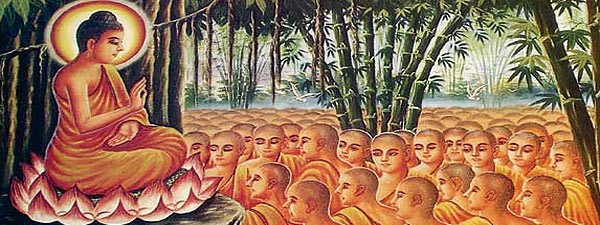
The six contemporaries mentioned are considered representatives of various Indian philosophical movements of the time. They are: Purana Kassapa,
Makkhali Gosala (originally Mahavira's student), Ajita Kesakambala, Pakudha Kaccayana, Sancaya Belatthaputta, and
Nigantha Nataputta (literally, the "Possessionless-One, Son of Nata," Mahavira).
 The sutra opens a window into their individual teachings,
as reported by King Ajatasattu to the Buddha.
Unfortunately, each of these accounts is very brief.
Not all who wander are lost.
Respect for Wanderers
This sutra reveals a culture that respected truth seekers who were wandering ascetics (shramanas), that is, spiritual wayfarers. They were an alternative to conventional Brahmin temple priests who held the Vedas as their sacred texts and ultimate authority, much as St. Issa (Jesus) wandered rather than being involved with the temple hierarchy and unquestionable sacred texts like the Talmud (part of Judaism's Bible).
 |
| The Buddha's India, the Middle Country |
King Ajatasattu, who usurped his powerful father King Bimbisara's position to become the ruler of the most influential area (Magadha) in India at the time, expressed his respect for any recluse, even if the person used to
be his servant.
WOMEN
Until the Buddha accepted women into his Monastic Order, all female recluses were Jains, since Mahavira had earlier accepted women. Buddhism became the first world religion to elevate women to equal spiritual status and social standing (at least within the Sangha). Jainism never caught on outside of India. However, the sexual equality the Buddha established was eventually subverted: Additional rules (garudhammas) were instituted and backdated as if the Buddha had always intended to subordinate women, which does not make historical sense as explained by Ven. Tathaloka.
The Fruits of Recluseship
 |
| Novice meditating, Burma (Dvlazar/flickr.com) |
Basic rewards
When asked about the fruits of Buddhist recluseship, the Buddha explained to these to the
king:
- respect, protection, and provisions from the king and lay people. These were benefits even other wandering ascetics could expect in ancient India with its charitable dana system -- reciprocal benefits of spiritual seekers aided and in turn aiding the people and society.
- endowment with morality as explained in the "The Net of All-Embracing Views" or Brahmajala Sutra.
- guarded sense faculties (indriya samvara)
- mindfulness and clear comprehension (sati-sampajana)
- contentment (santosa).
Intermediate rewards
Detached from the Five Hindrances, greater benefits arise from the
successful practice of meditation:
- the four material absorptions (jhanas)
- insight-knowledge (vipassana nyana)
- advanced spiritual capabilities
Highest rewards
The highest rewards, the ultimate goals of the Buddhist path, is the
complete realization of the Four Noble Truths and liberation from samsara -- rebirth and suffering.
Subscribe to:
Posts (Atom)