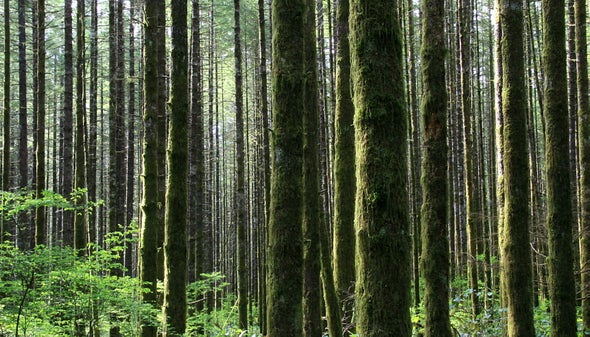
What's better the vertical or Horizontal Forest? Hmm, seems pretty clear (cut)
.
Bhumi Devi: Nature Spirit
World Nature Conservation Day is an annual event held on July 28th. This day stresses the need for preserving a healthy environment and natural resources to maintain a stable and healthy society. Saving plants and animals that face the threat of extinction is one of the primary goals of World Nature Conservation Day. Also, the celebrations emphasize keeping the various components of nature such as flora, fauna, energy resources, soil, water, and air intact. In addition, World Nature Conservation Day underlines the need for preserving the environment for future generations. We are therefore tasked with the need to leave a healthy planet for those coming after us to enjoy. More: nationaltoday.com/world-nature-conservation-day/
A groundbreaking chance discovery in southwest England in the Hangman Sandstone Formation revealed the world's oldest fossilized forest. Dating back 390 million years, these ancient trees help grow our knowledge of early ecosystems and how we believe forests developed during the Middle Devonian period.
This is what happens to trees when they take in "excess" CO2. That's a silly statement to fan the fires of global warming alarmism. There is no "excess." However much or little there is in the atmosphere, there's a failsafe system in place to restore us to balance. Like mushrooms (fungi), mammals breathe out carbon that trees breathe in. Then they breathe out oxygen.
It's a wonderful system, self-sustaining, self-correcting, self-balancing. More carbon is GOOD for trees and chlorophyll plants, most of which are in the ocean in the form of plankton and seaweeds.
Oak trees, for instance, accumulate more wood when there is more carbon dioxide (CO₂) in the atmosphere, a recent study shows.
Oak tree branches under sun in summer in Aegean Turkey (Emreturanphoto/Moment/Getty)
.
Oak trees accumulate more wood when there is more carbon dioxide (CO₂) in the atmosphere. That’s the key finding from our new study, carried out in a long-established forest in Staffordshire, England, that we have turned into a huge field experiment by injecting with extra CO₂.
After we increased CO₂ levels to what will be the planetary level in the 2050s, trees took more of it from the atmosphere and their wood production increased by 10 percent.
More CO2, please. We love it.
In some ways, this result is reassuring. We know that more CO₂ in the atmosphere can often help plants grow bigger and faster since photosynthesis captures the carbon [but we're trying to find a way to negatively spin that so people continue to alarmism] from which plants are largely made.
However, until now, the only comparable study on an older, mature forest (an Australian eucalyptus forest) found no link between extra CO₂ and tree growth.
Our work shows the link really does exist — at least in some common broadleaf forests.
However, woodier trees do not offer a silver bullet to solve climate change.
While carbon is certainly better off in trees than in the atmosphere, where it causes global warming, it’s not a long-term solution. [Of course not, because we need a manmade solution that can be monetized to profit private industry; we can't afford to leave this in the hands of Mother Nature.]
Over decades or centuries, wood rots away, and carbon dioxide is released back into the atmosphere [and the whole cycle repeats at that time as it has for billions of years].
So, as a store of carbon, trees are not remotely equivalent to it being locked away in coal seams and oil reservoirs deep underground [or on other planets, or in locked vaults and storage units, where the keepers can charge rent governments will have to pay. We need to stop corporate polluting and start planting more regionally-appropriate trees]. More
Rob MacKenzie, Richard Norby and The Conversation via Inverse (inverse.com), 8.18, 24; mycologist Paul Stamets, "How Psilocybin Mushrooms Can Help Save the World" at SXSW 2023; CC Liu, Crystal Q., Seth Auberon (eds.), Wisdom Quarterly
The world's oldest forest dating hundreds of millions of years old has been found
What garden existed in ancient New York state?
The world's oldest forest, which dates back hundreds of millions of years, has been found.
Scientists have unearthed the world's oldest known forest in upstate New York, USA.
This 386-million-year-old woodland predates the dinosaurs by over 100 million years.
Researchers mapped 3,000 square meters of the ancient forest in Cairo, New York. What other prehistoric wonders might lie hidden beneath our feet?
These early species reproduced using spores rather than seeds. Archaeopteris, reaching heights of 30 meters, was among the first plants to develop leaves. How did these ancient trees shape the world we know today?
Hiking the Gabrielino Trail from JPL to the dam in the riparian environment | drone footage
It's easy, right? - This is so beautiful!
(Diggin SoCal Outdoor Adventures) The hike begins in the JPL parking lot, above the reservoir and dam visible from the 210 Freeway.
Up the Gabrielino Trail, established by the "Gabrielino Indians" (the Indigenous Kizh or Tongva of Los Angeles, once known as Tovaangar), beyond Gould Mesa Trail Camp and Paul Little Picnic Area, ending up at the dam (about 3.5 miles in one direction).
This is beautiful hike is leisurely with easy trails (and dangerous rattlesnakes warming themselves in the dappled light and mulch of fallen leaves).
However, it does involve crisscrossing the water numerous times. A river runs down and sinks beneath JPL to come up again at Devil's Gate Dam. This is usually easy but could pose a problem when it rains and the water level rises and becomes a whitewater chute.
Good hiking shoes and plenty of water are always smart choices, particularly as the weather warms. There is also poison oak (the reddish green leaves with a waxy coating in the brush next to the trail). Along the trail there was one snake no one would want to step on or have a dog bark at.
Also, it's beloved by mountain bikers, who race by with hardly a warning. #dronefootage#hiking#hikingadventures
Jen Bradford, Dhr. Seven, Xochitl (eds.), Wisdom Quarterly
If the Native Paiute kept it clean, so can we.
Throughout the year, Yosemite National Park has several special events such as Junior Ranger Day, Earth Day (both in April), Apple Picking Day (mid August), and Yosemite Facelift (late September), where volunteers can just show up, no application needed.
For all special events and drop-in days, the park asks participants to wear long pants and closed-toe shoes, appropriate gear for the weather, and to bring sun protection, water, and snacks.
The park provides tools and protective equipment.
All participants must sign a volunteer agreement [42 kb DOCX]. To fill out the form in advance, it will be posted with each special event or drop-in project as they are planned.
(It can also be signed on the day of the project on-site). Guardians must sign the form for participants under the age of 18. More
Imagine getting away from it all to meditate in the wilderness of the woods when it's so cold no one will be bothering, except maybe Sasquatch (for some Sierra Sounds in NoCal) or a band of marauders from the local gas station. It finally becomes possible to meditate in stillness. But this is really glamping with all the creature comforts (better than home) and, apparently, a film crew and makeup artist, wardrobe person, and stylist. Maybe TEMU has all this for sale cheap. What kind of planning would meals take? Shish kabob tofu slabs on a bed of savory stew fixings, mmm mmm mmm, spilling water, and breaking shovels. It's idyllic.
❄ Camping in a snowstorm with two-bedroom air tentㅣSnow ASMR
(Kirin Camp) March 3, 2024: Multilingual subtitles are included. Recommended to watch after selecting subtitles. ※ This video may also be viewed in 4K HD. ※ Filmed only in permitted locations in a campground. ※ #glamping #campingvlog #camping #campinglife※
It is forbidden to use the video without the consent and permission of copyright holder Kirin Camp. ※ Subscriptions and likes are a great help with video production. ❤️ ※ Thanks for watching.
[Camping Equipment] 🔹 Tent: Recollector - Recollector TRIZ 16.2🔹 Bed: Recollector - Fabric Air Bed🔹 Sleeping Bag: STONECOLD - Sweet Warm Sleeping Bag🔹 Water Jug: Pilmoa - Valve Water Jug🔹 Fan: NamsanWorks TUF Non-powered Fan🔹 Kerosene Stove: Toyotomi - Omni 230🔹 Shelf: ON:PING - Love Shelf🔹 Wood Stove: Wood & Burn - Mystove Regular +🔹 Sofa: COODY - Air Sofa
Social media: Instagram: kirin_camp. Email: kirinfilm178@gmail.com #campingvlog #camping #campinglife
COMMENTS
@Blaster53: Advice for the future in the case of camping in a snowstorm. As soon as you put up your tent, start intensive heating inside. That warms the roof, which melts the snow, which prevents accumulation and avoids the collapse of the tent.
@ktkalicka (edited) Today's tents offer many options. You can buy ALL household amenities at the right store. [What's the "right" store? The store that sells ALL household amenities. D'uh. It's tautological, you see? Therefore, it's nearly worthless as "advice." Get the gear online or at REI or big box stores in season.] This is how camping SHOULD be. I've seen a lot of videos with this type of tent and equipment... You can camp for days like this, especially in the summer near a stream [when there's no snow and lots of fun things to do in the forest and lake or stream and meadow]... It's like a portable vacation home...
@WQ: Hey, why don't you change? It can't be comfortable going to sleep in the same outfit you arrived and worked in all day. It's not just the ASMR, the mirror cells would make us more comfortable to see you slip into something comfy.
We humans are experts in our misguided attempts to clean up the environment. Such is the case with our misunderstanding of the importance of [mushroom] decomposition.
I wish to help reframe the benefits of fungi with a “Let it Rot” Campaign. Rather than removing or chipping a fallen tree or its branches, leave them on the property and allow them to decompose to support fungal biodiversity.
Decomposition = new green growth
Alternatively, inoculate the fallen tree with gourmet mushrooms (more on this subject here) and see new delicacies bloom with a little help from nature’s own recyclers.
While sinister actors like blight, root rot, and rust mold make the news headlines, the truth is that fungi form an essential underpinning of the natural world.
Carbon cycling, soil formation, nutrient mineralization and utilization, protection from pathogens and herbivores, and control of plant and insect populations are only a few of the roles that fungi fulfill in the environment.
One inoculated wood chip is enough
Saprophytic or "wood-decomposing" fungi help drive the world's carbon cycle by making the carbon stored in wood available to build soils, microbial communities, and ultimately nourish plants.
The “white rot” fungi (such as Oyster mushrooms) break down the lignin in wood and the “brown rot” polypore fungi (such as Chicken of the Woods or Sulphur or Yellow Polypore) break down the cellulose.
As these fungi dine, their extracellular digestive systems leak some of the nutrients into their surrounding environment. These liberated nutrients that escape digestion by the fungi become “mineralized” in the soil and help form the base of the terrestrial food web.
The mycorrhizal species — including some favorite edible mushrooms like Chanterelles and Porcini mushrooms — critically aid the growth of their plant symbionts by scavenging and translocating mineral nutrients such as phosphate.
Throughout the process they colonize the roots of the plants and alter the microbial community in the rhizosphere (root zone) to help protect their plant host from pathogens.
Acids and digestive enzymes secreted by mycorrhizal fungi (as well as saprophytic species and lichens, a strange combination of algae and bacteria) can even break down rocks to further liberate minerals and micronutrients.
Shroom Junkie makes healthy mushroom mylk
The increased growth of the plant improves crop yields, soil aggregation, and carbon immobilization, to name just a few of the benefits.
Endophytic fungi are a fascinating group that live within and between the vascular cells of plants in a mutualistic relationship.
Researchers are now discovering them within nearly every plant that has been studied. These hidden fungi are known to increase drought tolerance and reduce predation by herbivores, among other yet-to-be discovered benefits to their host plants.
So the take home message is: LET IT ROT in peace! While there are certainly legitimate concerns about the rise of fungal pathogens, cankers, and blights on a warming planet, there is no reason to let them blind us to the wonders of the fungal fabric that builds and binds our biosphere.
Explore, study, and cultivate the fungi in our life, and see nature rebound in a joyous chorus with mushrooms leading the way!
To our planet, Paul Stamets
Here's a second opinion on Chicken of the Woods wild foraged shelf mushroom
Enjoy a plant day with guest leader and fiber-arts artisan Amy Stewart and Rob Remedi for another plant-dyeing and ethnobotany class, this time focusing on the plants and colors of the fall season.
The native plants featured are black walnut (brown), cactus-cochineal (pink), sagebrush (yellow), and orange (an over-dye).
Chumash Cecilia Garcia and Dr. Adams, USC
The class will also have an ethnobotany walk.
This class starts with a short easy walk identifying plants and their uses, as well as which ones yield color.
Upon return from our walk, we'll learn the plant dyeing process and how to prepare different fibers (wool, cotton, silk) for dyeing, then make the dye bath and take home a fabric of choice.
This is a fun, informative, and hands-on class, exploring nature's colorful and useful bounty.
$45.00 per person for a 100% cotton bandana and a lengthy wool yarn strand
$50.00 per person for a 100% silk scarf and a lengthy wool yarn strand
The Surprising Truth Behind Planting Trees and Climate Change
(PBS Terra) Check out Out of Our Elements: For decades we’ve been planting trees in hopes of reducing natural carbon as if it were "pollution." But when it comes to carbon sequestration, which makes the world greener, have we actually been getting it all backward?
During the UN Climate Conference (COP26), the topic of carbon capture and storage was hotly debated. In this episode, PBS Terra travels to the Pacific Northwest forests of Oregon to see what we can learn about forest carbon sinks from Prof. Beverly Law and her groundbreaking research with Oregon State University’s Department of Forestry.
What about planting trees and forest carbon storage? Let's see in the comments. It's good and necessary but takes ten to 20 years before the ground started sequestering carbon. Until then the barren ground is putting out carbon from plant decay in the ground, which would happen even if new trees wewre not coming. So we must preserve old growth forests.
#OldGrowthForests #CCS #CarbonCapture
Weathered is a show hosted by weather expert Maiya May and produced by Balance Media that helps explain the most common natural disasters, what causes them, how they’re changing, and what we can do to prepare.
Subscribe to PBS Terra to catch all episodes (bit.ly/3mOfd77).
Keep up with Weathered and PBS Terra on Facebook, Twitter, Instagram: Thank you Margaret A. Carghill Philanthropies for supporting PBS.
Diana Logan, Exemplore, June 7, '22; Pat Macpherson, Ananda (DBM) (eds.), Wisdom Quarterly
Woman gives solid tips for how to handle fairies if you come across them
We take human form, too, from past lives
Next time you're in the forest, heed these warnings. For most people, “fairies” (called woodland devas in Buddhism) are not cute, winged sprites from Disney cartoons. Rather, they are terrifying, otherworldly creatures who do not play by mortal human rules. In order to keep yourself safe from non-human entities when you’re out in the wilderness, follow these simple tips:
This sounds like pretty solid advice to remember on one hand. For people wishing to avoid unexpected encounters, as well as those wanting to be good stewards of wild places, take the advice.
In the comments section, some ask FTG what to do if they want to attract fairies. Most agree that attracting fairies is definitely the wrong approach.
After all, you have no idea what they will want or even demand from you. Read “Rip Van Winkle.” [And don't step into fairy rings to dance even if invited; you'll be there for weeks!]
FTG also clarifies that she’s using the word “fairies” as an umbrella term encompassing all non-human entities who may be roaming in the wilderness and what they can do to punish you: Fae, skinwalker, genie, shadow creature, Yeti, Sasquatch, Bigfoot, Dogman, wolf person, or other thing that might want to know why you're invading their space. Source
The Buddha's life is replete with trees: He was born under a sal tree, entered meditation under a rose apple tree, had his life saved by the women Sujata and Punna under a banyan, became enlightened under a pipal (all buddhas have a special tree), passed into nirvana under twin sals.
All those trees thriving on carbon (Getty)
How many trees? It’s a simple question, but as Nature Video describes it, getting the answer required 421,529 measurements from 50 countries on six continents.
The answer is that the world is home to over three trillion trees — with almost half of them living in tropical or subtropical forests [mainly in the Amazon and Siberia]. There are roughly 400 trees for every human.
Tropical and subtropical trees in climate chaos
But 12,000 years ago, before the advent of agriculture, Earth had twice as many trees as it does now [nearly 7 trillion]. Currently, the planet is losing 10 billion* trees a year.
Researchers represented the number of trees across the globe using bars that are taller for denser forests. This report was published in Nature on September 2, 2015.
*Editor’s Note (11/27/18): This sentence was edited after posting to correct the statistic.
Princess Yasodhara as sal tree dryad, like Queen Maya (Loriyan Tangai/Indian Museum)
.
Tree spirit: deva or dryad
"Fairies" (earthbound woodland devas*) are real in Buddhism.
In this ancient Hungarian fairy tale, Prince Green goes into the forest to hunt and slaughter animals. But they persuade him to be merciful, and they reward his kindness with a secret. With the animals' help he locates a special oak tree. From its branches tree fairies (dryads) are released. He loses two due to his miscalculations, but a rabbit helps him keep the third alive. They are so "airy" (vatadosha) that they need lots of water (kapha element) to live in a denser body. He falls in love and takes her to his castle to marry. But a wicked sorceress interferes and tries to replace the fairy with the sorceress' own unattractive daughter, whom the prince marries until he realizes what has happened.
India called me a devi, Ancient Greece a dryad
*DRYAD (Greek Δρυάς) is a treenymph or spirit in ancient Greek mythology. Drys is Greek for "oak." While a dryad is specifically a nymph of oak, the term has come to be used for all tree-fairies and all human-tree hybrids in general (at least in fantasy). They are usually depicted as very shy creatures except around the Goddess Artemis, who is friendly to most of them.More
On December 7th, 2005, U.S. federal agents conducted a nationwide sweep of "radical environmentalists" involved with the Earth Liberation Front — an organization the FBI has called America's "number one domestic terrorism threat."
How trees talk to each other (Suzanne Simard)
If a Tree Falls is a remarkable story about the group's rise and fall, told through the transformation and radicalization of one of its members, Daniel McGowan.
Part coming-of-age tale, part cops-and-robbers thriller, the film interweaves a chronicle of McGowan facing life in prison for his environmental activism with a dramatic investigation of the events that led to his involvement with the Earth Liberation Front or ELF.
FULL MOVIE: If a Tree Falls
Using never-before-seen archival footage and intimate interviews — with cell members and with the prosecutor and detective who were chasing them — If a Tree Falls asks hard questions about environmentalism, activism, and the way the FBI defines "terrorism" as against citizens but not the corporations who profit from the real terror. More: oscilloscope.net
(AccesstoInsight.org) A person shakes the branch of a wood-apple tree and all the fruit falls, ripe as well
as unripe. That person would collect only what is wanted and walk away leaving
the rest to rot. Such a wasteful attitude is deplored in Buddhism as not
only anti-social but criminal. The excessive exploitation of nature...
All materials on this site are submitted by editors and readers. All images, unless otherwise noted, were taken from the Internet and are assumed to be in the public domain.
In the event that there is still a problem, issue, or error with copyrighted material, the break of the copyright is unintentional and noncommercial, and the material will be removed immediately upon presented proof.
Contact us by submitting a comment marked "private."
Do not follow this journal if you are under vinaya or parental restrictions. Secure protection by Sucuri.
Wisdom Quarterly: American Buddhist Journal is licensed under a Creative Commons Attribution-Noncommercial-Share Alike 3.0 United States License. Permissions beyond the scope of this license may be available at creativecommons.org/about/licenses.




 This is the official trailer from Oscilloscope Laboratories of If A Tree Falls: A Story of the Earth Liberation Front.
























































