Showing posts with label plant. Show all posts

Friday, March 13, 2026

Bibi body-double back from the dead?

(Meidas Touch) All hell breaks loose as senile/feeble Trump freezes in war...enemies move in
Back from the dead or fake Goldstein?
  • Who is Emmanuel Goldstein? He is the invented Jewish figure in George Orwell's book Nineteen Eighty-Four, the leader of "The Brotherhood," aka The Resistance. His existence is Inner Party propaganda
VIDEO: Iranian missiles hitting central Tel Aviv in retaliatory strikes (WSJ)

Jewish billionaire Jared Kushner-Trump cancels
(Hidden Economics Secrets) March 12, 2026: Tensions in the Middle East are being escalated after Iran claimed that its missiles struck the location of Israeli Prime Minister Benjamin (Dictator Bibi) Netanyahu in Tel Aviv, Israel.

Iranian (IRGC) sources reported that the strike targeted key locations connected to the Israeli leadership, but Israeli authorities refuse to yet confirm the claim. They are unable to deny it with proof.

The American Knesset tells Trump what to do
According to emerging reports, Iran said the attack involved ballistic missiles aimed at strategic sites in Israel, while officials in Israel have yet to verify whether any government facilities or the prime minister’s office were hit.

This breaking development comes amid rising military tensions between Iran and Israel and the USA, with missile launches, air defense interceptions, and conflicting claims from both sides.

As the situation unfolds, the world is closely watching for confirmation from Israeli authorities and potential responses that could further escalate the conflict. #BreakingNews #Iran #Israel

Thursday, October 9, 2025

Taylor Swift update: Kelce's ex (NPR)


Our true feelings expressed

'The Life of a Showgirl' spotlights Taylor Swift as she moves away from heartache

(Fresh Air) Reviewed by Ken Tucker, Oct. 8, 2025: Swift's previous albums focused on the love she yearned for. The dozen songs on her latest release combine to form a picture of true love found, tested, and proven strong. npr.org

  • Is "Wood" PG-13?
  • Is "Opalite" about Trav's ex?
  • Is Nazi Barbie bat-s crazy or just making $$?

Friday, August 1, 2025

Win trip to see BLACKPINK in Tokyo


"We're going to spice up your life"?
It might be more entertaining to see Babymetal at the Intuit Dome, LA


Get ready for the ultimate K-POP experience. 102.7 KIIS FM and China Airlines from Taiwan are sending one lucky winner and a guest on a once-in-a-lifetime trip to Tokyo, Japan, to see BLACKPINK live in concert—all thanks to China Airlines, proudly from Taiwan since 1959.

(BLACKPINK) Killing it at Coachella 2023 with "Pretty Savage"
  • The grand prize includes:
  • Two roundtrip flights to Tokyo on China Airlines from one of the six China Airlines U.S. gateways
  • $1,200 in cash to use toward hotel stay
  • $1,000 in spending money for food, shopping, and unforgettable experiences
  • Two tickets to see BLACKPINK live at the Tokyo Dome on January 16th, 2026
Depart from one of these U.S. gateways:
  • Los Angeles, CA (LAX)
  • Ontario, CA (ONT)
  • San Francisco, CA (SFO)
  • New York, NY (JFK)
  • Seattle, WA (SEA)
  • Phoenix, AZ (PHX)

From city lights to stage lights, experience Asia on beat and in tour with China Airlines—from the blinking lights of Bangkok to the circus of Seoul and ending with the mayhem and madness happening in Tokyo.

It’s also possible to stop in Indonesia, Hong Kong, the Philippines, and Singapore along the way—where every stop is part of the journey. Book now at China-Airlines.com. History’s calling. Are you boarding?

Must be U.S. resident and 18 years or older to enter. Total prize value is $6,800. SourceWin a Flyaway Trip to See BLACKPINK in Tokyo from KIIS-FM and China Airlines! | 102.7 KIIS-FM | 102.7 KIIS-FM

Who funds K-Pop?
Meet the mega-rich Korean overlord chaebols - Who comes up with teen fashion trends?

Would you convert from Buddhist to Christian for fame and capitalism?

Wait. What happened to Blackpink?

Wednesday, May 15, 2024

Trees: one country gaining forests (video)

Where's the best place to mediate? The forest. But be protected: practice metta first.

Why does this forest look like a fingerprint?
(Vox) Team Vox set out to solve why a forest in the middle of Uruguay, South America, looks like a fingerprint and other odd patterns — and wound up finding something much bigger.
They're just trees. What's the big deal?
Deep in the geographic center of Uruguay, there’s a peculiar group of trees just a few kilometers down the road from the small town of San Gregorio de Polanco.

From the ground, it's not particularly notable. But from above, from a bird or drone's eye view (and particularly on Google Earth), the view is mind-boggling:

Hundreds of trees are arranged in perfect concentric arcs, all spiraling toward the center. Together, they look remarkably like a human fingerprint.

When the team first saw this forest in a Reddit post, it was fascinated.
  • Why had the trees been arranged in this shape?
  • Who planted them there?
  • And why — when one zooms out on satellite view — was the entire country of Uruguay covered in similar-looking forests?
To answer that question, the team went straight to the source: interviewing locals, experts, and people whose lives have been shaped by a transformed landscape and economy.

Further reading
ABOUT: Vox.com is a news website that helps cut through the noise and understand what's really driving the events in the headlines. Check out http://www.vox.com. Watch full video catalog: http://goo.gl/IZONyE. Follow Vox on Facebook: http://goo.gl/U2g06o or Twitter: http://goo.gl/XFrZ5H.
  • Vox.com, May 9, 2024; Xochitl, Ashley Wells (eds.), Wisdom Quarterly

Monday, March 11, 2024

Exposition on Karma (American Monk)

Ven. Subhuti (Jeremy Glick), Pa Auk Monastery, Burma; Dhr. Seven (ed.), Wisdom Quarterly
This begets more of this, as we sow so we reap, what comes around goes around, do unto others
.
What is the Pa Auk training?
Planting Wisdom: Reflections on the "Lesser Exposition on Karma Discourse" or "Shorter Analysis of Deeds Sutras" (Cula-kamma-vibhanga Sutta, MN 135) is the name of today's talk by Western Buddhist monastic Bhante Subhuti (AmericanMonk.org).

Ven. Subhuti is a long-time American Theravada Buddhist monk and student of the famous enlightened Burmese Meditation Master Pa Auk Sayadaw. Here he gives a cursory review of a significant sutra with the astounding tale from the Commentary on the rebirth story of Todeyya and Subha, a rich stingy man reborn as a pet dog in his former house, who becomes a close companion of his son.

Todeyya: I was a millionaire, but I was stingy.
The Buddha informs Subha that the dog in a former rebirth was his father, which comes as a massive insult. To prove it, the Buddha asks if his stingy father didn't by any chance leave inheritance money ungiven. He did. He died suddenly without revealing where he kept his treasure, which caused hardship to the family. The Buddha advises him to feed Todeyya the dog a rich meal until he's drowsy and then ask him to go to the treasure. The dog, still stingy, goes to take a nap over the spot her buried the money. This convinces Subha that the Buddha knows what he's talking about and that karma and rebirth are real phenomena. So he becomes a student and practices the Dhamma (Sanskrit Dharma, the Buddha's Teachings on Awakening).
Can I meditate in the forest, too?
PaAukForestMonastery.org, edited by Dhr. Seven, Wisdom Quarterly
He is named after the monastery
The system of Buddhist meditation taught at Pa-Auk Tawya (Pa Auk Forest Monastery) is based on the instructions by the historical Buddha as found in the Pāli language canon and its commentaries.

The system taught is called the Threefold Training:
  1. strict observance of precepts (sīla),
  2. developing stillness (samādhi), and
  3. as a basis for attaining wisdom (paññā).
It is further subdivided into the Seven Stages of Purification, which provide a step-by-step formula for systematically purifying one’s karma (deeds) of body (physical actions), speech (verbal actions), and mind (mental actions) of defilements in order to realize nirvana in this very lifetime.

Use the breath or Four Elements
In brief, the main practice is to begin with samatha (stilling, tranquilizing, making the mind content and joyous) meditation, which is to develop the meditative absorption called jhānas.

A yogi (Buddhist meditator) is free to choose any of the 40 serenity-meditation subjects as taught by the Buddha. At Pa-Auk Tawya, most yogis develop the absorptions or jhānas using mindfulness-of-breathing (ānāpānassati).

Having developed stillness (samma-samadhi or samatha), a yogi may proceed to practice insight (vipassanā) meditation.

There's also Pa Auk in Georgia
As an alternative, a yogi may omit the development of the absorptions, which a subtle and difficult for many who are not naturally inclined (from past life practice of the jhānas).

One will be taught instead to develop the less powerful "access concentration" with the serenity-meditation subject of Four Elements Meditation, prior to the practice of insight meditation.

In either case, the stillness/concentration attained by a yogi produces the "light of wisdom" or "sign" (nimitta) of progress in practice. More
  • Like cures like is the homeopathic saying. Is it true for our actions and their results? Giving little begets getting little. Having chosen an action in response to a situation, I can expect that kind of result from the world for a long time. Just one act of stealing, because it occurred over so many mind-moments (which are laid down like seeds in consciousness), will result in exponentially more of that. A good choice -- giving, being friendly, being possessed of right view -- will result in reaping exponentially more happiness than we've sown. It may seem unfair, but it's "lawful," that is, working out in some rule-bound way, according to universal law, in accordance with the nature of the world. Or else all that we did would come to nothing, mean nothing, and be merely random events happening to us with no rhyme or reason, nothing to learn, nothing to improve, no aha moments when it all makes sense and everything is just as it is supposed to be (given what we chose and did previously). The hope is that we can NOW do something different and begin, eventually, to get pleasant, welcome, wished-for results.

Monday, June 5, 2023

Forbidden Egyptian advanced technology

Universe Inside You, April 30, 2023; Pat Macpherson (ed.), Wisdom Quarterly


Forbidden Egyptian discovery of advanced technology
(Universe Inside You) Could the pit at Zawyet El Aryan have been connected to the Great Pyramid at Giza by underground electrical passages used to move water, as many have suggested?

The movement was not for the purposes of irrigation, but rather it was “electrified water” used to fuel an ancient civilization, as Brown and Hurtaks proposed.

Gold capstone, plaster insulation = electricity
Maybe this has something to do with the black residue found by Alessandro Barsanti in the pit’s oval tub. Could this be evidence of some sort of electrical burning or chemical process, the polished mirror-like tub the place where electricity was generated?

Perhaps this is why research on the site was abruptly shut down in 1964 and why it is now locked within a well-guarded military base. Perhaps beneath the pit at Zawyet El Aryan, hidden in an area Barsanti tried so hard to get to, is the proof of an electrified ancient Egypt. These are the types of secrets that would totally change our understanding of human history.
Narration: Petra Ortiz (petraortiz.com) T-shirts: teespring.com/stores/universe... 💜 Subscribe and like if you enjoyed the video. Thank you 💜 For Spanish-narrated videos, visit my Spanish channel: @UniverseInsideYouEspanol. ​To support this work and help get more videos completed, become a member of the channel by pressing the join button. Also support by joining patreon.com/universeinside...

Tuesday, March 21, 2023

Orchid facts. A flower from heaven (sutra)

Mediafeed; Hellmuth Hecker; Kelly Ani, Dhr. Seven (eds.), Wisdom Quarterly
Vanilla seed pods -- a flavor miracle -- come from Mexico and Guatemala (msn.com).
.
Things most don’t know about orchids
Flowers of Happiness Will Bloom
Anyone who’s ever cared for orchids knows that they’re pretty special.

From their practically microscopic seeds, to their tasty seed pods, to their worldwide range, these flowering beauties are nothing short of amazing.

They seem more of a celestial item -- like the mandarava (flame tree, coral tree, erythrina) bloom in Buddhist texts (e.g., Maha Kassapa: Father of the Sangha) -- than a terrestrial one. Here are a few things most probably didn’t know about them:

1. They are the largest family of flowering plants
By some estimates, Orchidacea is the largest family of flowering plants, with at least 25,000 to 30,000 species — not including the 100,000 hybrids and cultivars created by horticulturalists that aren’t naturally occurring. Of all flowering plant species on Earth, orchids make up about 10%. More
After the Buddha's passing: A flower from heaven
Hellmuth Hecker, Maha Kassapa: Father of the Sangha, Chp. 8 (DN 16), revised and enlarged translation from German by Nyanaponika Thera (edited by Wisdom Quarterly)
Devas and human beings loved to give the Buddha the gift of fragrant flowers.
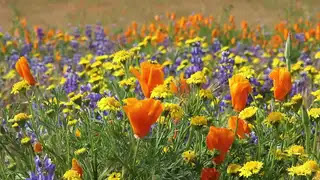
Wildflowers are neon signs doing everything they can to attract pollinators like bees.
.
Maha Kassap meets an ajivika naked ascetic
One of the Buddha's main disciples, Maha Kassapa, played a leading role in the Monastic Community (Sangha) after the Buddha passed. Only two of the five most prominent disciples were present, the brothers Ananda and Anuruddha. Sariputta and Maha Moggallana had already passed into bliss.

Maha Kassapa, with a large company of wandering ascetics, was traveling on the main road from Pava to Kusinara to see the Buddha. He veered and sat down under a tree to rest. Just then a naked ascetic passed by with a mandarava flower in his hand, which is said to grow only in a celestial (deva) world.

When Maha Kassapa saw it, he knew something unusual must have happened for such a flower to be found on earth.

He asked the naked ascetic whether he had heard any news about the Buddha, and the naked ascetic affirmed that he had, saying: "The recluse Gautama passed into nirvana a week ago. I picked up this mandarava flower from the place of cremation."

It looks like a celestial flower from the deva realm, the flame tree (Erythrina sandwicensis)
.
I'm not "naked." I'm a "sky-clad" sadhu.
Among the monastics who heard the news, only those who were arhats [fully enlightened] like Maha Kassapa could remain calm, cool, and collected.

The others who were not yet liberated from the passions and defilements lamented and wept: "Too soon has the Blessed One passed into nirvana! Too soon has the Eye of the World vanished from our sight!"

Flame tree flamboyant (Tropical Plantae)
There was one [crochety] monk named Subhadda who had ordained in his old age. He addressed the others: "Enough, friends! Do not grieve! Do not lament! We are well rid of that Great Ascetic. We have been troubled by his telling us, 'This is befitting, that is not befitting.' Now we can do what we like, and we won't have to do what we do not like!"

[This led Maha Kassapa to realize the need for a great Buddhist council to formalize the Teachings (Dharma) of the Buddha. In that sense, Maha Kassapa became the founder of "Buddhism," taking what he had learned from the Buddha, what he knew about monasticism, society, and Brahmins to give us a new -ism. Prior to that Buddhism was not a religion but a path of practice to enlightenment. It was soon to become a formal structure.]

Until then it had not been possible to set the funeral pyre alight as the devas [celestial "shining ones"] present wanted to wait until Venerable Maha Kassapa came and paid his respects to the remains of the Buddha. When he arrived at the place of cremation, he reverently walked twice around the pyre with clasped hands then, with bowed head, paid his respects at the feet of the Tathagata (the Buddha).

Relics (sarira) are an arhat's cremation remains.
When his company of monastics did likewise, the pyre, it is said, burst into flames by itself. Hardly had the bodily remains of the Tathagata been cremated when there arose a conflict about the distribution of the relics (sarira) among the laypeople assembled and those who had sent messengers later.

The distribution was settled by the Brahmin Dona, who divided the relics into eight portions and distributed them among. He took the vessel in which the relics had been.

There's a reserve in Los Angeles County for spring wildflowers (weather.com)
.
Maha Kassapa brought his share of the relics to the current king of Magadha, Ajatasattu. Having done so, he turned his thoughts to the preservation of the Buddha's spiritual heritage, the Teachings (Dharma) and the Disciplinary Code (Vinaya).

The necessity to do so was demonstrated to him by Subhadda's challenge of the discipline, advocating moral laxity. Maha Kassapa took this as a warning. If that attitude were to spread, it would lead to the decline and ruin of both the Monastic Community and the Teaching.

To prevent this, Maha Kassapa proposed holding a council by which the Dharma and Discipline could be reliably established and secured. He turned to the monastics gathered at Rajagaha (modern Rajgir, India). They agreed and at their request Maha Kassapa selected 500 [lit. "a large number" not actually 500] members, all but one of whom were fully enlightened (arhats). More

Saturday, March 18, 2023

New flower species found in Japan: glass orchid

Mindy Weisberger, CNN, 3/17/23; Kelly Ani, Dhr. Seven (eds.), Wisdom Quarterly

A new species of orchid has been discovered in Japan, and its petals look like they’re spun from glass
In a past life, I was a Japanese flower
Sometimes newfound flower species are lurking where scientists least expect to see them — in city parks, backyard gardens, and even in planters on apartment balconies.

That’s where researchers in Japan recently identified a new species of orchid, its pink-and-white blooms so delicate and fragile they look like they were spun from glass.

The newly described flower is a neighbor to populations of a related orchid species common in Japan that it closely resembles. Its discovery is an important reminder that unknown species are often living right under our noses, scientists reported Friday in the Journal of Plant Research.

“The incredible diversity of the orchid family, Orchidaceae, is truly astonishing, and new discoveries like this Spiranthes reinforce the urgency to study and protect these botanical gems,” Justin Kondrat, lead horticulturist for the Smithsonian Gardens Orchid Collection, told CNN in an email.

Kondrat was not involved in the research. Orchids in this genus — Spiranthes — are called “ladies’ tresses” for their resemblance to wavy locks of hair. Spiranthes have a central stem, around which grow an ascending spiral of tiny, bell-shaped flowers that can be white, pink, purple, or yellow.

There are about 50 species of Spiranthes found in Eurasia, Australia, and the Americas, typically in temperate or tropical regions, and these flowers have been known in Japan for hundreds of years, according to the study.

A new species of orchid has been discovered in Japan, and its petals look like they’re spun from glass (© Provided by CNN via MSN.com). We're dubbing it the "glass orchid."

Colors of the floral newcomer's blooms vary "from purple-pink to white," researchers said.

  • Populations of the floral newcomer were discovered in Tokyo prefecture near Hachijo Island, inspiring the species name Spiranthes hachijoensis. - Masayuki Ishibashi 
Before this discovery, three species of Spiranthes orchids were found in Japan: S. australis, S. sinensis, and S. hongkongensis, and only S. australis was thought to grow on the Japanese mainland.

However, during a survey on mainland Japan over a decade ago, lead study author Prof. Kenji Suetsugu, in Kobe University’s Division of Biodiversity, Ecology, and Speciation, found something unusual: flowers presumed to be S. australis but with smooth stems. (S. australis typically has hairy stems). More