Sunday, September 28, 2014

China fights HK pro-democracy demonstrations

Pat Macpherson, Pfc. Sandoval, Wisdom Quarterly; AP writers Elaine Kurtenbach, Louise Watt, Joanna Chiu contributed, Kelvin Chan (chanman) Associated Press
Riot police pepper spray peaceful demonstrators after thousands block the main road to the financial center district outside government HQ in Hong Kong, Sunday, Sept. 28, 2014. Hong Kong activists kicked off a long-threatened mass civil disobedience protest today to challenge Beijing over restrictions on democracy, voting reforms, escalating the political battle in the former British colony after police arrested dozens of student demonstrators (AP).

.
Police assault peaceful demonstrators (AP)
HONG KONG, China - Hong Kong police blasted pro-democracy protesters with tear gas and used vans with flashing lights in renewed efforts overnight to force demonstrators from streets near the government headquarters, as the city's top leader early Monday urged them to go home.

Hong Kong's top leader, Chief Executive Leung Chun-ying, reassured the public that rumors the Chinese army might intervene were untrue. "I hope the public will keep calm. Don't be misled by the rumors. Police will strive to maintain social order, including ensuring smooth traffic and ensuring the public safety," said the Beijing-backed Leung, who is deeply unpopular. He added, "When they carry out their duties, they will use their maximum discretion."
 
As sit-ins spread to other areas of Hong Kong in the strongest challenge yet to Beijing's decision to limit democratic reforms for the semi-autonomous city, Leung urged everyone to go home and avoid causing trouble.

Demonstrators walk through tear gas used by riot police against them after thousands blocked a main road at the financial central district in Hong Kong, Sunday, Sept. 28, 2014. Authorities launched a crackdown that spiraled into an extraordinary scene of chaos as the crowd jammed a busy road and resisted officers wielding pepper spray (AP).
 
Say no to police state
"We don't want Hong Kong to be messy," Leung said as he read a statement aloud early Monday on TV. After spending hours holding protesters at bay, police lobbed canisters of tear gas into the crowd on Sunday evening. The searing fumes sent demonstrators fleeing, though many came right back to continue their protest. The government said 26 people were taken to hospitals; some carried away on stretchers.

As the protest dragged past midnight, police began pushing the crowds back with their vans. Meanwhile, some protesters began occupying other downtown areas. Some protesters pulled back, fearing police might move more aggressively to end the protests, which began with sit-ins over a week earlier by students calling for Beijing to grant genuine democratic reforms to the former British colony. More

Demonstrators gather in Hong Kong financial district after riot police use tear gas on them after thousands blocked road, Sunday, Sept. 28, 2014. Police threatened further violent measures as they tried to clear thousands of pro-democracy demonstrators gathered outside government HQ in a challenge to Beijing over its decision to restrict democratic reforms for the city (AP).

How we got to NOW (video)

CC Liu, Amber Larson, Wisdom Quarterly;Weekend Edition Sunday
Droney and the Man on "This Modern World" (Tom Tomorrow/thismodernworld.com)
(PBS) Discover the extraordinary in the ordinary. How Zen. Join author Steven Johnson for a 6-part series that explores the power and legacy of great ideas. Hear the stories behind the remarkable ideas that made this modern world possible, the heroic unsung who brought them about, and the unexpected and bizarre consequences each triggered.

Celebrating the History and Power of Great Ideas: Six-Part Series to Premiere in Fall 2014 on PBS
How We Got to Now (Steven Johnson)
LOS ANGELES, California - PBS announced the premiere of HOW WE GOT TO NOW with Steven Johnson in fall 2014. 

The six-part series, to be produced for PBS by Nutopia and hosted by the popular American science author and media theorist, explores the power and the legacy of great ideas. 

Topics explored in the series include why and how ideas happen and their sometimes unintended results, including:
  • how Gutenberg and the printing press led to reading on a wider scale in Europe and the realization that many Europeans are farsighted and suddenly in need of spectacles, which opened the way for lots of experts glass works, which gives rise to developments in biology and astronomy due to microscopes, telescopes, cameras lenses, great mirrors and self-reflection,
  • how Lee Deforest invented the radio broadcasting to broadcast music, but not the classical music he loved and instead the jazz he hated,
  • how someone invented the phonograph, but his patent failed to include a feature to "play" what it could successfully record (enter Edison to hog up all the credit),
  • how the search for clean water opened the way to invention of the iPhone,
  • how the nagging problem of overheating in a New York printing business led to the invention of air conditioning, which inspired mass migration and a political transformation.
TV show host Steven Johnson (PBS)
Johnson explains the answers to the questions he poses in each episode.

For example, “How do we make something cold?” or “How do we create light?” And how have they driven other discoveries through the web of ideas and innovations -- the unintended consequences -- that made each finding possible? Were some foreseeable?

Drone Warfare (amazon)
Tracking each pursuit through history both ancient and contemporary, Johnson unlocks tales of unsung heroes and radical revolutions that changed the world and the way we live in it.
 
“PBS’s science programs explore the big, intriguing questions,” said Beth Hoppe, Chief Programming Executive and General Manager of General Audience Programming for PBS. “With the innovative new series HOW WE GOT TO NOW, we’re exploring humankind’s insatiable desire to find answers, invent solutions and make the world a better place.” More
NPR: Glass to Artificial Light: Innovations that Got Us to "Now"
NPR's Linda Wertheimer speaks to Stephen Johnson about his new book and TV series, How We Got to Now. He looks at six innovations that he thinks shaped the modern world.
Droney and the children on "This Modern World" (Tom Tomorrow/thismodernworld.com)

WE SAY NO - Drone Warfare: Killing by Remote Control (codepink.org)

A Parrot Bebop drone flies during a demonstration in May in San Francisco.
I'm not just a spy stealing your privacy, I make better Hollywood cinematography, keeping an eye on poachers, polluters, border crossers, protesters, and kill lots of soldiers. You'll love me. Anyway, you can't stop me! I've got my eye on you.
Droney on "This Modern World" (Tom Tomorrow/thismodernworld.com)

Eat Pray Love? Diet, Blapshemy, Hate (audio)

Eat Pray Love author gets quizzed on Dieting, Blasphemy, Hate
Elizabeth Gilbert was a successful magazine writer in New York when she went through a life crisis and decided to travel the world. When she got back, her book Eat Pray Love become one of the biggest best-sellers of the past decade, along with its sequel Committed. Her latest novel is called The Signature of All Things.
 
We've invited Gilbert to play a game called "I refuse to eat, pray, or love." Three questions about dieting, blasphemy, and hate.
 
PETER SAGAL, HOST: And now the game where we take people who have accomplished big things and ask them to do a very little thing, that is, play our game, Not My Job. Elizabeth Gilbert was a successful magazine writer in New York when she went through a life crisis and decided to travel. When she got back, her book Eat Pray Love became one of the biggest bestsellers of the last decade along with its sequel, Committed. She has a new novel out called The Signature of All Things. She joins us now. Liz Gilbert, welcome to WAIT WAIT...DON'T TELL ME. (APPLAUSE)
 
Elizabeth Gilbert is the author of the memoir Eat, Pray, Love, Committed and The Signature of All Things.
Author Gilbert (Jennifer Schatten/The Penguin Group/NPR)
ELIZABETH GILBERT: Thank you.
 
SAGAL: So there might be one or two people out there listening who neither read Eat Pray Love nor saw the film with Julia Roberts. So could you describe it briefly for them?
 
GILBERT: There might be one or two men out there.

SAGAL: Yes.

GILBERT: Yeah, to be very specific.

SAGAL: Who were afraid to admit it to their significant other.

TOM BODETT: No, my wife and I sat in the warm morning sun feeding each other grapes and read it to each other. (LAUGHTER)
BODETT: Now I'm sitting between two women, I can't speak freely. (LAUGHTER)
 
SAGAL: Well, so this is -- you, as I said, you were going through a life crisis. Your marriage ended, it was not going well. You said, I'm hitting the road. You went to Italy, and then Indonesia and India. And then you wrote a book about these -- about the lessons that you learned. Am I summarizing it correctly?
 
GILBERT: Yeah, you just did it beautifully.

SAGAL: Thank you.
 
GILBERT: Yeah, I ate my way through India, and actually -- ate my way through Italy. What am I saying?
 
SAGAL: I was about to say, you haven't read the book, have you? (LAUGHTER)

GILBERT: I haven't, actually. I did it all in upstate New York. I was just hoping I wouldn't get busted.

SAGAL: And this -- didn't you sort of create a movement of women finding themselves?

Elizabeth Gilbert as played by Julia Roberts
GILBERT: I hope so. That wouldn't be such a terrible movement to be responsible for. I certainly didn't set out to do that. My first books, by point of comparison, sold upwards of dozens of copies each. So I was not in any way prepared for that kind of a response, but I'm so surprised by it but delighted by it.

SAGAL: Are there women or anybody who had negative experiences like, "Yeah, I tried to follow in your footsteps. I went to Italy, I got food poisoning, drugged, woke up with one kidney. Thanks a lot!"?
 
GILBERT: (Laughter) Yeah, but the kidney they woke up with was on their plate. It was actually their meal.
 
SAGAL: Oh yes, that's even better. So one of the things that's happened - and this was probably something you didn't expect when you were a working magazine writer, is that you'd become kind of a self-help figure. You just did a tour with Oprah, right?
 
GILBERT: Yeah. I'm actually on tour with her right now. Well, not right this very minute.
 
SHELBY FERO: Is she there?

SAGAL: Is she there? Is she there?
 
O'CONNOR: Could you put her on?

GILBERT: Hang on a second. Ladies and gentlemen -- no. Yes, that's been an amazing thing. That's sort of like getting a phone call from the president.
 
SAGAL: Oh, it's better than that. (LAUGHTER)

SAGAL: President has to call people, Oprah chooses. What is it like being part of like an Oprah revival meeting? More

What is DEBT? You'll be surprised (audio)

Pat Macpherson, Amber Larson, Wisdom Quarterly; Sonali Kolhatkar (Pacifa Radio, KPFK Los Angeles, KPFA Berkeley) with David Graeber, author of Debt: The First 5,000 Years
My eyes may be the color of diarrhea, but that doesn't mean I'm a s---head (Tadolf Swiftler)
Jewish racism in America: promoting Islamophobia and fear (uprisingradio.org)

Debt (mhpbooks.com)
This is one of Uprising Radio's most popular interviews: David Graeber -- author, Occupy activist, and anthropologist -- on his acclaimed book Debt: The First 5000 Years.

In it Graeber shows how debt and debt-forgiveness have been at the center of social and political debates across the world and have given rise to innumerable violent uprisings.

He explores the history of money and credit and how societies have been divided into creditors and debtors. More

Saturday, September 27, 2014

Perverse Sex in the Ancient World (video)

Ashley Wells and Dhr. Seven, Wisdom Quarterly; History Channel video (via SFB)
Greek statue of the devi Eros (HEARTStephyHEART's photography/flickr.com)
WARNING: Viewer discretion is advised! Graphic content and sexual subject matter.

Tantric temple, India (UP)
After we "exposed" pornography in ancient Egypt, we had to wonder: What about hot Pompeii? Why not imperial Rome? "Sex in the Ancient World (Pompeii)," a History Channel documentary, reveals a world of decadence, prostitution, sexuality, perversion, she-wolves (lupinara), brothels, Pan, and Christian excess, shame, and guilt about it. Not much changes.
Modern sex in USA
(I'm Shmacked/Southern Methodist University) College drinking and lesbianism common on Christian college campuses?
(Elite Daily/Insights) Homeless Millennial survives by picking up women every night

Park yoga, Pasadena (janineglassyogaco.com)

Friday, September 26, 2014

Amazing U.S. racism and Ivy League (audio)

Ashley Wells, Wisdom Quarterly; Michael Slate (KPFKFri., 9-26-14, 10:00 am), Craig Steven Wilder, Ebony and Ivy; (flatironhotnews.com), Revolution Books, NY
logo
Ebony & Ivy Author Craig Steven Wilder to Speak at Revolution Books

1115Race did not come out of science and theology, but came to science and theology.

Americans from the USA (as distinct from the rest of continental America) went to England not so much to study medicine but as experts on race because they live with African, as they are the rich children of slave owners from the South.
451
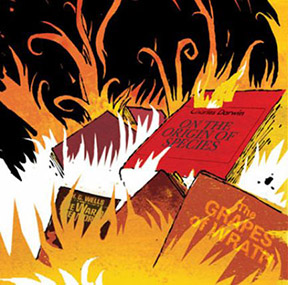
Burn all the books before the truth gets out!
They are bent on wiping out Native Americans, dehumanizing them, planning for their genocide, and considering African Americans as little better than primates. They raid corpses from graveyards to establish medicine and science in our America. The records show this, but no one before the author of Ebony and Ivy seems to have read the records in detail. Who would defend slavery, science or theology? They competed, and science won.

The mythologies of theology became the "empirical, verifiable" facts of science. The affluent American families that established the universities in this country -- during the "Enlightenment" -- were rooted in racism, slavery, genocide, and an imperial war mentality that still haunts us today.
 
U.S. Slavery and U.S. Universities
Eric Shapiro
Author Craig Steven Wilder will speak at Revolution Books on [Sunday, Sept. 28th] at 7:00 PM. A leading historian of race and African American culture, Wilder will discuss his latest book, Ebony & Ivy, released September 17th, 2013.

Ebony & Ivy (insightnews.com)
Ebony & Ivy examines the role racism played in the history of some of America’s most prestigious universities. Harvard, Yale, Princeton, and others exploited slaves to build and sustain themselves, while simultaneously serving as laboratories of racist thought. Slavery and racism, Wilder demonstrates, tarnish the legacy of even those institutions Americans perceive as bastions of liberalism.
 
Revolution Books, located at 146 West 26th Street, is one of the foremost independently-owned book stores in New York City. Dedicated to the cause of peaceful revolution developed by Bob Avakian, Revolution Books seeks to foster a clear understanding of the historical oppression that makes change so necessary. It is the ideal venue for a scholar like Wilder.

Wilder’s book has received considerable acclaim and publicity. The Allegra di Bonaventura of the Wall Street Journal writes:
 
“It is Mr. Wilder’s vast and often seemingly banal catalog of mercantile transactions, charitable bequests, and academic and administrative appointments -- all links in the chain that joins universities to slavery -- that lends the book its disturbing power... a passionate recounting of the collective dehumanization of African-Americans coincident with the rise in power and prestige of the Atlantic college, particularly the Ivy League.”

rnl
Oct. 2, 2014 (BA at RB)
A brief excerpt from Ebony and Ivory provides a tantalizing glimpse of its tone and subject matter:
 
“1830: Harvard was approaching its two hundredth anniversary, which meant that it was also nearing the bicentennial of its intimate engagement with Atlantic slavery. Beginning with the first graduating class, boys from Cambridge had been seeking fortunes in the plantations. By the time Henry Watson matriculated, Harvard’s history was inseparable from the history of slavery and the slave trade…”

Finally, here’s a little bit of information on Craig Steven Wilder himself:
 
Craig Steven Wilder is professor of American history at MIT, and has taught at Williams College and Dartmouth College. Wilder grew up in Brooklyn’s Bedford-Stuyvesant neighborhood is the author of A Covenant with Color and In the Company of Black Men.
 
Excerpts and bio courtesy of Revolution Books. Check out their website for more info on this and other upcoming events.

Hemis Monastery: Main ALTAR Room

CC Liu, Dhr. Seven, Wisdom Quarterly; Twiga_269/flickr (ॐ FEMEN); William Henry
Colorful walls and murals of Hemis Gompa with visions of stylized unseen beings
Himalayas: Hemis golden Buddha lovingly wrapped in prayer flags (twiga_269)
Hemis Monastery: Main Prayer Room Hemis Monastery (twiga_269/flickr.com)
.
Why do they call it an "altar"? It is, according to William Henry, because this special place has the power to alter the individual who stands in it. One enters an altered state and is altered. In ancient Egypt there were special altar stones (i.e., red granite) key in this transformation.

LADAKH, J&K, India - Hemis Monastery: Main Prayer Room Hemis Monastery is a Tibetan Buddhist monastery (gompa) of the Drukpa Lineage, located in Hemis, 45 km from the local capital of Leh, Ladakh, Buddhist India. The monastery was re-established in 1672 by the Ladakhi King Sengge Namgyal. The annual Hemis festival honoring Padmasambhava is held here in early June. More + Photos

Lama's desk: swastika (akasha deva Vril symbol) rug, skull hand drum, cash money, vajra, bell yoni, chant book, incense bowl, Vajrayana Buddhism-Bon shamanism (Twiga_269/WQ)
Arriving at Hemis Gompa, Ladakh, India (twiga_269/flickr.com)
Altered by Altar Stones?
William Henry (williamhenry.net)
Energy centers: the great pyramids of the Giza Plain, Egypt (sun-surfer.com)
It is an impressive fact that Nashville, Tennessee, my home, is the only city in the world that has reinterpretations of two mythic temples from antiquity. Both are among the finest in existence.
 
One temple is the “Queen of Heaven” Athena’s Parthenon, “Virgin-temple,” 438 B.C., Athens, Greece.
 
Sumer and Sumeru are connected (WQ)
The other is a $55 million 2,200-foot long rod laid out and growing on 19 acres. By a masterstroke of synchronicity, it is patterned like the world axis, Mount Meru [Sumeru, the Axis Mundi], the cosmic pillar or axis at the center of the world ascended by [the] Buddha and known throughout the ages as the model for all Trees of Life....

The Nashville gilgal’s [a circle of stones, usually 12] floor is made of red, white, and blue granite that sparkles in the sunlight. That’s because, as researchers such as Christopher Dunn and Freddy Silva note, red granite is loaded with quartz crystal. This "firestone" is a formidable conductor of energy, which is why it is the tuner of choice of the ancient stone workers of Egypt and Britain. (Remember, after all, Meru is described as an antenna).
  • Buddhism's great Sumeru (Mt. Meru) was an antenna?
Granite is considered a masculine stone. Limestone, which is associated with water, is considered to have feminine properties. Together, the granite floor and limestone pillars charge the Court of Three Stars with positive and negative polarity, just like an electrical circuit.
 
Etched into this granite "tuner" is a trinity of 15-foot wide pentacles -- a protective symbol known as Solomon’s Seal…and the star of Ishtar or Athena. At their center is the logo for Tennessee, a triceps, a triangle or trinity formed of three diamonds. One of the most powerful ancient symbols, the triceps is an ancient Nordic symbol of divine force, power, and protection.

It symbolizes the A U M trinity. It matches the alchemical symbol called the caput mortum, the skull or death’s head, the starting point for Enki’s alchemical work of transforming a human -- the impure or base metal -- into pure gold. More

Who Really Won the Battle of UC Berkeley?

CC Liu, Crystal Quintero, Wisdom Quarterly; Barbara Garson, Common Dreams, 9-24-14)
Why we protest: Mario Savio on the Operation of the Machine, UCB, Dec. 2, 1964. See Min. 3:20
Barbara Garson, then a student at Berkeley, speaking to a crowd of students in the fall of 1964 (Tom Kuykendal/FSM Archives/All rights reserved).
.
Fifty Years Later: Who Really Won the Battle of Berkeley?
As student activists return to campus to celebrate the 1964 Free Speech movement that galvanized for social justice, big questions remain about the direction of higher education since those radical days of upheaval and hope.
 
I’m going back to the Berkeley campus this week for the 50th reunion of the Free Speech Movement. You may have heard in some history class about Mario Savio and the first student sit-in of the 1960s. That was us, FSMers [Free Speech Movementers] at Berkeley.
 
UC Berkeley, clock tower, center of campus with view of Bay Bridge and San Francisco
.
Cal Berkeley (berkeley.edu, Aug 19, 2014)
It will feel a bit surreal. The university that had 801 of us arrested is welcoming us back by hanging Free Speech banners on the building we occupied. Home like a victorious football team! But it’s not a real victory because the people that tried to shut us up in the 1960s have a more chilling control over U.S. college students today than they ever had over us. Today it’s not police control, its economic control.
 
But The Free Speech Movement was half a century ago, so here’s a quick “teach-in” on the issues.
 
In the fall of 1964 students returned to campus -- some from a Freedom Summer in Mississippi or a stint with Cesar Chavez and the Farm Workers Organizing Committee -- to learn that we were no longer allowed to leaflet at the university entrance.
 
The reason they gave us was trash -- too much litter. But like our leaflets, that flimsy excuse was quickly dropped. When all the religious, political, and social clubs who used the space joined to complain, we were soon assured that the ban would apply only to leaflets that "advocated off-campus actions." The cat was out of the bag. More

Police convicted, AG Holder out, Ferguson apology


The right wing vilified and demonized Attorney General Eric Holder, the first African American in U.S. history to hold the post of the highest person in the justice system. Was Holder the highest? Right wing sources say he at one time dealt drugs, just as is said of Gov. Bill Clinton in Arkansas.
Jails Under Scrutiny
We have to agree with the horrible right wing that Holder was terrible -- doing little for the people yet a great deal for the banks, mortgage holders, the movers and shakers of a corrupt system of politics, finance, a military-industrial complex with aspirations to become a prison-industrial complex, a pharmaceutical-entertainment complex...

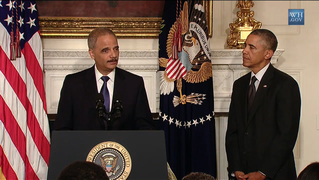
Ericholderresigns
Holder/Obama, face of Old Boys' Network?
He seems little better than the utter disappointment and fraud that B.S. Obama shown himself to be. Holder remembers being a federal prosecutor and still being mistreated by D.C. police in Georgetown because of what happened to Trayvon Martin. "I work for the Man, I am the Man!" he should have told the race-profiling officer, who would in turn have shot him. And being shot, he might have actually been sensitized to what African American and Latino citizens are daily put through with stop and frisk and other civil rights violations no one pays enough attention to to actually change.

Kathyjetnil-kijineratun
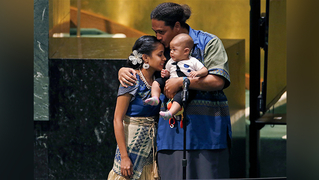
Marshall Islands Poet plea to UN Summit
There is a concept called greenwashing -- appearing to be "green" (ecological), that is, good for the environment. It is like whitewashing something dingy or filthy to make it appear sturdy and clean, like a corporate monster putting a pretty green leaf on a product when that product is poison.

Holder is like "blackwashing" a white racist injustice system he did nothing to repair or make equal. But he's a black man, not from Africa but Barbados, a scion of immigrants! Nonsense. He's an enemy to press freedom, to whistleblowers like Snowden and Manning. But he is a great freind to Wall Street and the U.S. police state.

He showed up like a johnny-come-lately in Ferguson and did what? There is another concept in public service called CYA (cover your @$$), which it seems he and Obama do well, as do Biden, Boehner, and all the other career figureheads who do nothing for Americans but oh so much for war profiteers, police, corporate heads, racist institutions. He headed the inJustice System (DOJ), the top lawgiver/law keeper. But Democracy Now! held a round table discussion to discuss Holder's tenure:
(Democracy Now!) Thursday, Sept. 26, 2014 and the heartbreaking tale of another police shooting of an innocent black man (this time in a Wal-Mart, black while shopping, murdered on sight): Shoot first, ask questions later, but you don't get a lot of answers that way.