Showing posts with label lakkhana. Show all posts

Tuesday, January 23, 2024

Origin and purpose of blue eyes (video)

Ananda (Dharma Buddhist Meditation), Ashley Wells (eds.), Wisdom Quarterly
The historical Buddha, Siddhartha Gautama, Shakyamuni ("Scythian Sage") had blue eyes.


The Origin and Purpose of Blue Eyes
(Survive the Jive) Jan. 22, 2024: Why do some people have blue eyes? What is the Darwin/Wallace evolutionary advantage of having blue eyes? Where did blue eyes evolve?
Blue eyes are an ancient thuman rait.
Blue eyes have piqued curiosity for centuries, standing out as a mesmerizing and rare trait among humans.

Discover the underlying science behind blue eyes as we explore various theories and genetic factors that contribute to their existence.

They were mainly associated with Mesolithic Western hunter gatherers like Cheddar man but the origin and story of this phenotype is complicated. A new study from Liverpool may have the answer as to what benefit this trait has -- better ability to see in low light.

This channel depends on your support: Patreon: survivethejive. All links: linktr.ee/SurvivetheJive

Thursday, May 2, 2019

The Buddha's second sutra (video)

Amber Larson, Dhr. Seven (eds.), Wisdom Quarterly; Chanting; Ven. Yuttadhammo; Wiki edit


The Anatta-lakkhaṇa Sutta preserved in the ancient Pali language (Anātmalakṣaṇa Sūkta in Sanskrit), is traditionally recorded as the second sutra or discourse delivered by the historical Buddha.
The title translates into the "Not-Self Characteristic Discourse" but is also known as the Pañcavaggiya Sutta in Pali and Pañcavargīya Sūtra in Sanskrit, which means the "Group of Five Discourse."

(Ven. Yuttadhammo) The Not-Self Characteristic Discourse
 
Contents
Gold Buddha (nortonsimon.org)
In this discourse the Buddha analyzes the constituents of the individual's body and mind as "heaps" or "groups" (khandha) of constituents.

He then shows how they are each radically passing away (anicca) and disappointing (dukkha, unable to fulfill or satisfy) and are thus unfit to identify as a "self" (atta, atman). The Pali version of this discourse reads:

"Form... feeling... perception... mental formation... consciousness is not self. If consciousness were self, this consciousness would not lend itself to disease.

"It would be possible [to say] with regard to consciousness, 'Let my consciousness be thus. Let my consciousness not be thus.'

"But precisely because consciousness is not self, consciousness lends itself to disease. And it is impossible [to say] with regard to consciousness, 'Let my consciousness be thus. Let my consciousness be not thus [and have it just be that desired way].'...

"So, meditators, any form [physical object]... feeling... perception... formation... [or] consciousness whatsoever -- whether past, future, or present, internal or external, obvious or subtle, mundane or sublime, far or near -- is to be seen as it actually is with right view [proper insight] as: 'This is not mine. This is not myself. This is not I am.'

"Seeing things in this way, the well-instructed disciple of the noble [enlightened] ones grows disenchanted with form, disenchanted with feeling, disenchanted with perception, disenchanted with formations, disenchanted with consciousness.

"Disenchanted, one becomes dispassionate [lets go]. Through dispassion, one is fully released. With full release comes the knowledge, 'Fully released.' One discerns that 'Rebirth is ended, the supreme life has been fulfilled, the task is done. There is nothing further for this world.'" More

Thursday, September 20, 2018

Sutra on the Not-self Characteristic

Ven. Ñanamoli Thera (trans.), Anatta-Lakkhana Sutra: "The Discourse on the Not-Self Characteristic (SN 22.59); Eliza Darcey, Dhr. Seven (eds.), Wisdom Quarterly
Thus have I heard. On one occasion the Blessed One was living at Benares, in the Deer Park at Isipatana (the "Resort of Seers"). There he addressed the meditators called the group of five [wandering ascetics]:

"Meditators!"

— "Venerable sir," they replied. Then the Blessed One said this:
  1. "Meditators, form [the physical, the material, the tangible, body] is not self. Were form self, then this form would not lead to affliction, and one could command of form: 'Let my form be thus, let my form not be thus.' Since form is not self, it leads to affliction, and no one can command form: 'Let my form be thus, let my form not be thus.'
  2. "Feeling is not self...
  3. "Perception is not self...
  4. "Determinations are not self...
  5. "Consciousness is not self. Were consciousness self, then this consciousness would not lead to affliction, and one could command consciousness: 'Let my consciousness be thus, let my consciousness not be thus.' Since consciousness is not self, it leads to affliction, and no one can command consciousness: 'Let my consciousness be thus, let my consciousness not be thus.'
"Meditators, how is one to conceive it: Is form permanent or impermanent?"

— "Impermanent, venerable sir."

— "Is what is impermanent painful or pleasant?" — "Painful, venerable sir."

— "Is what is impermanent -- and painful because it is subject to change -- fit to be regarded in this way: 'This is mine, this is I, this is myself'"?

— "No, venerable sir."

"Is feeling permanent or impermanent?...

"Is perception permanent or impermanent?...

"Are determinations permanent or impermanent?...

"Is consciousness permanent or impermanent?"

— "Impermanent, venerable sir."

— "Is what is impermanent pleasant or painful?"

— "Painful, venerable sir."

— "Is what is impermanent -- and painful since it is subject to change -- fit to be regarded in this way: 'This is mine, this is I, this is myself'"?

— "No, venerable sir."
"Therefore, meditators, any kind of form whatsoever -- whether past, future, or presently arisen, whether gross or subtle, whether internal (of oneself) or external (of another), whether inferior or superior, whether far or near must, with right understanding of how it truly is, be regarded: 'This is not mine, this is not I, this is not myself.'
 
"Any kind of feeling whatsoever...

"Any kind of perception whatsoever...
 
"Any kind of determination whatsoever...

"Any kind of consciousness whatsoever -- whether past, future, or presently arisen -- whether gross or subtle, whether internal or external, whether inferior or superior, whether far or near must, with right understanding of how it truly is, be regarded: 'This is not mine, this is not I, this is not myself.'

"Meditators, when a noble [i.e., enlightened] follower who has heard (the truth, the Dharma) sees things [namely, the Five Aggregates Clung to as Self, as they truly are] in this way,
  1. one finds estrangement in form,
  2. one finds estrangement in feeling,
  3. one finds estrangement in perception,
  4. one finds estrangement in determinations,
  5. one finds estrangement in consciousness.
"When one finds estrangement, passion fades out. With the fading of passion, one is liberated. When liberated, there is direct knowledge that one is liberated. One understands: 'Birth is exhausted, the pure life has been lived, what can be done has been done, of this [suffering in birth] there is no more beyond.'"

That is what the Blessed One said. The meditators were glad, and they approved of his words.

Now during this utterance, the hearts of the meditators of the group of five were liberated from taints through utterly letting go and clinging no more.

Wednesday, September 19, 2018

This world is a simulation: Maya

Dhr. Seven, Pat Macpherson, Amber Larson, Wisdom Quarterly; Alan Watts (alanwatts.org)

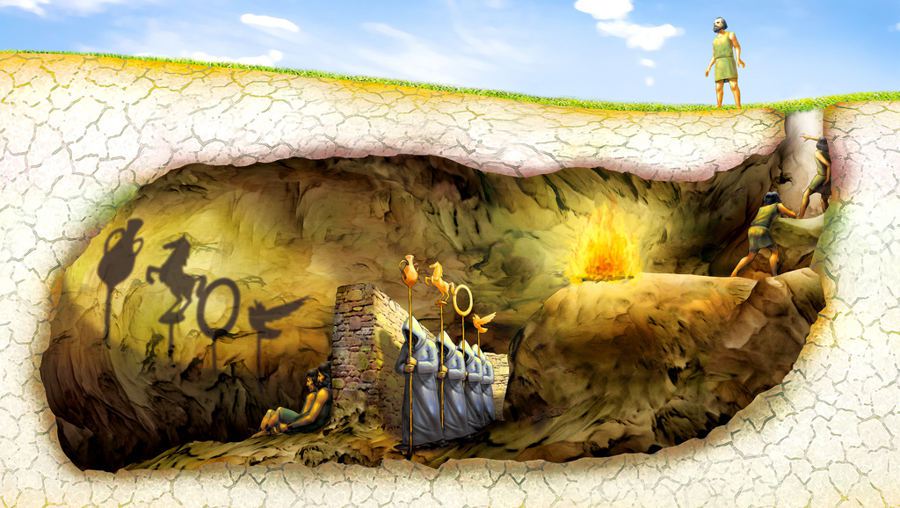
This is all unreal in more than one sense: Plato's cave allegory, the Buddha's maya.
.
I'm not a fraud. I'm rich, baby! Who paid you?
CON: How can anybody seriously say that this world -- solid as it is and totally real -- is a "simulation"? Elon Musk is a tool who lies about his adventures with Space X and calls a detractor he's mad at a "pedo" (molester).

The Wheel to Freedom
PRO: But Musk is not the only one who says this life, this world around us, is a "simulation." Doesn't everyone have the sense that there's something unreal going on here? What is the "proof" we're dreaming?

We wake up. So if we were to wake up from a dream-within-a-dream we would say, "Aha! We were just dreaming!" But we would still be dreaming.

What does the "Awakened One," the Buddha, say will happen when we awaken from this illusion, this maya? He says that in retrospect this will all seem like a dream to us. It was all unreal, insubstantial, painful and misleading. This is a dream, this is an illusion, this is maya -- not at all what it seems to be.

What does it seem to be?
  1. It seems to be permanent when it's not.
  2. It seems to be able to satisfy us when it cannot.
  3. It seems to be personal when it is not. It is all changing, unsatisfactory (disappointing), and impersonal (devoid of an inside-self experiencing an outside-world).
What is it actually?
O, Elon, exhale and BE at peace.
  • This simulation, this unreal we call real, has Three Universal Characteristics. Seeing them causes one to "wake up." The alternating "painful nightmare-pleasant dream" (called samsara) is thereby dispelled, and all is well. That awakened state is enlightenment (bodhi) that leads to peace (nirvana).

Thursday, July 27, 2017

What is the True Nature of Existence? (audio)

Ven. Bodhi; Dhr. Seven, Amber Larson, Crystal Quintero, Wisdom Quarterly; Urban Dharma
A buddha is a supremely enlightened teacher like the historical Buddha Shakyamuni.
   
Buddhist monk Bhikkhu Bodhi, Ph.D.
American Theravada Buddhist scholar-monk Bhikkhu Bodhi once created a ten-part audio course on Buddhism called "The Buddha's Teaching: As It Is" while living in Washington Buddhist Vihara in DC.

It was 1981 and Bhante G (then president of the Buddhist Vihara Society) suggested that young Bhikkhu Bodhi record lectures so the temple could distribute them as a set.

Traveling to Kandy, Sri Lanka -- where Bhikkhu Bodhi was living as editor of the Buddhist Publication Society -- to get permission to more widely publish these teachings. Bhikkhu Bodhi gladly gave it so long as it was not-for-profit but instead a gift of Dharma. The lectures are now in the "public domain," which means anyone may copy and help distribute them.

They make the most sense when listened to in the sequence Bhikkhu Bodhi recorded and listed them as they build on one another. These are MP3 files (free download) thanks to the great work of Los Angeles' Ven. Kusala at urbandharma.com).

Our noble meditation teacher Kalyani recommends they be placed on an MP3 player and listened to throughout the day. The simple merit of giving the gift of Dharma becomes supramundane when one listens and gains insight into the Buddha's message. Special thank you Bhikkhu Bodhi for decades of remarkable English scholarship bringing the Teachings to life.

AS IT IS (audio files)
  1. The Buddha - MP3 - 1:23 min - 19 MB
  2. The Four Noble Truths - MP3 - 1:21 min - 18.6 MB
  3. The True Nature of Existence - MP3 - 1:18 min - 18 MB
  4. Dependent Origination - MP3 - 1:15 min - 17.2 MB
  5. Rebirth and Karma - MP3 - 1:23 min - 19.1 MB
  6. Nirvana - MP3 - 1:16 min - 17.5 MB
  7. The Noble Eightfold Path - MP3 - 1:19 min - 18.1 MB
  8. Meditation - MP3 - 1:23 min - 19 MB
  9. Social Teachings of the Buddha - MP3 - 1:17 min - 17.7 MB
  10. The Sangha - MP3 - 1:18 min - 17.9 MB
REVIEW
Wisdom Quarterly
  1. The series begins by introducing what a buddha is and who the Buddha was.
  2. Then it moves on to the core teachings, Buddhism encapsulated in the Four Ennobling Truths. ("Noble" means enlightened).
  3. Reality is explained in Lecture 3.
  4. Then the means of gaining liberating-insight by mindful contemplation of the 12 links of causality called Dependent Origination to explain how the present suffering is rooted in the past.
  5. This leads to a discussion of rebirth and karma, essential links that reveal the true nature of disappointment (suffering or dukkha) central to the Buddha's teaching on how to bring about the end of suffering in the very life.
  6. Nirvana (called nibbana in Pali) is the complete cessation of suffering. It is NOT nothingness, emptiness, or the void. It is far subtler than we will ever imagine.
  7. It is brought about by cultivating the supramundane Noble Eightfold Path  of paths-and-fruits, magga-and-phala.
  8. This path is one of meditation (actual practice) more than intellectual study and detached learning.
  9. But self-cultivation in Buddhism also includes a sensitivity to the social dimension that critics of the ancient Theravada ("Teaching of the Buddhist Elders") school often cite as self-serving, wrongly assuming that the Buddha neglected society when in fact so much of his teachings are concerned with the betterment of a world that does not for the most part meditate.
  10. Those who dedicate their lives to meditating, to preserving the Dharma, and to teaching are the Sangha, the Monastic Order. As Americans and Socially Engaged Buddhists, we tend to dismiss the Order of Nuns and Monks (and countless temporarily-ordained practitioners) as an anachronism even as they continue to be a vibrant part of Buddhism.

Wednesday, July 19, 2017

10 Facts About the Buddha

Amber Larson and Dhr. Seven, Wisdom Quarterly (COMMENTARY)
Shakyamuni is not the famous fat Budai.
The human who became the Buddha, that is, the "Awakened One," was born Prince Siddhartha Gautama in a part of the world now known as Central Asia, between East and West. Dr. Ranajit Pal specifies Prince Siddhartha's hometown as modern Bamiyan, Afghanistan (not Nepal). Of course, Siddhartha was raised in three hometowns, three seasonal capitals. It is our conjecture that the other two were Kabul (Kapilavatthu or Kapilapura, the original site of the real Kapilavastu) and Mes Aynak (Little Copper Well).
    Accurate depiction of Buddha (Gandhara)
  1. Lived to the age of 80 but could have lived an entire lifetime, an age, a kalpa (120 years at that time) had he willed it.
  2. Had blues eyes, curly black hair, golden skin, and was tall and had other striking features.
  3. Mother passed away a week after his birth and her sister, married to the same Shakyan King Suddhodana, raised him and later became history's first Buddhist nun.
  4. Had a wife, his royal cousin Bimba Devi (called Princess Yasodhara and later the enlightened nun Ven. Bhaddakaccana), whom he married at 16 and a son, the future king (called Rahula and later the enlightened monk Ven. Rahula), who was born when Siddhartha was 29.
  5. Left home, renouncing the throne, at 29 in order to save his extended family, the Shakya Clan, and people; returned seven years later to do just that -- spreading the Buddha-Dharma in Afghanistan at the same time it was being spread in proto-India (unconsolidated Magadha, Savatthi, Benares, etc.)
    The Future-Buddha, Maitreya, dressed as a Central Asian king (IT)
  6. Had two yoga teachers (Alara Kalama and Uddaka Ramaputta) before setting off on his own to engage in more self-destructive austerities then to practice the meditative absorptions (jhanas, dhyanas) that led to direct realization and enlightenment at age 35.
  7. The Buddha taught everyone.
    Set out to establish a non-Vedic shraman Dharma and a monastic community of nuns and monks and female and male lay followers, as buddhas had in the past, understanding that gender is no impediment to attaining the stages of enlightenment in this very life and in his life was called not a
    Buddhist but a Karma-vadin, a "Teacher of the Importance of Intentional Action."
  8. Started history's first universal "world religion" along with the only two other more recent world religions, Catholicism (a popular form of imperial Christianity) and Islam.
  9. Reluctantly performed miracles, not wanting the display of magical powers (siddhis) to overshadow the paramount importance of the liberating teachings he rediscovered, which are called the Dharma and those who attain what he attained by following the Dharma, the Noble Sangha.
  10. He was reborn for his final birth on earth and realized Buddhahood here but did not limit his teachings to humans, instead making known the Dharma to devas, "shining ones" (fairies and space beings) from all over the galaxy, universe, or dimensions of samsara as the case may be.

Wednesday, February 11, 2015

The Buddha's amazing feet

Bhante, Dhr. Seven, Amber Larson, Crystal Quintero, Wisdom Quarterly
Foot of the massive mountain-sized Buddha in Leshan, China (stephen-t.com)

The Buddha's feet at Chaukhtatgyi Paya Pagoda in Rangoon, Burma (courtesy of TripAdvisor).

 
The Reclining Buddha's Feet
The Buddha in Burma (Bas1953/flickr)
When a Buddha statue is seen reclining, it is not because the Buddha is resting or sleeping. It signifies that he is entering final-nirvana (parinirvana), which he did in Kusinara (Kushinagar) between two sal trees.

This position, called the "lion's posture" (sīhaseyya, which helps overcome the hindrance to meditation called sloth and torpor) -- leaning on the right propped up on the right elbow head held in palm with a pillow or rolled up robe under one's breast, with one leg on top of the other -- is restful and keeps one from falling asleep.

It also, in architectural terms, exposes the soles of the feet. So a great deal of markings have been placed on them trying to depict the miraculous signs on his body. The various Marks of a Great Man, called the lakkhana, comes from an ancient Vedic teaching about cakkavatti or chakravartins, world-monarchs, which is what Prince Siddhartha was born capable of becoming (due to past karma) if he had not chosen to become a world-teacher.

The Buddha's golden feet, Thailand (Salvan Joachim/Salvanize/flickr.com)
.
The Buddha's feet (courtesy of TripAdvisor).
Focus on the Buddha's feet, which are revered as a symbol of him and by extension of the Dharma (Teaching), is not unusual in ancient India. The Buddha was from neighboring Indo-Scythia (Central Asia, the "Middle Country" between east and west), the area we now call Afghanistan. [See ranajitpal.com for details as the locations of all these ancient place names have been altered for political purposes.] Those kingdoms and territories, which were along the Silk Route, were cosmopolitan and influenced by the loosely affiliated kingdoms like Magadha and Kasi (Varanasi, Benares).
  • Images of the Buddha's footprint symbolize the Buddha's presence and teaching, known as the Dharma. They emphasize the fact that he was born a mortal human being who walked this Earth. It also reminds us that a "spiritual" Buddhist life is about maintaining our feet on the ground. While we aspire and play (work) toward "transcendence," going beyond all ignorance and suffering, we do not lose awareness of the physical (the sensual and fine-material spheres) and this plane of existence. At the same time, disembodied feet suggest the Buddha's absence, the human personality that was manifested in his final life, and by extension, his non-attachment or letting go. The Buddha's footprint, Buddhapada, is one of the aniconic symbols of Buddhism, which is to say, it does not attempt to be a true likeness of the teacher. For years after the Buddha's nirvana -- in keeping with his instructions -- his physical form and likeness were kept out of the teaching. Instead, images like the Dharma wheel, lion, the Bodhi tree, alms bowl, saffron robe, and footprint served to in his place.
These countries (janapadas, "clan footholds") are called "ancient India" only for convenience, for there was no such thing as "India." The Sanskrit language, the Brahmanism, the original concept of thousands of castes, the sacred knowledge texts (Vedas) all came not from what we call India but from the more ancient Indus Valley Civilization, which is right next door to Afghanistan in the Himalayan foothills.

What about his feet? At least 30 of the "marks" or "signs," 32 major ones and 80 minor ones, relate to his feet. We list them below. It is because of this peculiar feature of Indian reverence of saints's feet that Jesus (known as Issa in India and Isa in Islam) and his feet are mentioned.

There is a famous song, and Jesus's tomb -- not the temporary one in Palestine/Jerusalem called the Holy Sepulchre or the Garden Tomb but the permanent one in Kashmir called Rozabal (see the original work of Nicolas Notovich and contemporary scholarship by Holger Kersten) -- is marked with footprints, which is unheard of in Islam and Judaism but perfectly consistent with Buddhism, Brahmanism/Vedic Hinduism, and Jainism.
  • Images of the soles of the Buddha's feet
    Level feet
  • 1,000-spoked wheel sign on feet
  • Pliant hands and feet
  • Toes and fingers finely webbed
  • Full-sized heels
  • Arched insteps
  • Golden-hued body
  • Ten-foot aura
  • Soft, smooth skin
  • Soles, palms, shoulders, and crown of head well-rounded
  • He has beautiful fingers and toes.
  • He has well-proportioned fingers and toes.
  • He has tube-shaped fingers and toes.
  • His fingernails and toenails have a rosy tint.
  • His fingernails and toenails are slightly upturned at the tip.
  • His fingernails and toenails are smooth and rounded without ridges.
  • His ankles and wrists are rounded and undented.
  • His feet are of equal length.
  • He has a beautiful gait, like that of a king-elephant.
  • He has a stately gait, like that of a king-lion.
  • He has a beautiful gait, like that of a swan.
  • He has a majestic gait, like that of a royal ox.
  • His right foot leads when walking.
  • He has the strength of 1,000 crore elephants or 100,000 crore of ordinary men.
  • His skin is fine throughout his body.
  • His whole body has abundant signs of good fortune.
  • His body is always radiant.
  • His body is always refreshed like a lotus flower.
  • His body is exquisitely sensitive to touch.
  • His body has the scent of sandalwood.
Front view of the Buddha's in lion's pose (courtesy of TripAdvisor.com)
 
The Buddha statue at the Burmese temple known as Chauk Htat Gyi Pagoda is very impressive. It is 65 meters long and 16 meters high and wearing a golden robe, another fact relating to the day of his final nirvana. (See Last Days of the Buddha, based on the "Great Final-Nirvana Sutra," DN 16).

That robe was a fine gift from Pukkusa of the Malla clan. He said to a certain person: "Bring me at once, friend, two sets of golden-colored robes, burnished and ready for wear!" The person answered him: "So be it, sir!" And when the robes were brought, Pukkusa of the Malla clan offered them to the Buddha, saying: "May the Blessed One, O venerable sir, out of compassion, accept this from me." And the Buddha said: "Robe me in one, Pukkusa, and in the other robe Ananda" (DN 16, 44-45). Ananda was the Buddha's cousin and long-time attendant, whose memory was such that he remembered all of the sutras and recited them at the First Council so that we have them today.

The right arm of the Buddha is supporting the back of his head. The statue is from the texts: fair and golden complexion, blue eyes, red lips, golden robe, pink finger nails. The soles of the feet contain 108 segments with images representing the various auspicious characteristics or lakkhanas of the Buddha. Buddhists pay respect with fragrant incense sticks and flower offerings.

Around the statue there are shrines, one for each of the eight days of the week in Asian astrology (with Wednesday split into two days). Local people go to the shrine belonging to the day of their birth.

Tuesday, March 18, 2014

Was the Buddha a God? (sutra)

Dhr. Seven, Amber Larson (eds.), Wisdom Quarterly translation, Dona Sutra (AN 4:36); Bhikkhu Bodhi (the defilements); Ven. Thanissaro (explanatory note); Justalittledust.com
A golden Buddha rises from the forest in Thailand (Thai-on/flickr.com)
The Story of Dona the Brahmin as a hymn by MOD (TBCM.org.my, Malaysia)
  
Gandharan scroll (justalittledust.com)
[Thus have I heard.] At one time the Blessed One was traveling along the road between Ukkattha and Setabya while the Brahmin Dona was traveling along the same road.

The Brahmin Dona saw in the Blessed One's footprints thousand-spoked wheels, together with rims and hubs, complete in all of their features. On seeing them, the thought occurred to Dona, "Amazing and astounding, these are not the footprints of an ordinary human being!"
 
Then the Blessed One, leaving the road, went to sit at the root of a tree -- legs crossed, body erect, establishing [the four foundations of] mindfulness before him.
 
The statue is massive (Thai-on/flickr.com)
And Dona, following the Blessed One's footprints, saw him sitting there at the root of that tree -- confident and inspiring confidence, with senses calmed, heart/mind calmed, having attained the utmost self-control and tranquility, tamed, with senses restrained and guarded, a great being (naga).
  • [Naga is a term used to describe similar great beings, like tusker elephants or magical and/or extraterrestrial dragons. It was adopted by early Buddhists as yet another epithet for the Buddha and enlightened Buddhist disciples.]
On seeing him, Dona went up to [the Buddha] and asked, "Master, would you be a divine light being (godling, divinity, deity, deva)?" [See note below].
  
"No, Brahmin, I am not a divine light being."
 
"Would you be a divine messenger (angel/os, spirit, gandhabba)?"

"No, Brahmin, I am not a divine messenger."

"Would you be a mythical creature (yakkha)?"
 
"No, Brahmin, I am not a mythical creature."

"Would you be an ordinary human being?"
 
"No, Brahmin, I am not an ordinary human being."
 
Chiang Mai, northern Thailand (YR Journey/Arsenal1886london/flickr.com)
 
"When asked if you are a deva, gandhabba, yakkha, or an ordinary human being, you answer: 'No, Brahmin, I am not.' What sort of being are you then?"
 
"Brahmin, the defilements [asavas/taints and samyojanas/fetters] by which -- had they not been abandoned -- I would be a deva, gandhabba, yakkha, or an ordinary human being -- those are abandoned, their roots eradicated, made like a palmyra stump, deprived of the conditions of development, not destined for future rearising.
 
"Just like a red, blue, or white lotus -- born in water, grown up in water, rising above the water -- stands unsmeared by water so, too, I -- born in the world, grown up in the world, having risen above the world -- live unsmeared by the world. Remember me, Brahmin, as 'awakened.'
 
"The defilements by which I would go to [be reborn in] a deva-state, or become a gandhabba [angelic deva-messenger] in the sky, or go to a yakkha-state [becoming a "caretaker of the natural treasures hidden in the earth and tree roots," according to the Encyclopædia Britannica (2007)], or a human-state -- those have been eradicated by me, uprooted, their stems removed.

"Like a blue lotus rising up -- unsmeared by water -- unsmeared am I by the world, and so, Brahmin, I am awake."
Golden Buddha, mouth of Dambulla Cave, Sri Lanka (Richard Silver/rjsnyc/flickr.com)
 
Note: Now or in the future?
Noted by Ven. Thanissaro (Geoffrey DeGraff, Abbot, Wat Metta) edited by Amber Larson (Wisdom Quarterly)
Tan Geoff's best translation
Dona's question is phrased in the future tense, which has led to a great deal of discussion as to what this entire dialogue means: Is he asking what the Buddha will be in a future life, or is he asking what he is right now? The context of the discussion seems to demand the present: Dona wants to know what kind of being would have such footprints. And the Buddha's image of the lotus -- which is born in muck but rises above it to spread its beauty and wondrous fragrance -- describes his present state. Yet, some might argue that the grammar of Dona's questions seem to demand the futuret. A.K. Warder in his famous book, Introduction to Pali (p. 55), notes that the future tense is often used to express perplexity, surprise, or wonder about something in the present. We do it in English as well: "What on earth would this be?" This seems to be the sense here. Dona's earlier statement, "These are not the footprints of a human being," is also phrased in the future tense yet does not mean "What would they be in the future?" The mood of wonder extends throughout Dona's conversation with the Buddha.

It is also possible that the Buddha's answers to Dona's questions -- which, like the questions, are phrased in the future tense -- are a form of word-play, in which the Buddha is using the future tense in both its meanings, to refer both to his present and to his future state.
 
The Buddha not identifying himself as a human being relates to a point made throughout the Canon, which is that an awakened person can no longer really be defined in any way at all. On this point, see MN 72, SN 22.85, SN 22.86, and/or the article "A Verb for Nirvana." Because a mind/heart with clinging is "located" by its clinging, an awakened person is trapped, fettered, or located in no place at all in this or any other world: This is why one is unsmeared by the world (loka), like the lotus which is unsmeared by water it springs from.

The defilements left behind
Bhikkhu Bodhi (In the Buddha's Words: An Anthology of Discourses from the Pāli Canon/Wikipedia.org asava), edited by Dhr. Seven (Wisdom Quarterly)
Various points about various definitions of the mental defilements, defilements of the heart, obstacles to insight and enlightenment and liberation are collected and summarized by the American Theravada scholar-monk Bhikkhu Bodhi:

The āsavas or taints are a classification of defilements considered in their role of sustaining the forward movement of the process of [re]birth and death.

The commentaries derive the word from a root su meaning "to flow." Scholars differ as to whether the flow implied by the prefix ā is inward or outward; hence some have rendered it as "influxes" or "influences," others as "outflows" or "effluents."

A stock passage in the suttas  [Pali "discourses," sutras] indicates the term's real significance independently of etymology when it describes the āsavas as states "that defile, bring renewal of existence, give trouble, ripen in suffering, and lead to future birth, aging and death" (MN 36.47; I 250).

Thus other translators, bypassing the literal meaning, have rendered it "cankers," "corruptions," or "taints." The three taints mentioned in the Nikāyas [discourse collections, volumes] are respectively synonyms for craving for sensual pleasures, craving for existence, and ignorance. [The fourth āsava, attachment to views, appears in the commentaries.]

When the disciple's mind is liberated from the taints by the completion of the path of [enlightenment] arhantship, one reviews this newly won freedom and roars a lion's roar:

"Birth is destroyed, the spiritual life has been lived, what [was] to be done has been done; there is no more coming back to any state of being" (In the Buddha's Words: An Anthology of Discourses from the Pāli Canon, edited and introduced by Bhikkhu Bodhi, Wisdom Publications, Boston, 2005, p. 229).
 
Earlier British Buddhist scholars Rhys Davids and William Stede (1921-25) state in part that "Freedom from the 'āsavas' constitutes full enlightenment" [entry on āsava (pp. 115-16)].

Monday, March 30, 2009

Buddha's 32 Marks of a Great Man


These "marks" (lakkhana) are not a Buddhist invention. Rather, they have a long history in Vedic Brahmanism.
The amalgam of Eastern philosophy from India is now called "Hinduism," although there was never any such term in India, nor was there the idea of a "religion" separate from life. There were various dharmas (schools of thought). But almost all were centered around traditions handed down in the great epics, Aryan writings, and great commentaries.

The Buddha inadvertently contributed that by revolutionizing thought on stagnant traditions, reviving a great deal of "Hindu" scholarship. Buddhists went on to found a remarkable new Dharma rooted in Indian fundamentals but radically breaking from many traditions with a universal message.

Part of the old tradition were these "marks of a great man." The Buddha was remarkably facile with incorporating widespread beliefs and re-purposing them towards enlightened ends. Therefore, his use of an old tradition, imbuing it with new significance, does not necessarily mean he was condoning the belief.

Instead, he was often utilizing skillful means to teach. These marks were a convention well known among leading philosophers and nobles. The Buddha explained them to reinforce the teaching of karma, which contrary to modern opinion was neither well known, thoroughly understood, nor universally accepted among his contemporaries and their followers.

The Major Marks (lakkhana) and their significance

  1. Well-supported feet. Firm undertaking
  2. Wheels beneath the soles of the feet. Great retinues
  3. Projecting heels. Long life
  4. Long fingers and toes. Long life
  5. Soft and tender hands and feet. Well-united with people
  6. Net-like hands and feet. Well-united with people
  7. Ankles raised like conch shells. Becomes the best
  8. Lower part of the leg is like an antelope's. Gets the best things quickly
  9. Can touch and rub around his knees with both palms, while standing without bending.
    Great wealth
  10. The part concealed by garments is covered by a hood. Many sons
  11. Skin shines like gold. Get finest furnishings and garments
  12. Subtle skin such that dirt and sweat do not adhere to body. Great wisdom
  13. Single hairs, one to each pore. Well-respected
  14. Hair pointing upwards, black, ungraying, turning in rings to the right. Becomes the best
  15. Body frame is straight like Brahma ("supreme one"). Long life
  16. Seven outflows on his hands, feet, at the tips of the shoulders, and at the top of the back.
    Obtains excellent foods
  17. Upper part of the body is lion-like. No loss
  18. The hollow between his shoulders is filled. No loss
  19. Proportional with a body as long as the span of the arms. Great wealth
  20. Shoulders evenly rounded. No loss
  21. Releases the highest of tastes. Very healthy
  22. Jaw is lion-like. He cannot be overthrown.
  23. Forty teeth. His assemblies cannot be divided.
  24. Teeth are even. Pure retinues
  25. Teeth are undivided. His assemblies cannot be divided.
  26. Visible teeth are very white. Pure retinues
  27. A long and mighty tongue. His words are heeded.
  28. The voice of Brahma, mellifluous, resembling the song of a karavika bird. His words are heeded.
  29. Very blue eyes. Attractive look
  30. Eyelashes like those of a cow. Attractive look
  31. The filament between the eyebrows is white like soft cotton. Well-respected
  32. Head is turban-crowned. Many followers

Saturday, March 28, 2009

Sexy People Sound Better


The Buddha was remarkably beautiful. His voice is similarly praised as mellifluous. His reputation spread far and wide. It proceeded him. Not only was his ethical conduct remarkable, people who merely saw him at a distance became interested in what he had to say. He was tall and unlike most Indian holy men.

His own explanation of this (the 32 major and 80 minor physical marks of greatness) was karmic. Sutras explain how he came to have each feature, from his bright golden complexion to his blue eyes, from jet black curly hair to his sonorous voice. His voice in particular inspired confidence. It could be heard at a distance in a time when there were no microphones or PA systems.

Greg Soltis (LiveScience.com)

People with voices deemed sexy and attractive tend to have greater body symmetry upon close inspection, suggesting that what we hear in a person can greatly affect what we see in them.

"The sound of a person's voice reveals a considerable amount of biological information," said Susan Hughes, an evolutionary psychologist from Albright College in Reading, Pa. "It can reflect the mate value of a person."

Hughes, whose new study is detailed in the June 2008 edition of the Journal of Nonverbal Behavior, cautions that an attractive voice does not necessarily indicate that this person has an attractive face.

A symmetric body is genetically sound, scientists say, and in evolutionary terms, in the wild, it can be an important factor when selecting a mate. But sometimes changes during prenatal development can slightly skew this balance. For instance, the length ratio between index and ring fingers, known as the digit ratio, is fixed by the first trimester, a time that corresponds with vocal cord and larynx development. If the hormone surge that affects vocal development also affects finger growth, there should be a connection between an individual's voice and digit ratio.

Hughes could not demonstrate a connection between voice attractiveness and digit ratio in her previous work, possibly due to vocal changes that occur during puberty. So in the new study, about 100 individuals listened to previously recorded voices and independently rated them on nine traits important during mate selection: approachability, dominance, healthiness, honesty, intelligence, likelihood to get dates, maturity, sexiness, and warmth.

Study participants generally agreed on what made a voice attractive. But when Hughes used a spectrogram to analyze these voice ratings according to different acoustic properties such as pitch, intensity, jitter and shimmer, she could not find a common feature that made these voices seem attractive.

This indicates our perceptual system may be more advanced than expected.

"We can agree on what's an attractive voice yet I can't capture it with a computer," Hughes told LiveScience.

Investigating if a combination of these properties can define an attractive voice may shed light on a connection, she said.

PHOTOS: Modern beauty in youth and reaching maturity (radio star Pat Morrison, KPCC); the Buddha photographed in Bodhgaya, India (Wisdom Quarterly).