Showing posts with label the Great Chronicle. Show all posts

Wednesday, October 8, 2025

Native American giants found in Patagonia


Christian God forbids blood, raw meat
According to Antonio Pigafetta [7], one of the Ferdinand Magellan expedition's few survivors and its published chronicler, Magellan bestowed the name Patagão (or Patagón) on the GIANT inhabitants they encountered there.


The name "Patagonia" refers to the region, the land of giants with giant feet and footprints.

Modern Afghan cannibal cave giant (yakkha)
Although Pigafetta's account does not describe how this name came about, subsequent popular interpretations gave credence to a derivation meaning "land of the big feet."

However, this etymology is questionable. The term might be derived from an actual character name, "Patagón," a savage creature confronted by Primaleón of Greece, the hero in the homonymous Spanish chivalry novel (knight-errantry tale) by Francisco Vázquez [63].


No giants have ever existed.
This book, published in 1512, was the sequel of the romance Palmerín de Oliva; it was much in vogue at the time and a favorite reading of Magellan.

Magellan's perception of the natives, dressed in skins and eating raw meat, may have recalled the uncivilized Patagón in Vázquez's book.

European meets American giants
Novelist and travel writer Bruce Chatwin suggests etymological roots of both Patagon and Patagonia in his book, In Patagonia [64], noting a tenuous similarity between "Patagon" and the Greek word παταγος, which means "a roaring" or "gnashing of teeth."

(In his chronicle, Pigafetta describes the Patagonians as "roaring like bulls"). More

There are really giants on earth?

Siberian Asian Clovis DNA: not first
(Discovery FutureClovis culture Anzick-1 DNA found and analyzed. The Clovis were not the first Americans, not the first arrivals on the continent (the Americas). There have been older finds such as Monte Verde, Chile and the older White Sands footprints in New Mexico

Saturday, August 26, 2023

The Why Files: Atlantis-Lemuria at War

The Why Files, Aug. 24, 2023; Pat Macpherson, Dhr. Seven (eds.), Wisdom Quarterly

Atlantis rises, Lemuria falls: The war that sank a continent
(The Why Files) Premiered Aug. 24, 2023: The Why Files: Operation Podcast  Atlantis and the Fall of the Lemuria: The War that Sank a Continent For thousands of years, the world has been captivated by the mystery of Atlantis. The concept of an ancient city hidden beneath the ocean is fascinating. But what if there was not just a city, but an entire continent buried beneath the waves? The continent of Lemuria is a massive landmass believed to have sunk in the Indian Ocean after some ancient, catastrophic event. Atlantis and Lemuria are similar in that they’ve sparked numerous theories, legends and interpretations. But Atlantis and Lemuria are very different in one way. There’s no proof of Atlantis.
  • Thanks to PDS Debt for sponsoring this episode. Get back financial freedom today by visiting pdsdebt.com/files
#Atlantis #LostCity #Lemuria

EXECUTIVE PRODUCERS: Gino Gentile Jennifer Gentile AJ Gentile. Patreon members THANKS TO MODS: jengen13 (Mrs. Why Files) Victoria Young Loolykins JohnnyBGood Cricket Hybrid Paul Rohrbaugh Mischief Guilty Kiam Timothy Weal Messor Synful Original Jim - Reddit

🙏 SUPPORT THE WHY FILES 🙏 patreon.com/thewhyfiles (fun, free rerks) 👽 BUY WHY FILES MERCH 👽 👽 shop.thewhyfiles.com (Code: LIZZIDPEEPLE for 10% off first order) 👽 💬 CHAT ON DISCORD 💬 thewhyfiles.com/discord 💬 

🌐 OFFICIAL WEBSITE: thewhyfiles.com 🕵️ Submit a topic, suggestionm or just say hi: 🕵️ thewhyfiles.com/tips 🎨 Have a product suggestion or want to design artwork for TWF? 🎨 thewhyfiles.com/merch 📸 BE A WHY FILES MODEL (and get free stuff!) 📸 Send a photo of model/family/friends watching TWF, 📸 wearing TWF gear, using TWF merchandise: 📸 thewhyfiles.com/wild

🎧 THE PODCAST VERSION 🎧 🎧 thewhyfiles.com/podcast 🎧

Tuesday, August 9, 2022

Dolores Cannon: Past Life Regression and ETs

Janson Media, May 17, 2022; Pat Macpherson, Dhr. Seven (eds.), Wisdom Quarterly

Alien Chronicles (S1, E2): Dolores Cannon, space aliens, and UFOs
(Janson Media) Primarily known as a past life regression therapist, Dolores Cannon reveals her experiences as an extraterrestrial alien and U.F.O. investigator, citing compelling cases of alien abductions and communications with ETs:
  • The 31 Planes of Existence in Buddhism
    missing time (lost time that cannot be accounted for),
  • the seeding of earth by space aliens,
  • the extraterrestrial cover-up,
  • crashed UFO cases,
  • what the Greys truly are, and
  • humankind's future on the New Earth
are but a few provocative topics Cannon discusses.

From the dawn of humankind, they have been here guiding us, monitoring us, perhaps helping us with our advancement but also manipulating us to some kind of end game. No, we are not alone and never have been. From the true stories of credible eyewitnesses, learn fascinating insights into the alien presence on Earth and what it may mean for humankind.

#TV #Aliens #UFOs #FullEpisode

Wednesday, December 3, 2014

Beyond the Main Buddhist Collections (guide)

The Buddha and royal Indo-Scythian disciples, Gandhara (enlightened-spirituality.org)

This FIELD GUIDE is a quick glance through the pages of the Pali Text Society's publications catalog. It is enough to convince anyone that there is much more to classical Pali literature than the Tipitaka.

Intermingled with the familiar Sections (Nikayas), Monastic Disciplinary Code (Vinaya texts), and the "Higher Doctrine" or "Ultimate Teachings" (Abhidharma) are scores of titles with long, scarcely-pronounceable Pali names.

Although many Western students of Buddhism are likely to be unacquainted with these works (indeed, most have never been translated into English), these books have for centuries played a crucial role in the development of Buddhist thought and practice across Asia and, ultimately, the West. In fact, in some countries they are as deeply treasured as the sutras themselves.

But what are these ancient books, and what relevance do they have to the western student of Buddhism in the 21st century? Although complete answers to these questions lie well beyond the range of my abilities, I hope that this short document will provide enough of a road map to help orient the interested student as he or she sets out to explore this vast corpus of important Buddhist literature.

The origins of the post-canonical texts
Ven. Hotei, also known as Budai, sitting in a therapist's chair (Muffett68/flickr.com)
.
The Ti-pitaka (Pali canon) assumed its final form at the Third Buddhist Council (circa 250 BCE) and was first committed to writing sometime in the 1st cent. BCE. Shortly thereafter Buddhist scholar-monastics in Sri Lanka and southern India began to amass a body of secondary literature:
  • commentaries on the Tipitaka itself
  • historical chronicles
  • textbooks
  • Pali grammars
  • articles by learned scholars of the past
  • and more.
Most of these texts were written in Sinhala (Sinhalese), the language of Sri Lanka, a large island off the southern tip of India. But because Pali -- not Sinhala -- was the common language (lingua franca) of Theravada Buddhism, the "Teaching of the Enlightened Elders," the direct disciples of the Buddha, few Buddhist scholars outside of Sri Lanka could study them.

It was not until the 5th cent. CE, when the Indian monastic commentator Ven. Buddhaghosa began the laborious task of collating the ancient Sinhala commentaries and translating them into Pali, that these books first became accessible to non-Sinhala speakers around the Buddhist world.

These commentaries (Atthakatha) offer meticulously detailed explanations and analyzes -- phrase-by-phrase and word-by-word -- of the corresponding passages in the Tipitaka.
  
After Buddhaghosa the catalog of post-canonical Pali literature continued to grow with the addition of commentaries by both Buddhadatta (5th cent.) and Dhammapala (6th cent.), and sub-commentaries (Tika) by Dhammapala on several of Buddhaghosa's commentaries. During this time, and in the centuries that followed, other writers prepared Pali translations of additional early Sinhala texts.
 
These ranged from poetic hymns in celebration of the Buddha, to chronicles tracing the first millennium of Buddhist history, to detailed Abhidhamma textbooks. Most of the major post-canonical works, including the sub-commentaries, were completed by the 12th century.

Why these texts matter
The most famous Buddhist commentary of all
Post-canonical Pali literature supplements the Tipitaka in several important ways. First, the chronicles and commentaries provide a vital thread of temporal continuity that links us, via the persons and historical events of the intervening centuries, to the Tipitaka's world of ancient India.

A Tipitaka without this accompanying historical thread would forever be an isolated anachronism to us, its message lost in clouds of myth and fable, its pages left to gather dust in museum display cases alongside ancient Egyptian mummies. These texts remind us that the Dharma (Pali, Dhamma) is not an artifact but a practice, and that we belong to a long line of seekers who have endeavored, through patient practice, to keep these teachings alive and producing enlightened beings on this earth.
 
Second, almost everything we know today about the early years of Buddhism comes to us from these post-canonical books. Though the archeological evidence from that era is scant and the Tipitaka itself contains only a handful of passages describing events that followed the Buddha's  final nirvana (e.g., DN 16, MN 108, and Vinaya Cula-vagga XI and XII) the commentaries and chronicles contain a wealth of historical information with which we are able to partially reconstruct the early history of Buddhism. More

Saturday, February 23, 2013

"Breaking Dawn - Part 2" WINS big!

Wisdom Quarterly; San Francisco Chronicle (sfgate.com)
Behind the scenes: the making of "Breaking Dawn Part 2"
 
Come on! This is more embarrassing than, y'know.
LOS ANGELES (AP) - The "Twilight" team has finally earned some love -- or loathing-- from Team Razzies.
 
"The Twilight Saga: Breaking Dawn — Part 2" was picked as last year's [2012] worst picture Saturday by the Razzies, an Academy Awards spoof that hands out prizes for Hollywood's lousiest movies on the eve of the Oscars.
 
The finale to the blockbuster supernatural romance dominated the Razzies with seven awards, including worst actress for Kristen Stewart, supporting actor for Taylor Lautner, director for Bill Condon, and worst screen couple for Lautner and child co-star Mackenzie Foy.
 
Adam Sandler was named worst actor for the raunchy comedy "That's My Boy," his second-straight win after 2011's "Jack and Jill," which swept all 10 Razzie categories a year ago. Pop singer Rihanna won worst supporting actress for the action dud "Battleship."
 
"Twilight" movies had been well represented in Razzie nominations over the years but had not won any key awards there. More

Thursday, January 10, 2013

The Story of Setaketu (Bodhisat)

"The Great Chronicle of The Buddhas" (Maha Buddhavamsa), Tipitakadhara Mingun Sayadaw, edited and translated by U Ko Lay and U Tin Lwi; further intensive editing Wisdom Quarterly

Setaketu (Santusita) in Tusita world
The deva Setaketu, the future Buddha, enjoyed the supreme deva bliss in the [space] abode of Tusita for 4,000 years according to deva-time reckoning (which is equivalent to 576,000,000 years in the human world).
 
Then 1,000 human years before the end of his life-span in the Tusita world, divinities (brahmas) of the Pure Abodes (suddhavasa) proclaimed:

"Friends, 1,000 years from today there will appear in the human world an omniscient buddha!"
 
Because of this proclamation from the vault of the deva world, the uproar (buddha kolahala) announcing the appearance of a buddha, "An omniscient buddha will be appearing! An omniscient buddha will be appearing!" reverberated across the entire human world 1,000 years ahead of the event [Note 1].

The Devas' Request
On hearing the uproar announcing the advent of a buddha, the deva kings of the 10,000 world-systems -- such as the Four Great Sky Kings (near earth orbit rulers), Sakka, Suyama, Santusita (6th Heaven, Para-nimmita-vasavatti), Sunimmita, Vasavatti, and all Great-Brahmas congregated in a certain [galaxy or world-system] to hold a discussion on the Bodhisat (Bodhisattva) whose deva life-span had only seven days remaining, by human reckoning, and whose approaching end of life had become manifest through five predictive signs. 
 
Then they all approached the deva Setaketu with their hands joined in adoration and made this request:
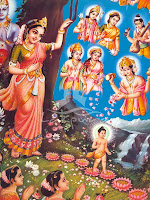
 
"O deva Bodhisat [Buddha-to-be], you have completely fulfilled the Ten Perfections, not with the desire to gain the bliss of Sakka [Michael or Thor, Lord of Lords (of Tavatimsa) and King of Kings (in the Realm of the Four Great Kings], of Mara (in Brahma's Retinue or 7th Heaven), of Brahma (in the Maha Brahma deva loka), or of a Universal Monarch (on Earth). You have fulfilled these perfections aspiring for all-knowing buddhahood in order to acquire for yourself freedom from the three worlds (spheres) as well as to liberate the multitudes of humans, devas ["shining ones"], and brahmas ["creative divinities," supremos].
 
"O deva Bodhisat, this is the most propitious time for you to become an omniscient awakened teacher! This is truly the right moment to become an omniscient awakened teacher! Therefore, take conception in the womb of the human world. And after attaining the supreme enlightenment of a teacher, liberate humans, devas, and brahmas from the round of suffering/rebirth (samsara) by teaching the Dharma of deathlessness: nirvana."

The Five Great Investigations
The deva Bodhisat Setaketu did not hastily consent to the supplication of the devas and brahmas who had come together from the 10,000 world-systems. Instead, in line with the tradition of previous bodhisattas, he made five great investigations:

(1) Is it the appropriate time for the appearance of a buddha?

(2) Is there an appropriate world (dipa, island, continent, planet, light) for the appearance of a buddha?

(3) Is there an appropriate land for the appearance of a buddha?

(4) Is there an appropriate family into which to be reborn (in a final existence)?

(5) Is it the appropriate span of life of a bodhisatta's mother. More

NOTE: With reference to the name of the Buddha-to-be as a deva, it was Santusita according to the chapter on Ratanasankama, Buddhavamsa which in Pali reads: Yada'ham tusite kaye santusito nama'ham tada. Also in the commentary to the Buddhavamsa and Jinalankara Tika the same name is mentioned. But in the exposition of the Pubbenivasa-katha, Veranja-kanda of the Parajika commentary, and in the exposition of the Bhayabherava Sutra of the Mulapanasa commentary, his name is given as Setaketu ["White Banner"]. Moreover, successive authors of Burmese chronicles or Buddhavamsas such as the Tathagata-Udana Dipani, Malalankara Vatthu, Jinatthapakasani, etc., give Setaketu as the name of the deva. Therefore, it has been explained by various teachers that Santusita was a common name derived from Tusita -- the name of the celestial abode (space world) -- whereas Setaketu was the proper name that specifically refers to the deva who would become Prince Siddhartha the Buddha Gautama.

Sunday, August 19, 2012

Real "fasting" for Ramadan

(The Brown Girl Chronicles) 
Moderate fasting help many paths to meditation
In light of Ramadan, now that Boudicaspeaks [almost as if the Bouddha, rather than Boudica, were speaking] has given you an overview of fasting beyond just no food or drink, I feel the need to discuss something that I strive to do any time of the year: 
  
Remembering GOD or zikr. However, for me the intensification of Remembering God is a different one this year. Many will say that fasting helps do this, but I have found it is all about first silencing the mind, and then intensifying that silence with the hunger. I mean, being hungry and tired surely brings about silence, but I still have yet to reach that truly meditative silence.
 
Silence is the Language of God,
All Else is Poor Translation” 
-Rumi
   
Persian mystic poet Rumi (Hossein Behzad)
No matter what state of spirituality I am in (and I do not believe in stages, but rather highs and lows), zikr reminds me of the source of spiritual refuge in this universe, regardless of what religion people classify themselves under.

Rather than trying to push forward our own views about right and wrong and the way people ought to live, it may just help to simply be silent, both physically and even mentally (and I can relate to mentally with my constantly wandering mind). More

Out beyond ideas of right and wrong,
There is a field. I’ll meet you there.
 
When the soul lies down in that grass,
The world is too full to talk about.
Ideas, language, even the phrase each other
Does not make any sense.
-Rumi (A Shot of Zen)

Friday, August 8, 2008

The Great Chronicle


Mahavamsa.org (click banner)
.
The Mahavamsa
.
The Mahavamsa, otherwise known as the “Great Chronicle,” is the single most important work of Sri Lankan origin (written in the Pali language). It describes the life and times of the people who forged the island nation, from the coming of Vijaya in 543 BCE to the reign of King Mahasena (334–361) (6th cent. BC to 4th cent. AD). A companion volume, the Culavamsa (“Lesser Chronicle”), covers the period from the 4th cent. to the British takeover in 1815.

The Mahavamsa is comprised of three parts, all written at different times in Sri Lankan history. The combined work, sometimes collectively referred to as the “Mahavamsa” provides an unbroken historical record of over two millennia and is considered the world’s longest continuous history. Buddhist monks of the Mahavihara maintained this Sri Lankan historical record starting from 3rd cent. B.C., somewhat similar to a modern-day diary. These records were combined and compiled into a single document in the 5th cent. CE by the great Buddhst elder Mahanama.

Earlier documents known as the “Dipavamsa” were also handed down and are much simpler with less information than the Mahavamsa, probably compiled relying on a text also used by Mahanama.

Overall, the Great Chronicle has over 200,000 words and about 960 pages. The first part (Chapters 1-37) is the Mahavamsa, the second part (Chapters 38-79) the Culavamsa Part 1, and the third and final part (Chapters 80-101) the Culavamsa Part 2.
.
The Lankavatara and Mahavamsa
Text by Dharma.org.ru

According to the same Sri Lanka (an ancient map of which is pictured at left, showing the island at the southern tip of India)record, in this land of Theravada practitioners, another Buddhist center named Abhayagiri Monastery (Vihara) was built by King Vattagamini Abhaya (B.C. 29-17), at the site of a Jain temple, in the town of Anuradhapura (XIX).
.
The Dipavamsa closes its record of the royal lineage of Sri Lanka with the description of how King Mahasena (A.D. 334-361) died under the influence of "the shameless, evil monks" of this Abhayagiri Monastery and had to receive consequences for a lifetime of evil conduct, and it warns readers to avoid such evil people as beings who are like snakes (XXII).

The Dipavamsa is considered to have been compiled between A.D. 361, the year King Mahasena died, and 429, the year Buddhaghosa [the most famous commentator who compiled perhaps the most famous meditation instruction manual, The Path of Purification], who had come from India to live near the Mahavihara [the "Great Monastery," pictured at left] in Anuradhapura, began writing a commentary on the disciplinary rules (Samanta-pasadika).

The other history book on Sri Lanka, the Mahavamsa, is said to have been compiled around the middle or end of the 5th cent. with the purpose of refining and supplementing the Dipavamsa.

According to this newer record, Mahayana studies and practice at Abhayagiri Monastery were conducted in a critical manner against the Theravada way of thinking represented by the practitioners at the Mahavihara. The latter hated the former so much that they tried removing the Mahayanists by means of political power. In the Mahavamsa "Mahayana" was called "Vetulyavada" (Vaipulya or Vitanda):

(1) King Voharikatissa (A.D. 269-291): "Suppressing the Vetulya-doctrine, and keeping heretics in check by his minister Kapila, he made the true doctrine to shine forth in glory" (XXXVI. 41).

(2) King Gothabhaya (Meghavannabhaya, A.D. 309-322): "He seized bhikkhus dwelling in Abhayagiri Monastery, 60 in number, who had turned to the Vetulya-doctrine [Mahayana Buddhism] and were like a thorn in the doctrine of the Buddha, and when he had excommunicated them, he banished them to the further coast" (XXXVI. 111,112).

In A.D. 410-411, Faxian, a Chinese monk, who had left China in 399 to seek Vinaya texts [books explaining the disciplinary rules and their origins], and who had made long travels by land, stayed in Sri Lanka for two years. He then returned by sea with Buddhist texts on board a ship, and back home wrote down a detailed record of the travels for himself (Taisho Tripitaka Vol. 51, No. 2085). According to this record, five thousand monks in Anuradhapura were abiding in the Abhayagiri Monastery, and for ninety days annually the Buddha's teeth were carried from the Temple of the Tooth to the Abhayagiri Monastery to receive people's offerings. In the Mahavihara Temple Complex three-thousand monks were abiding.

The English translator (dharma.org.ru) surmises that the Lankavatara Sutra was compiled at Abhayagiri Monastery some time between A.D. 411 (when Faxian left Lanka for home) and 435 (when Gunabhadra reached China, possibly bringing the Sanskrit text from Sri Lanka).... Read more
---
Sources: Buddhistravel.com (Theravada), Mahavamsa.org (photos), Dharma.org.ru






















