Wednesday, February 12, 2020

Slayer: the Executioner who went to Heaven

G.P. Malalasekera, Dictionary of Pali Proper Names (Pali Text Society vis palikanon.com/english) edited, updated, and expanded by Dhr. Seven, Pfc. Sandoval, Pat Macpherson, Wisdom Quarterly


I like killing for the king. It's a job.
Tambadāthika was a public executioner in ancient Rājagaha (the royal hill-rung capital, Rajgir).

He had copper colored teeth, tawny skin, and a body covered with scars. He wanted to join a gang of thieves, but for a long time, the ringleader refused to admit him -- on account of his inordinately cruel looks.

HE was eventually admitted, but when the band of thieves were captured, no one could be found who was willing to kill the large number (500) of them.

But the crowd demanded it and paid me to kill.
Well, that is to say, only one person could be found: Tambadathika agreed to execute his fellow thieves for a reward. He slew all his colleagues.

The backstabbing slayer was afterwards appointed "public executioner" for the kingdom and held the post for 55 years. When however he became too old to behead a man with a single blow, another man was appointed in his place.

The bad karma of killing for everyone involved: bad mental karma yielding bad results.

.
Tambadathika was deprived of the four perks to which he had for so many years been entitled:
  1. old clothes
  2. milk porridge made of ghee
  3. jasmine flowers, and
  4. perfumes.
Wise Sariputra was compassionate.
On the day he was deposed from office, he gave orders for milk porridge to be cooked. Then having bathed and decked himself out, he was about to eat when Ven. Sāriputra, out of compassion for him [giving him an opportunity to make great merit], appeared at his door.

Tambadathika invited the great disciple (thera) in and showed him great hospitality. When Sāriputta began his words of thanksgiving, his host could not concentrate his thoughts to listen and benefit from the ennobling teaching -- worried and full of misgivings by memories of his terrible past karma.

Yes, harm was done, but good can be done, too.
Sāriputta consoled him by representing to him that he had merely "carried out the king's orders." At the end of the sutra, Tambadāthika developed the qualities necessary for becoming a stream-winner (sotāpanna, the first stage of enlightenment) [which apparently he did not attain due to his muddled state of mind].

Tambadāthika accompanied Ven. Sariputra when he departed. But on his way back, he was gored to death by a mad cow. That cow was possessed by the same yakkhinī (yakshi = ogress) who had killed: Pukkusāti, Bāhīya of the Barkcloth, and Suppabuddha (DhA.ii.35; UdA.289). The Buddha declared that he had been reborn in the celestial Tusita heaven (DhA.ii.203ff). Source

The killer-crowd wants us to.
Tambadathika attained this very fortunate rebirth as a result of the great merit of showing hospitality and giving to the fully enlightened great disciple, who was in the habit of always entering and emerging from an exalted meditative attainment before receiving any gift, out of compassion for the giver, making that giver's offering much more meritorious, for karma depends not only on the state of mind of the giver but also the state of the receiver.

Death penalty: modern mass murderers called British public executioners last century.

Tuesday, February 11, 2020

Backstory: Bahiya's sudden enlightenment

G.P. Malalasekera, encyclopedia entry in Dictionary of Pali Proper Names (and PTS) derived from the Commentaries; Dhr. Seven, Pat Macpherson, Amber Larson (eds.), Wisdom Quarterly

But, Bahiya, this is the time for gathering alms.
Bāhiya Dārucīriya or "Bahiya of the Barkcloth" suddenly reached full enlightenment. How? The Commentaries (tika) give the backstory.

Bahiya was born in a householder's family Bāhiya (identified as Bhārukaccha in AP.ii.476), which led to his name.

He engaged in trade, voyaging by ship. Seven times he sailed down the Indus River and across the sea, and seven time returned home safely.

On his eighth trip, however, while on his way to the "Golden Land," Suvannabhūmi, he was shipwrecked. He saved his life by floating ashore on a plank of wood, reaching what he thought was an island which was in fact peninsular Suppāraka.

Having lost all his clothes, he made himself a bark garment (daruciriya), and went about, alms bowl in hand, in Suppāraka.

People, seeing his austere garment and struck by his ascetic demeanor, paid him great honor. They offered him costly robes and many other luxuries, and when he refused them his fame increased. Because of his bark garment, he was known as Dārucīriya.

He came to believe that he had attained full enlightenment, but a devata (a "shining one," said to be a brahma from the Pure Abodes or Suddhāvāsa, who had been a celibate companion in the supreme life during the time of Kassapa Buddha, according to the Commentary, MA.i.340), reading his thoughts and wishing him well, pointed out to him his error.

What is the road to nirvana? (NG)
The devata advised him to go see the Buddha in Sāvatthi. By the power of that devatā, Bāhiya reached Sāvatthi in one night, a distance of 120 leagues. But he was told that the Buddha was in the city on alms round.

Bāhiya followed him and pleaded to be taught something for gaining enlightenment. Twice he asked, and twice the Buddha refused, saying that it was not the time for teaching. But Bāhiya insisted, saying that life is uncertain and that the Buddha or he might pass away before it was time for teaching.

The Commentaries say that Bāhiya was too excited by his meeting with the Buddha and that the Buddha wished to give him time to regain his composure, hence his refusal.

But then the Buddha came to know of Bahiya's impending death and also of his potential (upanissaya) for full enlightenment. He was to attain in this very life due to his past karma (a pacchimabhavika).

Map showing ancient western trade routes serviced by this historical ancient Indian port. The gateway city of Bharakuccha is named on the map as Barigaza on the Gulf of Khambhat. The inhospitable mountains and deserts to the north of the Erythraean Sea suggests its importance in trade with ancient Axum, Egypt, Arabia, and the sea-land trade routes via the Tigris-Euphrates Valley and Ancient Rome. More
.
.
Oh yeah, first to reach...eat my dust, ladies!
The Buddha then taught him the optimal method of regarding all sen
se experiences -- namely, as mere (impersonal, disappointing, impermanent) experiences and nothing more.

Even as he listened, Bāhiya became an arhat, and the Buddha seeing this went on his way. Shortly after, Bāhiya was gored to death by a cow with a calf (like the story of Pukkusāti and the others*).

The Buddha on his way back, seeing Bahiya's body lying on the dung heap, directed the monastics to prepare it, cremate it, and erect a sacred burial mound (tope, thūpa, stupa) over the relics.

In the assembly he declared Bāhiya to be "foremost among those who instantly comprehend the truth" (khippābhiññānam) (A.i.24; Ud.i.10).

Let's climb this rock to practice or die trying.
Bāhiya's resolution to attain to this eminence was made in the time of Padumuttara Buddha when he heard the Buddha declare a wandering ascetic foremost in instantaneous comprehension.

In the time of Kassapa Buddha, when the Buddha's teachings were fading from the minds of humans, Bāhiya was one of seven wandering ascetics who climbed a massive rock and determined not to leave it until they had attained their goal of spiritual liberation.

Their leader became an arhat, and the second a non-returner (anāgāmī) -- passing away to rebirth in the Pure Abodes (Suddhāvāsa). The rest were reborn in this age as Pukkusāti, Kumāra Kassapa, Dabba-Mallaputta, Sabhiya, and Bāhiya.

Although Bāhiya had kept the precepts in previous rebirths, he had never given a bowl or a robe to a monk. For this reason the Buddha did not, at the end of his instruction, ordain Bahiya by saying "ehi bhikkhu pabbajā" to him.

The Buddha knew that Bāhiya had insufficient merit to obtain divine robes (from devas). Some say that he was once a brigand and had shot a non-teaching fully self-enlightened one (pacceka buddha) with an arrow and had taken possession of that pacceka buddha's alms bowl and robe.

Bāhiya was killed while searching for a proper robe to receive ordination (UdA.77ff.; AA.i.156ff.; DhA.ii.209ff.; Ap.ii.475ff).

*The violent cow that gored Bāhiya was the same one that murdered Pukkusāti, Tambadāthika the Public Executioner, and Suppabuddha (2). (It is said that the cow was possessed by a yakkhini or yakshi, a female-ogre or inimical spirit; see her story at DhA.ii.35f). Source

Monday, February 10, 2020

The Four Imponderables (sutra)

Dhr. Seven, Amber Larson (eds.), Acintita Sutra: "Imponderables" (AN 4.77); Giphy; derived from unsatisfactory original translation by Ven. Thanissaro (watmetta.org), Wisdom Quarterly
Rodin's Le Penseur ("The Thinker," one of a series of similar sculptures involved in the similarly imponderable Mandela Effect) sits pensively as if on a porcelain throne (norton.org).

.
My monkey mind only makes things worse.
"There are Four Imponderables on which it is wise not to dwell [1] as repeatedly doing so would bring about unhinged-madness and wearisome-vexation if one were to try. What are these four?
  1. The range of influence of a buddha is imponderable... [2]
  2. The range of influence of a person absorbed (jhana) in meditation… [3]
  3. The [mysterious] working out of the results of karma... [4]
  4. The origin [and so on] of the world is imponderable on which it is wise not to dwell as repeatedly doing so would bring about unhinged-madness and wearisome-vexation if one were to try.
"These are the Four Imponderables on which it is wise not to dwell as repeatedly doing so would bring about unhinged-madness and wearisome-vexation if one were to try."

1. Nor should they be speculated about because they are staggering, incomprehensible, and ultimately inconceivable]


2. Buddha-range: the range of powers a buddha develops as a result of becoming a supremely enlightened buddha, which is much more than an ordinary arhat (fully enlightened person) because arhats did not develop the Ten Perfections (paramis), so they do not possess the power to know all that a buddha know. Buddhas can teach effectively. They can establish a noble-sangha (community of enlightened disciples), and make the Dharma known in worlds darkened by ignorance. While everyone arhat's enlightenment and experience of nirvana is the same, their ability to make known the path is lacking. The ability to communicate the Dharma to others differs radically from individual to individual. There are countless arhats, shining ones (devas) and human beings, but precious few supreme (samma-sam) buddhas and pacceka (non-teaching) buddhas. Their range of influence is very great.

3. Jhana-range: the range of powers that one is able to manifest as a result of attaining and mastering the meditative absorptions (jhanas).

4. It should always be remembered that karma (intentional action of mind, speech, or body) is one thing, and its resultants (vipaka) and ripening fruits (phala) are quite another. Moreover, all actions impact how results are experienced, so there is hope no matter what one has done. More good now guarantees a better future, and the situation is never hopeless, even in the case of the five heinous acts. See the strange case of Angulimala the serial killer and saint. Even Buddhism's "Judas" figure, Devadatta, is not doomed forever, as his karma would suggest.

Sunday, February 9, 2020

The Fast Way to Enlightenment: Bahiya Sutra

John D. Ireland translation, Bahiya Sutra: "About Bahiya" (Verses of Uplift, Udana 1.10, PTS: Ud 6); G.P. Malalasekera; Pat Macpherson, Dhr. Seven, Amber Larson (eds.), Wisdom Quarterly

Samsara is long and wearisome. Wake up.
Thus have I heard. At one time the Blessed One (the Buddha) was staying near Savatthi in the Jeta Wood at Anathapindika's monastery.

At that time Bahiya of the Barkcloth (Bahiya Daruciriya) was living by the seashore at Supparaka. He was respected, revered, honored, venerated, given homage, and provided with the requisites of a wandering ascetic.

Now while he was in seclusion, this reflection arose in the mind of Bahiya of the Barkcloth: "Am I one of those in the world who are arhats (full enlightenment) or who have entered the path to arhatship?"

Then a deva who was a former blood relative of Bahiya of the Barkcloth understood that reflection in Bahiya's mind. Being compassionate and wishing to benefit him, he approached and said:

"Bahiya, you are neither an arhat nor have you entered the path to arhatship. You do not follow that practice whereby you could be an arhat or enter the path to arhatship."

"Then who in the world, including the devas, are arhats or have entered the path to arhatship?"

"There is, Bahiya, in a far country a town called Savatthi. There the Blessed One now lives who is the Arhat, the Fully Enlightened One. That venerable, Bahiya, is indeed an arhat and teaches Dharma for the realization of arhatship."

Bahiya of the Barkcloth, profoundly stirred by the words of that deva, then and there departed from Supparaka. Stopping only for one night everywhere (along the way), he made it to Savatthi where the Blessed One was staying in the Jeta Wood.

At that time a number of wandering ascetics were walking up and down in the open air. Bahiya of the Barkcloth approached them and said: "Where, reverend sirs, is the Blessed One now living, the Arhat, the Fully Enlightened One? We wish to see that venerable who is the Arhat, the Fully Enlightened One."

"The Blessed One, Bahiya, has gone for almsfood among the houses."

The Buddha had golden skin and a bright aura
Then Bahiya hurriedly left Jeta Wood. Entering Savatthi, he saw the Blessed One on alms round [with a company of monks] in Savatthi — pleasing, lovely to see, with serene senses and tranquil mind, attained to perfect poise and calm, controlled, a perfected one, watchful with restrained senses.

On seeing the Blessed One, Bahiya approached, fell down with his head at the Blessed One's feet, and said:

"Teach me Dharma, venerable sir! Teach me Dharma, Sugata, for my good and happiness for a long time."

Upon being spoken to in this way, the Buddha responded: "It is an unsuitable time, Bahiya. We have entered among the houses for almsfood."

But a second time Bahiya said: "It is difficult to know for certain, revered sir, how long the Blessed One will live or how long I will live. Teach me Dharma, venerable sir! Teach me Dharma, Sugata, so that it will be for my good and happiness for a long time!"

A second time the Buddha responded: "It is an unsuitable time, Bahiya. We have entered among the houses for almsfood."

But a third time Bahiya insisted: "It is difficult to know for certain... Teach me Dharma, Sugata, so that it will be for my good and happiness for a long time!"

[The Buddha relented and for the only time in his 45 year teaching career deviated from his schedule to instruct someone on alms round:] "Herein [here within this Teaching], Bahiya, train yourself thus:
  • 'In the seen will be merely what is seen;
  • in the heard will be merely what is heard;
  • in the sensed will be merely what is sensed;
  • in the cognized will be merely what is cognized.'
In the seen, Bahiya, let there be only the seen.
"In this way train yourself. When, Bahiya, for you in the seen is merely what is seen, in the heard merely what is heard, in the sensed merely what is sensed, in the cognized is merely what is cognized then, Bahiya, you will not be 'with that.'

"When, Bahiya, you are not 'with that' then you will not be 'in that.' When, Bahiya, you are not 'in that' then you will be neither here nor there (beyond) nor in between the two. Just this is the end of all suffering."

Now through this brief teaching of the Dharma of the Blessed One, the mind of Bahiya of the Barkcloth was immediately freed from the taints without grasping. Then the Buddha, having taught Bahiya with this brief instruction, went on his way.

Not long after the Blessed One's departure, a mother cow with a young calf mauled Bahiya of the Barkcloth and killed him. When the Blessed One, having walked in Savatthi, was departing the town and returning from alms round with a number of monastics, he saw Bahiya of the Barkcloth dead on the road.

A stupa for the Buddha, Topdara, Afghanistan
Seeing this he said to them: "Monastics, take Bahiya's body, put it on a litter, carry it away, cremate it, and make a sacred mound (stupa) for it. Your companion in the supreme life has passed away."

"Very well, revered sir," they replied to the Blessed One. And taking Bahiya's body, they put it on a litter, carried it away, cremated it, and made a sacred mound for it.

Then they returned to the Blessed One, bowed, sat respectfully to one side, and said: "Bahiya's body has been cremated, revered sir, and a sacred mound has been made for it. What is his destiny, what is his future birth?"

"Monastics, Bahiya of the Barkcloth was wise. He practiced according to Dharma and did not trouble me by disputing about Dharma. Monastics, Bahiya of the Barkcloth has attained final nirvana [final liberation following full enlightenment]."

Then, on realizing its significance, the Buddha pronounced this inspired utterance:

Where neither water nor earth
Nor fire nor air can gain a foothold,
There gleam no stars, no sun sheds light,
There shines no moon, yet there no darkness reigns.

When one, a sage, has come to know this
With certainty through one's own wisdom, one is
Freed from [worlds of] form and formlessness and is
Freed from pleasure and from pain.

This inspired utterance was spoken by the Blessed One, so I did hear.

Saturday, February 8, 2020

Oscars vs. Football: fave distraction? (video)

Rotten Tomatoes, Feb. 2, 2020; Ashley Wells, CC Liu, Sheldon S. (eds.), Wisdom Quarterly


2020 Oscar predictions: How to win the ballot
Hollywood's biggest moment has arrived: The Oscars! Whether playing along at home or in need of an extra edge for the office pool, Rotten Tomatoes has the lowdown and insider information on who's going home with the gold statues on Sunday night.

Ballot, ballot, get yer free ballot!
Host Mark Ellis is joined by Jacqueline Coley and Scott Mantz for a no-holds-barred discussion, as they give their predictions on all 24 categories. Will momentum carry the Korean best picture nominee Parasite all the way to the top? Or is 1917 or Once Upon a Time in Hollywood going to flex winning muscles? And just what the Fleck are Joker's chances?

From original shows and celebrity interviews to Tomatometer scores, RT is an insider’s guide to must-see movies and TV. Download printable 2020 Oscars ballot.
  • Actress in a Supporting Role: 4:44
  • Actor in a Supporting Role: 5:37
  • Original Screenplay: 7:01
  • Adapted Screenplay: 10:18
  • Animated Feature: 12:22
  • Documentary Feature: 14:01
  • International Feature Film: 15:17
  • Original Score: 16:45
  • Original Song: 17:50
  • Sound Editing: 20:00
  • Sound Mixing: 21:30
  • Makeup and Hairstyling: 21:44
  • Costume Design: 23:26
  • Cinematography: 24:38
  • Production Design: 25:31
  • Film Editing: 27:51
  • Visual Effects: 29:12
  • Documentary (Short Subject): 31:51
  • Short Film (Live Action): 32:35
  • Short Film (Animated): 32:55
  • Actor in a Leading Role: 34:18
  • Actress in a Leading Role: 36:37
  • Directing: 39:03
  • Best Picture: 42:44

Thailand: Soldier mass murderer kills 20+

BBC.com (bbc.co.uk); AP.org, Feb. 8, 2020; Pfc. Sandoval, Seth Auberon, Wisdom Quarterly


Tourist-friendly Thailand used to be a sweet "free land," uncolonized, full of Buddhist peace.

If only soldiers (militants) would meditate.
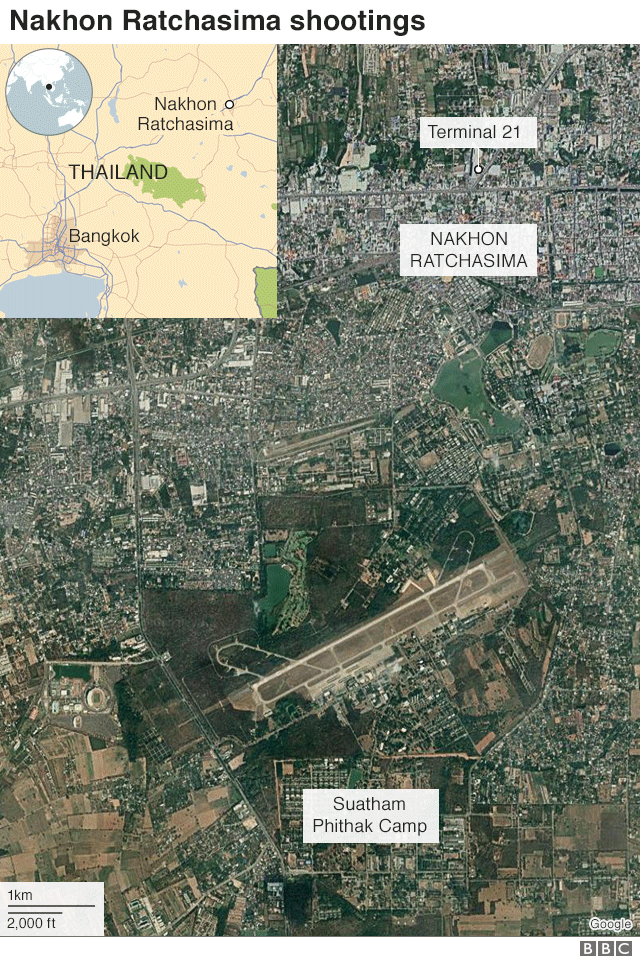
Thai soldier murders 20+, holes up in shopping mall: A soldier in the authoritarian Thai police state military, who is holed up in a popular shopping mall in northeastern Thailand, shot multiple people on Saturday, killing at least 20 and injuring 31 others... More
Suspect Thai soldier J. Thomma (BBC.co.uk).
Thai Army Junior Officer Jakraphanth Thomma, 20, [got tired and] killed his commanding officer before stealing weapons from a military camp.

He has murdered 20 people and injured dozens more [at least 31 according to the AP] in a gun rampage in the Thai city of Nakhon Ratchasima, Northeast Thailand (Isan).

I could've been a baby-monk and stayed good.
The suspect continued his attack in a shopping center, where he is now believed to be holed up, initially posting updates on his social media.
  • [Facebook censored those posts, quickly taking them down, and deprived the world of directly seeing what is happening so individuals could try to understand what was happeing and maybe why. What was the military planning that this soldier went berserk and rebelled against his commanding officer, whom he was indoctrinated to obey without question no matter the consequences? Mark Zuckerberg censors whatever government propagandists tell Facebook Corporation to censor if the social media giant -- with many embedded agents and assets from the FBI, CIA, NSA, NSC, and other Alphabet spy-agencies -- wants continued access to their capitalist markets and user databases].
Map"Security forces" [of the Thai police state] are in the complex and have "rescued" [aimed military grade assault rifles at scared civilians and told then to run to the sound of shooting] hundreds while searching for the gunman, with shots ringing out.

The military-gunman's motives remain unclear. More + VIDEO

    Friday, February 7, 2020

    2020 Conscious Life Expo, L.A. (Feb 7-10)

    Consciouslifeexpo.com; Ananda (Dharma Buddhist Meditation), Crystal Q., Wisdom Quarterly
    Dharma Buddhist Meditation has a visit planned: Feb. 8, 2020

    .
    We live in an evolving universe, in an orgasmic atomic dance of consciousness. Everything is transforming. The wise through history attempt to define the nature of reality.

    Many models have been devised. Most have fallen into the historical dustbin, with others barely hanging on. This generation is co-creating a new model. No, it is not all figured out and defined. But we know the elements to be included in a future model.


    It's LA's spiritual bazaar to spend money.
    The central intention of the Conscious Life Expo is to participate in the conscious co-creation of a new world based on new paradigms in science, spirituality, longevity, local and global community, relationship, and health and well-being.

    As we co-create a wholistic model through authentic self-expression, we participate in a powerful play of life and a passionate celebration of love.

    FULL INFO: consciouslifeexpo.com
    The Expo is a three-day gathering of individuals, tribes, and traditions celebrating evolving consciousness, a brainstorming session about who we are, what we're becoming, where we are, and where we're going. More

    How Pa Auk Sayadaw became enlightened

    Setti Wessels; Pa-Auk Center via Tusita Int'l; Dhr. Seven (ed.), Kalyani, Wisdom Quarterly


    I verified the Path in the Pali canon works.
    The most significant Theravada Buddhist teacher in the world today, certainly in Burma, is the most Venerable Bhaddanta Aciṇṇa.

    He is commonly referred to as “Venerable Pa-Auk Tawya Sayadaw” or less formally as simply “Pa-Auk Sayadaw.” He is the abbot and principal teacher at Pa-Auk Forest Monastery. Sayadaw is a Burmese title that means “respected teacher.”

    In 1934, Sayadaw was born in Leigh-Chaung Village, Hinthada Township, in the delta region about 100 miles north-west of the capital of Burma, Rangoon (now Yangon, Myanmar).

    In 1944, at age 10, he ordained as a novice monk (samanera) to train at his village monastery. During the next decade, he pursued the life of a typical scholar-novice, studying the texts of the Pali canon (including the Monastic Disciplinary Code, the Buddha's discourses, and the ultimate teachings or vinaya, suttas, and Abhidhamma) under various teachers. He passed the three Pali language exams while still a novice.

    Sayadaw-gyi is the greatest monk of our time! (wiki)
    In 1954, at age 20, Sayadaw received higher ordination as a monk (bhikkhu). He continued his study of the Pali canon under the guidance of learned elder monks.

    In 1956, he passed the prestigious Dhamma-acariya exam, the equivalent of earning a B.A. in Buddhist studies, which confers the title of “Dharma Teacher.”

    For the next eight years, Sayadaw continued his personal investigation and verification of the Dharma, travelling throughout Burma to learn from various well known teachers.

    In 1964, during his tenth “rains retreat” (vassa) as a fully ordained Buddhist monk, he turned his attention to intensifying his meditation practice and began the practice of “forest dwelling.” He continued his study of the Pali texts but in addition sought out practical instructions from the most revered meditation masters of those times.

    When one knows-and-sees dependent origination with a cleansed mind, one awakens.

    Burma is the large landmass on the right, renamed Myanmar by the military dictatorship.
    .
    High in the Himalayas on retreat with Sayadaw, India
    For the next 16 years, he made forest dwelling his primary practice. He spent these years in Mon state in the southern part of Burma -- three years in Mudon Township (south of Mawlamyine) and 13 years in Ye Township (about 100 miles down the coast). During this time, he lived a very simple life, devoting his time to intensive meditation and the study of the Pali canon.

    In 1981 Sayadaw received a message from the abbot of Pa-Auk Forest Monastery, Ven. Aggapañña. The abbot was dying and asked Ven. Acinna to look after the monastery. Five days later, Ven. Aggapañña passed away. As the new abbot of the monastery, Ven. Acinna became known as “Pa-Auk Tawya Sayadaw.”

    Although he oversaw the running of the monastery, Sayadaw would spend most of his time in seclusion, meditating in a bamboo hut in the upper forested area, which covered a deserted range of hills running along the base of the Taung Nyo mountain range. This area later came to be known as the Upper Monastery.

    Panoramic view of the Kullu Valley, India
    Since 1983, both monastics and laypeople have been coming to study meditation with Sayadaw.

    In the 1990s, foreign meditators began to arrive at the monastery. As Sayadaw’s reputation steadily grew, the Upper Monastery gradually expanded from a simple bamboo hut encampment and a handful of disciples to more than 250 meditation huts (kutis) in the thinning forest.


    The area included a large two-story meditation hall for men, a library (with office, computer room, and men’s dormitory on the lower levels), a clinic, a hospital, an almsgiving hall, a two-story refectory, a reception hall, and Sayadaw's dwelling.

    The Lower Monastery includes facilities of more than 180 meditator's huts, a large kitchen, a three-story meditation hall for women (with sleeping quarters on the ground floor), and a five-story dormitory.

    In March of 2007, there were more than 130 foreign monks, nuns, and lay practitioners residing at Pa-Auk Forest Monastery. During the annual three-month rains retreat, the total monastic population averages between 600-700.

    Together with laypeople, the monastery population sometimes tops 1,500 during festival times.

    In 1997 Sayadaw published his magnum opus, an enormous five-volume tome entitled The Practice that Leads to Nibbana (Nirvana), explaining the entire course of teaching in detail and supported by copious quotations from the Pali texts. It is available only in Burmese and Sinhalese.

    On January 4th, 1999, in public recognition of Sayadaw’s achievements, the government bestowed upon him the title Agga Maha Kammatthanacariya, which means “Greatly Respected Teacher of Meditation.”

    Sayadaw attained in a time of great tumult.
    Sayadaw now speaks fluent English and has lectured and led retreats outside of Burma since 1997. In December of 2006, he travelled to Sri Lanka to undertake a long-term personal retreat, staying in seclusion and suspending his teaching schedule throughout 2007.

    His teaching schedule for 2008 included a four-month retreat in the U.S., which ran from July to October, at the Forest Refuge in Barre, Massachusetts (Insight Meditation Society).
    .

    Sayadaw personally conducted a six-month intensive retreat at Pa-Auk Forest Monastery, Burma from January to June of 2010. After the retreat, Sayadaw joined the monks from Tusita Hermitage in Kullu, Himachal Pradesh, India for the Rains Retreat. At that time Sayadaw entered his own personal retreat for that three-month period. Source
    .


    Sayadaw’s teachings have been published in English, and several are highly regarded internationally. For he is both a highly esteemed Dhammā-acariya ("Dharma Teacher") and a personally accomplished Kammaṭṭhānā-acariya ("Meditation Teacher"). He has lectured and led retreats in the USA, Taiwan, China, Hong Kong, South Korea, Japan, Malaysia, Singapore, Indonesia, Thailand, Vietnam, Sri Lanka, Germany, and the UK.

    In 2009, Sayadaw was bestowed the title of Shwekyin Nikāya Rattaññūmahānāyaka [a great elder in the second largest monastic order in Burma] at the 17th Shwekyin Nikaya Saṅgha Conferencce in Burma. Original source
    He did. So can you. (PATM)
    At that time when one arrived at the forest nunnery and monastery, the Pa Auk Tawya Meditation Center, one started down a long muddy road. It had become a town, attracting Burmese devotees, ardent spiritual seekers from the West and Far East. It was vegetarian, egalitarian, with many nuns from different countries. It was open to everyone with an open hand. The gem was the great teacher, who could instruct someone from being unable to meditate to the final attainment of nirvana, spiritual awakening, complete enlightenment. We would not believe it had we not visited and seen it with our own eyes. Not only do people attain here, it happens in the West because Sayadaw and his accomplished teachers teach retreats beyond Burma.

    Bernie's Iowa; Trump's revenge (comedy)

    Seth Meyers (Late Show, 2/5/20); Seth Auberon, Pfc. Sandoval (eds.), Wisdom Quarterly


    Bernie beat Buttigieg, but Petey takes credit for DNC manipulation that screws Sanders
    (Late Night) "Politics makes strange bedfellows." We never thought we'd have anything good to say about Mittens Romney (his real name) or bad to say about Peter Booty-judge (not his real name).

    Senate GOP, except for Romney, acquits Trump in predicted removal from office trial
    If the DNC screws me again, I'll back Biden!
    Seth Meyers takes A Closer Look at Senate Republicans completing their cover-up of impeached (officially indicted) President Trump’s crimes today when they acquitted him after a removal from office/impeachment trial that banned witnesses because what he did wrong was not in question. The only thing in question was whether or not he should be removed from office for it. Watch Late Night with Seth Meyers weeknights 12:35/11:35c on NBC.


    Look at these two sell-outs. They're no better than Klobuchar or Clinton. I'm an Independent.