Showing posts with label sympathetic joy. Show all posts

Tuesday, November 5, 2024

Find Calm on Election Day: cute animals


Meditation + confidence = calm.
Calm.com and the San Diego Zoo are providing a peaceful diversion on Election Day with cute animal videos. 

Why it matters: It's important to find ways to de-stress and stay calm during election season, which won't be over on Nov. 5th.

Driving the news: Calm is hosting a live stream from the San Diego Zoo on Instagram so we can take a break from political doomscrolling to watch capybaras, meerkats, penguins, and other beautiful wildlife.

It starts at noon PT until polls close across the country.
Those humans are so full of fleas, ticks, and bugs because they won't clean each other.
.
Between the lines: Calm also has free "Election Season Support" content with breathing exercises, meditations and other mindfulness tools.

🐅 The intrigue: While he won't be featured on the livestream, a new tiger cub is out to play at the San Diego Zoo Safari Park.

Baby Barong, which means "king of spirits," stepped out of his den for the first time last week. Watch him here or visit him in person at the park this weekend. More

Thursday, July 20, 2023

Fix a dysregulated nervous system ASAP


What it FEELS like when our nervous system is dysregulated
(Crappy Childhood Fairy) Dec. 26, 2022. "Dysregulation" is a core symptom of Complex-PTSD, which usually occurs due to childhood traumas. If we had a rough childhood, we may have thought these symptoms were our fault -- personal failings that we're ashamed we haven't changed yet. Once we know the normal signs that childhood trauma has impacted us, we can drop the guilt and learn to adopt workarounds that help us re-regulate and resolve life's problems.

LETTERS: Want to submit a question for the Crappy Childhood Fairy to answer in a video? Keep it short, not too explicit, and relevant to this audience: bit.ly/3VVxqjm

How to reset a dysregulated nervous system (in under 60 seconds)

(Brain retraining program | re-origin®) Jan. 31, 2023. Stressful events from the past can have a lasting impact on the state of our nervous system in the present and even determine our reactions in the future.

Intense emotions, fearful thoughts, negative emotions, old (dysfunctional) behaviors, and past traumatic events can all build and contribute to a totally overwhelming stress load that can cause our nervous system to become "dysregulated" (out of control), causing us to feel constantly uneasy and on edge.

Visit re-origin.com/articles/reset... to read about this topic. Link to Intro to Limbic System Retraining Exercises | re-origin.com: Intro to Limbic System...®️.

This is a science-based brain retraining program to overcome chronic conditions and reclaim health and finally feel like ourselves again. Click here to access the first and second sections of this program for FREE. re-origin.com/free-trial Learn more at re-origin.com/program. Book a call with Ben: re-origin.com/book-a-call. Testimonials: re-origin.com/testimonials. Coaching: re-origin.com/group-coaching. Community: re-origin.com/our-community. FAQs: re-origin.com/faqs. Instagram.com/reorigin_of...

Too angry? Dr. Peter Attia explains way to stop it to podcaster Huberman

Wednesday, July 19, 2017

Divine Ways to Abide (The Brahma Viharas)

Chp. 3: The Four Divine Abidings
A professor of Theravada Buddhism once asked me, "Why is it assumed, at all the interfaith gatherings I attend, that God is the uniting factor among the religions? We should be concentrating on humanity rather than divinity."

When it is taken for granted that all people of faith worship a Supreme Creator and Sustainer God, Buddhists and Jains [two of the great Dharmic religions] are excluded.

Although Buddhists believe that there are gods [devas and brahmas] living in many celestial planes of existence, they do not ascribe original creative power to them [in fact, there are many brahmas, "supremes," wielding a power of creation or power over other's creations], nor do they believe that these gods have any influence over ultimate human liberation.
 
Belief in God cannot, therefore, provide common ground between Buddhists and religions such as Christianity, Islam, and Judaism. But can common ground be found in what religions say about humanity or about how we can work for a humane society? I believe the answer is "yes."
  • [In the past Buddhist and Catholic ecumenical gatherings have agreed on the centrality of the cause and cessation of suffering (dukkha) as common ground for discussion.]
What are the best ways to abide?
Buddhism speaks of four Brahma Viharas, the "Divine Abidings" or "Supreme Attitudes," and these qualities permeate the whole of Buddhist teaching. They are metta (loving kindness), karuna (compassion), mudita (sympathetic joy), and upekkha (equanimity).
 
Metta is boundless loving kindness radiated to all beings -- friends and enemies, strangers, the loved and unloved. It is an action-changing mental orientation.

Karuna is seen where people are so sensitive to the sufferings of others that they cannot rest until they act to relieve that suffering. To a greater degree than metta, karuna involves action or intercession.

Mudita is a quality that challenges me greatly. To show mudita is to feel joy over the successes of others, free of jealousy, envy, and bitterness, to actually celebrate or rejoice in their happiness and achievements even when we are facing tragedy ourselves.
 
Upekkha is equanimity but has often been misunderstood as indifference or lack of caring when it is actually looking on all things free of bias. It is not apathy in the face of pain, which would be the very antithesis of compassion.

Divine beings abide in mental peace.
Upekkha is really freedom from the self-centeredness that clouds understanding and destroys true discernment and wisdom. People who cultivate upekkha are no longer pulled this way and that by emotional reactions that have more to do with the ego than with actual concern for others. They can see right from wrong and can act with wisdom.
 
The Brahma Viharas speak to me of the ideals that should direct our lives -- the ideals that can create the kind of society any truly religious person yearns for.

Such a society would be one where loving kindness and compassion triumph over greed, where the success of one person does not mean the demeaning or exploitation of others, where rulers are guided by clear principles of right and wrong rather than hunger for praise or power.

These "Divine Abidings" -- or the way that Maha Brahma [the "Great Supremo," the first born in a world system based on its previous karma in former cycles of existence, being neither male nor female but beyond sexual dimorphism] spends its time -- give us a picture of merit and mundane good.

They touch the hope of all religions and can bring unity of purpose independent of a concept or idea of God.
 
So let compassion for the good of humanity be at the forefront of religious encounters. May those who come from the monotheistic traditions discover that they can share their hopes for a righteous society with their Buddhist neighbors.

May Buddhists find themselves united with their Catholic, Jain, Jewish, Christian, and Muslim friends in working for a world where loving kindness takes the place of greed. More

Friday, March 10, 2017

Science: How to give a woman an orgasm

IFLScience; Archives of Sexual Behavior; Ashley Wells, Dhr. Seven (eds.), Wisdom Quarterly
No one knows how I work down there; even I don't know! (Olga Zaretska/Shutterstock)
 
"Mind the gap" as they say in England.
Gaps, for the most part, are considered bad. The gender pay gap, for example, is notoriously awful. 

The “orgasm gap” -- the fact that men achieve orgasm a lot more [easily and] frequently than women during sexual frivolities -- is also decidedly rubbish.

And now science has waltzed in to save the day by trying to close it.
    Have a hang up(s) about sex? Let it go.
  • What does Buddhism say about sex for Buddhists? Avoid sexual misconduct, and it's fine. Sensual craving (trying to pain in life, real or perceived, by hedonistic means) can become an obsession, and it doesn't work. But most earthlings are predisposed to sensual desire, and there's a healthy way to approach it -- not guilt, shame, a sexist double-standard, repression, or acting out.
A group of researchers from Indiana University and Chapman University surveyed over 52,000 people  -- which included a range of straight, gay, lesbian, and bisexual men and women between the ages of 18 and 65.
 
They concluded that there is a “golden trio” of actions that will all-but-ensure female orgasm occurs. That, ladies and gentlemen, is deep kissing, genital stimulation, and oral sex.
 
The study, published in the Archives of Sexual Behavior, is a curious insight into just how bad the orgasm gap actually is. Of those surveyed, 95 percent of heterosexual men reported that they orgasmed during sexual acts with a partner, whereas just 65 percent of heterosexual women [reported that they] did.
 
Heterosexual women actually fared the worst of any category, with bisexual women reaching that hallowed state 66 percent of the time, rising to 86 percent for lesbian women. For bisexual men, the figure was 88 percent, and this rose to 89 percent for gay men.
 
I learned nothing from Vogue!
The aforementioned golden trio is the key way to close this orgasm gap -- and as the authors of the study note that education is key. Nearly 30 percent of men think that vaginal intercourse is the best way for women to achieve orgasm.

And as co-author Elisabeth Lloyd, a professor of biology at Indiana University, told The Guardian: “This couldn’t be further from the truth.”

Just 35 percent of heterosexual women orgasmed during vaginal sex alone. On the other hand, 80 percent of heterosexual women and 91 percent of lesbians orgasmed after the golden trio was applied.
 
The trio isn’t the only thing that helps. Writing in their study, the authors explain that women were more likely to orgasm if they were “more satisfied with their relationship, ask for what they want in bed, praise their partner for something they did in bed, call/email to tease about doing something sexual, wear sexy lingerie, try anal stimulation" and “act out fantasies.” More

Tuesday, June 24, 2014

The Joy of "Unselfish Joy" (Mudita)

Dhr. Seven, Amber Larson, Crystal Quintero (eds.), Wisdom Quarterly; Mudita (BPS.lk, Wheel #170/ATI), four essays by Nyanaponika Thera, Natasha Jackson, C.F. Knight, L.R. Oates
The Buddha overcoming near and distant "enemies" of meditation (David Adams/flickr)
 
Mudita: The Buddha's Teaching on Unselfish Joy
The Awakened One known as the Buddha said:
 
Herein [within this Dharma and Discipline], O meditators, a disciple's mind/heart pervades one quarter of the world with thoughts of unselfish joy, and so the second, and so the third, and so the fourth. And in this way the whole wide world, above, below, around, everywhere and equally, one continues to pervade with a heart/mind of unselfish joy, abundant, grown great, measureless, freed of hostility and ill-will.
 
Is Unselfish Joy Practicable?
Introduction by Ven. Nyanaponika Thera
Rainbow magic (Jasspierxia/flickr)
The virtue of mudita [unselfish joy, appreciative joy, altruistic joy, sympathetic joy, i.e., resonating or vibrating in line (in sympathy) with another person's happiness] is finding and experiencing joy in the happiness and success of others.

It has not received sufficient attention either in expositions of Buddhist ethics or in the meditative development of the Four Sublime States (Brahma Viharas), of which it is one. It was, therefore, thought desirable to compile this brief collection of essays and texts and to mention in this introduction a few supplementary features of this rather neglected subject.
 
It has been rightly stated that it is relatively easier for one to feel compassion or friendliness in situations that demand them than to cherish a spontaneous feeling of shared joy, outside of a narrow circle of one's family and friends.'
 
It mostly requires a deliberate effort to identify oneself with the joys and successes of others. Yet, the capacity of doing so has psychological roots in human nature that may be even deeper that one's compassionate responses.
 
There is firstly the fact that people do like to feel happy (with or without good reason) and would prefer it to the shared sadness of compassion [com-passion = con+passion = with+suffering]. Our gregarious nature (our "sociability") already gives us some familiarity with shared emotions and shared pleasure, though mostly on a much lower level than that of our present concern [which is the meditative development of this Sublime State].

There is in humans (and in some animals) more than an aggressive impulse, but also a natural bent towards mutual aid and cooperative action. There is the fact that happiness is infectious, and an unselfish joy can easily grow out of it. Children readily respond by their own smiles and happy mood to smiling faces and happiness around them. Though children can be quite jealous and envious at times, they also can visibly enjoy it when they have made a playmate happy with a small gift, and they are then quite pleased with themselves.

Let parents and educators wisely encourage this potential in children. Then this seed will quite naturally grow into a strong plant in the adolescent and the adult, maturing from impulsive and simple manifestations into the Sublime State of unselfish joy (mudita-brahma-vihara). Here too, the child may become "the parent of a person." Such education towards joy with others should chiefly be given in a practical way by gently making the child observe, appreciate, and enjoy the happiness and success of others, and by trying to create a little joy in others.

This can be aided by acquainting the child with examples of selfless lives and actions for the joyful admiration of them (and these, of course, go beyond Buddhist history to all human history). This feature should is present in Buddhist youth literature, schoolbooks, and as a theme in Buddhist magazines and adult literature.
 
Our negative impulses -- like aggression, envy, jealousy, and so on -- are often more in evidence than our positive tendencies toward communal service, mutual aid, unselfish joy, generous appreciation of the good qualities of others and so on. Yet, as all of these positive features are definitely found in humans (though rarely developed), it is realistic to appeal to them and activate and develop them by whatever means we can -- in our personal relationships, education, and so on.

"If it were impossible to cultivate the good, I would not tell you to do so," said the Buddha. This is, indeed, a positive, optimistic assurance.
 
If this potential for unselfish joy is widely and methodically encouraged and developed, starting with the Buddhist child (or any child) and continued with adults (individuals and Buddhist groups, including the Sangha), the seed for unselfish joy can grow into a strong plant that blossoms and finds fruition in other virtues, a kind of beneficial "chain reaction": magnanimity, tolerance, generosity (of heart and purse), friendliness, and compassion. When unselfish joy grows, many noxious weeds in the human heart will be displaced: jealousy and envy, ill will in various degrees and manifestations, cold-hearted indifference, miserliness, and so forth. Unselfish joy can, indeed, act as a powerful agent in releasing dormant forces of the good in the human heart.
 
We know very well how envy and jealousy (the chief opponents of unselfish joy) can poison our character as well as our social relationships on many levels of life. They can paralyze the productivity of society on governmental, professional, industrial, and commercial levels. Should we therefore not endeavor to cultivate their antidote: unselfish joy?
 
It will also vitalize and ennoble charity and social work. While compassion (karuna) is the inspiration for it, unselfish joy is its boon companion. It prevents compassionate action from being marred by a condescending or patronizing attitude, which often repels or hurts the recipient. Also, when active compassion and unselfish joy go together, it is less likely that works of service turn into droning routine performed with indifference.

Indifference, listlessness, boredom (all nuances of arati, famously regarded as one of Mara's daughters) are said to be the "distant enemies" of unselfish joy. They can be vanquished by the alliance of compassion and unselfish joy.
 
In one who gives and helps, the joy one finds in such action will enhance the blessings imparted by these wholesome deeds: Unselfishness will become more and more natural, and such ethical unselfishness will help one toward a better appreciation and the final realization of the Buddha's central doctrine of No-self (anatta, egolessness). One will also find it confirmed that one who is joyful in heart gains more easily the serenity of a concentrated mind. These are, indeed, great blessings which the cultivation of joy with others' happiness can bestow!

The compilation ends with a fifth "essay," an entry from the Path of Purification by the great Buddhist commentator Buddhaghosa on how to cultivate unselfish joy to the intensity of absorption. The 11 advantages listed at the end of this entry come not from merely trying to develop mudita but from actually attaining absorption through practicing it. It is the absorption (jhana) that powers the benefits.

Meditative Development of Unselfish Joy
Ven. Buddhaghosa (5th-century), excerpt from the Path of Purification (Visuddhimagga)
Meditation mudra (mysecretpsychiclife.com)
One who wishes to begin developing unselfish joy (mudita) meditation must avoid starting with a dearly beloved, neutral, or hostile person.
 
For it is not the mere fact that a person is dearly beloved that makes that person an immediate cause of developing unselfish joy, and still less so a neutral or hostile person. A person of the opposite sex or anyone who has passed away is also unsuitable subjects in this form of meditation [the former being likely to inspire lust, the latter being impossible to achieve absorption through].
  • [The only purpose of selecting a proper person as subject is to quickly gain mastery of this form of meditation; thereafter, one may it expand it to anyone. Rather than getting bogged down here, bear in mind that "Perfection is the enemy of good."]
A very close friend, however, can be a suitable subject -- one who is called in the Commentaries a close companion, for that person is always in a joyous mood, laughs first and speaks afterwards. That person should be the first to be pervaded with unselfish joy [sympathetic joy, joy in that person's joy, happiness in his or her happiness]. Or on seeing or hearing about a dear person being happy, cheerful, and joyous, unselfish joy can be aroused in this way: "This being, truly, is happy! How good, how excellent!" For this is what is referred to in the Vibhanga: "And how does a meditator dwell pervading one direction with heart imbued with unselfish joy? Just as one would be joyful on seeing a dear and beloved person, so one pervades all beings with unselfish joy" (Vib. 274).
 
But if this affectionate friend or dear person was happy in the past but is now unlucky and unfortunate, then unselfish joy can still be aroused by remembering that person's past happiness, or by anticipating that the person will be happy and successful again in the future.
 
Having thus aroused unselfish joy with respect to a dear person, the meditator can then direct it towards a neutral one, and after that towards a hostile one.
 
But if resentment towards the hostile one arises, one should make it subside in the same way as described under the exposition of loving-kindness (metta).
 
One should then break down the barriers by means of impartiality (upekkha) towards the four, that is, towards these three and oneself. And by cultivating the sign (nimitta, counterpart sign, after-image, which is obtained by deep concentration), developing and repeatedly practicing it, one should increase the absorption (jhana) to triple or (according to the Abhidhamma division) quadruple absorption.
 
Next, the versatility (in this meditation) should be understood in the same way as stated under loving-kindness. It consists of:
(a) Unspecified pervasion in these five ways:
"May all beings... all breathing things... all creatures... all persons... all those who have a personality be free from enmity, affliction, and anxiety, and live happily!"
(b) Specified pervasion in these seven ways:
"May all women... all men... all Noble Ones [ariyans, those who have attained any of the noble states]... all non Noble Ones... all devas... all human beings... all those in states of misery (in lower worlds) be free from enmity, and so on."
(c) Directional pervasion in these ten ways:
"May all beings (all breathing things, etc.; all women, etc.) in the eastern direction... in the western direction... northern... southern direction... in the intermediate eastern, western, northern, and southern direction... in the downward direction... in the upward direction be free from enmity, and so on."
This versatility is successful only in one whose mind has reached absorption (jhana).
 
When this meditator develops the mind-deliverance of unselfish joy through any of these kinds of absorption, one obtains these 11 advantages: One sleeps in comfort, wakes in comfort, and dreams no upsetting dreams, one is dear to human beings, dear to non-human beings, devas guard one, fire and poison and weapons do not affect one, one's mind is easily concentrated, the expression of one's face is serene, one dies unconfused, if one [with insight] penetrates no higher one will be reborn in the Brahma World (A v 342). More
  • The Jhanas in Theravada Buddhist Meditation
  • Mental States (cetasikas) in Buddhism: In the 89 types of consciousness enumerated in the first chapter, 52 mental states arise in varying degrees. There are seven concomitants common to every [kind of] consciousness. There are six others that may or may not arise in each and every consciousness. They are termed pakinnakā ("particulars"). All of these 13 are designated aññasamāna, a technical term: Añña means "other," samana means "common." Sobhanas (good), when compared with asobhanas (harmful), are called añña, "other," being of the opposite category. So are the asobhanas in contradistinction to sobhanas.

Thursday, February 21, 2013

We are "Enough :-)" (DharmaComics)

Seven, Wisdom Quarterly; Leah, DharmaComics.com/Enough
MORE
 
What if I am not enough? That is distressing. What if I am already enough? That's mind and heart-boggling.

I'd better reflect but reflect in a way that uplifts and liberates. Sometimes some unsavory things are good to see. But mostly we spend enough time doing that.

We give no time to celebrating, to reveling, to enjoying with gratitude and a sense of accomplishment.

There is so much to appreciate -- to have appreciative joy (mudita) for! Do it, do it, say it, say it: I'm ENOUGH! You're enough! We're enough!
 
Buddha's teaching on Unselfish JOY
Buddhist Publication Society (Wheel 170)
[The Buddha:] "O, monastics! Here [in this Dharma and Discipline], disciples let mind [heart] pervade one quarter of the cosmos with thoughts [feelings] of unselfish joy -- so the second, so the third, and so the fourth quarter. Thus the whole wide world -- above, below, around, everywhere and equally -- one continues to pervade with a heart of unselfish joy, abundant, grown great, grown measureless, without hostility or ill-will." More

Thursday, July 21, 2011

Path to Enlightenment: No One Strives Alone

Wisdom Quarterly
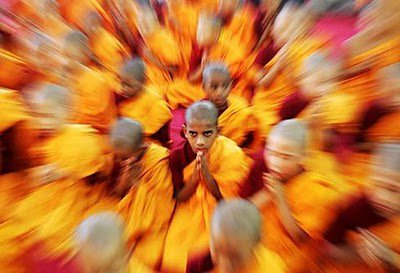
Young Buddhist novice studies and strives for enlightenment with an entire support network provided free by others (HimalayaCrafts/Facebook)

A bodhisattva is an individual who vows to forego final emancipation until others also find the way to freedom. It is a wonderful -- if often exaggerated, misunderstood, and undermined -- ideal reflecting how we are all interconnected and interdependent.

Everyone must indeed do his/her own striving, but no one need do it alone. Even in the forest, on his quest, Siddhartha could not do it alone. He had a great deal of help, encouragement, and support. Most of this is implicit or ignored because we (as Americans) are "rugged individualists" who prefer stories of remarkable survival, struggle, and success in the face of all odds.
  • But his yogi-gurus Alara Kalama and Uddaka Ramaputra helped
  • Earth-devas (pictured above) helped when they said they would feed the Bodhisattva through his pores if he continued to fast
  • The Five Ascetics (who were his companions on the path of penance and austerities) helped
  • The laywoman Sujata (who fed him a nutritious meal that caused him to realize that the body is not an impediment but a potential boon on the way to enlightenment) helped
  • King Bimbisara (who promised protection and asked him to come back when he accomplished his goal) helped
  • His wife Princess Yasodhara (who watched their son and confidently knew he was out for the good of everyone) helped
  • His family (King Suddhodana, Queen Mahaprajapati, and Maya Devi looking down from the Space World of the Thirty-Three) helped
  • Sakka, King of the Devas of the World of the Thirty-Three (who might have been prompted by Maya Devi to look after the good Siddhartha on his quest) helped protect and later, along with Brahma Sahampati, asked the Buddha to teach the liberating Dharma to the world...
These and perhaps many other beings helped the Bodhisattva until he became the Buddha.

Later bodhisattvas, inspired by such stories of enlightened self-interest manifesting as "sacrifice" for the benefit of others (and therefore of all), also vowed to help save all living beings.


Ksitigarbha Bodhisattva mantra: Om Ba La Mo Ling To Ning Swaha

One excellent example is Ksitigarbha ("Earth-Treasury") Bodhisattva, who vowed:

"Unless the hells become empty, I vow not to attain buddhahood. Until all have achieved ultimate liberation, I shall not consider my enlightenment full..."

There are many "hells" (narakas) in Buddhist cosmology, of incredible duration and unimaginable misery, but none actually eternal.

For this reason, in the Mahayana Buddhist tradition, he is regarded as "caretaker of the world" until the return of the future buddha Maitreya, whose birth is anticipated in 5.7 billion years. (Such is the reckoning of time by the historical Buddha in India, speaking of aeons (kalpas) and the long stretches of time between short periods when the liberating Dharma exists in the world and is able to be learned and practiced.

The wonderful thing, then, is that we are not alone in our quest, our struggle and striving. Others around us -- even apparent, unrelated strangers whom we are connected to -- are helping and ready to help. Beneficial unseen beings are also helping. And we ourselves, often without realizing it, are helping and encouraging others.

Sunday, July 3, 2011

Finding happiness from Buddhist point of view

Jerome Ryan (mountainsoftravelphotos.com) and Wisdom Quarterly
Dieter Glogowski is a contemporary Tibet and Nepal photographer. His photos are excellent, and the quotes he chooses to accompany them are short and thought-provoking (mountainsoftravelphotos.com).

The root teachings of Buddhism are the Four Noble Truths, which state that there is disappointment and we can rise above it by a path of practice that reduces our attachment and clinging to things, people, and states. There are Buddhist resources to assist in increasing joy.

At war with China? Ever notice how much the most famous Buddhist, the 14th Dalai Lama, laughs? He laughs in spite of all difficulties. If we can learn to do that, it will serve the world well. Smile, and the whole world smiles.

Wisdom (the 14th Dalai Lama): It is important to know that there are three kinds of wisdom: / Wisdom resulting from listening, / wisdom resulting from reflection, and / wisdom resulting from meditation.

Consciousness (Dhammapada): We are what we think / All we are arises from our thoughts / With our thoughts we create the world.

Compassion (Mother Teresa): Always try to act in a way that people are happy to have met you.

Equanimity (Sutta Nipata): We exchange the breath of air with the rain forests. We drink the very water that flows into the ocean. Water and air are integral parts of our lives. And we are part of the whole world. We realize that we depend on each other, that we are related to each other. Then we will deal with all of nature carefully, we are part of it.

Love (Phil Bosmans): A flower needs sun to become a flower. / A human being needs love to become a human being.

Impermanence (14th Dalai Lama): It is my firm conviction that the power of the gun barrel is of limited time. / But the power of truth will increase more and more with time.

Mindfulness (Thich Nhat Hanh): Real life is experienced here and now. The past has already gone; the future has not yet come. Only in the present moment can we truly live life.

Meditation (Sogyal Rinpoche): The gift of learning to meditate is the greatest gift you can give yourself in this life. For it is only through meditation that you can undertake the journey to discover your true nature, and so find the stability and confidence you will need to live, and die, well; meditation is the road to enlightenment.

Sunday, March 6, 2011

Film proves We Are all connected ("I Am")

Rob Sidon LA Yoga (March 2011)

"I Am" is Hollywood humorist-producer-writer-director Tom Shadyac's most passionate project after working with Buddhist Jim Carrey.

LA YOGA: How would you describe the film?

TOM SHADYAC: My hope is that "I Am" is a window into Truth, a glimpse into the miracle, the mystery and magic of who we really are, and of the basic nature of the connection and unity of all things. In a way, I think of "I Am" as the ultimate reality show.

LA YOGA: You made the film to answer two fundamental questions.

TOM: Yes: What's wrong with the world? And what can we do about it? And when I say what's wrong with the world, I didn't want to hear the usual answers like war, hunger, poverty, the environmental crisis, or even greed.

These to me are not the problem; they are symptoms of a larger endemic problem. In "I Am," I wanted to talk about the root cause of the ills of the world, attempt to identify it, because if there is a common cause and we can talk about it, air it out in the public forum, then we have a chance to solve it.

Until then, we are like doctors who keep prescribing medication to treat our collective nausea when what we need is the wisdom to ask ourselves what we're ingesting in the first place that is making us all sick.

LA YOGA: One reason I enjoyed the film is that its underlying message is so positive -- that human beings are not hardwired as selfish creatures. You turn to scientists to explain.

TOM: Well, I was raised Catholic, so this is not exactly the message I was taught growing up. I was told I was born bad, burdened with something called "original sin," and that all mankind was similarly infected.

It was a revelation to me that for tens of thousands of years, indigenous cultures taught a very different story about our inherent goodness, which is being backed by the sciences now.

We are discovering a plethora of evidence about our hard wiring for connection and compassion, from the vagus nerve, which releases oxytocin [the love and empathy hormone] at simply witnessing a compassionate act, to the mirror neurons, which cause us to literally feel another person's pain and thereby empathize.

Darwin himself, who has been grossly misunderstood to believe exclusively in our competitiveness (hence the famous saying "survival of the fittest"), actually observed and noted that humankind's real power comes in its ability to perform complex tasks together -- that is, to sympathize and cooperate.

LA YOGA: To exemplify the essence of "I Am," you set up an experiment. Can you explain it and say why it's important?

TOM: The experiment in the movie's just a demonstration and not scientific at all, but it does suggest something that is incredible if it's true -- that our thoughts and emotions affect the living systems around us.

  • See this month's free issue of LA Yoga magazine for the entire sit down interview by Rob Sidon.

"I Am" is a prismatic and probing exploration of our world, what's wrong with it, and what we can do to make it better. It represents Tom Shadyac's first foray into non-fiction following a comedy directing career in Hollywood with such films as "Ace Ventura," "Liar Liar," "Bruce Almighty," and many more. "I Am" follows the filmmaker after a cycling accident left him incapacitated, possibly for good. He emerged a changed man. Disillusioned with life on Hollywood's A-list, he sold his house and moved into a humble community, starting life anew. Armed with nothing but curiosity and a camera crew, Shadyac embarks on a journey to discover how we can all improve our lives. Appearing as character, commentator, guide, and even guinea pig, Shadyac meets with a variety of thinkers and doers -- remarkable luminaries from the worlds of science, philosophy, and faith -- including Noam Chomsky, Howard Zinn, Archbishop Desmond Tutu, David Suzuki, Lynne McTaggart, Ray Anderson, John Francis, Coleman Barks, and Marc Ian Barasch. An irrepressible Everyman who asks many questions but offers no easy answers, he takes the audience to places it has never been before, and presents even familiar phenomena in radically new ways.


LAYogaMagazine.com

Monday, May 31, 2010

Symptoms of Inner-Peace

Text by Saskia Davis (Wildmind.com)

Be on the lookout for symptoms of inner-peace. The hearts of a great many have already been exposed to inner peace, and it is possible that people everywhere could come down with it in epidemic proportions. This could pose a serious threat to what has, up to now, been a fairly stable condition of conflict in the world.

Signs and Symptoms

  • A tendency to think and act spontaneously rather than on fears based on past experiences
  • An unmistakable ability to enjoy each moment
  • A loss of interest in judging other people
  • A loss of interest in judging self
  • A loss of interest in interpreting the actions of others
  • A loss of interest in conflict
  • A loss of the ability to worry (a very serious symptom)
  • Frequent, overwhelming episodes of appreciation
  • Contented feelings of connectedness with others and nature
  • Frequent attacks of smiling
  • An increasing tendency to let things happen rather than make them happen
  • An increased susceptibility to the love extended by others as well as the uncontrollable urge to extend it

WARNING: If you have some or all of the above symptoms, please be advised that your condition of inner-peace may be so far advanced as to not be curable. If you are exposed to anyone exhibiting any of these symptoms, remain exposed. [It's good for you].

Monday, December 7, 2009

Saturday, August 15, 2009

Delight in Someone Else's Misery

Schadenfreude /ˈʃɑːdənfrɔɪdə/ is "pleasure derived from the misfortunes of others" [Ref]. It is the opposite of the Buddhist concept of mudita: "happiness in others' happiness" or "appreciative joy at the success and good fortune of others."
  • IMAGE: "Curses, foiled again!" audience pleasure at a villain's pain
This German loanword may also be defined as "a malicious satisfaction in the misfortunes of others" or "largely unanticipated delight in the suffering of another which is cognized as trivial and/or appropriate."

Antonyms
The Buddhist concept of mudita -- "empathy," "sympathetic joy," or "happiness in another's good fortune" -- is cited as an antonym of schadenfreude [Ref 1]. Alternatively envy (German, Gluckschmerz), or "unhappiness at another's good fortune," could be considered schadenfreude's counterpart. Other antonyms such as empathy, pity, and compassion are "unhappiness at another's misfortune."