Showing posts with label easy steps. Show all posts

Saturday, June 27, 2026

Alcohol was ruining my life. How I quit


Why alcohol is ruining our lives (Jordan Peterson, Andrew Huberman, Mike Tyson)
(Sober Leon) Today's video shares some motivation to end alcoholism from some of the most influential people in the world. If quitting alcohol makes me a quitters, then I quit! I'd rather be clear, detoxed, and sober. If anyone is trying to get sober and needs some motivation, this video is a must watch. #alcoholfree #sober #stopdrinking
  • soberclear.com
  • soberclear.com/dark-contr...
  • Get INSTANT access to BRAND NEW “Alcohol Control 🍺 Video Training” (2023)
  • 📞 Book a roadmap call to see if the Soberclear Program and First Principles Thinking could be a good match: soberclear.com/bookcall-ytd 🎭
  • SOBERCLEAR PROGRAM: See if REFRAMING method is the right thing to try. (Spots are limited): soberclear.com/soberclear...
  • MEN ONLY: First Principles Thinking to control alcohol: soberclear.com #sober #stopdrinking #alcoholfree
  • TIMESTAMPS: 00:00 - The truth about alcohol 02:15 - Andrew Huberman & James Hetfield 02:37 - David Harbour 1 02:53 - Bill Burr 03:14 - Nikki Glaser 03:41 - Ben Affleck 1 04:09 - Joe Rogan & Malcolm Gladwell 04:47 - David Nutt 05:29 - Jordan Peterson & Theo Von 05:50 - Joe Rogan & Malcolm Gladwell 2 06:22 - Daniel Radcliffe 06:52 - Ben Affleck 2 07:12 - Daniel Radcliffe 2 07:25 - Jordan Peterson 2 08:22 - Robert Lowe 08:48 - Brad Pitt 09:28 - James Hethfield 2 10:13 - Mike Tyson 10:48 - Janey Lee Grace 11:48 - Scott Strode 12:38 - Jordan Peterson 3 13:15 - Andrew Huberman 2 13:54 - Paul Churchill 15:06 - Anthony Hopkins 16:02 - Bradley Cooper 16:28 - Patrick Bet David 17:02 - David Harbour 2 17:45 - Ian McShane 18:06 - Ben Affleck 2
  • 🗣 Interact with me on a personal level! Facebook group: https://www.facebook.com/groups/43652...
  • 🎁 Check out the SOBERCLEAR website
  • 🚨If this video helped, share it with friend to benefit as well :)
  • Sober Leon, May 10, 2023; Seth Auberon, Pfc. Sandoval, CC Liu (eds.), Wisdom Quarterly

Wednesday, April 2, 2025

'Sure, I'll Join Your Cult' (Maria Bamford)

  • Get to know Maria Bamford in nine jokes about beauty standards in L.A., having a workplace nemesis and going to therapy as a child.
Sure, I'll Join Your Cult: A Memoir of Mental Illness and the Quest to Belong Anywhere

Sure, I'll Join Your Cult (Audible Audiobook)
Unabridged. Stand-up comedian and author Maria Bamford narrates her Simon & Schuster publication, which has garnered 4.4 out of 5 stars with 994 ratings. It is a Goodreads Choice Award nominee.

From “weird, scary, ingenious” (The New York Times) stand-up comedian Maria Bamford, an instant New York Times bestselling, brutally honest, and “laugh-out-loud funny” (Jennette McCurdy, #1 New York Times bestselling author) memoir about show business, mental health, and the comfort of rigid belief systems — from Dale Carnegie’s How to Win Friends and Influence People, to Richard Simmons, to 12-step programs.

This is Not Happening: Psych Ward

Maria Bamford is a comedian’s comedian (an outsider among outsiders) and has always fought to find a place to belong. From struggling with an eating disorder as a child of the 1980s, to navigating a career in the arts (and medical debt and psychiatric institutionalization), she has tried just about every method possible to not only be a part of the world, but to want to be a part of it.


I'd have to be crazy to be a conservative.
In Bamford’s “trademark blend of disarming intimacy and dark whimsy” (Publishers Weekly), Sure, I’ll Join Your Cult brings us on a quest to participate in something. With sincerity and transparency, she recounts every anonymous fellowship she has joined (including but not limited to: Debtors Anonymous, Sex and Love Addicts Anonymous, and Overeaters Anonymous), every hypomanic episode (from worrying about selling out under capitalism to enforcing union rules on her Netflix TV show set to protect her health), and every easy 1-to-3-step recipe for fudge in between.

(Let's get inside the artist's head) Maria Bamford on cults

Packed with “Bamford’s brilliance, relentless humor, and insatiable instinct for survival (Library Journal), this memoir explores what it means to keep going, and to be a member of society (or any group she’s invited to) despite not being very good at it.

In turn, she hopes to transform isolating experiences into comedy that will make you feel less alone (without turning into a cult following). NOTE: Purchase of this title includes accompanying PDF in your Audible Library along with the audio. Sure, I'll Join Your Cult
  • Maria Bamford, Amazon.com; Comedy Central; Laugh Society; Ashley Wells, Sheldon S. (eds.), Wisdom Quarterly

Friday, August 9, 2024

Machine used to build Egyptian pyramid

VIDEO: Long-lost ancient Egyptian pyramid building tech may have just been unearthed
.
Long-lost ancient Egyptian pyramid building tech may have just been unearthed
Ancient Step Pyramid of Djoser, Egypt (iStock)
(Indy 100) Egypt’s Great Pyramids have been a source of wonder and mystery for centuries. Now, recent research has shed a dazzling light on the secrets of how they were created and how this involved the impressive use of water.

Now, a new study has suggested that at least one of the great structures was built using equipment that was far more sophisticated than once thought.

The paper, published in the journal PLOS ONE on Aug. 5, 2024, posits that the iconic 4,500-year-old Step Pyramid of Djoser [once thought to be the oldest pyramid in the world] was erected with the help of a unique hydraulic lift system.

In the past, experts believed that the Step Pyramid of Djoser was most likely constructed using a network of ramps and levers.

However, the latest analysis, led by Xavier Landreau of France’s CEA Paleotechnic Institute, suggests that the ancient Egyptians channeled nearby canals to power weight-bearing lifts.

The construction of the Pyramid of Djoser, also known as the Step Pyramid, has defied explanation for centuries, with suggestions of advanced ET technology, sound levitation, pouring concrete to form blocks in place. Was it all hydraulic?

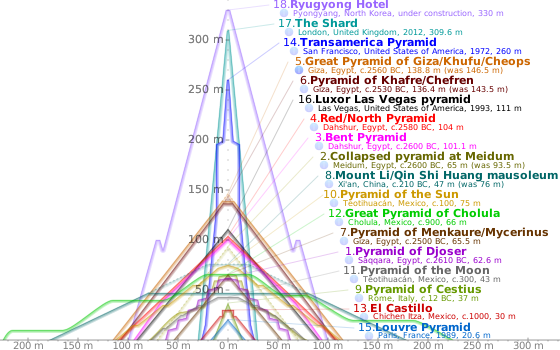
Comparison of pyramids (wikimedia.org)
The study suggests that water was enabled to flow into two shafts, located in the pyramid itself, which were used to help raise and lower a float used to carry the heavy stone building blocks.

“Ancient Egyptians are famous for their pioneering and mastery of hydraulics through canals for irrigation purposes and barges to transport huge stones,” the researchers wrote. More:

Wednesday, June 19, 2024

TikTok: FREE wi-fi DIY? Nicki Minaj clone?

  • Main components, splitter and solder board
    Make your own free Wi-Fi "hotspot" for to link cell phone to the internet? (See Minute 30:40). In a minute of building, after gathering these simple ingredients, it may be possible. Everything about the setup is easy except possibly getting the tiny and super simple motherboard (photo at right) to solder the phone cable wires to at the very beginning of the instructional video. Is it a transistor or just an easier way to connect each of the five wires (black, white, blue, green, and red) from the phone cable?
  • 2-way cable splitter (MasterPlus MA-2102) 5-2400 MHz All Ports Power Pass
  • two small lengths of coated copper wire (red and orange)
  • Movistar Telefonica 5100114 97844 8
  • copper wire coiled around a pen
  • phone charging/data transfer cable
  • glue
  • solder
  • wire stripper
  • lighter
  • zip tie
  • then just follow the assembly video at Min. 30:41.
Nicki Minaj a clone of Cambodian Buddhist Princess Neaky Moneang?
Is rap singer and pop idol Nicki Minaj a physical clone of Camboian Princess Neaky Moneag?
Taylor Swift clone of Satanist Zeena [LaVey]?

Anton LaVey's daughter was a pop singer, too.
Covertly lesbian-leaning bisexual rapper and pop idol Nicki Mina (who's married to beard Kenneth Petty) is an oddly Asiatic Black woman said to be from an island in the Americas. She has a demonic entity or spirit who possesses her, a sexually vulgar and aggressive male alter ego she refers to as "Roman," which may explain her sexuality. Could she be the product of the DNA transfer (cloning) of Cambodian Buddhist Princess Neak Moneang (1943-2019)?

We look nothing alike. I'm a TN Christian.
It would not surprise us to find that such a program exists, just as other possessed oddball performers like Katy Perry, Beyonce, Doja Cat, SZA, and the super successful Taylor Swift might be channeled entities, "walk ins," invited to possess a singer and present (dancing, speaking, behaving as a diva rather than human would).

In the case of Taylor "Nazi Barbie" Swift, the connection to Satanist Anton LaVey's blonde daughter Zeena is striking, and joke conspiracy theory is made out of that striking resemblance, as if Taylor were Zeena. It is more likely that Taylor is a clone offspring of an older Zeena, a transition (of spirit and or DNA) taking place in or around 1989). Was Taylor born (birthed) for this role in corporate rock, pop, and country music?

Tuesday, March 28, 2023

Awaken by self-power or other-power?

Alan Watts; Dhr. Seven, Sayalay, Ashley Wells (eds.), Wisdom Quarterly Wiki edit
In the decadent Kali Yuga, be reborn in Amida's "Western Paradise" instead of bodhi.

Jiriki (self-power) versus tariki (other-power), by our will or another's will, that is the question.

To love ALL means to love ourselves, too.
Can we possibly attain selflessness (anatta, emptiness, the liberating realization that all things are impersonal) by self-will? Can we attain wisdom by our own ignorant efforts of trial and error?

It seems impossible. Or in any case, it seemed impossible until someone did it. Furtively scrambling in the dark, life after life, striving for complete liberation, someone came upon the ultimate truth and was liberated then pointed out the way for others to awaken themselves.

No one saves us but ourselves;
No one can and no one may;
We ourselves must walk the Path;
Buddhas only point the way.

Since then others have awakened to complete wisdom, having been shown the way. These beings are called disciples or followers of buddhas, particularly of a special kind of buddha, the supremely self-enlightened, supremely self-awakened (samma-sam-buddha), who managed to do it on their own over many, many lifetimes.

They weren't really on their own at all. They had a great deal of help all along the way, but as for the final awakening, that was not done under a teacher -- as no enlightened teacher exists when a buddha awakens.

They do it, it is said, by pursuing the development of the Ten Perfections over a long course of samsara (cyclical rebirth) over the span of aeons (kalpas) and great-aeons (mahakalpas), staggering periods of time (Vedic measurement).

Alan Watts on Amitabha's Pure Land

By self or help: jiriki versus tariki
(redirected from Tariki Buddhism)
Jiriki (自力) is one's own strength (will, power). It is the Japanese Buddhist term for self-power, the ability to achieve awakening (bodhi), liberation (moksha), enlightenment (in other words, to reach nirvana) through one's own efforts. Tariki (他力) means "other power," "outside help."

These terms in Japanese Buddhist schools classify methods by whether they rely on oneself (as the historical Buddha advised, particularly in his final admonition for us to "be lamps/islands (dipas) unto ourselves and to strive with diligence) or on an outside force.

Examples of an outside force are a Cosmic Buddha (e.g., Amitabha), God, Brahman, Brahma, or some other agency (higher power, other power, maybe even the group power of the Arya-Sangha, the community of enlightened disciples who followed the historical Buddha's advice).

How does one arrive at final emancipation, deliverance, liberation (moksha), reach the further shore of nirvana (the end of all rebirth and suffering)? How does one become spiritually enlightened? [2]

Jiriki is commonly practiced in Zen Buddhism, as in traditional Theravada (and the earlier "Hinayana" school, none of which survived and the last of which seems to have been the Sarvastivada) Buddhism.
  • NOTE: Theravada is a back-to-basics movement, not a surviving form of Hinayana ("Lesser or Smaller Vehicle" schools, but as there are no more Hinayana schools to hurl invective at, ill-informed Mahayana ("Great Vehicle") Buddhists sometimes accuse Theravada as being such a school.
In Pure Land Buddhism, tariki often refers to the power of Amitābha Buddha [3].

Who needs to put for effort like Siddhartha?

These two terms describe the strands of practice that followers of every religion throughout the world develop.

In most religions we can find popular expressions of faith that rely on the worship of external powers such as an idol or "god" of some kind who is expected to bestow favor after being given offerings of faith from a believer (sacrifices, vows, pledges of allegiance).

Some believers of Pure Land Buddhism accept that through faith and reliance on Amitabha Buddha one will be led to enlightenment (salvation).

These are examples of tariki, reliance on a power outside of oneself for salvation.

Self-will
Jiriki is seeking spiritual enlightenment through one's own efforts.

An example of jiriki in Buddhism is the practice of meditation. In meditation, one observes the body (most often in the form of following the breath and mind to directly experience the principles of impermanence and dependent arising or "emptiness"/its impersonal nature or the selflessness) of all phenomena.

Such principles are formally discussed in the Buddhist scriptures, but jiriki implies experiencing them directly for oneself. More

Monday, September 5, 2022

Sex, anger, dysregulation, can't think? Heal it

Anna (Crappy Childhood Fairy, 9/5, 2022); Crystal Q., Ashley Wells (eds.), Wisdom Quarterly

Trouble feeling connected in relationships? Trauma could be the cause
(Crappy Childhood Fairy) August 16, 2022. Labor Day Sale: 29% OFF dating and relationships course Sept. 3-5. Have CPTSD? FREE TOOLS: bit.ly/2vwqSRY


Angry, dysregulated, can't think? Here's HOW to feel better ASAP
(Crappy Childhood Fairy) September 5, 2022. FREE TOOLS: bit.ly/2vwqSRY COACHING: New Programs Open Now: bit.ly/3bqKBHm * Best Online Course for Beginners: HEALING CHILDHOOD PTSD bit.ly/39NxUBo Change Trauma-Driven Dating Patterns DATING & RELATIONSHIPS COURSE bit.ly/39sfsgZ

Access ALL courses BECOME A MEMBER bit.ly/2rukHvh Free Online Course, Calming Techniques THE DAILY PRACTICE bit.ly/3608opl Heal the Core Symptom of Childhood Trauma DYSREGULATION BOOTCAMP bit.ly/3t5vPtN Heal Your Capacity to Connect with Others CONNECTION BOOTCAMP bit.ly/3vCryih COACHING/WEBSITE/COURSES Find links to Crappy Childhood Fairy Programs here: bit.ly/35C0vcu

Contact Anna (the Crappy Childhood Fairy) and Her Team: hello@crappychildhoodfairy.com PARTNER PROGRAMS (commissions on referrals and recommendation services) NEED ONLINE THERAPY? BetterHelp can connect one with a licensed, online therapist. betterhelp.com/CCF NEED HEALING FOR OVEREATING? Here's the program I follow: tuneclick.brightlineeating.com...

Wednesday, June 10, 2020

How to Meditate: Step-by-Step Guide

Katherine Hurst (thelawofattraction.com); Amber Larson, Ashley Wells (eds.), Wisdom Quarterly

How to Meditate: A Step-by-Step Beginner's Guide to Meditation
I want meditation to be like surfing. Can it be?
Meditation offers remarkable benefits, especially for those already using The Law of Attraction (LOA). From becoming more in tune with our thoughts to improving overall well-being, meditation has something to offer everyone.

Om (aum), Sanskrit
If someone is a complete meditation beginner, we may be wondering how to get started. Learning to meditate isn’t as complex as one might think. If we want to experience the positives that the practice can bring, then here is a beginner’s guide to meditation.

Meditation Guide: A Brief History of Meditation
Although meditation is enormously popular, most may not have heard much about its origins. The word has its roots in the Latin term meditatum, which translates as “ponder” or revolve in mind, actively contemplate. But who first suggested the practice, and how did it evolve?

Ancient History of Meditation
There is the ultimate, the gone beyond: nirvana
There is compelling evidence suggesting that hunter-gatherer cultures involved meditation. The earliest proper records we have of meditative practices indicates that the history of meditation begins around 1500 BCE.

In its earliest forms, it appears to have been part of the early Vedic tradition in Bharat (proto-India). Over a thousand years later, it became part of Buddhist practices in India, Central Asia, and China, home of Taoism.

Interest in meditation was later cultivated in Western society, first by Philo of Alexandria and later by Saint Augustine.

To fully grasp the history of meditation, it’s important to note the split that appeared in the Eastern traditions of the Vedas (Brahmanism now Hinduism) and Buddhist meditation, respectively.

While Hindus believed that meditation could be used to essentially commune with GOD (Brahman) or be reborn with God (Brahma), the Buddhist perspective held that we could use the practice to break the cycle of rebirth and awaken (gain enlightenment) and better understand the interconnectedness between all things.

It is this non-religious reading of meditation that is most commonly adhered to today... More

Friday, April 17, 2020

Addiction Recovery: "One Breath at a Time"

Kevin Griffin, One Breath at a Time (excerpts), BuddhistRecovery.org; Eds., Wisdom Quarterly

What would the Buddha say to an alcoholic or drug addict? What can the Recovery Movement offer the Buddhist path? Author Kevin Griffin immersed himself in the Buddhist and Twelve Step traditions, and in One Breath at a Time he gives some surprising and inspiring answers to these questions. As a Buddhist meditation teacher and longtime Twelve Step practitioner, he weaves his personal story of recovery with traditional Buddhist teachings, taking us on a journey through the steps

“Six months before the holiday retreat with [enlightened lay Buddhist meditation teacher] Ruth Denison [as confirmed by living Buddhist master  Ajahn Jumnien, who is profiled in Jack Kornfield's classic book on Buddhist greats], I went on a solo retreat for a week at a Buddhist monastery in the hills above Santa Cruz.

Living Buddhist Masters (Jack Kornfield)
“The first couple of days of sitting I continued my usual prayer rituals, morning and evening. But as I got deeper into practice, I found praying to something or someone outside myself started to feel false and artificial. I asked myself what 'God' felt like.

“As I meditated day after day, the idea of a being called God faded and was replaced by a sense of spirit that was in me and in everything. The name Great Spirit sprang to mind. This sounded almost silly, as if I were adopting a Native American belief system and yet, these words best fit my sense of a Higher Power: a vast, subtle energy pervading all things – a Great Spirit.”

[A better "Higher Power" than God]
I'm your Highest Power, goddammit!
“So for some years I adopted these words when I prayed. My Higher Power was both inside and outside. Today, verbal prayer sometimes falls away entirely, replaced simply by the effort to be aware and awake, to be mindful in each moment. At other times I use Buddhist forms of prayer (which I’ll explore in Step Eleven).”

“I don’t mean to say that I’ve got the Higher Power thing all figured out and I’m on the right side. Rather, this is where I’ve come to. Buddhist practice, in one way, strips everything away, so it’s hard to hold on to concepts like 'God.'

“On the other hand, the practice gives you such powerful inner resources that another kind of trust may supplant the formal faith in God.”

“The idea of a Higher Power changes; like everything, it’s impermanent. We learn to trust our understanding and let it evolve. Sometimes our inner landscape is so parched, there’s no sense of power or life; at other times we feel a gentle hand guiding us.

“Mindfulness, developed in meditation, helps us to see our relationship to our Higher Power in this moment and to work with that relationship in the most helpful way. In fact, mindfulness itself can be used as a Higher Power, as we shall see in Step Three” (pp. 41-42).

“Looking back, I see how in meditation it was possible to deceive myself. In silence, in my own mind, what appeared and disappeared, was not seen or heard by anyone else. I got no feedback, and besides that, I didn’t recognize the “nature of my wrongs,” the destructive and dysfunctional quality of my thinking – not to mention my behavior. This is where the Twelve Steps have something to offer Buddhism.”

[Is it any easier in Asia?]
Sons of the Buddha (Kamala Tiyavanich)
“In Asia, the monastery is the center of social life for many people. The monks are teachers for the lay people, even confidants. They offer guidance on matters large and small. Buddhism acts as a social and spiritual support system. However, for lay Buddhists in the West, we’ve largely lost this element...”

“What’s difficult to achieve is the kind of support that those in Twelve Step groups give each other. This may be because of a central difference in orientation between Twelve Step groups and Buddhist groups.

“In the Twelve Step groups, what brings people together is a common affliction, be it alcoholism, drug addiction, codependence, overeating, or something else. The members of these groups share a struggle, and also the willingness to engage that struggle with tremendous honesty.

“The Twelve Step tradition emphasizes the need for support, for “carrying the message”, for an ongoing fellowship as we deal with our failings. People in recovery also have the sense of having survived something together, and like any group of survivors, they share a bond forged in pain, struggle and eventual redemption.”

“In contrast, a Buddhist group is filled with people who, in some sense, are striving for Buddhahood, for perfection. Everyone is trying to learn Right Speech, Right Effort, Right Concentration, and on and on.

“In that context, there isn’t the same tendency to talk about one’s failings. You’re 'supposed' to be meditating right and being a good little Buddhist. There’s a striving for this ideal. And in that striving, there may even be a touch of competitiveness.

“So although the Buddhist teachings emphasize compassion and interconnectedness, in many Buddhist communities we haven’t found ways to bring the kind of immediate bonding that newcomers to the Twelve Steps can feel after their first meeting when they are surrounded by people offering their phone numbers and asking how they can help” (pp. 124-125). More
  • Preface
  • Introduction
  • Part One: Surrender
  • (Step 1; Meditation Exercise: Vipassana; Step 2; Step 3)
  • Part Two: Investigation and responsibility
  • (Step 4; Meditation Exercise: noting the Hindrances; Step 5; Step 6; Step 7; Step 8; Step 9)
  • Part Three: Fulfillment
  • (Step 10; Step 11; Meditation Exercise: cultivating the wholesome: mudita and karuna; Step 12; Back to Step 1)
RecoveryDharma.org is a recovery movement based on Buddhist principles.

Tuesday, September 3, 2019

Recovery Dharma: Buddhist 12 Steps

Transition Team (recoverydharma.org); Seth Auberon, Crystal Q. (eds.), Wisdom Quarterly

Recovery Dharma book now available
Recovery Dharma is a peer-led, grass-roots, democratically-structured organization. Its mission is to support individuals on their path of recovery from addiction using Buddhist practices and principles.

They believe that traditional Buddhist teachings, often referred to as "the Dharma," offer a powerful approach to healing from addiction and living a life of true freedom.

The program is based on the idea that everyone is his or her own guide in recovery from addiction, with the help and understanding of wise friends and community (sangha).

The belief is that this is what the Dharma teaches. So it’s with great joy and excitement that all come together to build a recovery community and support structure, informed by the spirit of democracy.

The belief is that the organization should focus on providing resources to local sanghas who wish to use Buddhist practices and principles for recovery. Each of us must determine our path and practice for ourselves with the support of both local and global communities.

There are many texts and teachers in the Buddhist tradition and many opportunities to learn.

Recovery Dharma is based on the idea of choice: Groups and individuals within groups should be encouraged to explore, learn, and understand by following their own path to take care of their own needs.

It accepts and honors the fact that there are many possible roads to the wise understanding and effort that are part of this practice. Recovery Dharma is here to support this exploration, not to limit it.

The ideals, aims, and structure of this organization will be decided by the community itself.

Although a Transition Team has been formed to allow us to incorporate and obtain nonprofit status, one of the first tasks of the new organization will be to support the democratic elections of a Board of Directors that represents the diversity and breadth of the membership. More

As a community, everyone involved will define the scope and nature of this new organization’s mission. What YOU CAN DO now:

Friday, July 19, 2019

NEW: Recovery Dharma: 12 Steps (survey)

Recovery Dharma; Seth Auberon, Ashley Wells, Crystal Q. (eds.)Wisdom Quarterly
Recovery Dharma is reaching out with love, hope, and deep gratitude, excited for the momentum they’re building together. They want to hear from YOU!

Complete this survey, and be a part of building Recovery Dharma!

The Refuge Recovery Annual International Conference (#RefCon5) just wrapped, and hearts are FULL. It was a lively, heartfelt space of community connection, support, and clarification on what this transitional time at Refuge Recovery means for its sangha (spiritual community) at large. They came together, unified as one, and celebrated the Buddhist path of recovery. They also honored the challenges the sangha faces at this moment, all with full heart.

If you attended, THANK YOU for being present and committing to wise speech and wise action while navigating this challenging and hopeful time together. If not, you were held in their hearts in Chicago.

Recovery Dharma and Refuge Recovery World Services at #RefCon5 both had the opportunity to address the community, each sharing the vision driving their efforts and organizational structures.
Recovery Dharma has been described by some in the community as a “break-away” group. And you know what? It is.

They broke away because they had a different vision for Refuge Recovery. They are eager to start something new, a TRULY peer-led, democratically-organized, grassroots movement. They are building an organization from the ground up, a collaborative effort led by members. They are committed to financial integrity and transparency.

They will follow no leader. Rather, they will trust in the wisdom of the Dharma and in each individual’s own potential for recovery and awakening. They do so guided by LOVE and a fierce commitment to support people who want to recover using Buddhist principles and practices.

If anyone is called to the mission and the recovery approach of Recovery Dharma, they are eagerly invited to join these collective efforts by participating in the first survey:

Complete the survey and have your voice heard TODAY.

(Hurry! Deadline to complete the first survey is Wednesday, July 24th @ midnight PST)

This survey is seeking YOUR invaluable input on how to build Recovery Dharma’s mission, governance, and activities. The survey addresses the following key questions:
  • How do you want the Board of Directors elected?
  • Do you want a democratic process for governance?
  • How do you envision meditation fitting into the mission of the organization?
  • Which ways would you like the national organization to support local sanghas
  • And more!
As Amy Reed, a member of the Recovery Dharma transition circle, said at #RefCon5, “This is a path of empowerment, not powerlessness. And we are empowered now to build something from the ground up, defined by us, as a collective of beautifully flawed and suffering human beings.”


Again, if anyone is called to Recovery Dharma, you are invited to join the conversation and complete the survey today. (Deadline to submit is July 24th @ midnight PST.)

You are invited to join the collective of beautifully flawed and suffering human beings who are building a Buddhist path of recovery within the ethos of democracy, peer-leadership, and grassroots organizing.

Recovery Dharma supports and honors all that may be arising for you during this time, whether it is grief, sadness, joy, excitement, anger, or optimism.

No one is being asked to take a side. Finding the path that’s right for YOU is the MOST important thing. The bottom line is we all deserve a sangha in which we can feel supported and cared for as we do this brave work of recovery and healing. You are encouraged to identify what that means for you.

Thank you for your commitment to recovery and for bravely walking this path.

-- Recovery Dharma Transition Circle

P.S. On Thursday, July 18, starting at 7:00 pm Pacific and 10:00 pm Eastern, RD will be holding the second of two Sangha Town Halls to continue the conversation about Recovery Dharma and this transitional time within Refuge Recovery. It will be an opportunity for everyone to ask questions and discuss the present and future of Recovery Dharma. This call is meant to be informational and supportive and is open to all interested.

Join Zoom Meeting: zoom.us/j/703132748

One tap mobile
+16699006833,,703132748# US (San Jose)
+16465588656,,703132748# US (New York)

Dial by your location
+1 669 900 6833 US (San Jose)
+1 646 558 8656 US (New York)

Meeting ID: 703 132 748

Twitter
Facebook
Website
Mailing address:
Refuge Recovery
2000 NE 42nd St., # 204
Portland, OR 97213-1305