"Leading Buddhist Studies Program Eyes Tibetan Gap" Angilee Shah (UCLA International Institute)
UCLA has an impressive collection of Tibetan-language texts, says Robert Buswell.
Center events on Tibetan Buddhism are part of an effort to create a UCLA chair in the field. On May 23, 2007 a high-ranking Buddhist abbot and a University of Michigan professor read the poetry of a modern Tibetan monk in the original language and in English translation.
Berkeley, CA (USA) -- A quick search of UCLA's library collections returns 472 entries of Tibetan language texts. The problem is that no one at UCLA is devoted to studying them.
.
"The only area that we really don't cover right now is Tibet," says UCLA Center for Buddhist Studies Director Robert Buswell, a scholar of the religious tradition in Korea.
Home to four professors and looking to hire more, UCLA has the largest faculty for Buddhist studies in the Western world and the largest U.S. enrollments in courses on Buddhism. Two UCLA art historians specialize in Buddhism, and faculty members from several other departments have strong interests. More>>
It is customary for Thai men to [temporarily] enter the monkhood for training at least once.
(BBC [and WQ]) -- A Buddhist preacher [revered monk of long standing in the Sangha] in Thailand has announced plans for new guidelines aimed at curbing the flamboyant behavior of gay and transgender monks.
The "good manners" curriculum -- the country's first -- is being introduced in the northern province of Chiang Rai.
The senior monk told the BBC he was particularly concerned by effeminate activities among novices [who are not monks and are therefore only bound to ten rather than the 227 rules monks follow] such as the wearing of make-up and tight robes.
More than 90% of the Thai population are followers of [Theravada] Buddhism.
The BBC's Jonathan Head in Bangkok says tales of monks [who are actually only temporarily-ordained novices, samaneras, not "monks"] behaving badly are nothing new in Thailand.
In recent years, they have been accused of abuses of their exalted position in society that range from amassing dozens of luxury cars, to running fake amulet scams, to violating their vows of celibacy, our correspondent says.
Senior monk Phra ["Venerable"] Maha Wudhijaya Vajiramedhi told the BBC he would address issues like smoking, drinking alcohol, walking, and going to the toilet properly, which are all detailed in the traditional 75 Dharma principles of Buddhism, and the 227 precepts for [fully-ordained] monks.
He was especially concerned, he said, by the flamboyant behavior of gay and transgender [novices, who are technically pandakas and therefore ineligible to become "monks"], who can often be seen wearing revealingly tight robes, carrying pink purses, and having effeminately-shaped eyebrows. [Thailand accepts a third gender known as kathoey, "transsexuals," who also existed in ancient India and in the Buddha's time were referred to as pandakas, and even in indigenous American tribes, such as the Chumash].
Thailand has a very large and visible population of transgender men [pandakas]. And Phra Vajiramedhi acknowledged that it was difficult to exclude them from the monkhood [as celibate novices]. But he hoped his course could at least persuade them to curb their more extrovert habits.
If successful, the "good manners" course, at the Novice Demonstration School, would be replicated at other Buddhist monasteries and seminaries, he said. Source
A stellar explosion has smashed the record for most distant object in the known universe.
The gamma-ray burst came from about 13 billion light-years away, and represents a relic from when the universe was just 630 million years old.
"It easily surpassed the most distant galaxies and quasars," said Edo Berger, an astrophysicist at Harvard University and a leading member of the team that first demonstrated the burst's origin. "In fact, it showed that we can use these spectacular events to pinpoint the first generation of stars and galaxies."
"The burst most likely arose from the explosion of a massive star," said Derek Fox, an astrophysicist at Penn State University. "We're seeing the demise of a star — and probably the birth of a black hole — in one of the universe's earliest stellar generations."
Gamma-ray bursts mark the dying explosion of large stars that have run out of fuel. The collapsing star cores form either black holes or neutron stars that create an intense burst of high-energy gamma-rays and form some of the brightest explosions in the early universe.
A light-year is the distance that light can travel in a year, or about 6 trillion miles (10 trillion kilometers). So astronomers are seeing this particular burst as it existed 13 billion years ago, because... More>>
Every night the brain releases DMT (dimethyltryptamine) allowing more than dreaming but perhaps a nightly hallucinogenic or psychedelic experience. The molecule exists everywhere in nature -- plants, humans, animals, entities... It is related to the active ingredient in Prozac (a poisonous fluoride-based pharmaceutical widely used to treat clinical depression) and has a much better affect on serotonin levels.
The future of psychiatric medicine is the further study of entheogens. But the naturally occurring herbs and psychotropic substances are superior and sustainable, unlike synthetic facsimiles.
Presented are a series of interview clips from the movie "DMT: The Spirit Molecule." Its release has been delayed. It is expected out in early 2009.
Children are to be offered lessons on how to speak English formally amid fears that many are suffering from "word poverty," it has been reported. But how many words do people tend to know and use?
Do people know more words than they actually use? And is having a large vocabulary something you learn or have a natural ability for?
These are burning issues in the worlds of linguistics and education. On Monday [4/27/09] it was reported that children in England will have lessons in formal language amid fears that some are suffering from stunted vocabularies.
US company Global Language Monitor (GLM) believes that the one millionth word will be added to the English language in mid-June. More>>
Canadian protester chants as Tamils demonstrate on a downtown Toronto street protesting the political turmoil in Sri Lanka, 4/27/09. Colombo dismissed a Tamil truce. The Liberation Tigers of Tamil Eelam rebels are now cornered in less than 4 sq miles (10 sq km) of coastline by a Sri Lankan military intent on ending a disastrous war separatists started in 1983 (Reuters/Mark Blinch).
COLOMBO, Sri Lanka – Sri Lanka agreed to stop firing heavy weapons into the northern war zone to safeguard thousands of civilians trapped there, but resisted growing pressure today for a cease-fire in its war with the Tamil Tiger rebels.
The rebels accused the government of instantly violating its promise by launching airstrikes from three sides on a village in a densely populated no-fire zone, a pro-guerrilla Web site reported. More>>
MEXICO CITY, Mexico -- Be afraid, very afraid. Fear, that's the most important thing. Fear prevents illness. Fear feels like you're doing something useful. Obey authorities. Don't question. Instead, help out: demand your local government purchase flu vaccines from large pharmaceutical corporations. Big Pharma is your friend. We're here for you. Price should be no object. Do it for the kids.
Anyway, "price gouging" helps the economy. And you do want to help the economy, don't you?? And gouging is in the eye of the gouger. Discourage travel. Sorry, no refunds. So don't bother at the ticket counter. Just be glad you didn't go. Stay home. Avoid other people. Watch more TV. Shop the Web. We have a great special on super-duper face masks. Nothing, after all, sells like fear. So be afraid, be very afraid...yes, even more afraid than that.
VIDEO: CIA MEMOS -- FOX News (head of the right wing media in America) smooths over torture (with extremist Peter Brookes, former director of operations for the CIA, now with the super-right wing "Heritage Foundation")
False-color image of influenza virus, or virion, taken with transmission electron micrography. The flu's protein-laced fatty coat (orange) toughens up in cold weather, helping it survive (Credit: CDC/Cynthia Goldsmith).
Pain (dukkha) is characteristic of the human experience (as on all 31 Planes of Existence). The "suffering" that accompanies it, however, is optional. There is unpleasant sensation to be sure.
But our reaction to it -- taking it personally (anatta), seeing it as persisting (anicca) -- our mistakes we make now. Karma is not what comes from the past. (That's vipaka and phala, result and fruit). Karma is action -- our deeds, our choices, our volitions -- in the present responding to what comes our way.
The Swine Flu epidemic is the latest reminder of these truths. What are the myths and mysteries associated with it? Should it be blamed on human abuse and slaughter of pigs. More>>
Tanzanian Adam Kuleit-Ole-Mwarabu-Lemareka, right, talks with Alaskan Lizzy Tigaragh Hahn, after the signing ceremony for a declaration and action plan drafted during the U.N. affiliated Indigenous Peoples' Global Summit on Climate Change in Anchorage on 4/24/09. About 400 indigenous people from 80 nations are attending the summit. Recommendations will be presented to the Conference of Parties at the United Nations Framework Convention on Climate Change in Copenhagen, Denmark, this December (AP/Al Grillo).
BANGKOK – Southeast Asia will be hit particularly hard by climate change, causing the region's agriculture-dependent economies to contract by as much as 6.7 percent annually by the end of the century, according to a study released Monday.
The Asian Development Bank study focused on Indonesia, the Philippines, Thailand and Vietnam. Those countries are especially vulnerable because they have large coastal populations facing rising sea levels and rely heavily on rice and other agriculture products which could suffer from water shortages as well as floods. Vietnam was found to be the most vulnerable.
"Climate change seriously threatens Southeast Asia's families, food supplies and financial prosperity," said Ursula Schaefer-Preuss, the ADB's vice president for knowledge management and sustainable development. "If Southeast Asian nations delay action on climate change, their economies and people will ultimately suffer."
If nothing is done to combat global warming, the report said that by 2100 the four Asian countries would see temperatures rise an average of 8.6 Fahrenheit (4.8 Celsius) from the 1990 level. They would also likely suffer drops in rainfall leading to worsening droughts and more forest fires, more destructive tropical storms and flooding from rising seas that could displace millions of people and lead to the destruction of 965 square miles (2,500 square kilometers) of mangroves.
The economic cost, according to the report, would be... More>>
(KQED) Religion and health care: Put these words together in the same sentence, and opinions are sure to fly. Join the April edition of "Health Dialogues" as it explores how religion affects health care: from making major life decisions, to choosing health practitioners, to religio-cultural attitudes towards health care, and much more. Tune in to hear more. (Find local airtimes). View clips from this month's interviews.
Health Dialogues is a special series from KQED's "The California Report." It fa-cilitates an ongoing discussion of California health care issues important to the underserved: children, low-income residents, minorities, and people with disabilities to name just a few. Learn more>>
Budismo.com [Translate this page] Para saber qué es el Budismo, sus orígenes, su historia, y sus diferentes prácticas. Así como para conocer el Centro Budista de la Ciudad de México y sus...www.budismo.com. More
Rumi was a Bactrian poet (some claim Persian, Iranian, Afghan, and Turkish as empires have come and gone), who lived 800 years ago and traveled widely. Bactria was next to the Buddhist center of Gandhara, part of the Indian empire. (See map below). Rumi represents a school of Islamic mysticism known as Sufism.
This tradition shares elements and qualities that make it more like Hinduism, Buddhism, and shamanism than orthodox, very non-mystical Islam. Its essential message is the oneness of human beings and the divine world[s]. This merging (in Buddhism, non-dualism; in Hinduism, yoga or union) of the individual with the whole is a classic characteristic of mysticism. While many claim Rumi as their own, he in fact belongs to our collective world heritage.
The Human Plane is characterized by a lot of pleasure and very obvious suffering. This balance makes it ideal for gaining enlightenment and liberation.
Liberation (enlightenment) from the Wheel of Rebirth is said in general to be possible only from the Human Plane. It is the lowest world considered a "fortunate" destination.
Earth-bound fairies (bhummattha devas) co-exist in the Human Plane.
The Human Plane is marked by questioning and curiosity. It is also a Realm of Passion (kama-loka, which includes lower celestial worlds and unfortunate subterranean destinations); human beings (Sanskrit, manushyas; Pali, manussa) want to strive, consume, acquire, enjoy, explore.
Here the Dharma is openly available, yet only a few seek it. The rest become caught up in striving, consuming, and acquiring and thereby miss the remarkable opportunity they have by their fortunate rebirth there.
This plane features four "islands" (continents). Being live there, sometimes unaware of what beings are doing on the other islands. They are different in appearance and different in mind.
.
As hard as it is for some people to believe, and as impossible as it is for others not to believe, the Human Plane is shared with other beings, both seen (animals) and unseen. These unseen beings are numerous and include ogres (yakkhas), sylphs, mermaids, wood nymphs, fairies (bhummattha-devas in general), elves (kumbhandas), and dryads (rakshasas).
Listen to discussion of unseen beings in the human world and ways to see them byGraham Hancock(WQ).
It is visited by other beings as well, for example, "angels" (catu maha rajika devas) and contacted by brahmas (divinities), harmed by maras ("killers") and meddled with by titans (asuras) and nagas (dragons) and gandhabbas (sprites) as well as hungry ghosts (petas) and a variety of spirits whose diversity accords with their karma.
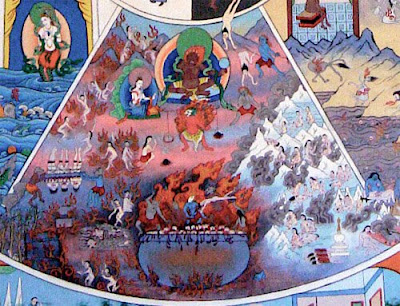
(About.com) The Hell Realm is depicted as a place partly of fire and partly of ice. In the fiery part of the realm, hell beings (narakas) are subjected to pain and torment. In the icy part, they are frozen.
Interpreted psychologically, hell beings are recognized by their acute aggression. Fiery hell beings are angry and abusive, and they drive away anyone who would befriend or love them. Icy hell beings shove others away with their unfeeling coldness. In the torment of their isolation, their aggression increasingly turns inward, and they become self-destructive. More>>
.
In fact, the idea that there are only six realms in Buddhist cosmology is a gross over simplification. The Buddha outlined 31 Planes of Existence. But this, too, is a simple outline. A closer examination of any of these general planes reveals that there are indeed many more worlds and layers within them.
.
The "Animal Realm," for example, has countless species and undersea, underground niches few people have any idea about. Similarly, the Realm of Hungry Ghosts (petas, pretas) is very diverse. The majority of planes are inhabited by devas (light beings). But the majority of beings are packed in lower realms. The hells differ, just as the celestial worlds do, according to the karma that effected rebirth there. Like the Human Realm, there are almost as many worlds as individuals to experience them. No realm is permanent but can last so long as to feel eternal.
Naturalist John Muir maintained a legendary devotion to Cali-fornia's Sierra Nevada, particu-larly Yosemite National Park. A new book explores the lesser-known passion that rooted his love for nature: plants. Molly Peterson says Muir cultivated his botanical studies through a Southland connection.
John Muir believed that the beauty residing in nature, particularly plants, makes people better contributors to the world.
Molly Peterson: John Muir preferred learning in the wild to studying in classrooms. But after he quit college in Wisconsin, he kept up with his former teacher Ezra Carr and Ezra's wife Jeanne. Environmental historian Bonnie Gisel says the Carrs moved in the late 1800s to Pasadena. More>>
COLOMBO, Sri Lanka – Tens of thousands of civilians trapped in Sri Lanka's northern war zone are facing starvation, the Tamil Tiger rebels warned Saturday as the U.N. sent its top humanitarian official to assess the crisis.
Reports of chaos in the northern war zone have increased in recent days as the Sri Lankan military pushed forward with its offensive to destroy the rebel group and end this Indian Ocean island nation's bloody, quarter century civil war.
More than 100,000 civilians have fled the tiny coastal strip still under rebel control... More>>
Matt Groening, creator of the Simpsons, began with a comic strip entitled Life in Hell. It depicted life in Los Angeles through the eyes of rabbits. The economic collapse has led to the flagship weekly periodical (the LA Weekly) not being able to pay its comics after 22 years of strips.
According to a CNN profile, Matt Greoening’s “Life in Hell” is being dropped by its flagship paper, LA Weekly, after 22 years:
CNN: To the root of animation, cartooning: You’re still doing “Life in Hell,” correct?
Groening: Um, yes, but … well, I feel like the floodwaters are rising.
CNN: Really?
Groening: Yeah, the alternative newsweeklies are really struggling. In fact, this coming week will be my final week after 22 years in the LA Weekly. I and all the other cartoonists are being dismissed because they can’t afford to pay.
Groening: Yes! Yes, I’m toying with that. But it’s very strange. I’ve been doing the weekly comic strip for 29 years, “The Simpsons” weekly for 20 years, the “Futurama” weekly for five years and then a little break and then the four movies, and then the “Simpsons” movie…so I have a series of ongoing deadlines. So the idea of establishing a Web presence that I’ll have to feed on an ongoing basis doesn’t give me a lot of pep. (laughs) One more treadmill. (Source: The Daily Cartoonist).
LIFE IN HELL
Life in Hell started in 1977 as a self-published comic book Groening used to describe life in Los Angeles to his friends. Groening photocopied and distributed it in a small "punk" corner of the record store in which he worked, Licorice Pizza on Sunset Boulevard. Life in Hell debuted as a comic strip in the avant-garde Wet magazine in 1978, to which Groening made his first professional cartoon sale.
The first strip, entitled "Forbidden Words," appeared in the September/October issue. Popular in the underground, Life in Hell was picked up by the Los Angeles Reader (an alternative weekly newspaper where Groening also worked as a typesetter, editor, paste-up artist and music critic) in 1980, where it began appearing weekly.
The strip was frequently a serial, discussing various topics such as "Love is Hell," a 1984 "13-chapter miniseries" pontificating on love and relationships. More>>
Lindsay Lohan in talks to strip in Vegas Lohan is reportedly looking into the Bur-lesque producton Peepshow to revitalize her fading acting career. This is the typical trajectory post-breakup, particularly for lesbians. If only celebrities had friends then they could offer up some sane advice to counter insane behavior. More>>
In Buddhism, meditation serves to calm and control the mind. It is essential to break the cycle of suffering, attain enlightenment, and reach nirvana. Follow these steps for mindfulness of breathing meditation, one of the two simplest meditations. This meditation is the practice Siddhartha was undertaking under the Bodhi tree when he achieved full enlightenment.
Breathing meditation with Thich Nhat Hanh filmed on retreat in Vietnam, Spring 2007. English translation by Sr. Dang Nghiem. This clip is from the video "Each of My Steps is a Prayer."
All materials on this site are submitted by editors and readers. All images, unless otherwise noted, were taken from the Internet and are assumed to be in the public domain.
In the event that there is still a problem, issue, or error with copyrighted material, the break of the copyright is unintentional and noncommercial, and the material will be removed immediately upon presented proof.
Contact us by submitting a comment marked "private."
Do not follow this journal if you are under vinaya or parental restrictions. Secure protection by Sucuri.
Wisdom Quarterly: American Buddhist Journal is licensed under a Creative Commons Attribution-Noncommercial-Share Alike 3.0 United States License. Permissions beyond the scope of this license may be available at creativecommons.org/about/licenses.